View Full Version : America's Financial Crisis
Armenian
09-17-2008, 09:26 AM
Armenian, how bad do you think the US economy is going to get? Is it going to be another Great Depression or maybe the US will fall like the USSR altogether?
In light of all that's been happening in the financial sector here in the US, this is a very difficult question to answer. But I'll attempt to give you 'my' perspective, and I'll try to do so in as few words as possible.
Although I am not a financial expert (I hate numbers), I read a lot and I have observed global politics for a long time now. In my opinion, the current crisis is much-much more serious than we are led to believe. We are not being told the severity of the turmoil in Wall Street because government officials along with Wall Street executives and news media representatives are engaged in a concerted effort to downplay the current financial crisis in an attempt to alleviate concerns in the general public. However, the situation is getting so bad now that despite their best efforts they can no longer hide it.
While the US was a beloved industrial power with substantial gold reserves and natural wealth, the US dollar was powerful, claimed by many to be "almighty," an obvious reference to its perceived divine power (perhaps to its detriment). Due to its stability, strenght and longterm promise, nations worldwide chose to trade in the US dollar, thereby further elevating its value in the global market. This global reverence towards the US dollar reached its height in the post-World War Two years and then again in the post-Soviet years. However, the dollar's longterm prospects began to change when the US economy began to transform itself from an industry based economy to a service based consumer economy led by financial institutions and international corporations. What's more, by the 1970s (?) the US government no longer backed the dollar with gold reserves. With the dropping of the traditional gold system, the legal tender essentially became a government backed credit, a piece of paper with nothing to back it up other than the government's word. What's more, the recent years were plagued by liberal lending practices, chronic mismanagement, severe corruption, etc., which also began to gradually undermine the dollar.
By the turn of the 21 century the US dollar no longer looked as stable or as promising as it had been in the past. This, coupled with major geopolitical tangles the US government kept getting involved in, encouraged some major nations to begin flirting with the idea of moving away from the US dollar in their trade transactions, further weakening the US currency. As a result of all this, the US dollar has been worthless as a currency for some time now. During the 20th century, the dollar managed to first create and then maintained a high global posture while America was considered to be the leader of the so-called free world. And in recent years the dollar got a major boost after the Soviet Union's collapse, making America 'the' undisputed global superpower. So, in a sense, the dollar's current worth is derived from its previous momentum and a lot of political 'hype' and not much else. For some time now I have been saying - don't believe the hype.
Geopolitically, things have changed quite a bit since the dawn of the 21st century. China rising, India rising, Iran rising, Russia rising... Since the financial power of the US is intimately connected to its preponderance on the global stage, US government officials and financial experts must have seen the looming financial crisis. Seeing it, they had to take action to secure their wealth and power. However, instead of attempting to devise plans that would truly remedy the root causes of the nation's economic problems, special interests in government began devising plans that were politically and financially very risky. In a sense, these special interests sought quick fixes that could also yield high dividends. So, they eventually began to plan the invasion of the Middle East as an attempt to control the region's energy wealth. There was also talk that if Washington could control Middle Eastern and Central Asian energy distribution it could also control China, since China, as big as it's economy is, it is not an energy producer. Moreover, taking advantage of Russia's political weakness during the 1990s, Washington also planned to setup shop in the immensely energy rich republics of Central Asia. Naturally, the Balkans and the Caucasus also played a crucial part in these equations. In a certain sense, this was a race against time for Washington.
However, the government had to somehow convince "we the people" that we had to do this. But how? How could they convince the people that they had to willingly carry the burden and support the invasion of nations and be involved in armed conflicts overseas for the foreseeable future?
Difficult task, no?
Well, in my opinion, the answer was - September 11, 2001. That highly suspicious event convinced the grazers in this nation (the majority) that the US had to get involved in bloody militarily campaigns overseas, not surprisingly mainly in the Middle East and Central Asia. For the grazers, it was a simply a matter of protecting America and you know, freedom... democracy... human rights... etc... For government officials, however, it was simply a matter of getting their hands on black gold so that they can revitalize their weakening financial system and maintain their political advantage over Russia and China. Of course there were several other major factors involved: Israeli lobby, the defense industry, mega corporations... Nevertheless, as a result of 9/11 we saw the US (and its lackeys) getting involved in conflicts from the Balkans to the Caucasus, from the Middle East to Central Asia. I need to mention here that Washington's agenda had started several years prior to the 9/11 attacks, the 9/11 attacks served to accelerate it and intensify it.
Needless to say, Washington's moves have backfired in the Middle East, Central Asia and most recently in the Caucasus; but succeeded somewhat in the Balkans. Overall, the West did not realize its ambitions in Central Asia (which was to control the massive oil/gas wealth of the region) because Russia, rebounding for their 1990's slumber, gradually managed to make longterm deals with Central Asian republics and in a sense monopolized their energy distribution. The West was not able to realize its ambitions in the Middle East (which was to exploit Iraq's oil wealth and impose itself on Gulf states) because the Iraqi people did not accept them as liberators, as Washington had initially hoped. The West did not realize its ambition in Afghanistan (which was to become a route through which Central Asian energy would be diverted south to Pakistan and beyond) because of botched deals with Pakistani officials and the Taliban. And, finally, the US was not able to realize its ambitions in the Caucasus (which was to divert Central Asian energy through Azerbaijan and Georgia to the West) because Moscow recently crushed their puppet in Tbilisi.
Therefore, the major gamble has in a sense backfired severely. These quagmires are now costing the US government hundreds of billions of dollars annually. Don't forget that the US already has approximately a ten trillion dollar debt.
All this means: The US has a hollow economy with no future.
What does the US produce anymore? The answer is, only arms. The US is the number one arms exporter in the world. Which is quite revealing, incidentally. Nevertheless, China is becoming the economic superpower, surpassing Japan, Germany and the US. As global demand for energy rises, energy resources dwindle. The undisputed 'natural resource' superpower today is Russia. The world's last major proven reserves today (which are located in Eurasia) are more-or-less controlled by Moscow. In recent years China and Russia have been getting closer, economically, politically and militarily. And when you join together the world's biggest producer of goods (who also happens to have the world's largest military) with the world's biggest holder of natural wealth (who is also a military superpower) - you end up having a 'supermegapower' on your hands.
Anyway, I would be afraid of what the future holds in America because serious governmental policy in the US is not made by American patriots, they are made by the Federal Reserve (a privately owned institution that controls the US dollar), by international mega corporations, by the Israeli lobby, by the oil lobby, by the defense industry... Unless these people begin placing America's well being ahead of their special interests this nation will implode and its demise will be worst than that of Rome's...
Armenian
09-17-2008, 09:27 AM
Here is an interesting piece from Yesterday's New York Times.
***************************
Wall Street’s Next Big Problem
http://graphics8.nytimes.com/packages/images/photo/2008/09/15/0915-MARKETS/25011588.JPG
WHEN I drove to the Beverly Hills offices of Drexel Burnham Lambert on Feb. 13, 1990, the last thing I expected to hear was that the investment bank where I worked was going under. Yet early that morning, we were told that the company was filing for bankruptcy. I was, to put it mildly, blown away. At the time, Drexel had $3.5 billion in assets and was the biggest underwriter of junk bonds. It all seemed like a very big deal at the time. But what’s happening this week makes me pine for the good old days. When Lehman Brothers filed for bankruptcy on Monday, it became the latest but surely not the last victim of the subprime mortgage collapse. Lehman owned more than $600 billion in assets. Financial institutions around the world have already reported more than half a trillion dollars of mortgage-related losses and that figure will most likely double or triple before the crisis exhausts itself.
But there is a bigger potential failure lurking: the American International Group, the insurance giant. It poses a much larger threat to the financial system than Lehman Brothers ever did because it plays an integral role in several key markets: credit derivatives, mortgages, corporate loans and hedge funds. Late Monday, A.I.G. was downgraded by the major credit rating agencies. This credit downgrade could require A.I.G. to post billions of dollars of additional collateral for its mortgage derivative contracts. Fat chance. That’s collateral A.I.G. does not have. There is therefore a substantial possibility that A.I.G. will be unable to meet its obligations and be forced into liquidation. A side effect: Its collapse would be as close to an extinction-level event as the financial markets have seen since the Great Depression.
A.I.G. does business with virtually every financial institution in the world. Most important, it is a central player in the unregulated, Brobdingnagian credit default swap market that is reported to be at least $60 trillion in size. Nobody knows this market’s real size, or who owes what to whom, because there is no central clearinghouse or regulator for it. Credit default swaps are a type of credit insurance contract in which one party pays another party to protect it from the risk of default on a particular debt instrument. If that debt instrument (a bond, a bank loan, a mortgage) defaults, the insurer compensates the insured for his loss. The insurer (which could be a bank, an investment bank or a hedge fund) is required to post collateral to support its payment obligation, but in the insane credit environment that preceded the credit crisis, this collateral deposit was generally too small.
As a result, the credit default market is best described as an insurance market where many of the individual trades are undercapitalized. But even worse, many of the insurers are grossly undercapitalized. In one case in the New York courts, the Swiss banking giant UBS is suing a hedge fund that said it would insure nearly $1.5 billion in bonds but was unable to do so. No wonder — the hedge fund had only $200 million in assets. If A.I.G. collapsed, its hundreds of billions of dollars of mortgage-related assets would be added to those being sold by other financial institutions. This would just depress values further. The counterparties around the world to A.I.G.’s credit default swaps may be unable to collect on their trades. As a large hedge-fund investor, A.I.G. would suddenly become a large redeemer from hedge funds, forcing fund managers to sell positions and probably driving down prices in the world’s financial markets. More failures, particularly of hedge funds, could follow. Regulators knew that if Lehman went down, the world wouldn’t end. But Wall Street isn’t remotely prepared for the inestimable damage the financial system would suffer if A.I.G. collapsed.
While Gov. David A. Paterson of New York on Monday allowed A.I.G. to borrow $20 billion from its subsidiaries, that move will only postpone the day of reckoning. The Federal Reserve was also trying to arrange at least $70 billion in loans from investment banks, but it’s hard to see how Wall Street could come up with that much money. More promisingly, A.I.G. asked the Federal Reserve for a bridge loan. True, there is no precedent for the central bank to extend assistance to an insurance company. But these are unprecedented times, and the Federal Reserve should provide A.I.G. with some form of financial support while the company liquidates its mortgage-related assets in an orderly manner. The Fed cannot afford to stand on principle. The myth of free markets ended with the takeover of Fannie Mae and Freddie Mac. Actually, it ended with their creation.
Source: http://www.nytimes.com/2008/09/16/opinion/16lewitt.html?ref=opinion
Armenian
09-17-2008, 09:31 AM
Naturally, oil plays an immense factor in all this...
**********************
Portrait of an Oil-Addicted Former Superpower
http://www.militaryspot.com/gallery/data/512/desertstorm1.jpg
How Rising Oil Prices Are Obliterating America's Superpower Status
Nineteen years ago, the fall of the Berlin Wall effectively eliminated the Soviet Union as the world's other superpower. Yes, the USSR as a political entity stumbled on for another two years, but it was clearly an ex-superpower from the moment it lost control over its satellites in Eastern Europe. Less than a month ago, the United States similarly lost its claim to superpower status when a barrel crude oil roared past $110 on the international market, gasoline prices crossed the $3.50 threshold at American pumps, and diesel fuel topped $4.00. As was true of the USSR following the dismantling of the Berlin Wall, the USA will no doubt continue to stumble on like the superpower it once was; but as the nation's economy continues to be eviscerated to pay for its daily oil fix, it, too, will be seen by increasing numbers of savvy observers as an ex-superpower-in-the-making. That the fall of the Berlin Wall spelled the erasure of the Soviet Union's superpower status was obvious to international observers at the time. After all, the USSR visibly ceased to exercise dominion over an empire (and an associated military-industrial complex) encompassing nearly half of Europeand much of Central Asia. The relationship between rising oil prices and the obliteration of America's superpower status is, however, hardly as self-evident. So let's consider the connection.
Dry Hole Superpower
The fact is, America's wealth and power has long rested on the abundance of cheap petroleum. The United States was, for a long time, the world's leading producer of oil, supplying its own needs while generating a healthy surplus for export. Oil was the basis for the rise of the first giant multinational corporations in the U.S., notably John D. Rockefeller's Standard Oil Company (now reconstituted as Exxon Mobil, the world's wealthiest publicly-traded corporation). Abundant, exceedingly affordable petroleum was also responsible for the emergence of the American automotive and trucking industries, the flourishing of the domestic airline industry, the development of the petrochemical and plastics industries, the suburbanization of America, and the mechanizationof its agriculture. Without cheap and abundant oil, the United States would neverhave experienced the historic economic expansion of the post-World War II era. No less important was the role of abundant petroleum in fueling the global reach of U.S. military power. For all the talk of America's growing reliance on computers, advanced sensors, and stealth technology to prevail in warfare, it has been oil above all that gave the U.S. military its capacity to "project power" onto distant battlefields like Iraq and Afghanistan. EveryHumvee, tank, helicopter, and jet fighter requires its daily ration of petroleum, without which America's technology-driven military would be forced to abandon the battlefield. No surprise, then, that the U.S. Department of Defense is the world's single biggest consumer of petroleum, using more of it every day than the entire nation of Sweden.
From the end of World War II through the height of the Cold War, the U.S. claim to superpower status rested on a vast sea of oil. As long as most ofour oil came from domestic sources and the price remained reasonably low, the American economy thrived and the annual cost of deploying vast armies abroad was relatively manageable. But that sea has been shrinking since the 1950s. Domestic oil production reached a peak in 1970 and has been in decline ever since -- with a growing dependency on imported oil as the result. When it came to reliance on imports, the United States crossed the 50% threshold in 1998 and now has passed 65%. Though few fully realized it, this represented a significant erosion of sovereign independence even before the price of a barrel of crude soared above $110. By now, we are transferring such staggering sums yearly to foreign oil producers, who are using it to gobble up valuable American assets, that, whether we know it or not, we have essentially abandoned our claim to superpowerdom. According to the latest data from the U.S. Department of Energy, the United States is importing 12-14 million barrels of oil per day. At a current price of about $115 per barrel, that's $1.5 billion per day, or $548 billion per year. This represents the single largest contribution to America's balance-of-payments deficit, and is a leading cause for the dollar's ongoing drop in value. If oil prices rise any higher -- in response, perhaps, to a new crisis in the Middle East (as might be occasioned by U.S. air strikes on Iran) -- our annual import bill could quickly approach three-quarters of a trillion dollars or more per year. While our economy is being depleted of these funds, at a moment when credit is scarce and economic growth has screeched to a halt, the oil regimes on which we depend for our daily fix are depositing their mountains of accumulating petrodollars in "sovereign wealth funds" (SWFs) -- state-controlled investment accounts that buy up prized foreign assets in order to secure non-oil-dependent sources of wealth. At present, these funds are already believed to hold in excess of several trillion dollars; the richest, the Abu Dhabi Investment Authority (ADIA), alone holds $875 billion.
The ADIA first made headlines in November 2007 when it acquired a $7.5 billion stake in Citigroup, America's largest bank holding company. The fund has also made substantial investments in Advanced Micro Systems, a major chip maker, and the Carlyle Group, the private equity giant. Another big SWF, the Kuwait Investment Authority, also acquired a multibillion-dollar stake in Citigroup, along with a $6.6 billion chunk of Merrill Lynch. And these arebut the first of a series of major SWF moves that will be aimed at acquiring stakes in top American banks and corporations. The managers of these funds naturally insist that they have no intention of using their ownership of prime American properties to influence U.S. policy. In time, however, a transfer of economic power of this magnitude cannot help but translate into a transfer of political power as well. Indeed, this prospect has already stirred deep misgivings in Congress. "In the short run, that they [the Middle Eastern SWFs] are investing here is good," Senator Evan Bayh (D-Indiana) recently observed. "But in the long run it is unsustainable. Our power and authority is eroding because of the amounts we are sending abroad for energy=80¦."
No Summer Tax Holiday for the Pentagon
Foreign ownership of key nodes of our economy is only one sign of fading American superpower status. Oil's impact on the military is another. Every day, the average G.I. in Iraq uses approximately 27 gallons of petroleum-based fuels. With some 160,000 American troops in Iraq, that amounts to 4.37 million gallons in daily oil usage, including gasoline for vans and light vehicles, diesel for trucks and armored vehicles, and aviation fuel for helicopters, drones, and fixed-wing aircraft. With U.S. forces paying, as of late April, an average of $3.23 per gallon for these fuels, the Pentagon is already spending approximately $14 million per day on oil ($98 million perweek, $5.1 billion per year) to stay in Iraq. Meanwhile, our Iraqi allies, who are expected to receive a windfall of $70 billion this year from the rising price of their oil exports, charge their citizens $1.36 per gallon for gasoline. When questioned about why Iraqis are paying almost a third less for oil than American forces in their country, senior Iraqi government officials scoff at any suggestion of impropriety. "America has hardly even begun to repay its debt to Iraq," said Abdul Basit, the head of Iraq's Supreme Board of Audit, an independent body that oversees Iraqi governmental expenditures. "This is an immoral request because we didn't ask them to come to Iraq, and before they came in 2003 we didn't have all these needs."
Needless to say, this is not exactly the way grateful clients are supposed to address superpower patrons. "It's totally unacceptable to me that we are spending tens of billions of dollars on rebuilding Iraq while they are putting tens of billions of dollars in banks around the world from oil revenues," said Senator Carl Levin (D-Michigan), chairman of the Armed Services Committee. "It doesn't compute as far as I'm concerned." Certainly, however, our allies in the region, especially the Sunni kingdoms of Kuwait, Saudi Arabia, and the United Arab Emirates (UAE) that presumably look to Washington to stabilize Iraq and curb the growing power of Shiite Iran, are willing to help the Pentagon out by supplying U.S. troops with free or deeply-discounted petroleum. No such luck. Except for some partially subsidized oil supplied by Kuwait, all oil-producing U.S. allies in the region charge us the market rate for petroleum. Take that as a striking reflection of how little credence even countries whose ruling elites have traditionally looked to the U.S. for protection now attach to our supposed superpower status. Think of this as a strikingly clear-eyed assessment of American power.
As far as they're concerned, we're now just another of those hopeless oil addicts driving a monster gas-guzzler up to the pump -- and they're perfectly happy to collect our cash which they can then use to cherry-pick our prime assets. So expect no summer tax holidays for the Pentagon, not in the Middle East, anyway. Worse yet, the U.S. military will need even more oil for the future wars on which the Pentagon is now doing the planning. In this way, the U.S. experience in Iraq has especially worrisome implications. Under the military "transformation" initiated by Secretary of Defense Donald Rumsfeld in 2001,the future U.S. war machine will rely less on "boots on the ground" and ever more on technology. But technology entails an ever-greater requirement for oil, as the newer weapons sought by Rumsfeld (and now Secretary of Defense Robert Gates) all consume many times more fuel than those they will replace. To put this in perspective: The average G.I in Iraq now uses about seven times as much oil per day as G.I.s did in the first Gulf War less than two decades ago. And every sign indicates that the same ratio of increase will apply to coming conflicts; that the daily cost of fighting will skyrocket; and that the Pentagon's capacity to shoulder multiple foreign military burdens will unravel. Thus are superpowers undone.
[...]
Source: http://www.tomdispatch.com/post/174929/michael_klare_america_out_of_gas
Armenian
09-17-2008, 09:32 AM
An interesting analysis that can help one place current geopolitical situations around the world in a better perspective.
**************************
The Rise of the Rest
http://ecx.images-amazon.com/images/I/51XJQyQWocL._SS500_.jpg
It's true China is booming, Russia is growing more assertive, terrorism is a threat. But if America is losing the ability to dictate to this new world, it has not lost the ability to lead.
Fareed Zakaria NEWSWEEK
Americans are glum at the moment. No, I mean really glum. In April, a new poll revealed that 81 percent of the American people believe that the country is on the "wrong track." In the 25 years that pollsters have asked this question, last month's response was by far the most negative. Other polls, asking similar questions, found levels of gloom that were even more alarming, often at 30- and 40-year highs. There are reasons to be pessimistic—a financial panic and looming recession, a seemingly endless war in Iraq, and the ongoing threat of terrorism. But the facts on the ground—unemployment numbers, foreclosure rates, deaths from terror attacks—are simply not dire enough to explain the present atmosphere of malaise.
American anxiety springs from something much deeper, a sense that large and disruptive forces are coursing through the world. In almost every industry, in every aspect of life, it feels like the patterns of the past are being scrambled. "Whirl is king, having driven out Zeus," wrote Aristophanes 2,400 years ago. And—for the first time in living memory—the United States does not seem to be leading the charge. Americans see that a new world is coming into being, but fear it is one being shaped in distant lands and by foreign people.
Look around. The world's tallest building is in Taipei, and will soon be in Dubai. Its largest publicly traded company is in Beijing. Its biggest refinery is being constructed in India. Its largest passenger airplane is built in Europe. The largest investment fund on the planet is in Abu Dhabi; the biggest movie industry is Bollywood, not Hollywood. Once quintessentially American icons have been usurped by the natives. The largest Ferris wheel is in Singapore. The largest casino is in Macao, which overtook Las Vegas in gambling revenues last year. America no longer dominates even its favorite sport, shopping. The Mall of America in Minnesota once boasted that it was the largest shopping mall in the world. Today it wouldn't make the top ten. In the most recent rankings, only two of the world's ten richest people are American. These lists are arbitrary and a bit silly, but consider that only ten years ago, the United States would have serenely topped almost every one of these categories.
These factoids reflect a seismic shift in power and attitudes. It is one that I sense when I travel around the world. In America, we are still debating the nature and extent of anti-Americanism. One side says that the problem is real and worrying and that we must woo the world back. The other says this is the inevitable price of power and that many of these countries are envious—and vaguely French—so we can safely ignore their griping. But while we argue over why they hate us, "they" have moved on, and are now far more interested in other, more dynamic parts of the globe. The world has shifted from anti-Americanism to post-Americanism.
I. The End of Pax Americana
During the 1980s, when I would visit India—where I grew up—most Indians were fascinated by the United States. Their interest, I have to confess, was not in the important power players in Washington or the great intellectuals in Cambridge. People would often ask me about … Donald Trump. He was the very symbol of the United States—brassy, rich, and modern. He symbolized the feeling that if you wanted to find the biggest and largest anything, you had to look to America. Today, outside of entertainment figures, there is no comparable interest in American personalities. If you wonder why, read India's newspapers or watch its television. There are dozens of Indian businessmen who are now wealthier than the Donald. Indians are obsessed by their own vulgar real estate billionaires. And that newfound interest in their own story is being replicated across much of the world.
How much? Well, consider this fact. In 2006 and 2007, 124 countries grew their economies at over 4 percent a year. That includes more than 30 countries in Africa. Over the last two decades, lands outside the industrialized West have been growing at rates that were once unthinkable. While there have been booms and busts, the overall trend has been unambiguously upward. Antoine van Agtmael, the fund manager who coined the term "emerging markets," has identified the 25 companies most likely to be the world's next great multinationals. His list includes four companies each from Brazil, Mexico, South Korea, and Taiwan; three from India, two from China, and one each from Argentina, Chile, Malaysia, and South Africa. This is something much broader than the much-ballyhooed rise of China or even Asia. It is the rise of the rest—the rest of the world.
We are living through the third great power shift in modern history. The first was the rise of the Western world, around the 15th century. It produced the world as we know it now—science and technology, commerce and capitalism, the industrial and agricultural revolutions. It also led to the prolonged political dominance of the nations of the Western world. The second shift, which took place in the closing years of the 19th century, was the rise of the United States. Once it industrialized, it soon became the most powerful nation in the world, stronger than any likely combination of other nations. For the last 20 years, America's superpower status in every realm has been largely unchallenged—something that's never happened before in history, at least since the Roman Empire dominated the known world 2,000 years ago. During this Pax Americana, the global economy has accelerated dramatically. And that expansion is the driver behind the third great power shift of the modern age—the rise of the rest.
At the military and political level, we still live in a unipolar world. But along every other dimension—industrial, financial, social, cultural—the distribution of power is shifting, moving away from American dominance. In terms of war and peace, economics and business, ideas and art, this will produce a landscape that is quite different from the one we have lived in until now—one defined and directed from many places and by many peoples. The post-American world is naturally an unsettling prospect for Americans, but it should not be. This will not be a world defined by the decline of America but rather the rise of everyone else. It is the result of a series of positive trends that have been progressing over the last 20 years, trends that have created an international climate of unprecedented peace and prosperity.
I know. That's not the world that people perceive. We are told that we live in dark, dangerous times. Terrorism, rogue states, nuclear proliferation, financial panics, recession, outsourcing, and illegal immigrants all loom large in the national discourse. Al Qaeda, Iran, North Korea, China, Russia are all threats in some way or another. But just how violent is today's world, really? A team of scholars at the University of Maryland has been tracking deaths caused by organized violence. Their data show that wars of all kinds have been declining since the mid-1980s and that we are now at the lowest levels of global violence since the 1950s. Deaths from terrorism are reported to have risen in recent years. But on closer examination, 80 percent of those casualties come from Afghanistan and Iraq, which are really war zones with ongoing insurgencies—and the overall numbers remain small. Looking at the evidence, Harvard's polymath professor Steven Pinker has ventured to speculate that we are probably living "in the most peaceful time of our species' existence."
Why does it not feel that way? Why do we think we live in scary times? Part of the problem is that as violence has been ebbing, information has been exploding. The last 20 years have produced an information revolution that brings us news and, most crucially, images from around the world all the time. The immediacy of the images and the intensity of the 24-hour news cycle combine to produce constant hype. Every weather disturbance is the "storm of the decade." Every bomb that explodes is BREAKING NEWS. Because the information revolution is so new, we—reporters, writers, readers, viewers—are all just now figuring out how to put everything in context.
We didn't watch daily footage of the two million people who died in Indochina in the 1970s, or the million who perished in the sands of the Iran-Iraq war ten years later. We saw little of the civil war in the Congo in the 1990s, where millions died. But today any bomb that goes off, any rocket that is fired, any death that results, is documented by someone, somewhere and ricochets instantly across the world. Add to this terrorist attacks, which are random and brutal. "That could have been me," you think. Actually, your chances of being killed in a terrorist attack are tiny—for an American, smaller than drowning in your bathtub. But it doesn't feel like that.
The threats we face are real. Islamic jihadists are a nasty bunch—they do want to attack civilians everywhere. But it is increasingly clear that militants and suicide bombers make up a tiny portion of the world's 1.3 billion Muslims. They can do real damage, especially if they get their hands on nuclear weapons. But the combined efforts of the world's governments have effectively put them on the run and continue to track them and their money. Jihad persists, but the jihadists have had to scatter, work in small local cells, and use simple and undetectable weapons. They have not been able to hit big, symbolic targets, especially ones involving Americans. So they blow up bombs in cafés, marketplaces, and subway stations. The problem is that in doing so, they kill locals and alienate ordinary Muslims. Look at the polls. Support for violence of any kind has dropped dramatically over the last five years in all Muslim countries.
Militant groups have reconstituted in certain areas where they exploit a particular local issue or have support from a local ethnic group or sect, most worryingly in Pakistan and Afghanistan where Islamic radicalism has become associated with Pashtun identity politics. But as a result, these groups are becoming more local and less global. Al Qaeda in Iraq, for example, has turned into a group that is more anti-Shiite than anti-American. The bottom line is this: since 9/11, Al Qaeda Central, the gang run by Osama bin Laden, has not been able to launch a single major terror attack in the West or any Arab country—its original targets. They used to do terrorism, now they make videotapes. Of course one day they will get lucky again, but that they have been stymied for almost seven years points out that in this battle between governments and terror groups, the former need not despair.
Some point to the dangers posed by countries like Iran. These rogue states present real problems, but look at them in context. The American economy is 68 times the size of Iran's. Its military budget is 110 times that of the mullahs. Were Iran to attain a nuclear capacity, it would complicate the geopolitics of the Middle East. But none of the problems we face compare with the dangers posed by a rising Germany in the first half of the 20th century or an expansionist Soviet Union in the second half. Those were great global powers bent on world domination. If this is 1938, as some neoconservatives tell us, then Iran is Romania, not Germany.
Others paint a dark picture of a world in which dictators are on the march. China and Russia and assorted other oil potentates are surging. We must draw the battle lines now, they warn, and engage in a great Manichean struggle that will define the next century. Some of John McCain's rhetoric has suggested that he adheres to this dire, dyspeptic view. But before we all sign on for a new Cold War, let's take a deep breath and gain some perspective. Today's rising great powers are relatively benign by historical measure. In the past, when countries grew rich they've wanted to become great military powers, overturn the existing order, and create their own empires or spheres of influence. But since the rise of Japan and Germany in the 1960s and 1970s, none have done this, choosing instead to get rich within the existing international order. China and India are clearly moving in this direction. Even Russia, the most aggressive and revanchist great power today, has done little that compares with past aggressors. The fact that for the first time in history, the United States can contest Russian influence in Ukraine—a country 4,800 miles away from Washington that Russia has dominated or ruled for 350 years—tells us something about the balance of power between the West and Russia.
Compare Russia and China with where they were 35 years ago. At the time both (particularly Russia) were great power threats, actively conspiring against the United States, arming guerrilla movement across the globe, funding insurgencies and civil wars, blocking every American plan in the United Nations. Now they are more integrated into the global economy and society than at any point in at least 100 years. They occupy an uncomfortable gray zone, neither friends nor foes, cooperating with the United States and the West on some issues, obstructing others. But how large is their potential for trouble? Russia's military spending is $35 billion, or 1/20th of the Pentagon's. China has about 20 nuclear missiles that can reach the United States. We have 830 missiles, most with multiple warheads, that can reach China. Who should be worried about whom? Other rising autocracies like Saudi Arabia and the Gulf states are close U.S. allies that shelter under America's military protection, buy its weapons, invest in its companies, and follow many of its diktats. With Iran's ambitions growing in the region, these countries are likely to become even closer allies, unless America gratuitously alienates them.
[...]
Source: http://www.newsweek.com/id/135380/output/print
Armenian
09-17-2008, 09:32 AM
“Velvet Revolutions” Backfire in Central Asia
http://cache.daylife.com/imageserve/0e0y9JC1Yi5O6/610x.jpg
Central Asia was the scene of several British-sponsored and American-sponsored attempts at regime change. The latter were characterised by velvet revolutions similar to the Orange Revolution in Ukraine and the Rose Revolution in Georgia. These velvet revolutions financed by the U.S. failed in Central Asia, aside from Kyrgyzstan where there had been partial success with the so-called Tulip Revolution. As a result the U.S. government has suffered major geo-strategic setbacks in Central Asia. All of Central Asia’s leaders have distanced themselves from America.
Russia and Iran have also secured energy deals in the region. America’s efforts, over several decades, to exert a hegemonic role in Central Asia seem to have been reversed overnight. The U.S. sponsored velvet revolutions have backfired. Relations between Uzbekistan and the U.S. were especially hard hit. Uzbekistan is under the authoritarian rule of President Islam Karamov. Starting in the second half of the 1990s President Karamov was enticed into bringing Uzbekistan into the fold of the Anglo-American alliance and NATO. When there was an attempt on President Karamov’s life, he suspected the Kremlin because of his independent policy stance. This is what led Uzbekistan to leave CSTO. But Islam Karamov, years later, changed his mind as to who was attempting to get rid of him.
According to Zbigniew Brzezinski, Uzbekistan represented a major obstacle to any renewed Russian control of Central Asia and was virtually invulnerable to Russian pressure; this is why it was important to secure Uzbekistan as an American protectorate in Central Asia. Uzbekistan also has the largest military force in Central Asia. In 1998, Uzbekistan held war games with NATO troops in Uzbekistan. Uzbekistan was becoming heavily militarized in the same manner as Georgia was in the Caucasus. The U.S. gave Uzbekistan huge amounts of financial aid to challenge the Kremlin in Central Asia and also provided training to Uzbek forces. With the launching of the “Global War on Terror,” in 2001, Uzbekistan, an Anglo-American ally, immediately offered bases and military facilities to the U.S. in Karshi-Khanabad.
The leadership of Uzbekistan already knew the direction the “Global War on Terror” would take. To the irritation of the Bush Jr. Administration, the Uzbek President formulated a policy of self-reliance. The honeymoon between Uzbekistan and the Anglo-American alliance ended when Washington D.C. and London contemplated removing Islam Karamov from power. He was a little too independent for their comfort and taste. Their attempts at removing the Uzbek President failed, leading eventually to a shift in geo-political alliances.
The tragic events of Andijan on May 13, 2005 were the breaking point between Uzbekistan and the Anglo-American alliance. The people of Andijan were incited into confronting the Uzbek authorities, which resulted in a heavy security clampdown on the protesters and a loss of lives. Armed groups were reported to have been involved. In the U.S., Britain, and the E.U., the media reports focused narrowly on human rights violations without mentioning the covert role of the Anglo-American alliance. Uzbekistan held Britain and the U.S. responsible accusing them of inciting rebellion.
M. K. Bhadrakumar, the former Indian ambassador to Uzbekistan (1995-1998), revealed that the Hezbut Tahrir (HT) was one of the parties blamed for stirring the crowd in Andijan by the Uzbek government. [9] The group was already destabilizing Uzbekistan and using violent tactics. The headquarters of this group happens to be in London and they enjoy the support of the British government. London is a hub for many similar organizations that further Anglo-American interests in various countries, including Iran and Sudan, through destabilization campaigns. Uzbekistan even started clamping down on foreign non-governmental organizations (NGOs) because of the tragic events of Andijan.
The Anglo-American alliance had played its cards wrong in Central Asia. Uzbekistan officially left the GUUAM Group, a NATO-U.S. sponsored anti-Russian body. GUUAM once again became the GUAM (Georgia, Ukraine, Azerbaijan and Moldava) Group on May 24, 2005. On July 29, 2005 the U.S. military was ordered to leave Uzbekistan within a six-month period.[10] Literally, the Americans were told they were no longer welcome in Uzbekistan and Central Asia. Russia, China, and the SCO added their voices to the demands. The U.S. cleared its airbase in Uzbekistan by November, 2005.
Uzbekistan rejoined the CSTO alliance on June 26, 2006 and realigned itself, once again, with Moscow. The Uzbek President also became a vocal advocate, along with Iran, for pushing the U.S. totally out of Central Asia. [11] Unlike Uzbekistan, Kyrgyzstan continued to allow the U.S. to use Manas Air Base, but with restrictions and in an uncertain atmosphere. The Kyrgyz government also would make it clear that no U.S. operations could target Iran from Kyrgyzstan.
Source: http://www.payvand.com/news/07/sep/1274.html
Armenian
09-17-2008, 09:33 AM
The geopolitical perspective.
**************************
Europe and America: Sharing the Spoils of War
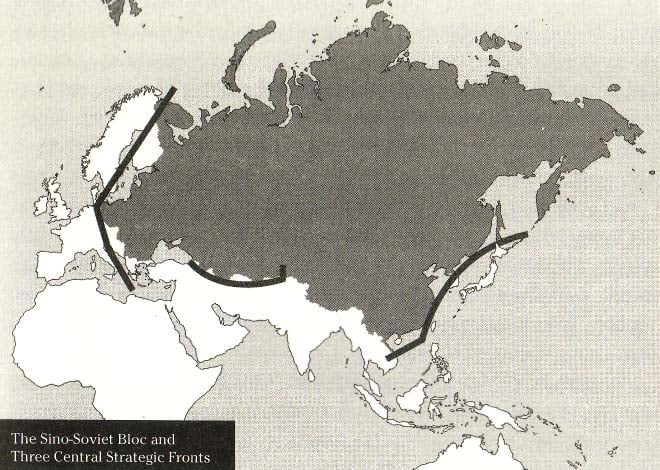
http://www.globalresearch.ca/articlePictures/Chessboard%20SIno-Soviet%20Bloc%20and%203%20Strategic%20Fronts.jpg
The “Pivotal Area” Discovered: Defining Geo-Strategic Boundaries
The “pivotal area” was used in Sir Halford J. Mackinder’s “Heartland” to describe the area of Eurasia that formed the pivotally important core of the global geo-strategic and geo-political environment. We now find that through geo-political realities and necessity the area in question must be redefined. Halford Mackinder coined the term to define an area within the Eurasian landmass, but it is apparent that the “pivotal area” in the truest sense of the word and possibly the “Heartland” itself is a much broader and diverse area that not only lies in Eurasia, but extends into Africa. The global environment is not static. It seems that this area is anchored by geographic reality, but is shifting because of socio-economic, demographic, and political factors. To define the pivotal area, we must look at the area(s) in which — in the course of the post-Cold War era — the U.S. military has been heavily involved in, from low spectrum to high spectrum warfare and operations. This also includes hostile economic actions and covert intelligence operations.
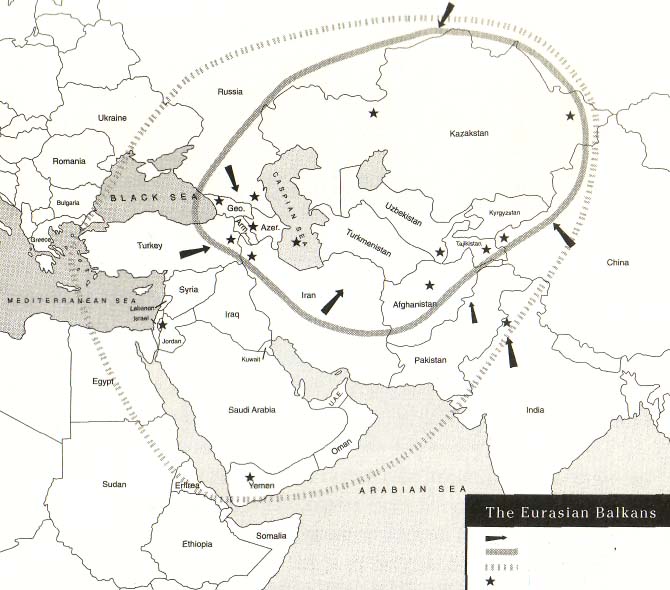
After pinpointing these areas one can set a conceptual boundary. This subject area is of vast geography, it includes the Balkans, the Caucasus, Central Asia, the Middle East, and East Africa. These regions, arguably, together form the tectonic plate that holds the globe together in a geo-political sense. It is this geographic stretch that has been, and continues, to be a geo-strategic chessboard for competitions of expansion and repulsion. These areas are also some of the most important cultural bridges on the face of the earth. The cultures and knowledge of different civilizations have interacted here for thousands of years. Intense cultural diffusion has also taken place within this geographic stretch as a global cross-road.
http://www.globalresearch.ca/articlePictures/Eurasian%20Balkans.jpg
Zbigniew Brzezinski has also stipulated that an area roughly corresponded in geographic boundaries to the area that has just been defined is pivotal to global power and Eurasian security. Henry Kissinger has also more or less made similar statements by explaining the importance of neutralizing Iraq and Afghanistan (before its pro-Soviet government was overthrown), both Soviet allies, and containing an Iran fresh with revolutionary fervor in 1979. This was according to Henry Kissinger because of the pivotal importance of the area. [2] Global security encompasses this vast and “pivotal” area as a singularity and it is the Middle East that is the focal point of this geographic stretch.
From “Pivotal Area” to “Arc of Instability”
An arc of uncertainty and instability has been generated by Britain, Israel, the U.S., and their partners, including their intelligence apparatus, from East Africa and the Balkans to the Middle East, the Caucasus, and Central Asia. Decades of American-led military confrontations, low-intensity warfare, sanctions, economic manipulation, and intelligence operations have undermined the nation-states of the subject area. From the remains of the former Yugoslavia, Sudan, war-torn Somalia, and Anglo-American occupied Iraq to Afghanistan, Kashmir, and the South Federal District of the Russian Federation where Chechnya is located the U.S. has fomented instability. This area roughly corresponds to what Zbigniew Brzezinski calls the “Eurasian Balkans” an area that the U.S. must seek to manipulate and ultimately control should it continue to be a superpower. [3] The pivotal area has also synthetically been manufactured into a zone of instability that can be called the “Arc of Instability.”
http://www.globalresearch.ca/articlePictures/Spykman%20Rimland%20(1944).jpg
In 1993, Zbigniew Brzezinski stated that, “The tragedies of Lebanon of the 1980s, or of Kurdistan and the former Yugoslavia of the early 1990s are previews of things to come within the Eurasian oblong of maximum danger.” [4] What was implied by Brzezinski was balkanization ranging from sectarianism to ethnic clashes. The situation in Iraq is part of this process, as are the tensions in Lebanon, Kosovo, Turkey, and Caucasia. A classical “divide and conquer” strategy is at play. The underlying objective is to provoke ethnic clashes across the Middle East and Central Asia. This venture, which is linked to Bzezinski’s forecast, is part of an agenda which consists in literally redrawing the map of this broader region. Moreover, there have also been attempts at sparking sectarian and ethnic differences in Iran from adjoining areas in Anglo-American occupied Iraq and NATO-garrisoned Afghanistan that implicate America and its allies.
CENTCOM and the Rimland: Encircling Russia, China, and Central Asia
CENTCOM more or less corresponds to what Brzezinski calls a “large geographic oblong that demarcates the central zone of global instability” which runs from the Balkans through the Middle East and Central Asia to Kashmir and East Africa. [5] This “central zone of global instability” is also linked to the central area of Nicholas Spykman’s “Rimland.” It must be noted that, during the Cold War, Nicholas Spykman was also known as a master of containment theory. The Rimland is the concept of a geographic area adjacent to the “Heartland” that is comprised of most of Europe, the Middle East, the Indian sub-continent, Southeast Asia, and the Far East. This area forms an enveloping geographic ring around Mackinder’s “Heartland.” In other words, the Rimland essentially surrounds the central, core region of Eurasia. CENTCOM lies in the axis or midpoint of Spykman’s Rimland. This area, the Rimland, was central to Cold War containment theories in regards to the Soviet Union and China, the “Red Giants.” The concept of this area was also used in geo-strategic planning in regards to Iraq, Iran, and Afghanistan. This is an important fact to remember, because it deeply influences American geo-strategy in regards to the Iraq-Iran War and the Soviet-Afghan War. The encirclement of the Eurasian core, which was where the Soviet Union was geographically placed, is still a U.S. objective after the end of the Cold War. Containment theory it appears may really have been more about “penetration.”
Penetration of the Eurasian core is underway. NATO is a bridgehead from Europe that is pushing towards Russia. An Asiatic sister-alliance of NATO is being forged against China. The axis of the Rimland, which includes the Middle East and Afghanistan, is being militarily infiltrated and mobilized by NATO and its allies. CENTCOM indeed is an appropriate and suitable name for this mid-area that is crucial and “central” to connecting the Asiatic and European flanks of any trans-Eurasian military network surrounding Russia and China. Furthermore, this area can also be used for creating a wedge between the European portion of Russia, which is the nerve of Russia, and China. Additionally, if one also examines the geographic position of U.S. and NATO military bases they are concentrated in the Rimland.
The Geo-Strategic Importance of the Middle East in regards to Eurasia
The Middle East, formerly called the Near East, is an abstract geographic concept that has been shifting with geo-strategic, political, and socio-economic policy. For example, there was a time when academics, map makers, and geographers considered the Balkans as a part of the region. In the mind of many the Middle East is a synonym for Arab World or for Southwest Asia, but both terms are different. The Middle East includes non-Arab countries like Iran, Turkey, and Cyprus. The term Southwest Asia also excludes Egypt, the European portion of Turkey in Thrace and even Greece, depending if you categorize it as a part of the region. The Middle East is a region that embraces three continents (two if you look at Europe and Asia as Eurasia); Europe, Asia, and Africa. It is from here that Anglo-American geo-strategists believed they could establish global hegemony by controlling Eurasia.
Three important maritime passages and five important bodies of water also are located or embrace the area around the Middle East. The important maritime passages and straits can be used to manipulate, cut, and control global navigation, international trade, maritime traffic, and energy supplies. Theses strategic maritime passages are the Suez Canal of Egypt, the Bosphorus/Bosporus of Turkey, and the Gate of Tears (Bab al-Mandeb) located between Djibouti and Yemen at the southern tip of the Red Sea. The five important bodies of water in this area are the Black Sea, the Caspian Sea, the Persian Gulf, the Red Sea, and the eastern end of the Mediterranean Sea. Control over these maritime passages would have grave ramifications for Russia, China, Iran, and any adversaries of NATO in regards to trade, naval movements, and energy supplies.
It is safe to say the post-Cold War objective of the United States in Eurasia is penetration. The different geographic regions of Europe and Asia are important, but they are not as pivotal in geo-strategic value as the Middle East and its geographic periphery (including Central Asia), which are also important energy hubs. If one scrutinizes a map of the earth or Eurasia they will notice that Indo-China or Japan or the Korean Peninsula cannot lead to any meaningful “penetration” of Eurasia. The Russian Federation also acts as a barrier to any drive from Eastern Europe that would be meaningless unless Ukraine fell into NATO’s orbit and Russia lost its Caucasian territories. Due to political realities India, the giant of the Indian sub-continent, can only be used as a counter-weight to China or to spoil the formation of a Eurasian alliance led by Russia, China, and Iran. Whatever value these geographic areas have in regards to containment theory is lost in regards to penetration, aside from India and Ukraine under the proper circumstances. It is from the Middle East and the area that has been mandated to the U.S. military under CENTCOM that Eurasian penetration can commence. Thus, it is by way of instability and war in this region that the U.S. and NATO have a pretext and justification for their military presence. It is also this area that will be the linkage between the military flanks being created against Russia, China, and their allies on the outer edges of Eurasia.
The Outer Peripheries of the “Arc of Instability” are manned by NATO
The hub of the “Arc of Instability” is where Iraq, Iran, Eastern Syria, and portions of Anatolia are geographically situated. This area is the most dangerous and volatile section of the “Arc of Instability.” Should a crisis with Iran and Syria be lit then the whole “Arc of Instability” can be lit ablaze like a powder keg. Iraq and the Persian Gulf are currently active and tense military zones of operation. This hub within the “Arc of Instability” is distinctly Anglo-American in its characteristic. It is the Anglo-American alliance that manages and oversees this war zone. Several European countries had initially posted their troops in Anglo-American occupied Iraq, but gradually reduced and removed their military contingents. Italy and Spain were amongst these countries. The European troop movements were publicly correlated to political changes in national governments within the respective capitals of these European countries. The aim of the troop movements was to portray the departures as acts of opposition to the war in Iraq. Angry European populations were misled into believing that a shift in foreign policy was underway, but this was an act of public deception. These nations compensated the broader war effort and agenda by deploying or re-shuffling their troops to Afghanistan or to Lebanon. Their actions were almost inconsequential to the broader war effort.
NATO members, such as Germany, are also involved and present in military operations in the Horn of Africa. The military activities of NATO and its members, including their almost perfectly coinciding military operations in the Eastern Mediterranean, the Red Sea, and the Arabian Sea, discloses advanced insight about a larger war agenda. The whole “Arc of Instability” is manned by NATO and close NATO allies, such as Australia and Israel. NATO as a whole is involved in the war project and American, British, Polish, Danish, Czech, and Romanian troops are present in Anglo-American occupied Iraq. Moreover, NATO is also responsible for certain aspects of military training inside Iraq. Additionally, there is a Franco-German presence in the Persian Gulf and NATO also has made security arrangements in the Persian Gulf with nations such as Kuwait.
However, what gives a particular NATO characteristic to the outer peripheries (tiers) of the “Arc of Instability” (in reality the area of military operations) is that greater numbers of NATO countries are involved in the military operations in these zones. Also NATO has an official mandate in these areas and has a role in the so-called “post-conflict” phase of operations in these areas. This phase in reality is the occupational and restructuring phase of the conflicts ensuing in the “Arc of Instability.” This form of “post-conflict” participation could also be linked to the low tolerance the populations of many of these NATO states would have in regards to casualties or supporting the war effort. The bulk of NATO troops have been positioned within the eastern and western outer peripheries of the military theatre of operations. Once again, the war zones almost precisely correspond to what is defined by the U.S. military as CENTCOM. It is only the former Yugoslavia that falls outside CENTCOM’s borders. It is from the Balkans that academics get the geo-political term “balkanization,” meaning to divide. The Balkans constitutes the westernmost periphery of the “Arc of Instability.”
[...]
Source: http://www.globalresearch.ca/index.php?context=va&aid=6423
Armenian
09-17-2008, 09:34 AM
The Sino-Russian Alliance: Challenging America's Ambitions in Eurasia
http://cache.daylife.com/imageserve/02qz4rNdt60CK/610x.jpg
Global Research, September 23, 2007
“But if the middle space [Russia and the former Soviet Union] rebuffs the West [the European Union and America], becomes an assertive single entity, and either gains control over the South [Middle East] or forms an alliance with the major Eastern actor [China], then America’s primacy in Eurasia shrinks dramatically. The same would be the case if the two major Eastern players were somehow to unite. Finally, any ejection of America by its Western partners [the Franco-German entente] from its perch on the western periphery [Europe] would automatically spell the end of America’s participation in the game on the Eurasian chessboard, even though that would probably also mean the eventual subordination of the western extremity to a revived player occupying the middle space [e.g. Russia].”
-Zbigniew Brzezinski (The Grand Chessboard: American Primacy and Its Geostrategic Imperatives, 1997)
Sir Isaac Newton’s Third Law of Motion states that “for every action there is an equal and opposite reaction.” These precepts of physics can also be used in the social sciences, specifically with reference to social relations and geo-politics. America and Britain, the Anglo-American alliance, have engaged in an ambitious project to control global energy resources. Their actions have resulted in a series of complicated reactions, which have established a Eurasian-based coalition which is preparing to challenge the Anglo-American axis.
Encircling Russia and China: Anglo-American Global Ambitions Backfire
“Today we are witnessing an almost uncontained hyper use of force – military force – in international relations, force that is plunging the world into an abyss of permanent conflicts. As a result we do not have sufficient strength to find a comprehensive solution to any one of these conflicts. Finding a political settlement also becomes impossible. We are seeing a greater and greater disdain for the basic principles of international law. And independent legal norms are, as a matter of fact, coming increasingly closer to one state’s legal system. One state and, of course, first and foremost the United States, has overstepped its national borders in every way.”
-Vladimir Putin at the Munich Conference on Security Policy in Germany (February 11, 2007)
What American leaders and officials called the “New World Order” is what the Chinese and Russians consider a “Unipolar World.” This is the vision or hallucination, depending on perspective, that has bridged the Sino-Russian divide between Beijing and Moscow. China and Russia are well aware of the fact that they are targets of the Anglo-American alliance. Their mutual fears of encirclement have brought them together. It is no accident that in the same year that NATO bombarded Yugoslavia, President Jiang Zemin of China and President Boris Yeltsin of Russia made an anticipated joint declaration at a historic summit in December of 1999 that revealed that China and the Russian Federation would join hands to resist the “New World Order.” The seeds for this Sino-Russian declaration were in fact laid in 1996 when both sides declared that they opposed the global imposition of single-state hegemony.
Both Jiang Zemin and Boris Yeltsin stated that all nation-states should be treated equally, enjoy security, respect each other’s sovereignty, and most importantly not interfere in the internal affairs of other nation-states. These statements were directed at the U.S. government and its partners. The Chinese and Russians also called for the establishment of a more equitable economic and political global order. Both nations also indicated that America was behind separatist movements in their respective countries. They also underscored American-led amibitions to balkanize and finlandize the nation-states of Eurasia. Influential Americans such as Zbigniew Brzezinski had already advocated for de-centralizing and eventually dividing up the Russian Federation.
Both the Chinese and Russians issued a statement warning that the creation of an international missile shield and the contravention of the Anti-Ballistic Missile Treaty (ABM Treaty) would destabilize the international environment and polarize the globe. In 1999, the Chinese and Russians were aware of what was to come and the direction that America was headed towards. In June 2002, less than a year before the onslaught of the “Global War on Terror,” George W. Bush Jr. announced that the U.S. was withdrawing from the ABM Treaty. On July 24, 2001, less than two months before September 11, 2001, China and Russia signed the Treaty of Good-Neighbourliness and Friendly Cooperation. The latter is a softly worded mutual defence pact against the U.S., NATO, and the U.S. sponsored Asian military network which was surrounding China. [1]
The military pact of the Shanghai Treaty Organization (SCO) also follows the same softly worded format. It is also worth noting that Article 12 of the 2001 Sino-Russian bilateral treaty stipulates that China and Russia will work together to maintain the global strategic balance, “observation of the basic agreements relevant to the safeguard and maintenance of strategic stability,” and “promote the process of nuclear disarmament.” [2] This seems to be an insinuation about a nuclear threat posed from the United States. Standing in the Way of America and Britain: A “Chinese-Russian-Iranian Coalition” As a result of the Anglo-American drive to encircle and ultimately dismantle China and Russia, Moscow and Beijing have joined ranks and the SCO has slowly evolved and emerged in the heart of Eurasia as a powerful international body.
The main objectives of the SCO are defensive in nature. The economic objectives of the SCO are to integrate and unite Eurasian economies against the economic and financial onslaught and manipulation from the “Trilateral” of North America, Western Europe, and Japan, which controls significant portions of the global economy. The SCO charter was also created, using Western national security jargon, to combat “terrorism, separatism, and extremism.” Terrorist activities, separatist movements, and extremist movements in Russia, China, and Central Asia are all forces traditionally nurtured, funded, armed, and covertly supported by the British and the U.S. governments. Several separatist and extremist groups that have destabilized SCO members even have offices in London.
Iran, India, Pakistan, and Mongolia are all SCO observer members. The observer status of Iran in the SCO is misleading. Iran is a de facto member. The observer status is intended to hide the nature of trilateral cooperation between Iran, Russia, and China so that the SCO cannot be labeled and demonized as an anti-American or anti-Western military grouping. The stated interests of China and Russia are to ensure the continuity of a “Multi-Polar World.” Zbigniew Brzezinski prefigured in his 1997 book The Grand Chessboard: American Primacy and the Geostrategic Imperatives and warned against the creation or “emergence of a hostile [Eurasian-based] coalition that could eventually seek to challenge America’s primacy.” [3] He also called this potential Eurasian coalition an “‘antihegemonic’ alliance” that would be formed from a “Chinese-Russian-Iranian coalition” with China as its linchpin. [4] This is the SCO and several Eurasian groups that are connected to the SCO.
In 1993, Brzezinski wrote “In assessing China’s future options, one has to consider also the possibility that an economically successful and politically self-confident China — but one which feels excluded from the global system and which decides to become both the advocate and the leader of the deprived states of the world — may decide to pose not only an articulate doctrinal but also a powerful geopolitical challenge to the dominant trilateral world [a reference to the economic front formed by North America, Western Europe, and Japan].” [5]
Brzezinski warns that Beijing’s answer to challenging the global status quo would be the creation of a Chinese-Russian-Iranian coalition: “For Chinese strategists, confronting the trilateral coalition of America and Europe and Japan, the most effective geopolitical counter might well be to try and fashion a triple alliance of its own, linking China with Iran in the Persian Gulf/Middle East region and with Russia in the area of the former Soviet Union [and Eastern Europe].” [6] Brzezinski goes on to say that the Chinese-Russian-Iranian coalition, which he moreover calls an “antiestablishmentarian [anti-establishmentarian] coalition,” could be a potent magnet for other states [e.g., Venezuela] dissatisfied with the [global] status quo.” [7] Furthermore, Brzezinski warned in 1997 that “The most immediate task [for the U.S.] is to make certain that no state or combination of states gains the capacity to expel the United States from Eurasia or even to diminish significantly its decisive arbitration role.” [8] It may be that his warnings were forgotten, because the U.S. has been repealed from Central Asia and U.S. forces have been evicted from Uzbekistan and Tajikistan.
“Velvet Revolutions” Backfire in Central Asia
Central Asia was the scene of several British-sponsored and American-sponsored attempts at regime change. The latter were characterised by velvet revolutions similar to the Orange Revolution in Ukraine and the Rose Revolution in Georgia. These velvet revolutions financed by the U.S. failed in Central Asia, aside from Kyrgyzstan where there had been partial success with the so-called Tulip Revolution. As a result the U.S. government has suffered major geo-strategic setbacks in Central Asia. All of Central Asia’s leaders have distanced themselves from America. Russia and Iran have also secured energy deals in the region. America’s efforts, over several decades, to exert a hegemonic role in Central Asia seem to have been reversed overnight. The U.S. sponsored velvet revolutions have backfired. Relations between Uzbekistan and the U.S. were especially hard hit.
Uzbekistan is under the authoritarian rule of President Islam Karamov. Starting in the second half of the 1990s President Karamov was enticed into bringing Uzbekistan into the fold of the Anglo-American alliance and NATO. When there was an attempt on President Karamov’s life, he suspected the Kremlin because of his independent policy stance. This is what led Uzbekistan to leave CSTO. But Islam Karamov, years later, changed his mind as to who was attempting to get rid of him. According to Zbigniew Brzezinski, Uzbekistan represented a major obstacle to any renewed Russian control of Central Asia and was virtually invulnerable to Russian pressure; this is why it was important to secure Uzbekistan as an American protectorate in Central Asia. Uzbekistan also has the largest military force in Central Asia. In 1998, Uzbekistan held war games with NATO troops in Uzbekistan. Uzbekistan was becoming heavily militarized in the same manner as Georgia was in the Caucasus. The U.S. gave Uzbekistan huge amounts of financial aid to challenge the Kremlin in Central Asia and also provided training to Uzbek forces.
With the launching of the “Global War on Terror,” in 2001, Uzbekistan, an Anglo-American ally, immediately offered bases and military facilities to the U.S. in Karshi-Khanabad. The leadership of Uzbekistan already knew the direction the “Global War on Terror” would take. To the irritation of the Bush Jr. Administration, the Uzbek President formulated a policy of self-reliance. The honeymoon between Uzbekistan and the Anglo-American alliance ended when Washington D.C. and London contemplated removing Islam Karamov from power. He was a little too independent for their comfort and taste. Their attempts at removing the Uzbek President failed, leading eventually to a shift in geo-political alliances.
The tragic events of Andijan on May 13, 2005 were the breaking point between Uzbekistan and the Anglo-American alliance. The people of Andijan were incited into confronting the Uzbek authorities, which resulted in a heavy security clampdown on the protesters and a loss of lives. Armed groups were reported to have been involved. In the U.S., Britain, and the E.U., the media reports focused narrowly on human rights violations without mentioning the covert role of the Anglo-American alliance. Uzbekistan held Britain and the U.S. responsible accusing them of inciting rebellion.
M. K. Bhadrakumar, the former Indian ambassador to Uzbekistan (1995-1998), revealed that the Hezbut Tahrir (HT) was one of the parties blamed for stirring the crowd in Andijan by the Uzbek government. [9] The group was already destabilizing Uzbekistan and using violent tactics. The headquarters of this group happens to be in London and they enjoy the support of the British government. London is a hub for many similar organizations that further Anglo-American interests in various countries, including Iran and Sudan, through destabilization campaigns. Uzbekistan even started clamping down on foreign non-governmental organizations (NGOs) because of the tragic events of Andijan. The Anglo-American alliance had played its cards wrong in Central Asia. Uzbekistan officially left the GUUAM Group, a NATO-U.S. sponsored anti-Russian body. GUUAM once again became the GUAM (Georgia, Ukraine, Azerbaijan and Moldava) Group on May 24, 2005.
On July 29, 2005 the U.S. military was ordered to leave Uzbekistan within a six-month period. [10] Literally, the Americans were told they were no longer welcome in Uzbekistan and Central Asia. Russia, China, and the SCO added their voices to the demands. The U.S. cleared its airbase in Uzbekistan by November, 2005. Uzbekistan rejoined the CSTO alliance on June 26, 2006 and realigned itself, once again, with Moscow. The Uzbek President also became a vocal advocate, along with Iran, for pushing the U.S. totally out of Central Asia. [11] Unlike Uzbekistan, Kyrgyzstan continued to allow the U.S. to use Manas Air Base, but with restrictions and in an uncertain atmosphere. The Kyrgyz government also would make it clear that no U.S. operations could target Iran from Kyrgyzstan.
[...]
Source: http://www.globalresearch.ca/index.php?context=va&aid=6688
Armenian
09-17-2008, 09:48 AM
A very illuminating news report about the plunder of Iraq's natural resources currently going on by a consortium of Western powers. History is repeating once again, and once again it's more-or-less the same players. As the stress on global oil/gas reserves increases so will global wars. With the Russian Federation controlling a large percentage of these reserves, as well as having great influence in the oil/gas rich regions such as Central Asia and the Caspian Sea region, the emphasis on oil/gas exploitation will be placed upon other more vulnerable regions, namely Africa, the Middle East and South America. For those with a keen understanding of geopolitics it was obvious why the US and its allies went to war in Iraq and Afghanistan. Increasingly the masses are beginnings to see this obvious fact as well. So, the question remains: Will there be indignation or mass protests throughout the West? I'm afraid the answer is, no. With oil and gas prices rising higher and higher the masses will be made to comply.
Armenian
*****************************
Deals With Iraq Are Set to Bring Oil Giants Back
http://graphics8.nytimes.com/images/2008/06/19/world/19iraq_600.jpg
Four Western oil companies are in the final stages of negotiations this month on contracts that will return them to Iraq, 36 years after losing their oil concession to nationalization as Saddam Hussein rose to power. Exxon Mobil, Shell, Total and BP — the original partners in the Iraq Petroleum Company — along with Chevron and a number of smaller oil companies, are in talks with Iraq’s Oil Ministry for no-bid contracts to service Iraq’s largest fields, according to ministry officials, oil company officials and an American diplomat. The deals, expected to be announced on June 30, will lay the foundation for the first commercial work for the major companies in Iraq since the American invasion, and open a new and potentially lucrative country for their operations.
The no-bid contracts are unusual for the industry, and the offers prevailed over others by more than 40 companies, including companies in Russia, China and India. The contracts, which would run for one to two years and are relatively small by industry standards, would nonetheless give the companies an advantage in bidding on future contracts in a country that many experts consider to be the best hope for a large-scale increase in oil production. There was suspicion among many in the Arab world and among parts of the American public that the United States had gone to war in Iraq precisely to secure the oil wealth these contracts seek to extract. The Bush administration has said that the war was necessary to combat terrorism. It is not clear what role the United States played in awarding the contracts; there are still American advisers to Iraq’s Oil Ministry.
Sensitive to the appearance that they were profiting from the war and already under pressure because of record high oil prices, senior officials of two of the companies, speaking only on the condition that they not be identified, said they were helping Iraq rebuild its decrepit oil industry. For an industry being frozen out of new ventures in the world’s dominant oil-producing countries, from Russia to Venezuela, Iraq offers a rare and prized opportunity. While enriched by $140 per barrel oil, the oil majors are also struggling to replace their reserves as ever more of the world’s oil patch becomes off limits. Governments in countries like Bolivia and Venezuela are nationalizing their oil industries or seeking a larger share of the record profits for their national budgets. Russia and Kazakhstan have forced the major companies to renegotiate contracts.
The Iraqi government’s stated goal in inviting back the major companies is to increase oil production by half a million barrels per day by attracting modern technology and expertise to oil fields now desperately short of both. The revenue would be used for reconstruction, although the Iraqi government has had trouble spending the oil revenues it now has, in part because of bureaucratic inefficiency. For the American government, increasing output in Iraq, as elsewhere, serves the foreign policy goal of increasing oil production globally to alleviate the exceptionally tight supply that is a cause of soaring prices. The Iraqi Oil Ministry, through a spokesman, said the no-bid contracts were a stop-gap measure to bring modern skills into the fields while the oil law was pending in Parliament.
It said the companies had been chosen because they had been advising the ministry without charge for two years before being awarded the contracts, and because these companies had the needed technology. A Shell spokeswoman hinted at the kind of work the companies might be engaged in. “We can confirm that we have submitted a conceptual proposal to the Iraqi authorities to minimize current and future gas flaring in the south through gas gathering and utilization,” said the spokeswoman, Marnie Funk. “The contents of the proposal are confidential.” While small, the deals hold great promise for the companies. “The bigger prize everybody is waiting for is development of the giant new fields,” Leila Benali, an authority on Middle East oil at Cambridge Energy Research Associates, said in a telephone interview from the firm’s Paris office. The current contracts, she said, are a “foothold” in Iraq for companies striving for these longer-term deals.
Any Western oil official who comes to Iraq would require heavy security, exposing the companies to all the same logistical nightmares that have hampered previous attempts, often undertaken at huge cost, to rebuild Iraq’s oil infrastructure. And work in the deserts and swamps that contain much of Iraq’s oil reserves would be virtually impossible unless carried out solely by Iraqi subcontractors, who would likely be threatened by insurgents for cooperating with Western companies. Yet at today’s oil prices, there is no shortage of companies coveting a contract in Iraq. It is not only one of the few countries where oil reserves are up for grabs, but also one of the few that is viewed within the industry as having considerable potential to rapidly increase production.
David Fyfe, a Middle East analyst at the International Energy Agency, a Paris-based group that monitors oil production for the developed countries, said he believed that Iraq’s output could increase to about 3 million barrels a day from its current 2.5 million, though it would probably take longer than the six months the Oil Ministry estimated. Mr. Fyfe’s organization estimated that repair work on existing fields could bring Iraq’s output up to roughly four million barrels per day within several years. After new fields are tapped, Iraq is expected to reach a plateau of about six million barrels per day, Mr. Fyfe said, which could suppress current world oil prices. The contracts, the two oil company officials said, are a continuation of work the companies had been conducting here to assist the Oil Ministry under two-year-old memorandums of understanding. The companies provided free advice and training to the Iraqis. This relationship with the ministry, said company officials and an American diplomat, was a reason the contracts were not opened to competitive bidding.
A total of 46 companies, including the leading oil companies of China, India and Russia, had memorandums of understanding with the Oil Ministry, yet were not awarded contracts. The no-bid deals are structured as service contracts. The companies will be paid for their work, rather than offered a license to the oil deposits. As such, they do not require the passage of an oil law setting out terms for competitive bidding. The legislation has been stalled by disputes among Shiite, Sunni and Kurdish parties over revenue sharing and other conditions. The first oil contracts for the majors in Iraq are exceptional for the oil industry. They include a provision that could allow the companies to reap large profits at today’s prices: the ministry and companies are negotiating payment in oil rather than cash.
“These are not actually service contracts,” Ms. Benali said. “They were designed to circumvent the legislative stalemate” and bring Western companies with experience managing large projects into Iraq before the passage of the oil law. A clause in the draft contracts would allow the companies to match bids from competing companies to retain the work once it is opened to bidding, according to the Iraq country manager for a major oil company who did not consent to be cited publicly discussing the terms. Assem Jihad, the Oil Ministry spokesman, said the ministry chose companies it was comfortable working with under the charitable memorandum of understanding agreements, and for their technical prowess. “Because of that, they got the priority,” he said. In all cases but one, the same company that had provided free advice to the ministry for work on a specific field was offered the technical support contract for that field, one of the companies’ officials said.
The exception is the West Qurna field in southern Iraq, outside Basra. There, the Russian company Lukoil, which claims a Hussein-era contract for the field, had been providing free training to Iraqi engineers, but a consortium of Chevron and Total, a French company, was offered the contract. A spokesman for Lukoil declined to comment. Charles Ries, the chief economic official in the American Embassy in Baghdad, described the no-bid contracts as a bridging mechanism to bring modern technology into the fields before the oil law was passed, and as an extension of the earlier work without charge. To be sure, these are not the first foreign oil contracts in Iraq, and all have proved contentious. The Kurdistan regional government, which in many respects functions as an independent entity in northern Iraq, has concluded a number of deals. Hunt Oil Company of Dallas, for example, signed a production-sharing agreement with the regional government last fall, though its legality is questioned by the central Iraqi government. The technical support agreements, however, are the first commercial work by the major oil companies in Iraq.
The impact, experts say, could be remarkable increases in Iraqi oil output. While the current contracts are unrelated to the companies’ previous work in Iraq, in a twist of corporate history for some of the world’s largest companies, all four oil majors that had lost their concessions in Iraq are now back. But a spokesman for Exxon said the company’s approach to Iraq was no different from its work elsewhere. “Consistent with our longstanding, global business strategy, ExxonMobil would pursue business opportunities as they arise in Iraq, just as we would in other countries in which we are permitted to operate,” the spokesman, Len D’Eramo, said in an e-mailed statement. But the company is clearly aware of the history. In an interview with Newsweek last fall, the former chief executive of Exxon, Lee Raymond, praised Iraq’s potential as an oil-producing country and added that Exxon was in a position to know. “There is an enormous amount of oil in Iraq,” Mr. Raymond said. “We were part of the consortium, the four companies that were there when Saddam Hussein threw us out, and we basically had the whole country.”
Source: http://www.nytimes.com/2008/06/19/world/middleeast/19iraq.html?ref=business
Armenian
09-17-2008, 06:51 PM
The Russian connection...
**************************
Putin’s War-whoop: The impending clash with Russia
http://img.dailymail.co.uk/i/pix/2008/05_04/putinDM1705_468x522.jpg
June 21, 2007, By Mike Whitney
"What is a 'unipolar’ world?
It is world in which there is one master, one sovereign--- one center of authority, one center of force, one center of decision-making. And at the end of the day this is pernicious not only for all those within this system, but also for the sovereign itself because it destroys itself from within. It has nothing in common with democracy, which is the power of the majority in respect to the interests and opinions of the minority. In Russia, we are constantly being lectured about democracy. But for some reason those who teach us do not want to learn themselves." Russian President Vladimir Putin’s address to the Munich Conference on Security Policy 2-10-07. The deployment of the US Missile Defense System in Eastern Europe is a de-facto declaration of war on the Russian Federation. As Russian President Putin said in a recent press conference, "If this missile system is put in place, it will work automatically with the entire nuclear capability of the United States. It will be an integral part of the US nuclear capability." This will disrupt the current configuration of international security and force Russia to begin work on a new regime of tactical nuclear weapons. This is a very serious development. Russia will now have to rethink its current policy vis a vis the United States and develop a long-range strategy for fending off further hostile encroachments into former-Soviet states by NATO.
Welcome to the new Cold War.
Putin cannot ignore the gravity of the proposed system or the threat it poses to Russia’s national security. Bush’s Missile Defense is not defensive at all, but offensive. It thrusts US military bases--with nuclear infrastructure and radar--up to Russia’s doorstep giving the US a clear advantage in "first-strike" capability. That means that Washington will be able to intimidate Russia on issues that are of critical international importance. Putin cannot allow this. He must force Bush to remove this dagger held to Moscow’s throat.
Bush’s Pyrrhic Victory at the G-8
The central issues on the docket at the G-8 meetings were downplayed in the media. The press primarily focused its attention on the "anticipated" conflict between Bush and Putin. But, the brouhaha never materialized; both were respectful and gracious. President Bush, however, was adamant that his plan for missile defense in Czechoslovakia and Poland would go ahead according to schedule. Putin, for the most part remained politely silent. His objections were censored in the media. But less than 10 hours after the closing ceremonies of the G-8, Putin fired off the first salvo in what will certainly be remembered as "the war that brought down the Empire". Putin addressed 200 corporate leaders at the International Economic Forum in St. Petersburg and his comments left little doubt that he had already settled on a plan for countering Bush’s missile shield in the Czech Republic. Putin’s speech articulated his vision of a "Moscow-centered" new world order which would create a ``new balance of power''--less dependent on Washington. He said, ``The new architecture of economic relations requires a completely new approach. Russia intends to become an alternative global financial center and to make the ruble a reserve currency for central banks."
"The world is changing before our eyes.'' Countries that yesterday seemed hopelessly behind are today the fastest growing economies of the world. Institutions such as the World Trade Organization and the IMF are ``archaic, undemocratic and inflexible''. They don’t `` reflect the new balance of power.''
Putin's speech is defiant rejection of the present system. We can be sure that it has not passed unnoticed by anxious mandarins in the US political establishment. Russia is announcing the beginning of an asymmetrical war; designed to cripple the United States economically, weaken the institutions which have traditionally enhanced its wealth, and precipitate a shift of global power away from Washington. Putin’s challenge to the US dollar is particularly worrisome. He emphasizes the inherent unfairness of the current system, which relies almost entirely on the dollar and which has an extremely negative effect on many smaller countries’ economies and financial reserves.
"There can be only one answer to this challenge," he said. "The creation of several world currencies and several financial centers."
Putin’s remarks are a direct attack on the dollar and its position as the de facto international currency. He imagines a world where goods and resources are traded in rubles or "baskets of currencies"--not just greenbacks. This would create greater parity between the countries and, hence, a more even distribution of power. Putin's vision is a clear threat to America’s ongoing economic dominance. Already, in the last few months, Norway, Iran, Syria, UAE, Kuwait, and Venezuela have announced that they are either cutting back on their USD reserves or converting from the greenback to the euro or a "basket of currencies". Dollar hegemony is at the very center of American power, and yet, the downturn is visible everywhere. If the dollar loses its place as the world’s "reserve currency"; the US will have to pay-down its monstrous current account deficit and live within its means. America will lose the ability to simply print fiat money and use it in exchange for valuable resources and manufactured goods. Putin is now openly challenging the monetary-system that provides the flow of oxygen to the American superpower.
Can he carry it off?
What kind of damage can Russia really inflict on the dollar or on the many lofty-sounding organizations (WTO, World Bank, IMF, NATO and Federal Reserve) which prop up the US Empire? Russia’s power is mushrooming. Its GDP is leaping ahead at 8% per annum and by 2020 Russia will be among the five biggest economies in the world. It now has the third largest Forex reserves in the world and it is gradually moving away from the anemic dollar to euros and rubles. Nearly 10% of its wealth is currently in gold. Russia has also overtaken Saudi Arabia as the world’s leading supplier of petroleum. It produces 13% of the world’s daily output and has the world’s largest reserves of natural gas. In fact, Putin has worked energetically to create the world’s first Natural Gas cartel—an alliance between Russia, Qatar, Iran and Algeria. The group could potentially control 40% of the world’s remaining natural gas and set prices as it sees fit. Putin’s ambitions are not limited to the energy sector either---although he has strengthened the country by turning away foreign investment and "re-nationalization" vital resources. As Pavel Korduban says in his recent article "Putin Harvests Political Dividends from Russian Economic Dynamism"; Putin intends to expand beyond energy and focus on technological modernization:
"The shift in official discourse to "innovations" reflects an attempt to reorient economic policy from the goal of consolidating the status of "energy superpower" to the emphasis on industrial modernization and catching up with the technological revolution. The key role in formulating this new policy is given to Sergei Ivanov, who promised that by the year 2020 Russia would gain leadership (measured as 10% of the world market) in such high-technology sectors as nuclear energy, shipbuilding, aircraft, satellites and delivery systems, and computer software."
Putin has also strengthened ties with his Central Asian neighbors and engaged in "cooperative" military maneuvers with China. "Last month it signed deals with Turkmenistan, Uzbekistan and Kazakhstan to revive the Soviet-era united system of gas pipelines, which will help Russia strengthen its role of the monopoly supplier from the region". (Reuters) He has transformed the Commonwealth of Independent States (CIS) into a formidable economic-military alliance capable of resisting foreign intervention in Central Asia by the United States and NATO. The CIS is bound to play a major role in regional issues as the real motives behind the "war on terror" are exposed and America's geopolitical objectives in Central Asia become clearer. So far, Washington has established its military bases and outposts throughout the region with impunity. But the mood is darkening in Moscow and Beijing and there may be changes in the future. We should also remember that Putin is surrounded by ex-KGB agents and Soviet-era hardliners. They’ve never trusted America's motives and now they can point to the new US bases, the "colored-coded" revolutions, the broken treaties and the projected missile defense system--to prove that Uncle Sam is "up to no good".
Putin sees himself as leading a global insurgency against the US Empire. He represents the emerging-market economies of China, India and Brazil. These 4 nations will progressively overtake the "old order". Last year 60% of the world's output was produced outside the G-7 countries. According to Goldman Sachs, by 2050 Brazil, Russia, India and China will be the world's leading economies. The transition from "superpower rule" is already underway. The centers of geopolitical power are shifting like giant tectonic plates. The trend is irreversible. The deployment of Bush’s missile defense system will only hasten the decline of the "unipolar-model" by triggering an asymmetrical war, where Forex reserves, vital resources and political maneuvering will be used as the weapons-of-choice. War with Russia is pointless and preventable. There are better choices than confrontation.
Source: http://uruknet.info/?p=m33894&s1=h1
Armenian
09-17-2008, 07:13 PM
The South American connection...
***************************
Doing It Their Own Way: Venezuela, Argentina, Bolivia, Ecuador
http://cache.daylife.com/imageserve/018zbT0agy1I1/610x.jpg
A new wave of Latin American leaders is changing the face of the region and its relations with the United States, multilateral institutions, international financial markets and foreign investors. While this is often seen in Washington in political terms, as the rise of populism or anti-Americanism, much can be explained by looking at the economics of these changes. Rafael Correa, Ecuador's newly elected president, is a case in point. Correa recently sent the country's bond markets tumbling by announcing that he would seek to restructure Ecuador's foreign debt. He is looking toward a 75 percent debt reduction, and will use the savings on debt service to increase social spending.
Correa, who got his Ph.D. in economics at the University of Illinois in Urbana, understands very well that foreign capital can, in some circumstances, contribute to development. But when a country is borrowing simply to pay off debt, it may make more sense to clear some debt off the books and start over, just as someone who declares bankruptcy in the United States does. Argentina defaulted on its debt in December 2001. The government drove a hard bargain with its foreign creditors and with the International Monetary Fund, which wanted the government to pay more to the defaulted bondholders and to follow more orthodox macro- economic policy prescriptions. In the end the Argentines were proven right. The economy shrank for only about three months after the default; it has since grown at an annual rate of more than 8 percent, pulling more than 8 million people out of poverty in a country of 36 million.
President Néstor Kirchner of Argentina has pursued these policies outside of the international spotlight. But the way he led Argentina out of its depression of 1998-2002 is comparable to President Franklin D. Roosevelt's leadership in the United States during the Great Depression. Like Roosevelt, Kirchner had to reject the advice of the majority of the economics profession (Roosevelt did this even before Keynes had published his General Theory), stand up to powerful interests (foreign bondholders and utility companies, the IMF and World Bank), and do what was best for the country. A stable and competitive exchange rate, reasonable interest rates and the use of unorthodox measures to control inflation were some of the policies that Argentina needed to produce its remarkable economic recovery.
Venezuela's Hugo Chávez is a more controversial leader, but his government's economic policies are working. The year 2006 will be the second in a row in which Venezuela has a 10 percent growth rate, the highest in the region, after a 17.8 percent jump in 2004. To put the country on a solid growth path, the government needed to get control over the national oil company PDVSA, which is the source of nearly half the government's revenues and 80 percent of the country's export earnings. The opposition resisted fiercely, with a U.S.-backed military coup and an oil strike that devastated the economy in 2002-2003. But since the government prevailed it has been able to assure not only rapid growth but vastly expanded social programs for the poor, including free health care, subsidized food and increased access to education.
Some say this is just an oil boom that will collapse when oil prices drop, but the Chávez government has budgeted conservatively for oil prices that were about half of what they are now. The governments of Argentina and Venezuela are transforming not only their own countries but also the region by finally breaking the IMF's control over credit. Only a few years ago, a government that did not agree to IMF conditions would find itself denied credit not only from the Fund but from the much larger World Bank, Inter-American Development Bank, G-7 governments and even the private sector. This was the major instrument of Washington's influence in the region, and helped bring higher interest rates, tighter budgets, privatization, indiscriminate liberalization of international trade and capital flows and the abandonment of development strategies.
Venezuela has now provided an alternative source of credit, with no economic policy strings attached, to Argentina, Bolivia, Ecuador and other countries. The dissolution of the IMF's "creditors' cartel" is the most important change in the international financial system since the collapse of the Bretton Woods system of fixed exchange rates in 1973. Now even poor countries like Bolivia can say no to the "Washington consensus," capture billions of dollars of additional revenues from resources like natural gas, and use them to deliver on their promises of a New Deal for the region's poor.
The region's first indigenous president, Evo Morales, is also making history as he completes his first year in office. President Luiz Inácio Lula da Silva of Brazil has continued the neoliberal policies (and resultant sluggish economic growth) of his predecessor. But he has been a team player internationally, forging a close alliance with Argentina and Venezuela that has buried Washington's proposed "Free Trade Area of the Americas," and pursuing increased regional economic integration. Latin America has clearly taken a turn in a new economic direction, and it looks to be overwhelmingly positive. After 26 years of slow economic growth, it would be difficult for the new leaders to do worse.
Source: http://www.venezuelanalysis.com/analysis/2156
Armenian
09-17-2008, 07:24 PM
The Asian connection...
**************************
An anti-American military confederacy may loom in Asia
http://fec2.mofcom.gov.cn/articleimage/200606/1150419881725.jpg
September 21st, 2005
The members of the Shanghai Cooperation Organization (SCO), an intergovernmental association comprising China, Russia, Kazakhstan, Kyrgystan, Tajikistan and Uzbekistan, will recognize the organization’s fifth anniversary in June 2006 with a much anticipated celebration, “Everyone agrees this first jubilee date must be celebrated accordingly,” said Vitally Vorobyev, Russia’s coordinator in the SCO. Washington, however, will not be joining in the festivities. The reason for Washington’s sour mood? Growing anxiety surrounding the ultimate mission of the SCO and its impact on Central Asia and the Middle East. Pictures taken by journalists of Russian President Vladimir Putin during the recent joint Russsian-Chinese Peace Mission 2005 military exercises, showing the president in full military attire and holding a large model warplane were not reassuring. His subsequent flight in a supersonic bomber specifically designed to deliver a nuclear payload did not help either. This raises an important question: with SCO leaders such as Russia’s Vladimir Putin, China’s Hu Jintao and Iran’s Mahmoud Ahmadinejad openly embracing military modernization and improved synergies, is the organization destined to become a military confederacy with the U.S. as its main target? “For the SCO to be turned into a military and political bloc or alliance, the present-day SCO would need to be dissolved. The legislation of some of the SCO member-countries makes this [military confederacy] impossible,” said Vitally Vorobyov. He immediately followed these comments with a contradictory statement, “Cooperation between defense agencies within the SCO framework can and should develop. The SCO makes provision for this, it’s nothing new.” Statements of this type from high-level Russian and SCO officials continue to perplex western intelligence officials, leading some to speculate that it may be only a matter of time before the SCO begins to exert its collective military influence in Central Asia and the Middle East.
Peace Mission 2005
In August, “Peace Mission 2005,” a joint eight-day military exercise involving 10,000 Russian and Chinese troops, was held in Russia’s Far East and China’s Shandong Peninsula. The exercises were led by Russian General Makhmut Gareyev, a veteran of World War II who fought against both Germany and Japan. Requests by Washington to reduce the scope of the exercises were rejected by both Russia and China. The joint exercises involved beach landings, airborne assaults, naval blockades, anti-ship missiles and precision bombing from strategic bombers. To the surprise of western intelligence officials, Russian Tu-95MS Bear and Tu-22M3 Backfire strategic bombers designed to carry nuclear-tipped cruise missiles were deployed during the exercises. The exercises reportedly involved a mock intervention to stabilize an imaginary country driven by ethnic strife. In response, the U.S. launched a week long “Joint Air Sea Exercise 2005” in Okinawa and Guam which included 10,000 troops and 100 warplanes from the USS Kitty Hawk strike group. In addition, the U.S. and South Korea participated in a twelve day “Ulchi Focus Lens 2005” military exercise. Taiwan has already announced that it has scheduled its own invasion defense exercise code named “Yama Sakura” for 2006. Taken collectively, the military exercises send a clear message to Moscow and Beijing that the U.S. is prepared to respond to any collaborative military threat.
Recent Military Exchanges
In September, Russian Defense Minister Sergey Ivanov announced his country had agreed to supply China with a total of 40 IL-76 transport and IL-78 refueling planes at a cost of about $1 billion. Later this month, Ivanov is expected to sign contracts to deliver Russian military vehicles to China. The recent plane and vehicle sales continue a trend of Russian military hardware transfers to China which have included: 200 fourth-generation fighter aircraft, several S-300 air defense batteries, guided missile destroyers and sophisticated submarines worth a combined $15 billion over the past ten years. In 2004 alone, Russian arms exports to China totaled $2.3 billion. According to Konstantin Makiyenko, the deputy director of the Center for Strategic and Technological Analysis, a Moscow-based think tank, China is also interested in purchasing Russian made A-50 Mainstay AWACS planes and a manufacturing license for the Su-30MK2 multi-role fighter. Moreover, Beijing has made it clear that wants to accelerate the purchase of advanced Russian fighters, unmanned aircraft and long and short-range missiles as part of its ongoing modernization program. Not surprisingly, Russian Defense Minister Ivanov announced this month that Russian servicemen would travel to China for training stating, “Russia needs more experts who can speak Chinese.” More than 500 Chinese students already study at Russian military universities. But why the sudden urgency for improved communication between the two militaries? Washington has begun to take notice of the evolving relationship. U.S. State Department spokesman Sean McCormack commented in August, “We would hope that anything that they [China and Russia] do is not something that would be disruptive to the current atmosphere in the [Central Asia] region.” Unfortunately, Mr. McCormack may be disappointed.
Future Military Exercises
Immediately after the completion of their historic joint military exercises, Russia and China announced plans to hold additional joint exercises in 2006. Both countries anticipate expanding the exercises to include SCO member states Kazakhstan, Kyrgyzstan, Tajikistan, and Uzbekistan, as well as observer states India, Iran, Mongolia and Pakistan. “It is possible by the time we decide to hold such exercises with China; other SCO countries would be willing to join, like India,” one Russian official said. Russian Defense Minister Ivanov concurred, “I think that future Russia-China military exercises will be held and other members of the SCO will probably take part in them.” Russia and India are scheduled to hold their first joint army drill next month, with mock raids on terrorist facilities taking place in the Indian province of Rajastahn, on the boarder with Pakistan. Andrei Kokoshin, a former secretary of the Russian Security Council and a member of parliament said the impending follow-up to the Peace Mission 2005 exercises could be part of a Russia-China-India triangle which supports the increased activity of the SCO. “The exercise might focus on maintaining stability in Central Asia and ensuring the security of oil supplies via sea routes,” Kokoshin said. Chinese, Indian and Russian naval assets working in unison to protect oil supplies in the Persian Gulf? This comment shows another disturbing aspect of the emerging confederacy, an increased willingness to use its combined military strength to secure strategic energy reserves located in the Middle East. The mere thought of the Persian Gulf clogged with warships enforcing multilateral allegiances and interests is enough to make any intelligence analyst stay up all night. General Yury Baluyevskiy, Chief of Staff of the Russian Armed Forces, further elaborated on the topic of SCO military cooperation, “I do not rule out that, if a decision is made by the SCO, of which Russian and China are members, the armed forces of our countries may be involved in performing certain tasks.” General Baluyevskiy failed to elaborate on what those “certain tasks” would include. Observer country Pakistan is also becoming more active in the military aspects of the SCO. In September, Chinese General Liang Guanglie, a member of the Central Military Commission and Chief of Staff of the People’s Liberation Army (PLA), met with Pakistani General Ehsan Ul Haq, Chairman of the Joint Chiefs of Staff, to strengthen military-to-military ties. During the meeting in Beijing, the two generals exchanged views on issues of common global and regional interest, as well as army building. The most troubling development of the past month related to the SCO is the growing prospect of a nuclear-obsessed Iran joining the organization as a permanent member. Mahmoud Ahmadinejad, the newly elected conservative President of Iran, is a proven U.S. antagonist and a firm believer in spreading revolutionary Islamist ideology throughout the Muslim world. His recent comments at the U.N. concerning the U.S. show a preparation for confrontation with the U.S. Making matters worse; Iran is planning to build up its military forces. Iran had planned to double its military budget by 2010, but thanks to record oil revenues, that timetable has been adjusted to 2008.
New Thinking Needed
The SCO is a menacing confederacy of powerful nations arising out of the shadows of the Cold War that could cause tremendous global instability and even lead to world war. Geopolitics aside, the SCO has the potential to become the most powerful alliance on earth, combining Russia’s energy, military and technology expertise; China and India’s economic and human capital; and Iran’s enormous energy resources and growing military capabilities. This unique combination makes the SCO a formidable adversary for the U.S. In February, Chinese People’s Liberation Army (PLA) chief of staff General Liang Guanglie said the Peace Mission 2005 exercises would, “protect the peace and stability in our region and the world.” The world? The world has been led to believe that the SCO is a regional alliance designed to address issues of mutual concern such as terrorism, separatism and extremism -- whatever they may mean at the moment for the members of the SCO. With military operations scheduled for 2006 and an expanded list of participating nations, the military threat posed by the SCO is starting to take shape. At this time, what steps need to be taken by the U.S. to prepare for a possible SCO military threat? First, the U.S. Congress, Department of Defense and U.S. intelligence community must recognize that the continued military modernization and integration involving Russia, China, India, Pakistan and Iran will directly threaten the U.S. and its allies within the next several years. This is an uncomfortable reality, but one which is taking shape right before our eyes. Second, calls by the SCO and others in the international community for an immediate withdraw of U.S. troops from the Middle East and Central Asia should be disregarded, due to the horrific consequences that the inevitable power vacuum would cause. Instead, strategic alliances should be strengthened with countries such as Georgia and the Ukraine to counter any regional threat. Third, recent calls by Iran for a Muslim seat on the UN Security Council should be viewed for what they are; an effort by Tehran to weaken U.S. legitimacy in the international community and diminish its influence in Central Asia and the Middle East. Iranian President Mahmoud Ahmadinejad’s announcement that his country will sell “peaceful” nuclear technology to other Islamic countries is too chilling to contemplate. In short, the SCO is an immature, but potentially dangerous confederacy of countries with a mutual interest to dethrone the U.S. and if necessary, confront it militarily. Under the guise of economic partnership, regional alliances and friendship, China, Russia and the other members of the SCO are rapidly increasing their collective power. Recent Pentagon reports identifying China as a growing threat are indeed accurate, but don’t go far enough. The reports are deficient in that they base their analysis and predictions on countries such as China acting unilaterally. As a result, compulsory discussions concerning the rise of regional and global alliances that threaten the U.S. are not taking place. This could be a fatal mistake, since the SCO has become the perfect vehicle for coordinated military action in the future. Frederick W. Stakelbeck Jr. is an expert on bilateral and trilateral alliances as they relate to China foreign policy.
Source: http://www.americanthinker.com/artic...rticle_id=4837
Armenian
09-17-2008, 07:33 PM
Brazil, Russia, India and China Overtake USA
http://k41.pbase.com/g6/51/580751/2/79044166.FA5eMHAi.jpg
June 26, 2007
The largest threats to the American economic power have overtaken the domination of the USA in the global energy industry. Brazil, Russia, India and China – have taken over the domination of the USA in the global energy industry, shows the newest study by the investment bank, Goldman Sachs. The strengthening of the economic power of those four countries – new economic giants united under the name BRIC – is already obvious in the metal and mining sector, and it is slowly starting to be felt in the insurance and consumer industries, says Anthony Ling, the director of that investment bank.
“For all companies that operate globally, the world is changing at an ever faster rate, bringing larger challenges than ever before – that is true globalization”, he said. One of the most important changes is the growth of the BRIC economies, he added. According to a Goldman Sachs study, at the end of the first Gulf War in 1991, of the 20 largest companies in the energy sector by market capitalization, 55 percent were American, and 45 percent European. However, in 2007, 35 percent of the largest energy companies come from BRIC countries, 35 percent European, and around 30 percent American, it says in the study. “The USA is now trailing behind, with the smallest percentage of energy companies in the world”, says Ling.
“If we assume the global resources industry is a traditional leader as far as global trends are concerned, we will start to notice the same trend in the mining industry, where 20 percent of the top 20 companies are from BRIC countries”, he said. “We are convinced that the same form will happen in all other industries”.
This form is already present in the insurance sector, in which the BRIC countries hold 10 percent of the top 20 companies. In the world industry of refreshing drinks, in which the new economic powers are just starting to be represented with a 5 percent share. Ling is predicting that BRIC will soon start to penetrate the food and pharmaceutical sectors. If investors and corporations do not take into account the growing strength of BRIC in the global economy, they will start to fall behind in the growth of investments, and lose their competitive advantage of their companies, warned Ling, talking at a press conference before the summit in Geneva on July 5-6, about the United Nations Global Compact initiative.
An initiative that was stated in 2000 is in question. The aim of the initiative is connecting the business sectors with UN agencies, governments, and the civilian population, in supporting basic social values, which reflect the ten principles on which the initiative is based, which includes respecting human rights and fair work, responsible behaviour towards the environment, and anti-corruption measures. The Goldman Sachs study, which analyses the effect of those factors in a number of industry sectors, will be released on the 3rd of July.
Source: http://www.javno.com/en/economy/clanak.php?id=57122
Armenian
09-17-2008, 07:41 PM
On Track for U.S. Collapse
http://www.alienshift.com/sitebuildercontent/sitebuilderpictures/burningconst.jpg
Bush and Cheney are steering the U.S. into a collapse. Only strong public voices by influential people can prevent the coming disaster. We desperately need for men and women who are known to the public and have credibility to speak up in the critical period ahead to avoid catastrophe.
* A few weeks ago, Israel bombed a alleged nuclear facility in Syria. This is a warm-up for an attack on Iran.
* In the last few days, the U.S. unilaterally tightened sanctions on Iran. Russia and China do not support this move.
* A week ago Bush warned Iran that its attainment of nuclear arms would lead to World War III.
* Russia, which has been assisting Iran in its nuclear construction program for decades, regards Western military action against Iran as unacceptable.
* China has been arming Iran with missiles. Its relations with Iran have been improving for years.
We know that Bush and Cheney are capable of pre-emptive attack. We know that Bush will act if he believes he is right no matter what the costs are. In his distorted worldview, Iran with nuclear weapons is a scenario worth any cost to avoid. We know that Bush, Cheney, and Rice have repeatedly warned Iran of meaningful consequences if Iran arms itself with nuclear weapons. We know that their terms in office end in 15 months. These are the critical months. But it is by no means clear that the front-running candidates for office who may replace them hold substantially different views. Hillary Clinton has publicly called for sanctions against Iran and has called Iran a threat to Israel. Why may an unprovoked attack on Iran lead to WWIII and why may it lead to the collapse of the U.S.?
Imagine this scenario. The U.S. encourages Israel to bomb the Natanz nuclear facility in Iran. Russia attempts to restrain an Iranian response but fails. Iran responds in any of many ways, such as launching missiles on Israel, firing on shipping in the Straits of Hormuz, mining the Straits of Hormuz, sending troops into Iraq, or allying its military with Hezbollah and attacking Israel from Lebanon. The U.S., citing Iran’s aggressions (that will be the story), launches a full-scale attack on Iran designed to devastate the country. This attack has actually been planned by the U.S. for years. Syria is unable to maintain neutrality and quickly becomes a battleground between Iran and Israel.
The price of oil by this point has already soared to $200 a barrel. The U.S. begins to use its strategic reserve and to divert Iraqi production. Russia responds by taking steps to prevent its oil production from reaching the U.S. China responds by cutting off its support of the U.S. Treasury market. Venezuela halts oil shipments to the U.S. The first stages of WWIII are economic warfare designed to cripple the U.S. and halt its war-making capacity.
The U.S., unable to finance its deficits and fund its sovereign debt, is forced into raising interest rates drastically in order to borrow. The Fed is forced to print money. An inflationary spiral occurs. Meanwhile the high interest rates and high oil prices, not to mention the shock of a spreading conflict, drive the U.S. economy into severe decline. The U.S. attempts to raise taxes in order to fund itself, further crippling the economy. Gold soars to $1,500–$2,000 an ounce. The U.S. attempts to bolster its military forces. The draft is reinstated. The severity of the emergency allows Bush and Cheney to assume emergency powers and begin a dictatorship. Elections are postponed.
The U.S. collapses.
Unfortunately, even if this scenario does not occur, the position of the U.S. is so precarious that any number of other scenarios equally disastrous lie in wait. This house needs urgently to be put in order or it will fall, and especially if it does not terminate its imperial adventures. The very fact that Bush and Cheney (or any major U.S. political officials) gain by starting WWIII is a terrible indictment of our entire political system. Who can stop this? Who can prevent this? It will only take a few well-placed people to prevent this catastrophe. My guess is 5–20 people could sway public opinion against war or provide enough cover for Congressional dissenters to screw up their courage. Maybe even as few as 3 or 4 influential people could derail the Bush-Cheney train to disaster. They need to speak out at the right times and they must be heard. Previously mute or muted voices simply must speak out. They know who they are. They know that their silence will mean silent approval of a U.S. collapse.
Source: http://www.lewrockwell.com/rozeff/rozeff183.html
Armenian
09-17-2008, 07:45 PM
Rural U.S. Takes Worst Hit as Gas Tops $4 Average
http://www.solarnavigator.net/images/poverty_homeless_french_man_shopping_trolley.jpg
Gasoline prices reached a national average of $4 a gallon for the first time over the weekend, adding more strain to motorists across the country. But the pain is not being felt uniformly. Across broad swaths of the South, Southwest and the upper Great Plains, the combination of low incomes, high gas prices and heavy dependence on pickup trucks and vans is putting an even tighter squeeze on family budgets. Here in the Mississippi Delta, some farm workers are borrowing money from their bosses so they can fill their tanks and get to work. Some are switching jobs for shorter commutes. People are giving up meat so they can buy fuel. Gasoline theft is rising. And drivers are running out of gas more often, leaving their cars by the side of the road until they can scrape together gas money. The disparity between rural America and the rest of the country is a matter of simple home economics. Nationwide, Americans are now spending about 4 percent of their take-home income on gasoline. By contrast, in some counties in the Mississippi Delta, that figure has surpassed 13 percent. As a result, gasoline expenses are rivaling what families spend on food and housing. “This crisis really impacts those who are at the economic margins of society, mostly in the rural areas and particularly parts of the Southeast,” said Fred Rozell, retail pricing director at the Oil Price Information Service, a fuel analysis firm. “These are people who have to decide between food and transportation.” A survey by Mr. Rozell’s firm late last month found that the gasoline crisis is taking the highest toll, as a percentage of income, on people in rural areas of the South, New Mexico, Montana, Wyoming and North and South Dakota.
With the exception of rural Maine, the Northeast appears least affected by gasoline prices because people there make more money and drive shorter distances, or they take a bus or train to work. But across Mississippi and the rural South, little public transit is available and people have no choice but to drive to work. Since jobs are scarce, commutes are frequently 20 miles or more. Many of the vehicles on the roads here are old rundown trucks, some getting 10 or fewer miles to the gallon. The survey showed that of the 13 counties where people spent 13 percent or more of their family income on gasoline, 5 were located in Mississippi, 4 were in Alabama, 3 were in Kentucky and 1 was in West Virginia. While people here in Holmes County spent an average of 15.6 percent of their income on gasoline, people in Nassau County, N.Y., spent barely more than 2 percent, according to the survey. Economists say that despite widespread concern about gasoline prices, the nationwide impact of the oil crisis has so far been gentler than during the oil crises of the 1970s and 1980s, when shortages caused long lines at the pump, set off inflation and drove the economy into recession. Americans on average now spend about 4 percent of their after-tax income on transportation fuels, according to Brian A. Bethune, an economist at Global Insight, a forecasting firm. That compares with 4.5 percent in early 1981, the highest point since World War II. At its lowest point, in 1998, that share dropped to 1.9 percent. “Gas prices have doubled over the last year but the economy has not fallen off the cliff,” said Rajeev Dhawan, director of the Economic Forecasting Center at Georgia State University. “But for the rural lower income people, as a proportion of their income the rise of gas prices is very high.”
While people everywhere are talking about gasoline prices these days, some folks in Tchula (the T is silent) have gone beyond talking. Anthony Clark, a farm worker from Tchula, says he prays every night for lower gasoline prices. He recently decided not to fix his broken 1992 Chevrolet Astro van because he could not afford the fuel. Now he hires friends and family members to drive him around to buy food and medicine for his diabetic aunt, and his boss sends a van to pick him up for the 10-mile commute to work. A trip from Tchula to the nearest sizable town about 15 minutes away can cost him $25 roundtrip — for the driving and the waiting. That is about 10 percent of what he makes in a week. Taking a break under some cottonwood trees beside a drainage ditch filled with buzzing mosquitoes, Mr. Clark and members of his work crew spoke of the big and little changes that higher gas prices have brought. The extra dollars spent at the pump mean electric bills are going unpaid and macaroni is replacing meat at supper. Donations to church are being put off, and video rentals are now unaffordable. Cleveland Whiteside, who works with Mr. Clark and used to commute 30 miles a day, said his Jeep Cherokee was repossessed last month, because “I paid so much for gas to get to work I couldn’t pay my payments anymore.” His employer, Larry Clanton, has lent him a pickup truck so he can get to work. Signs of pain and adaptation because of the cost of gas are everywhere. Local fried chicken restaurants are closing because people are eating out less. At the hardware store here, sales have plummeted to $30 a day from $250 a day a month ago. “Money goes to gasoline — I know mine does,” said the hardware store’s manager, Pam Williams, who tries to attract customers by putting out choice crickets for fishing bait beside the front door.
Local governments are leaving grass high along the roads and doing fewer road repairs to save on fuel costs. The Holmes County government has cut the work week to four days to give workers gasoline relief (keeping the same total of hours), and politicians are even considering replacing sanitation workers with prison inmates on some shifts to conserve money for fuel. The local price for a gallon of regular unleaded gasoline was roughly $3.85 last week, slightly below the national average, but the median family income in Holmes County is about $18,500. Nationwide, regular unleaded gasoline reached an average of $4.005 on Sunday, according to the American Automobile Association. That is the highest price ever and about a dollar higher than at the start of the year. While looking to cut workers at his fish processing plant in nearby Isola, Miss., xxxx Stevens, president of Consolidated Catfish Producers, said that 10 workers walked into his office last week and volunteered to take a buyout rather than continue commuting from Charleston, Miss., 65 miles away. “The gas ate them alive,” he said. Workers at the plant are trying to find ways to cope. Josephine Cage, who fillets fish, said her 30-mile commute from Tchula to Isola in her 1998 Ford Escort four days a week is costing her $200 a month, or nearly 20 percent of her pay. “I make it by the grace of God,” she said, and also by replacing meat at supper with soups and green beans and broccoli. She fills her car a little bit every day, because “I can’t afford to fill it up. Whatever money I have, I put it in.”
Sociologists and economists who study rural poverty say the gasoline crisis in the rural South, if it persists, could accelerate population loss and decrease the tax base in some areas as more people move closer to urban manufacturing jobs. They warn that the high cost of driving makes low-wage labor even less attractive to workers, especially those who also have to pay for child care and can live off welfare and food stamps. “As gas prices rise, working less could be the economically rational choice,” said Tim Slack, a sociologist at Louisiana State University who studies rural poverty. “That would mean lower incomes for the poor and greater distance from the mainstream.”
Source: http://www.starnewsonline.com/article/20080609/ZNYT01/806090305/1002
Armenian
09-17-2008, 08:05 PM
A Challenge for the U.S.: Sun Rising on the East
http://cache.daylife.com/imageserve/00JFdw43UybUu/610x.jpg
What a difference five years — and one war — make!
In a 2003 article in Newsweek, written on the eve of the invasion of Iraq, Fareed Zakaria — a columnist for the magazine and the editor of its international edition — wrote: “It is now clear that the current era can really have only one name, the unipolar world — an age with only one global power. America’s position today is unprecedented.” He went on to declare that “American dominance is not simply military. The U.S. economy is as large as the next three — Japan, Germany and Britain — put together,” adding that “it is more dynamic economically, more youthful demographically and more flexible culturally than any other part of the world.” What worries people around the world above all else, he wrote, “is living in a world shaped and dominated by one country — the United States.” In his new book, “The Post-American World,” Mr. Zakaria writes that America remains a politico-military superpower, but “in every other dimension — industrial, financial, educational, social, cultural — the distribution of power is shifting, moving away from American dominance.” With the rise of China, India and other emerging markets, with economic growth sweeping much of the planet, and the world becoming increasingly decentralized and interconnected, he contends, “we are moving into a post-American world, one defined and directed from many places and by many people.”
For that matter, Mr. Zakaria argues that we are now in the midst of the third great tectonic power shift to occur over the last 500 years: the first was the rise of the West, which produced “modernity as we know it: science and technology, commerce and capitalism, the agricultural and industrial revolutions”; the second was the rise of the United States in the 20th century; and the third is what he calls “the rise of the rest,” with China and India “becoming bigger players in their neighborhoods and beyond,” Russia becoming more aggressive, and Europe acting with “immense strength and purpose” on matters of trade and economics. Many of this volume’s more acute arguments echo those that have been made by other analysts and writers, most notably, the New York Times columnist Thomas L. Friedman on globalization, and Jimmy Carter’s national security adviser, Zbigniew Brzezinski, on America’s growing isolation in an increasingly adversarial world. But Mr. Zakaria uses his wide-ranging fluency in economics, foreign policy and cultural politics to give the lay reader a lucid picture of a globalized world (and America’s role in it) that is changing at light speed, even as he provides a host of historical analogies to examine the possible fallout of these changes.
The irony of the “rise of the rest,” Mr. Zakaria notes, is that it is largely a result of American ideas and actions: “For 60 years, American politicians and diplomats have traveled around the world pushing countries to open their markets, free up their politics, and embrace trade and technology. We have urged peoples in distant lands to take up the challenge of competing in the global economy, freeing up their currencies, and developing new industries. We counseled them to be unafraid of change and learn the secrets of our success. And it worked: the natives have gotten good at capitalism.” But at the same time, he goes on, America is “becoming suspicious of the very things we have long celebrated — free markets, trade, immigration and technological change”: witness Democratic candidates’ dissing of Nafta, Republican calls for tighter immigration control, and studies showing that American students are falling behind students from other developed countries in science and math.
While readers might take recent signs like recession at home, a falling dollar abroad and a huge trade deficit as suggesting that the American economy is in trouble, Mr. Zakaria asserts that the United States (unlike Britain, which was undone as a world power because of “irreversible economic deterioration”) can maintain “a vital, vibrant economy, at the forefront of the next revolutions in science, technology, and industry — as long as it can embrace and adjust to the challenges confronting it.” As Mr. Zakaria sees it, the “economic dysfunctions in America today” are the product not of “deep inefficiencies within the American economy,” but of specific government policies — which could be reformed “quickly and relatively easily” to put the country on a more stable footing. “A set of sensible reforms could be enacted tomorrow,” he says, “to trim wasteful spending and subsidies, increase savings, expand training in science and technology, secure pensions, create a workable immigration process and achieve significant efficiencies in the use of energy” — if only the current political process weren’t crippled by partisanship, special-interest agendas, a sensation-driven media, ideological attack groups and legislative gridlock.
As for the United States’ role in a world that is rapidly shifting from unipolarity into a far messier and more dynamic system, Mr. Zakaria suggests that it should become a kind of “global broker,” forging close relationships with other major countries, while exchanging the peremptory, directive-issuing role of a superpower for “consultation, cooperation, and even compromise” — in short, repudiating the sort of cowboy unilateralism favored by the current Bush administration and embracing a behind-the-scenes power derived from “setting the agenda, defining the issues and mobilizing coalitions.” The central strategic challenge for American diplomacy in the years to come, Mr. Zakaria says, concerns China: how to deter its aggression and expansionism, while at the same time accommodating its legitimate growth. He suggests that in a world in which “the United States is seen as an overbearing hegemon,” China might well seek to position itself as “the alternative to a hectoring and arrogant America,” gradually expanding its economic ties and enlarging its sphere of influence.
“How will America,” he asks, “cope with such a scenario — a kind of cold war but this time with a vibrant market society, with the world’s largest population, a nation that is not showcasing a hopeless model of state socialism or squandering its power in pointless military interventions? This is a new challenge for the United States, one it has not tackled before, and for which it is largely unprepared.” There are some curious gaps and questionable assertions in this book. While President Bush’s controversial No Child Left Behind program has put increased emphasis on test-taking, and college applicants worry about their SAT scores in what Forbes magazine calls “a test-crazed era,” Mr. Zakaria writes: “Other educational systems teach you to take tests; the American system teaches you to think,” adding that “American culture celebrates and reinforces problem solving, questioning authority, and thinking heretically.”
He skims lightly over the critical role that the Iraq war played in shaping America’s current problems on the world stage (he himself supported the effort to oust Saddam Hussein and wrote in March of 2003 that the war “will look better when it is over” and weapons of mass destruction are found). And in sharp contrast to Qaeda experts like the former C.I.A. officer Michael Scheuer (who argue that the Iraq war has served as a recruitment tool for Osama bin Laden) and a new State Department report (which notes the growth of Qaeda affiliates in the Middle East, North Africa and Europe, and the growing ability of al Qaeda itself to plot attacks from Pakistan), Mr. Zakaria contends that “over the last six years, support for bin Laden and his goals has fallen steadily throughout the Muslim world.” Such dubious assertions distract attention from the many more convincing arguments in this book and the volume’s overall take on the United States’ place in a rapidly changing global landscape — a provocative and often shrewd take that opens a big picture window on the closing of the first American century and the advent of a new world in which “the rest rise, and the West wanes.”
Source: http://www.nytimes.com/2008/05/06/books/06kaku.html?bl&ex=1210219200&en=07a617cef516e341&ei=5087%0A
Armenian
09-17-2008, 08:10 PM
One of the ways to defeat an otherwise mighty empire is to undermine its financial system. The following news articles underscore the sound strategy of moving away from the US Dollar at a time when other currencies are on the rise. It is now beginning to seem as if Iran, Venezuela and Russia have gradually begun to implement such measures, albeit in limited form. If China and oil producing Arab states within the Persian Gulf region join them in their move against the US dollar, that is precisely when the US will fall into utter ruin. We may already be witnessing the beginning stages of an America's decline. Alarmingly, the danger that is being posed to the dollar from overseas is coming at a time when the US economy is suffering a serious crisis and a time when America's national debt is running in the tune of trillions of dollars and fast rising. Needless to say, an organized attack on the US dollar can potentially have an utterly devastating impact upon the US. As a result, I believe that US policy makers in Washington will attempt everything and anything in their powers to prevent such a thing from occurring. Consequently, this may either result in drastic reversals in Washington's foreign policy formulations, or it may simply result in additional military confrontations around the world. Nonetheless, Americans today are finally waking up from their American Dream... only to find themselves in an American Nightmare.
Armenian
************************
The Almighty Ruble
http://graphics8.nytimes.com/images/2007/08/08/business/08ruble-600.jpg
The ruble got no respect. During the cold war, it symbolized the backward Soviet economy. After the U.S.S.R. collapsed, it was an avatar of instability. Even plumbers in Moscow often preferred to be paid in bottles of vodka rather than rubles — the bottles did not lose their value. No more. Lifted by high oil prices and a wave of foreign investment, the once humble ruble is showing its muscle, and fueling a consumer boom. After gaining 20 percent in value against the dollar in the last few years, the ruble is even starting to displace the greenback as Russians’ currency of choice for both saving and spending. As the ruble increases in value — not just against the dollar, but against brawnier currencies, too, like the euro — imported goods are becoming cheaper for Russian consumers. Now ruble notes, once handed over by the fistful for a loaf of bread, are being used to purchase Mercedeses, flat-screen televisions and European beach vacations. Of course, the party could be short-lived. Russia takes in roughly $530 million a day from oil, its most lucrative export. If the price of oil declines, so will the ruble. And even if the price of oil does not fall, an oil-fueled boom brings dangers of its own. In many countries, an over-reliance on petrodollars has led to underinvestment in businesses outside oil and gas, and a subsequent withering of other domestic industries. To deal with such downsides of the ruble’s rise, Russia is salting away oil money in a rainy day fund, called the Stabilization Fund, which holds more than $120 billion. In January, Moscow will split it into two funds: the Reserve Fund and the Fund of National Prosperity, the latter intended for state investments.
Together with the Central Bank of Russia’s foreign reserves, Russian authorities have a currency reserve of $413 billion, the largest per capita foreign currency reserve of any major economy, including China’s. In an oil downturn, authorities could spend that reserve to protect the ruble. In the meantime, the reserve adds an aura of stability to the economy for investors. “Excluding a couple of oil countries where the money belongs to the local ruling family, which is something different, Russia has surpassed all the newly industrializing Asian countries,” in foreign currency reserves, Kenneth S. Rogoff, an economics professor at Harvard, said in a telephone interview. Analysts say Russia’s underlying fundamentals are good, too. First, oil exports are not the sole source of the ruble’s rise. That was the case before 2007, but now foreign investment has become a significant factor. Private capital flows into Russia increased roughly 360 percent in the first six months of this year, compared with the same period last year. Only about 30 percent is attributable to oil and other extractive industries, according to the State Statistics Committee. Analysts also point to what they call Russia’s sound macroeconomics. President Vladimir V. Putin’s government has managed inflation, though certainly not eliminated it. And through its tight control over politics and society, the regime has kept demands for social spending in check — a leadership approach reminiscent of the authoritarian “Asian model” of economic development.
[...]
Source: http://www.nytimes.com/2007/08/08/business/worldbusiness/08ruble.html?ref=worldbusiness
Iran: Almost Dollar-Free
http://strategyunit.blogsome.com/images/eurovdollar.gif
Iran is trumpeting its success at shifting away from the use of dollars in its oil trade. Such a shift is not easy, and generates little but costs. Mohammad-Ali Khatibi, an executive in Iran's National Iranian Oil Co., said Oct. 2 that after two years of effort, Iran uses the U.S. dollar in only 15 percent of its oil transactions, with 20 percent being carried out in Japanese yen and 65 percent in euros. Insisting upon non-dollar payment really only creates rhetorical ammunition. So long as the global system -- and the energy industry in particular -- is dollar-denominated, any non-dollar payments for oil subtract the exchange rate costs from the payments. Put simply, Iran's insistence on anything but dollars translates into a small transaction fee loss on every oil sale. So while Iran can stand proud and bite its thumb at Washington, proud that it has played a small role in reducing demand for the dollar and thus making the currency slightly weaker, the process racks up a hardly inconsequential cost. In the first quarter of 2007, a 1 percent transaction cost would have cost Iran $500 million, a significant sum for a country wracked by inflation and dropping living standards. Once the payments are done, keeping the proceeds in non-dollar currencies could make more sense. For the past few years the U.S. dollar has been weakening, so the relative value of non-dollar holdings has gradually increased. Such logic is more obvious for euros, where gains have been impressive, than for the yen, whose real appreciation has been only marginal.
[...]
Source: http://www.stratfor.com/products/pre...ected=Analyses
Are Iran, Russia, China behind dollar's free-fall?
http://www1.istockphoto.com/file_thumbview_approve/2852189/2/istockphoto_2852189_weak_dollar.jpg
Some see 'Currency Cold War' meant to bring U.S. to its knees
The hottest selling book in China right now is called "Currency Wars," which makes the case that the U.S. Federal Reserve is a puppet of the Rothschilds banking dynasty and it has persuaded some top officials Beijing should resist America's demands to appreciate its own undervalued currency, the yuan. This might not be news of concern to most Americans if the U.S. dollar were not in precipitous free-fall, having reached record lows against the euro yesterday. What would it mean if China ever threw its economic weight around by dumping dollars in a major way? Suffice it to say it is referred to in some quarters as China's financial "nuclear option," because it would be the economic equivalent of detonating a thermonuclear weapon in the world's financial markets. But the American dollar's fate is hardly in the hands of the Chinese alone. Other foreign parties suspected of participating in a new "Currency Cold War" are Iran, Russia and Venezuela. Diane Francis, a financial reporter for the National Post in Canada, says it plainly and boldly: "There is a Currency Cold War being waged by Russia, Iran and various allies such as Venezuela." The grand strategy being engineered by Vladimir Putin, she writes, is to force the use of euros as the international monetary standard as a transition to the Russian ruble. "This is simply a monetary version of the old Cold War, minus the missiles," she writes.
Experts don't see any short-term reprieve for the falling value of the dollar. Kathy Lien, chief currency strategist with DailyFX.com in the US, told Bloomberg she expects the American dollar to slide even further, forcing more lending rates cuts in the U.S. to stave off recession. "It seems like every single passing day we have a new record low in the dollar, and a new record high in the euro, and it's driven by the fact that U.S. data is continuing to deteriorate," she said. If other nations do not follow the U.S. in cutting rates, the slide in the value of the dollar would most likely continue. If the dollar trend continues spiraling downward, the risk is that nations like China – or Japan or Saudi Arabia – which have been buying U.S. Treasury bonds and thereby funding America's deficit, would stop that practice. That would be the nuclear option. China, with $1.3 trillion in foreign exchange reserves as a result of the massive and growing $260 billion U.S. trade deficit, has taken huge losses with the falling dollar, given that some 80 percent of China's $1.3 trillion in foreign reserves is held in U.S. dollar assets, largely in U.S. treasury securities.
[...]
Source: http://www.wnd.com/news/article.asp?ARTICLE_ID=57936
Russia Quietly Starts to Shift Its Oil Trade Into Rubles
http://www.ekaterinburg-hotels.net/files/1000rubles.jpg
Americans surely found little to celebrate when the price of oil settled above $100 a barrel last week. They could, though, be thankful that oil is still priced in dollars, making the milestone of triple-digit oil prices noteworthy at all. Russia, the world’s second-largest oil-exporting nation after Saudi Arabia, has been quietly preparing to switch trading in Russian Ural Blend oil, the country’s primary export, to the ruble from the dollar. Industry analysts and officials, however, say that this change, if it comes, is still some time off. The Russian effort began modestly this month, with trading in refined products for the domestic market. Still, the effort to squeeze the dollar out of Russian oil sales is yet another project notable for swagger and ambition by the Kremlin, which has already wielded its energy wealth to assert influence in Eastern Europe and former Soviet states. “They are serious,” said Yaroslav Lissovolik, the chief economist at Deutsche Bank in Moscow. “This is something they are giving priority to.”
Oil trading is nearly always denominated in dollars. When Middle Eastern oil is sold to Asia, for example, the price is set in dollars. Similarly, Russia’s large trade with Western Europe and the former Soviet states in crude oil and natural gas is conducted in dollar-denominated contracts. Gazprom, the natural gas monopoly, set the price of gas in Ukraine at $179 per 1,000 cubic meters in 2008, for example. There are no proposals yet to switch gas pricing away from dollars. As a result, companies and countries that buy petroleum products are encouraged to hold dollar reserves to pay for their supplies, coincidentally helping the American economy support its trade deficit. Russia would like to change this practice, at least among its customers, as a means of elevating the importance of the ruble, a new source of national pride after gaining 30 percent against the dollar during the current oil boom. In a speech on economic policy this month, Dmitri A. Medvedev, a deputy prime minister and the likely successor to President Vladimir V. Putin in elections on March 2, said Russia should seize opportunities created by the weak dollar. “Today, the global economy is going through uneasy times,” Mr. Medvedev said. “The role of the key reserve currencies is under review. And we must take advantage of it.” He asserted that “the ruble will de facto become one of the regional reserve currencies.”
Other oil-exporting countries are also chafing at dealing in the weakening dollar. Since 2005, Iran, the world’s fourth-largest oil exporter, has tried to open a commodity exchange to trade oil in currencies other than the dollar. The Iranian ambassador to Russia said Iran might choose rubles to free his country from “dollar slavery.” To be sure, some economists have dismissed the project as improbable, given the exotic nature of a security — oil futures contracts denominated in rubles — that would blend currency risk with the dollar-based global oil market. Ruble-denominated futures contracts for Ural Blend, the main Russian grade, would be attractive only if the dollar continues to depreciate, said Vitaly Y. Yermakov, research director for Russian and Caspian energy at Cambridge Energy Research Associates. “There is a big distance between the desire to trade commodities for rubles and the ability to do so,” he said. All this has not stopped the Kremlin from trying. “We are in Russia, and the currency is rubles, not euros, not dollars,” he said. “We don’t want to depend on the rise or fall of the dollar.” “We will trade in rubles, to strengthen the ruble,” he said.
Source: http://www.nytimes.com/2008/02/27/business/worldbusiness/27place.html?ref=worldbusiness
United Russia backs ban on "dollar", "euro" terms among MPs
The pro-presidential United Russia faction backs a proposal by the head of Russia's Public Chamber to ban MPs and officials from using the terms "dollar" and "euro" in domestic economic debates, a faction top official said Friday. "This is a very timely initiative," Vyacheslav Volodin said commenting on the initiative voiced by academician Yevgeny Velikhov Thursday. "We believe we should use only the word 'ruble'." "If today government members [and] deputies calculate expenses and revenue in foreign currency, speak and think about foreign currency, we will never establish our national currency," he said. "We need to start with ourselves, to convince society that our ruble is the most stable currency, and that it's strengthening," Volodin said. Volodin said the lives of Russians could improve if officials dealing with finance and economics were to begin counting everything in rubles.
Source: http://en.rian.ru/russia/20060414/46423009.html
The situation in the US may be bad but that doesn't mean other places are enjoying great prosperity. The entire world is in very shaky situations and I wouldn't be surprised if for example China under goes a MASSIVE restructuring in the coming decades.
Personally I am not too pessimistic on the US ... at least no where near what these rather biased views in this thread try to paint. The main hurt in the US is the housing market which will inevitably bounce back. There are sectors that are in huge troubles (for example automobile and air travel) and one would have to live under a rock not to realize that manufacturing jobs have been moving to china.
But much like the "tech outsourcing" and the "oh everything is going to India" ended up being mostly an empty scare, I think the manufacturing will also correct itself over time. There was a time where "made in USA" really said something about the quality ... and the way China has been going, I don't think it'll be long till we see similar days again. After all, people will only tolerate so many dead babies and pets before taking a second look at China and reevaluating things a bit :)
skhara
09-18-2008, 06:05 AM
You know the worrying proposition that comes with a potential US collapse, is the starting of conflicts much more dangerous than Iraq and Afganistan.
America may become desperate, and when such giants fall they fall hard and they crush others as well. America has more conventional firepower then probably the rest of the world. America has enough nuclear capacity to blow up the world 3 times over.
Dangerous times.
Armanen
09-18-2008, 07:05 AM
You know the worrying proposition that comes with a potential US collapse, is the starting of conflicts much more dangerous than Iraq and Afganistan.
America may become desperate, and when such giants fall they fall hard and they crush others as well. America has more conventional firepower then probably the rest of the world. America has enough nuclear capacity to blow up the world 3 times over.
Dangerous times.
But I would expect that to occur whether the decline is rapid or even immediate such as with the soviet union, or if it's more drawn out.
No one can say what route america will take, it could go the way of rome and be destroyed or look more like the u.k. which until 1918 was the world's hegemonic power. Plus with the changing demographics in the u.s. it would be a suprise to see a split among the union shortly before or after the crash.
All of this is interesting to discuss, but we shouldn't overlook the power the u.s. has and will continue to have, even if this is not going to be her century.
Dangerous times.
You can say that again and again. With all the billions that the west is pumping into "liquid" confidence is getting even worse. All these billions are nothing but future economic promises that they can not fulfill. The turning point of all of this mess goes to one point in history.... when Tsar Putin locked Khodorkovsky. It was one of the smartest moves by the Russians.
yerazhishda
09-18-2008, 09:19 AM
The continued Bolshevik-style nationalization of America...we're in deep sh*t here people; this is only the beginning.
************
With Fed’s $85 Billion Loan, A.I.G. Starts to Calculate a Measured Sell-Off
http://graphics8.nytimes.com/images/2008/09/18/business/18aig.650.jpg
September 18, 2008
By MARY WILLIAMS WALSH
A day after the Fed’s stunning takeover of American International Group, its new managers began contemplating a breakup of the insurer’s far-flung empire and selling it off in coming months.
They are not under pressure to act quickly and settle for fire-sale prices. The purpose of the Fed’s $85 billion loan, after all, was to buy time for A.I.G. so it would not have to dump its healthy companies in a chaotic market. Even so, A.I.G. is borrowing the Fed’s money on expensive terms, and it must pay it off within two years. So A.I.G. also has an incentive to sell off subsidiaries and pay off its costly loan early.
Many questions remain to be answered about the process. The Fed oversees the banking system and has no experience dismantling a gigantic insurance company with global reach.
A committee of state insurance regulators is being formed to oversee the sale of A.I.G.’s life and property-casualty insurance companies, considered the xxxels in its crown.
source: New York Times (http://www.nytimes.com/2008/09/18/business/18aig.html)
North Pole
09-18-2008, 12:35 PM
USA is going down big time....
Morgan Stanley To Be Sold To Communist China?
Morgan Stanley Said to Be in Talks With China's CIC (Update1)
By Christine Harper
Sept. 18 (Bloomberg) -- Morgan Stanley, the second-biggest independent U.S. securities firm, may sell a larger stake to China Investment Corp. and is in talks about a possible merger with Wachovia Corp., a person familiar with the matter said.
Morgan Stanley pared its loss on the New York Stock Exchange after the person said China's state-controlled fund may buy as much as 49 percent of the New York-based investment bank. The person declined to be identified because the talks aren't public and may end in no agreement.
Morgan Stanley, led by Chief Executive Officer John Mack, and Goldman Sachs Group Inc., the biggest U.S. securities firm, tumbled the most ever yesterday as the deepening credit crunch fueled concern their funding sources are drying up. Morgan Stanley shares plunged 42 percent this week as Lehman Brothers Holdings Inc. filed for bankruptcy protection and Merrill Lynch & Co. sold itself to Bank of America Corp.
``John Mack certainly needs the stability of the core deposit base at Wachovia at this point, so I can see some of the broad outlines of such a deal, but I think investors would greet that one with some incredulity,'' Nancy Bush, founder and analyst at NAB Research LLC, said in an interview on Bloomberg Television. ``This is a very extraordinary time.''
Morgan Stanley's shares fell $1.46, or 6.7 percent to $20.29 in New York Stock Exchange composite trading at 10:14 a.m., after falling as much as 14 percent earlier today. Wachovia rose 8.4 percent to $9.89.
Gao Xiging in U.S.
China Investment Corp. bought a 9.9 percent stake in Morgan Stanley in December after the firm reported a quarterly loss. CIC's president, Gao Xiging, is in the U.S. with Wei Christianson, who runs Morgan Stanley's business in China, the Financial Times reported today.
Mack addressed employees this morning in a crowded meeting in New York, saying the firm's earnings and balance sheet were sound, according to people who attended or watched the firm-wide video broadcast. He said Morgan Stanley was in stronger shape than Lehman or Bear Stearns Co., which was forced to sell itself to JPMorgan Chase & Co. earlier this year.
Two of the attendees, who declined to be named because they weren't authorized to speak to the press, said he sounded upbeat and confident.
Mark Lake, a spokesman at Morgan Stanley in New York, declined to comment.
READ MORE -- http://www.bloomberg.com/apps/news?pid=20601103&sid=arWNJZwdieJw&refer=news
North Pole
09-18-2008, 12:41 PM
The Almighty Ruble
Source: http://www.nytimes.com/2007/08/08/business/worldbusiness/08ruble.html?ref=worldbusiness
Buy Rubles.
The Central Bank of the Russian Federation (Bank of Russia)
External and Public Relations Department
12 Neglinnaya Street, Moscow, 107016 Russia; tel: (7 495) 771 4417, 771 4669; fax: (7 495) 771-4932
http://www.cbr.ru/eng/pwe.aspx?file=/eng/press/080918_112721eng_res.htm
http://www.cbr.ru/eng
North Pole
09-18-2008, 01:46 PM
Here's what Ron Paul said during CNN interview:
"We cannot afford 700 billion dollars in protecting an Empire. It has to come to an end because the truth is we are flat out broke and we have to borrow every single penny to fight that war from the Chinese."
Source: http://youtube.com/watch?v=EF37-9OGblw
Fannie and Freddie taken onto US government books
”Meanwhile, the federal debt will grow at an unsustainable rate, which means more borrowing from China, more borrowing from Japan, and more borrowing from oil exporters like Saudi Arabia,” Conrad said.
http://www.ft.com/cms/s/0/e30472a6-7e79-11dd-b1af-000077b07658.html
Armenian
09-18-2008, 06:27 PM
You know the worrying proposition that comes with a potential US collapse, is the starting of conflicts much more dangerous than Iraq and Afganistan. America may become desperate, and when such giants fall they fall hard and they crush others as well. America has more conventional firepower then probably the rest of the world. America has enough nuclear capacity to blow up the world 3 times over. Dangerous times.
Excellent point, Skhara. I have been saying this in my posts. Their fear of loosing their wealth and power will force them to react in violent and unpredictable manner. The wars in Iraq and Afghanistan are inherently tied to their desire to protect their global hegemony. But that was only the start.
I just found this.
REAL REASON WHY USA & ISRAEL WILL ATTACK IRAN http://www.youtube.com/watch?v=EEpp9E6aJGw&feature=related
that was a great video, really makes it clear as day doesn't it? Very simple message to pass around too.
yerazhishda
09-18-2008, 06:59 PM
Really great video. Just shows us how little we understand about the workings of geopolitics. I think the American people sense that it was for "oil", but they don't get that it is bigger than some oil tycoon getting a couple more billion dollars. It's about the life or death of the entire American Empire.
Armenian
09-18-2008, 07:17 PM
It's about the life or death of the entire American Empire.
That's the whole point. It does not have to be this way. We dont need a xxxxing empire. Empires live big and they die big. If this nation down sizes, tightens its belt, eats less, wastes less, purchases less, lives more simply, recognizes that the financial system is utterly corrupt, recognizes that US politicians don't serve the people they serve special interests, recognizes that we are fighting wars overseas to feed a mouths of a select few, recognizes that our relationship with nations like Israel and Saudi Arabia are liabilities, recognizes that the trillions spent of wars and dictators overseas can be better spent in the nation, recognizes that the nation needs alternative energy... we might just pull through this mess.
Armenian
09-18-2008, 07:26 PM
The situation in the US may be bad but that doesn't mean other places are enjoying great prosperity.
You are living in a dream world. Certain Asian nations and Russia are indeed enjoying great prosperity today. Great prosperity does not mean having a shopping mall in every xxxxing town, nor does it mean getting 10,000 television channels in your home 24 hours a day... China is the global economic superpower. India is the new silicone valley. And Russia is simply flooded in cash. However, Russia's real wealth is the fact that it essentially owes no money to anybody! Russia also controls the largest amounts of the globe's natural resources. Give Russia and China a couple of decades and they will most probably have a living standard better than ours in the West. There are three places on earth today that are enjoying great prosperity - Russia, China and Gulf States and not too far off behind them is India. And there are two places going into decline - Western Europe and the US.
The entire world is in very shaky situations and I wouldn't be surprised if for example China under goes a MASSIVE restructuring in the coming decades.
The entire world is in a shaky situation is because the entire world relied on the US dollar for many decades. With the US dollar in decline, yes the world's financial system has to readjust. In the aftermath of this global readjustment, and if American politicians don't wake up, the US will be a third world nation.
Personally I am not too pessimistic on the US ... at least no where near what these rather biased views in this thread try to paint.
The great majority of the top financial experts and as well as political experts will 'strongly' disagree with you, as would I and many other here. You are still in living in the hype. You are still not directly effected by the current situation. By the time the inevitable arrives it will be too late for individuals like you. Gradually, the living standard will drop here. Social services will be cut. The nation's infrastructure will deteriorate. There will be high unemployment. Thee will be high taxes. There will be lower wages. There will be a high cost of living. There will be the inability for most people to purchase homes. The nation's crime rate will surely increase. Societal tensions will increase. There will be an increase in health problems. There will be a further decline in education. There will be more bloody and costly wars... In my opinion, the aforementioned is a 'best case scenario' for the US in the coming decade or two.
If you are wealthy, or if you come from a wealthy family that knows how to manage their finances, you may not be greatly effected by any of the above. However, the vast majority of Americans (fat, stupid, and living in debt) will be gravely effected by the coming economic storm.
The main hurt in the US is the housing market which will inevitably bounce back. There are sectors that are in huge troubles (for example automobile and air travel) and one would have to live under a rock not to realize that manufacturing jobs have been moving to china. But much like the "tech outsourcing" and the "oh everything is going to India" ended up being mostly an empty scare, I think the manufacturing will also correct itself over time. There was a time where "made in USA" really said something about the quality ... and the way China has been going, I don't think it'll be long till we see similar days again. After all, people will only tolerate so many dead babies and pets before taking a second look at China and reevaluating things a bit :)
OK, you're sounding like a redneck. I have been through this path with you before. I just suggest you 'read' what I have posted here (they are mostly from reputable American sources) and give it some thought.
Anoush
09-18-2008, 07:28 PM
Excellent point, Skhara. I have been saying this in my posts. Their fear of loosing their wealth and power will force them to react in violent and unpredictable manner. The wars in Iraq and Afghanistan are inherently tied to their desire to protect their global hegemony. But that was only the start.
I just found this.
REAL REASON WHY USA & ISRAEL WILL ATTACK IRAN http://www.youtube.com/watch?v=EEpp9E6aJGw&feature=related
Thank you Armenian for the video. Two of the largest financial institutions here in the US such as Merryll Lynch their dollars went down on the market to some crazy numbers like 17 cents. We're headed into depression and it's scary. It would be even more scary to go into WWIII. I feel very bad for our children. :(
I'd love to revisit this thread in about 5 years. It would be interesting to see how these typical "dooms day" scenarios will come to fruition and in what ways :D
Until then, Mr. Armenian, feel free to call me any names you wish. Only time will tell ... and until then, I know know ... you are amazingly smart and everyone else who disagrees with you is a dumb redneck. So what else is new? :D
Would you be willing to render a guess on what the shape of the US economy will be in 5 years from this day? Let us put this amazing intellect and "vision of the world" (bias?) of yours to a true test if you are man enough.
Anoush
09-19-2008, 04:02 AM
Sip, you are unfortunately not being realistic. :confused:
I totally agree with Armenian as I can see the market and the politics with it and where it's headed to. We are heading into depression and it is very unfortunate but it is the realistic picture. There's a full fledged recession with the housing and the realestate going bankrupt; why people in here are even selling their cars because they cannot make the payments. The market sucks and so is the world politics. We are headed into depression. It's too bad but that's what it looks like in most likelyhood.
Would you be willing to render a guess on what the shape of the US economy will be in 5 years from this day? Let us put this amazing intellect and "vision of the world" (bias?) of yours to a true test if you are man enough.
Do you think anyone was able to predict the rise of Russia during the Yeltsin years?
The requirements of the US to stabilize economically are clear, it must abandon it's empire agenda, and to do this, a political administration must steer the country in this direction, what does this have to do with predictions for 5 years down the road? We either get such an administration, or we don't, it's simple enough no?
Armenian
09-19-2008, 09:46 AM
I'd love to revisit this thread in about 5 years. It would be interesting to see how these typical "dooms day" scenarios will come to fruition and in what ways :D
Dear Sip,
You are acting silly, again. It can easily head to a doomsday scenario, but it does not have to. And there are no time frames in this discussion. Everything is dependent upon various domestic and international factors. But what are you basing your great optimism on? Obviously not the political and financial experts. Perhaps Fox News experts?...
We have been living in a post World War Two America (The American Dream), when the country was riding high and was the epicenter for politics and commence. Well, it's all but over now and this is only the beginning. Global geopolitics as well as the global financial system is gradually changing. America's inevitable collaspe as a global power may take a few decades to fully come about or a few years, it may be catastrophic or simply bad, nonetheless, there 'will' be a drastic decline in America's economic and political capabilities.
Like I told Yerazhishda, it does 'not' have to be this way. We 'don't' need a xxxxing empire. Empires live big and they die big. If this nation down sizes, tightens its belt, eats less, wastes less, purchases less, lives simply, lives within their means, stops borrowing money unnecessarily, stop using credit cards, recognizes that the financial system is utterly corrupt, recognizes that the Federal Reserve is ruining the nation, recognizes that US politicians don't serve the people they serve special interests, recognizances that globalism is ruing the nation, recognizes that we are fighting wars overseas to feed the mouths of a select few, recognizes that our relationship with nations like Israel and Saudi Arabia are major liabilities, recognizes that the trillions spent of wars and dictators overseas can be better spent in the nation, recognizes that the nation needs alternative energy... we might just pull through this mess.
Like individuals, nations have to live within their means. The US, like its citizens, has been living way beyond its real means for a long time now. And like when individuals who are living beyond their means go bankrupt when times are rough, so can nations. That is where the US stands today. In short, the bigger your liability is the harder will be your eventual fall.
And there is a growing fear of a major global war. Like I told Skhara, their profound fear of loosing their wealth and power will force them to react in violent and unpredictable manner. The wars in Serbia, Iraq and Afghanistan and the future war in Iran and their rabid hate of Russia are inherently tied to their desire to protect their global hegemony.
I'm going to leave you with one of my favorite Wall Street saying: "Past performance does not guarantee future results"...
Think about it.
Your financial Guru
Armenian :)
If this nation down sizes, tightens its belt, eats less, wastes less, purchases less, lives simply, lives within their means, stops borrowing money unnecessarily, stop using credit cards, recognizes that the financial system is utterly corrupt, recognizes that the Federal Reserve is ruining the nation, recognizes that US politicians don't serve the people they serve special interests, recognizances that globalism is ruing the nation, recognizes that we are fighting wars overseas to feed the mouths of a select few, recognizes that our relationship with nations like Israel and Saudi Arabia are major liabilities, recognizes that the trillions spent of wars and dictators overseas can be better spent in the nation, recognizes that the nation needs alternative energy... we might just pull through this mess.
I completely agree with this. My position thus far which seems to have resulted in me being labeled a "red neck" is my inherent optimism in the outcome.
I'm going to leave you with one of my favorite Wall Street saying: "Past performance does not guarantee future results"...
But doesn't history repeat itself? Isn't that the whole premis behind why so many like to repeat this cliche about empires eventually "falling"?
For the 5-year revisiting sake, there is no doubt Globalism is a reality ... China and India will continue to force huge shifts in how things are done. But in the long run, it is going to come down to the old producer/consumer factor. If you produce more than you consume, you'll probably be in a better shape than the reverse ... and in US's case, no doubt the consumption has been blowing out of proportion but it does have the ability to catch up in terms of production (in the broad sense of the term). Of course cutting back on consumption (again broad sense of the word) wouldn't hurt at this point.
Sip, you are unfortunately not being realistic. :confused:
I totally agree with Armenian as I can see the market and the politics with it and where it's headed to. We are heading into depression and it is very unfortunate but it is the realistic picture. There's a full fledged recession with the housing and the realestate going bankrupt; why people in here are even selling their cars because they cannot make the payments. The market sucks and so is the world politics. We are headed into depression. It's too bad but that's what it looks like in most likelyhood.
There have been economic recessions and depressions in the past. We have recovered from them just fine. Why is this one any different? The housing market was just exploding out of control and now it has gone through a very serious correction. Of course the negative effect was highly amplified by the sub prime disaster and the severe over-lending.
Do you think anyone was able to predict the rise of Russia during the Yeltsin years?
The requirements of the US to stabilize economically are clear, it must abandon it's empire agenda, and to do this, a political administration must steer the country in this direction, what does this have to do with predictions for 5 years down the road? We either get such an administration, or we don't, it's simple enough no?
It certainly wouldn't hurt the US to step away from the "Republican" agenda for a few years. That's for sure. I am not one to believe much in conspiracy theories but if I didn't know how dumb the general voting public in the US actually is, I would seriously have considered such a theory on how the hell Bush ended up in office for 2 terms. :crying::eek:
Lamb Boy
09-19-2008, 02:13 PM
Man some ppl here are amazingly simple minded. FYI we are not even in a recession yet. If you actually understand what has to take place in order for us to actually be in a recession. We will go into a recession no doubt but we are not there right now. Talking about depression like it's already happening is ignorant. Welcome to a free market society you pansies. What is happening right now is a market correction. Most of the companies that are folding are doing so because their administrative finance employees decided to invest huge amounts of money into mortgages. So the correction started when ppl decided they were not going to buy homes at the current market values. Ppl defaulted on their mortgages and now we are where we find ourselves. That coupled with this hurricane season and oil prices means our economy has been insanely unlucky lately. Watch the U.S. government come out on top after buying these companies dirt cheap. Right now is a great time to buy which is another way our economy will balance out. Ppl with the capacity to invest right now will do so and then come up BIG once the market returns to its old self.
Armenian
09-19-2008, 06:02 PM
But doesn't history repeat itself? Isn't that the whole premis behind why so many like to repeat this cliche about empires eventually "falling"?
Yes, silly thing, "history" repeats, not the economy's performance.
There have been economic recessions and depressions in the past. We have recovered from them just fine.
The empire has over eaten, its going into cardiac arrest. If it survives, I'm pretty sure it will, it will require longterm therapy and a drastic change of lifestyle and eating habits.
When the US went into its economic depression in the 1930s it was not as vulnerable as it is today. The US was an industrial powerhouse back then. The US government was not in deep debt. The US did not have countless serious problems around the globe. The US financial system was not as dependent on foreign exchange. It was not as dependent on foreign energy. And other than western Europe (who were close trading partners) the US did not have any serious financial or political competitors on earth. Today, the US is too fat, too bloated, too stupid, too shallow to withstand a deep and lasting recession. You must be a total 'idiot' if they think that this economic mess is simply a result of the mortgage crisis. The fundamental problems in the economy were there for may years. We saw a little introduction in the year 2000, at a time when the mortgage sector was doing very well. Then came the wars, Afghanistan and Iraq, to remedy the problems. Since the wars have not gone as planned, the situation seems to be getting worst. Today's mortgage crisis is the trigger not the cause.
Federal Reserve Chairman Ben Bernanke said today - the system could be days away from total collaspe.
The Fed is in essence forcing the government to somehow come up with trillions of dollars to remedy this problem. One problem, however. The US government does not have the money, it has to borrow it at the tax payers expense. And guess who it has to borrow it from? The Federal reserve, oil producing Arab states, China, Europe, Russia... America is for sale. The current national debt which will have to be payed sooner or later in one way or another is already about 10 trillion dollars. If you can't see the severity of the current crisis, you must be deaf, dumb and blind. Again, the mortgage crisis is not the problem, it's simply the trigger that set things in motion. Thus far, all the mayhem remains in the investment sector and the housing sector. If not checked properly it could get out of control like wildfire and ravage the entire country.
Listen to what the 'real' president of the US had to say today:
Bernanke Warns of 'Deep and Extensive Recession' If Feds Don't Take Action
http://cache.daylife.com/imageserve/05ateDp9H4aUJ/610x.jpg
Federal Reserve Chairman Ben Bernanke told House Republicans Friday morning that the country is facing its “most severe post-war” financial crisis, and warned of a “deep and extensive recession” if nothing is done. Sources who participated in the phone call briefing with Treasury Secretary Henry Paulson and Bernanke told FOX News that details of the federal government’s proposed rescue package are thin. But Bernanke described the situation as “quite dire,” as he suggested conditions were the worst since World War II. Sources said Paulson described stress in the financial infrastructure as "significant" and "spreading." He said that if the government doesn't act soon it would be "nothing short of a disaster" for the markets. Paulson and President Bush warned Friday morning in separate press conferences that it would take a “significant” infusion of taxpayer dollars to correct the economy. Lawmakers and members of the Bush administration are meeting over the weekend to draft a rescue plan, which Paulson says he hopes will pass through Congress next week. However, while Bernanke and Paulson briefed Republicans, there has been no such meeting with Democrats. The briefing could be indicative of complaints on the GOP side that they have not been kept in the loop on the administration’s rescue of Freddie Mac, Fannie Mae and this week American International Group.
Source: http://www.foxnews.com/printer_friendly_story/0,3566,425501,00.html
Anoush
09-20-2008, 05:54 AM
Man some ppl here are amazingly simple minded. FYI we are not even in a recession yet. If you actually understand what has to take place in order for us to actually be in a recession. We will go into a recession no doubt but we are not there right now. Talking about depression like it's already happening is ignorant. Welcome to a free market society you pansies. What is happening right now is a market correction. Most of the companies that are folding are doing so because their administrative finance employees decided to invest huge amounts of money into mortgages. So the correction started when ppl decided they were not going to buy homes at the current market values. Ppl defaulted on their mortgages and now we are where we find ourselves. That coupled with this hurricane season and oil prices means our economy has been insanely unlucky lately. Watch the U.S. government come out on top after buying these companies dirt cheap. Right now is a great time to buy which is another way our economy will balance out. Ppl with the capacity to invest right now will do so and then come up BIG once the market returns to its old self.
Sheep Boy, FYI did you hear what Armenian just informed us? Read it very carefully and digest it intelligently if you understand it, that is..... I hope.....
If we aren't in a recession, I don't know than what this horrific economy is about.... it's been a year now that there's a great shortage of jobs available... people left and right are selling their houses, people now have started selling their cars in a state where cars get you around and about as buses are not the norm and far and between, soon thanks to the shortage of money and jobs people will start vandalyzing and stealing from each other, and you don't call this a recession? We are living in one silly boy. Our political immaturities by going into wars like Iraq and now they want to go into war with Iran too has double worsened the economical turmoil that we're in right now. Get up from your hibernation and smell the coffee.
Anonymouse
09-20-2008, 09:02 AM
When it comes to economics there is only one site I trust.
What's Behind the Financial Market Crisis?
by Antony Mueller | Posted on 9/18/2008
The financial crisis is not over. Neither tax rebates nor low interest rates nor higher or lower exchange rates can do the job of reviving an economy that is burdened by debt loads that are too high. On the contrary: the policy measures that the US authorities have been applying will prolong the agony. Be prepared for the challenges of extended financial turmoil and economic stagnation.
Early this year, the US central bank decided to manage the debt crisis in the light-hearted belief that a few aggressive rate cuts would "unfreeze" the banking system. Yet as of the end of the third quarter of 2008, the arteries of the financial system are still cluttered, and the financial system has moved even closer to total collapse.
Those banks and brokerages that haven't yet failed have been kept alive by emergency monetary transfusions from the US central bank. The Fed has cast away all restraints of economic rationality and is acting in a purely political way. The Board of Governors of the US Federal Reserve System is pursuing the goal of getting the financial system through the mess — at least until the end of the year, no matter how high the costs will be thereafter.
The American central bank has adopted the financial equivalent of the military strategy of scorched earth. The economic philosophy of the current chairman of the US Federal Reserve System can be summarized in the slogan, "No depression under my rule!" He resembles a military leader who stubbornly declares, "No defeat under my rule!" the more the chance of victory is slipping away, and defeat can be denied no longer.
The current economic disaster is the result of the combination of negligence, hubris, and wrong economic theory. For decades, an economic and monetary policy has been practiced based on the illusion of, "It doesn't matter." At first it was, "Deficits don't matter." From that, the policy of "it doesn't matter" got extended to money creation, the credit expansion, the stock-market bubble, and the housing boom. Now, we're being told that buying financial junk by the central bank to beef up banks and brokerages also doesn't matter.
As a byproduct of this mindless economic and monetary policy, financial market operators, too, have lost their heads. Trusting the official cheerleaders, investors hold on in the trenches until they will have lost their last shirt. Economic weakness is spreading around the globe. There is no new spurt of economic growth in sight. Yet many investors stay put because they have been conditioned to believe that government will bail them out.
The current financial crisis is not of a cyclical nature. The financial turmoil is the symptom of the structural imbalances in the real economy. Over decades, expansive monetary policy has gone hand in hand with implicit and explicit bailout guarantees, and this has distorted the process of capital allocation. Under such perverted conditions, those investors will win most who cast away the restraints of prudence. It is a game that can go on for a long time — up to the point when the irrationality has become systemic.
The behavior of the investment community reflects the incentive structure that has been put in place by the authorities. Investors have learnt to dance to the tunes of the pied pipers at high places. After all, the individual market player could see from those who were ahead of him in the abandonment of prudence how money is being made. In the wake of this, financial companies have become overextended and are now in need of deleveraging. Yet the core problem lies in the imbalances of the real economy.
In the Austrian theory of the business cycle, the distinction is made between the "primary" and "secondary" depression. The secondary depression is what catches the eye: the turmoil in the financial markets. Yet the underlying cause is the distortion of the economy's capital structure: the primary depression.
The simple fact is that the US economy is burdened with a highly lopsided capital structure as the consequence of a wide discrepancy between consumption and production, which, in turn, is the result of monetary policy. Persistent trade imbalances are the symptoms of this discrepancy. This means for the US economy that lower interest rates and government incentives aimed at boosting consumption work as pure poison. Instead of more consumption, more savings, less consumption and fewer imports are needed.
The current financial crisis reflects that many debtors have reached their debt limit and that creditors are lowering that limit. From now on, business and consumers, governments and investors must work under the restraints of lowered debt ceilings.
Economic policy as it is currently practiced is in a fix: lower interest rates may temporarily help to alleviate the financial crisis, but they exacerbate the fundamentals that are the cause of the financial crisis. Equally, a lower dollar would make imports costlier for the United States, while a strong dollar comes with lower import prices. But while a low dollar would help to expand exports, a strong dollar impedes export growth. Therefore, the United States will have high trade deficits as long as the economy does not fall deeper into recession.
Without an adaptation that would increase savings, decrease consumption, and reduce imports, the US economy can only go on in the old fashion with ever more debt accumulation. But the limit of debt expansion has been reached. The financial crisis has reduced the willingness of domestic and foreign creditors to extend loans.
Foreign creditors are getting ready to reduce their holding of US debt in a more drastic way. The governmental takeover of the mortgage agencies Fannie Mae and Freddie Mac bailed out the monetary authorities of China, Japan, Russia, and other foreign countries that hold agency debt. As a result of the socialization of the so-called government-sponsored enterprises, the Treasury opened a window of opportunity for these countries to unload their US assets at subsidized prices, all at the cost of the US taxpayer.
A profound restructuring of global capital has become unavoidable. Such a process is quite different from a recession in the traditional sense. In contrast to a sharp and typically short-lived recession, when, after the rupture, business as usual can go on, the restructuring of a distorted capital structure will require time to play out. Rebalancing the distorted capital structure of an economy requires enduring nitty-gritty entrepreneurial piecemeal work. This can only be done under the guidance of the discovery process of competition, as it is inherent in the workings of the price system of the unhampered market.
Anticyclical fiscal and monetary policies are of no help when it comes to the daily toil in business to work towards reestablishing a balanced capital structure. The so-called income multiplier won't work, and lower interest rates won't stimulate spending. On the contrary: these policy measures only make the task of the entrepreneur harder.
The difficulties ahead arise from the problem that business as usual cannot go on under conditions of a credit crunch, which has its roots in the distortions of the economy's capital structure. Thus, even if the financial market turmoil were to settle, there won't be the simple resumption of the old ways of doing business. The belief that, after the financial crisis is over, the real economy can reemerge unscathed, is probably the greatest error that many investors share with the policymakers.
As a result of the bailouts and the socialization of the mortgage agencies, the financial system is now fully infected with moral hazard. The disastrous effects of these government interventions will show up soon. The major task of bringing the capital structure in order is still ahead and more pain is in the waiting.
As long as governments and central banks continue to focus on the monetary symptoms of the "secondary depression" and continue to ignore the structural aspects of the "primary depression," they act like quacks. Ignorant of the lessons of the Austrian School, the authorities will most likely continue with their disastrous policies.
Antony Mueller is the founder of the Continental Economics Institute . He is an adjunct scholar of the Ludwig von Mises Institute and academic director of the Instituto Ludwig von Mises Brasil. He maintains the blog Money, Markets, and the Business Cycle. Comment on the blog.
http://www.mises.org/story/3111
Anonymouse
09-20-2008, 09:12 AM
I completely agree with this. My position thus far which seems to have resulted in me being labeled a "red neck" is my inherent optimism in the outcome.
But doesn't history repeat itself? Isn't that the whole premis behind why so many like to repeat this cliche about empires eventually "falling"?
For the 5-year revisiting sake, there is no doubt Globalism is a reality ... China and India will continue to force huge shifts in how things are done. But in the long run, it is going to come down to the old producer/consumer factor. If you produce more than you consume, you'll probably be in a better shape than the reverse ... and in US's case, no doubt the consumption has been blowing out of proportion but it does have the ability to catch up in terms of production (in the broad sense of the term). Of course cutting back on consumption (again broad sense of the word) wouldn't hurt at this point.
The U.S. has to go more than cut back on consumption. It is consuming more than it is producing and it is consuming more than it can afford to consume. The problem with the consumption and production point is that American economics ever since World War II has been heavily influenced by Keynesianism which assumes (incorrectly) that consumption is what drives and fuels the economy and not saving.
When a society becomes consumption whorres as is the case with America, due to faulty economic logic (Keynesianism), they begin to spend and consume more than they produce and live beyond their means and in our case, supported by the good credit of Japanese and Chinese who continue to finance our extravagant lifestyle.
In other words this confuses cause and effect. Establishment economists believe that lower consumer spending causes recession. They do not realize that lower consumer spending is a result and effect of the economic phenomena, not a cause of it.
Anoush
09-20-2008, 11:23 AM
Thanks for the info above Anonymouse.
I would like to add to the informative essay above that if we use the analogy of the individual consumer; I see similarities. Meaning the babyboomers in this country have lived above their means by living off credit cards and where did it get them? More and more into debt while the institutions who gave the credits lived it off of the poor individuals who got sucked in and into more and more into deficit for themselves and it's inevitable that such individuals finally went into bankcruptsy. But of course in the case of a huge and powerful country such as ours, the case becomes much more complicated and even more disastrous for the country and the taxpayers.
Armenian
09-20-2008, 12:07 PM
When it comes to economics there is only one site I trust.
Thank you for the site. It looks like a very reputable and prestigious institute. How were you introduced to it?
Anonymouse
09-20-2008, 05:28 PM
Bailout Hall of Shame
September 20, 2008 11:40 AM by J. Henderson | Other posts by J. Henderson | Comments (1)
The Wall Street Journal editorial page's Stephen Moore supports the trillion dollar bailout of investment banks. Stephen is the alleged champion of free markets and was formerly with Club For Growth and was a federal budget policy director at the Cato Institute. His reasoning? Taxpayers must be made to subsidize an industry to avoid a "meltdown." Wrong! The meltdown, caused by the deflation of a Fed-created bubble, cannot be avoided. The bailout is merely transferring the costs to taxpayers.
http://blog.mises.org/archives/008561.asp
Bailouts and Economic Calculation
September 20, 2008 4:15 PM by Robert Blumen | Other posts by Robert Blumen | Comments (1)
In his seminal article on economic calculation under central planning, Mises showed that a central planner cannot allocate productive factors in a manner consistent with consumer demand because the planner does not have the ability to calculate in terms of market prices. Market prices come about as the result of a competitive bidding process among decentralized private property owners who are seeking to earn profits.
In some cases, firms are not just being bailed out, they are being nationalized. Nationalization means that the ownership of the firm changes from the private sector to the government. This puts the Fed, or the Treasury, or whoever becomes the de-facto owner of these firms, in charge of them.
While the nationalization of the health care sector, the coal industry, the airlines, or any other industry would be bad enough, the nationalization of a single industry mainly destroys the ability of that industry to allocate capital rationally. But even within that industry, they have access to external market prices for their inputs and their outputs. And nationalized firms can still adopt technological advances that are generated by the competitive part of the economy.
The role of financial institutions within a market economy is to allocate capital. Banks, for example, borrow from small depositors and lend to home buyers or small businesses. Investment banks invest the equity of the share holders in asset markets, facilitate the issuance of new securities, and manage the capital of private investors.
This is why the recent round of bailouts of financial institutions is so damaging. The impact of these nationalizations is multiplied compared to the takeover of an industrial sector because the capital allocation function is so critical to a market economy. Financial institutions do not produce a physical good, they act entrepreneurially within the total capital structure of the economy to allocate productive factors. In no sense can this entrepreneurial function be replicated by a central planner operating outside of the profit and loss system.
I usually try to link to a news story at the start of a blog post, but for this point, any of the hundreds of articles archived by GATA would serve just as well.
http://blog.mises.org/archives/008563.asp
skhara
09-21-2008, 04:59 PM
Russia is also experiencing a 'financial crisis'. Some say the worst since 1998:
http://www.themoscowtimes.com/index.htm
Armenian
09-21-2008, 05:22 PM
Russia is also experiencing a 'financial crisis'. Some say the worst since 1998: http://www.themoscowtimes.com/index.htm
Not just America, not just Russia, the 'global' financial system is doing very bad because the world's financial system is integrated with that of America's, the world's largest economy. I find it funny that western media with the help of their branches in Russia are choosing to 'highlight' the bad performance of the Russian economy today. Although there is dead silence when it come to Russian news in America, I recently saw several reports on television about Russia's bad stock market. What's going on, why are they all of a sudden interested about Russia's economy? In reality, however, it is the Russian stock market that is doing poorly due to its integration to the global system and various other political factors stemming from the Russo-Georgian war. Anyway, the problem in Russia is their - stock market. Other sectors of the Russian economy are doing quite well. More importantly, unlike America's tens of trillions of dollars of debt and deteriorating dollar, the Russian Federation today is virtually debt free and the ruble is very strong. Russia's economic problems today seem superficial and temporary, America's economic problems are profound and longterm.
Anonymouse
09-21-2008, 05:42 PM
Not just America, not just Russia, the 'global' financial system is doing very bad because the world's financial system is integrated with that of America's, the world's largest economy. I find it funny that western media with the help of their branches in Russia are choosing to 'highlight' the bad performance of the Russian economy today. Although there is dead silence when it come to Russian news in America, I recently saw several reports on television about Russia's bad stock market. In reality, it is the Russian stock market that is doing poorly due to its integration to the global system and various other political factors stemming from the Russo-Georgian war. What's going on, why are they all of a sudden interested about Russia's economy? Anyway, the problem in Russia is their - stock market. Other sectors of the Russian economy are doing quite well. More importantly, unlike America's tens of trillions of dollars of debt and deteriorating dollar, the Russian Federation today is virtually debt free and the ruble is very strong. Russia's economic problem today is superficial, America's economic problems are profound and longterm.
Integration into a global system is not bad per se. Trade and investment and the flow of capital should be encouraged and is in fact necessary in this mode of economics. The key for other countries was that they had relied too much on the dollar. Had the main dollar asset holders like China and Japan dumped their holdings a long time ago, America would have experienced a turmoil by itself and it would have recovered, but now we have gone past the point of no return. This is going to be a worldwide depression.
However, what America has been reaping on the world is outright fraud. It's banking system is nothing more than a modernized mercantalism. Part of the problem is with central banking itself (and fractional reserve banking in particular) which the Federal Reserve is the final arbiter of the mystical power of setting the interest rate, which is responsible for these boom and bust cycles.
Anonymouse
09-21-2008, 05:50 PM
http://www.youtube.com/watch?v=3qLefrvxbq8
Too bad this man couldn't be president. Wisdom.
ZORAVAR
09-22-2008, 04:43 AM
Minister says Russia’s GDP up 7.7% in January-August
SOCHI, Sep 22 (Prime-Tass) -- Russia’s gross domestic product rose 7.7% in January-August, Economic Development Minister Elvira Nabiullina told reporters during an investment forum on September 20.
In August, GDP grew 7%, Nabiullina also said.
In 2007, the country’s GDP grew 7.8% in January-August and 7% in August.
The ministry is keeping its forecast for GDP growth in 2008 at 7.8%, Nabiullina also said.
In 2007, GDP grew 8.1%.
Source: http://www.prime-tass.com/news/show.asp?topicid=0&id=444648
Armenian
09-22-2008, 07:31 AM
Integration into a global system is not bad per se. Trade and investment and the flow of capital should be encouraged and is in fact necessary in this mode of economics. The key for other countries was that they had relied too much on the dollar.
Well, that is why I made the point to Skhara that other nation are doing badly today (including Russia) because of their full integration into the global financial system which is lead by the largest economy on earth, America, and because of their dependence on the dollar. In essence, we have not had a free market economy. What we have had for a long time is 'one' economic/military/political/cultural superpower setting standards and trends for everyone else. The this superpower suffers so will the rest of the world. That is the fundamental problem I see. This is the fundamental problem we need to remedy. But things are gradually changing. Question is what will the resulting mess look like... And you are right, Japan, China, Germany, Saudi Arabia, etc., prolonged the inevitable, perhaps even made it much worst.
Too bad this man couldn't be president. Wisdom.
Wisdom, indeed. A great man. It's a total shame that the current system automatically rejects these types of individuals. He is also of a caliber the vast majority of Americans today will not and cannot understand. What a sad time for this country.
Armenian
09-22-2008, 07:37 AM
Merkel Calls U.S. Irresponsible
http://cache.daylife.com/imageserve/0bdy6Rv0DWgGV/610x.jpg
The U.S. government was irresponsible in regard to world markets when it allowed its largest banks and financial institutions to operate without sufficient oversight, German Chancellor Angela Merkel said at a meeting of conservative leaders in Linz, Austria, the Associated Press reports. "Anyone who makes a real product knows how it is supposed to look and what standards are expected. In financial markets you also need to know what is being traded. Otherwise, things happen that we all end up paying for," Merkel said. Somewhat earlier, in an interview with German media, Merkel said that she sympathizes with people who wonder if the world economy is “fair.” Problems on the mortgage market and interbank crediting practically paralyzed the U.S. financial system earlier this year and caused a number of large companies to close. Federal authorities closed the IndyMac bank, with assets of $32 billion, in July. On September 15, Lehmann Brothers, one of the oldest American investment banks, filed for bankruptcy. The U.S. government nationalized major mortgage companies Fannie Mae and Freddie Mac to avoid the collapse of credit markets. Along with the bad news in the United States, a series of painful collapses began around the world. The Russian stock market was rescued from danger by massive financial support from the government and Central Bank.
Source: http://www.kommersant.com/p-13260/world_economic_crisis/
Armenian
09-22-2008, 12:35 PM
The American Empire: Too Big to Fail?
http://airbornecombatengineer.typepad.com/photos/other/usstillno1b.jpg
Who gets bailed out – and who doesn't by Justin Raimondo
In reading about the federal bailout of all those financial wheeler-dealer outfits that are supposedly "too big to fail," the layman may be forgiven for failing to comprehend the intricacies of the arcane financial instruments currently backfiring on their whiz-kid inventors. Such exotic creatures as "credit default swaps" may elude the understanding of the hoi polloi, but one thing the man in the street does know: he'll never be "too big to fail," of that he can be sure. He's just not the Bear-Stearns type, and Congress would never shell out a penny before he loses his savings and his home, which – due to the propaganda of Panglossian economics, whereby houses stopped being homes and became investments – amount to pretty much the same thing. The paper-pushers of Wall Street made untold trillions out of a policy that was doomed to fail [.pdf] in advance, and whose critics have long predicted would end in precisely the manner our tale of economic woe is unfolding.
The policy of bank credit expansion, which enriches the already wealthy at the expense of the rest of us, has a fatal allure. It induces an initial euphoria, the false promise of permanent prosperity. This Panglossian view is the perfect economic system for an emerging empire, especially one with such inflated pretensions as ours. It is the economics of hubris – the same grandiosity that let us imagine we could implant "democracy" in the arid soil of Iraq and make the desert bloom. After the fall of the Soviet Union, the U.S. bestrode the earth like a colossus, America's stock was rising, and the pride that goeth before a fall imbued our leaders with the illusion that they couldn't fail. The American empire, they thought, is too big to fail. It's the end of history – and the rest will just be a mopping-up operation, that will be well worth the costs. The failed policies that led to our current economic predicament – the whole system of central banking and fiat currency – are precisely those policies that benefited those who are now demanding to be bailed out. They may have bankrupted the country, but you can be damned sure they aren't going down with the rest of us, no sirree!
This outrageous rip-off is mirrored in the foreign policy realm, where the very same crowd that dragged us waist-deep into the Middle Eastern quicksand are lecturing us from every podium. The neocons who brought us the Iraq war are directing John McCain's campaign, hanging on to power for dear life, shamelessly touting their alleged "success" even as the $3 trillion bill comes in and the people ask "For what?' These are the real dead-enders, the ones who believe that George W. Bush never implemented his self-proclaimed "global democratic revolution," but they will. The same foreign lobbyists who pushed for the overthrow of Saddam Hussein by U.S. force of arms have now turned their sights on Iran. The same newspaper columnists and professional know-it-alls who imagined that we would have a quick victory in Iraq – that it would be a "cakewalk," as one of the more arrogant neocons once put it – are still dominating the official discourse with their calls to action on this front and that. Bill Kristol, the little Lenin of the neocons, who made the Iraq war his vocation, was awarded a coveted pulpit on the op-ed page of the New York Times. Other people are demoted for advocating failed policies, but members in good standing of the War Party are promoted. They, too, are too big to fail. When the bill comes due, American taxpayers – and grieving parents and loved ones of the fallen – will have to pay, while the authors of our suicidal foreign policy get off scot-free.
The war profiteers aren't just the arms manufacturers, the Halliburtons, and the "private" international security firms who do the empire's dirty work. Key to the War Party are the intellectuals who gain prestige and real power over policymaking and public opinion on the strength of their reputations as paladins of interventionism. In some cases, these two types are embodied in the same people, Richard Perle being the exemplar. In any event, what's becoming increasingly clear is that the bailout brothers are all members of the same clan: think of them as a Mafia family, with a strict hierarchy of authority and command, albeit an informal one. At the top is the Don, finance capital, which controls the engine and sits at the dashboard pressing buttons according to a pattern: first inflation, then deflation, boom then bust, peace and then war again. But the bailout boys always parachute to safety before disaster envelopes the rest of us. Which is why failure only emboldens them. Our rulers really do believe their empire is too big to fail, but of all the would-be lords of creation, our own ruling elite may have the shortest reign – and the hardest fall. The engine that runs the machinery of imperialism is breaking down at key junctures, and the whole structure is teetering and creaking ominously, as if to presage the coming implosion.
For the truth of the matter is that the very bigness of the American Imperium, the sheer scope of its rulers' ambition, is precisely what is fated to bring about its downfall, and a very messy and painful descent it will surely be. As I relate in Reclaiming the American Right: The Lost Legacy of the Conservative Movement, during Rose Wilder Lane's eye-opening trip to the Soviet Union in the 1920s she met a Russian peasant who predicted, with perfect accuracy, the fate of the commissars some 70 years later: "'It's too big,' he said. 'Too big. At the top, it is too small. It will not work. In Moscow, there are only men, and man is not God. A man has only a man's head, and one hundred heads together do not make one great head. No. Only God can know Russia.'" The problem is that some men think they are gods. In the end, however, we will all pay the price for their hubris – the guilty as well as the innocent – as the American empire meets the fate of its Soviet predecessor, and for the same reason.
Source: http://www.antiwar.com/justin/?articleid=13489
... And you are right, Japan, China, Germany, Saudi Arabia, etc., prolonged the inevitable, perhaps even made it much worst.
In any addiction scenario, you have the dealers and you have the junkies. They both benefit for a while until the junkie ends up in rehab (or worse).
freakyfreaky
09-22-2008, 02:19 PM
Could be a good time to be long on gold and short on the U.S. dollar.
Lernakan
09-23-2008, 10:57 AM
Here is an interesting documentary they showed on dutch tv a few days ago. Only the first minute or so you will hear dutch after that it's mostly in english.
"Sponsors for Uncle Sam" Link:
http://player.omroep.nl/?aflID=7933615
first you'll see an advertisement after that the documentary will start and you can watch it big screen.
Armenian
09-23-2008, 02:27 PM
Here is an interesting documentary they showed on dutch tv a few days ago.
"the more the world loans us money to consume the deeper the problems gonna get. We are just gonna keep on borrowing and keep on spending. We are like a heroin addict. You know, the solution isn't to keep supplying of some more heroin, the solution is to cut us off, let us go through the withdrawal..."
Thank you enker, deeply naive individuals like Sheep boy and Sip, should watch this sobering report. I wonder why we Americans don't have the right (or the privilege) to see these types of programing on mainstream television? Instead we are forced to watch a tacky three ring circus - CNN, MSNBC and FOX...
Anoush
09-23-2008, 02:34 PM
Well, I just saw on Channel 60 that they're now talking about 700 Billion dollars deficit and they say that they have found a solution to ask from every household to pay up to $10,000. That is, the taxpayers have to come up with that money. How nice and how interesting for the lower and middle class people who happen to have budgetted and very limited income.
OPEN LETTER TO CONGRESS ON THE $700 BILLION PAULSON BAILOUT PLAN
Dear Congress
Treasury Secretary Paulson is asking you to rush through a $700 billion package because "we're literally maybe days away from a complete meltdown of our financial system".
Paulson states that it must be done quickly and that it is better than the alternatives. Fed Chairman Bernanke agrees.
The firsy question Congress should ask is how would Paulson or Bernanke know?
It was only a month ago Paulson was reiterating to anyone who would listen how sound our banking system is. The fact of the matter is that neither Paulson nor Bernanke saw this coming, yet now Congress is supposed to trust they now "know" the solution.
Problem Defined
Before one can work out a solution, the first step is to identify the problem. The problem is not a lack of liquidity, it is not a lack of trust, it is not lack of consumer confidence, it is not subprime lending, and in fact the problem is not housing at all.
The problem is consumers and corporations are deep in debt with no way to service that debt.
Attempts to bail out banks and brokers at taxpayer expense will do nothing but add to consumer debt, weaken the US dollar, and literally waste $700+ billion dollars that can and should go to more productive uses.
What Caused the Problem?
* The Fed
* Congress
* Fractional Reserve Lending
* The Treasury
The root cause of this problem is the Fed micromanaging interest rates, the Treasury cheerleading every step of the way, and Congressional sponsored spending that went wild. The critical issue that ties everything together is fractional reserve lending allows banks to borrow money (credit really) into existence with insane amounts of leverage.
To top it all off, Greenspan slashed rates to 1% fueling the biggest global housing bubble the world has ever seen. Congress needs to figure out a way to eliminate the Fed.
Fed Uncertainty Principle
I kindly ask of you to please read the Fed Uncertainty Principle written April 03, 2008 before any hint of this meltdown occurred. Here is Corollary Number Two.
Uncertainty Principle Corollary Number Two:
The government/quasi-government body most responsible for creating this mess (the Fed), will attempt a big power grab, purportedly to fix whatever problems it creates. The bigger the mess it creates, the more power it will attempt to grab. Over time this leads to dangerously concentrated power into the hands of those who have already proven they do not know what they are doing.
Why The Paulson Solution Fails
The Paulson solution fails because it does not help consumers or businesses service debt, it does not create any jobs, it increases the national debt, and it encourages more reckless lending by banks. Attempting to bail out banks on the back of cash strapped consumers is simply doomed to fail.
If printing money was the solution to all problems, Zimbabwe would be the most prosperous country in the world.
The Barney Frank Non-Solution
"We're going to be buying up a lot of mortgage paper" said House Financial Services Committee Chairman Barney Frank.
Sadly, that will not do a single thing in and of itself to stop foreclosures. All that will do is bail out banks and brokers at taxpayer expense.
Barney Frank also stated "We should be more willing to write down the mortgages. We'll become the lender. The government will wind up in a controlling position so that we can reduce the number of foreclosures."
Congress needs to ask "How much extra will Barney Frank's proposal cost taxpayers?"
Where does the madness end?
As stated earlier the problem is not housing in the first place, and besides taxpayers who pay their mortgages on time should not be subsidizing those who don't!
Banks Need To Recapitalize
Paulson wants to recapitalize banks so they can keep lending. Ironically, one of the problems is lending. The US has been on a credit binge to such an extent that I have to ask what more do we need? More Pizza Huts? More Home Depots? More Houses? More Nail Salons? More Car Dealers? What?
What is the urgent need to lend still more?
We are in this mess because of too much reckless lending. We do not need more lending, we need more saving!
Paulson's idea that more lending is needed is ass backwards. Paulson's proposal cheapens the dollar, and discourage the one thing that is desperately needed: saving.
Alternatives Discussed
In the mad rush to push through this package, Paulson states it is beter than the alternatives. That is an interesting statement because no alternative have even been presented to Congress, let alone discussed.
Shouldn't there be a discussion of alternatives before doing a mad dash to sign a $700 billion package?
Paulson is attempting to hoodwink Congress to pass his plan without any discussion of alternatives. I believe the Paulson proposal is the worst of all solutions in that it bails out banks at the expense of the taxpayer and the taxpayer gets virtually nothing out of the deal: no jobs, no tax relief, no health care.
Paulson claims that taxpayer will benefit by the bailout indirectly because once the government owns the debt, servicers will be more willing to negotiate terms. Once again, it will be taxpayers on the hook for any negotiation granted. Paulson conveniently ignores this cost as does Barney Frank.
Taxpayer Gets Nothing From Current Bailout Proposals
The taxpayer gets nothing for this bailout $700 billion. Actually the taxpayer gets a negative benefit because the Paulson and Frank proposals will cheapen the US dollar, increase the deficit, and ultimately cause prices of imported goods to rise for everyone, while saving a relative few.
The solution is to address the recapitalization of banks in a fair way that does not jeopardize the taxpayer but instead puts the onus of responsibility on banks making reckless lending.
Recapitalizing Banks
Banks are undercapitalized. They need funding badly. Here is what I propose.
* Reduce the capital gains tax by 50% for any investor willing to cash out stocks and invest in 5 year bank CDs.
* Eliminate the difference between long term and short term capital gains.
* Eliminate taxable interest on savings accounts, CDs, and US treasuries.
The above would promote saving rather over speculation and provide a big boost in government revenues as well. Stock prices will not be affected over the long haul by these measures.
Jobs, Jobs, Jobs
I am a libertarian. I do not believe in makeshift government proposals. However, I would rather get something than nothing for $700 Billion. Paulson's proposal scores a big fat zero in term of providing any jobs or any real economic stimulus.
It is no secret that infrastructure in the US is decaying and needs to be fixed. A collapsing bridge in Minnesota is one key example. And what out our aging energy grid? Instead of giving $700 Billion to banks that deserve to go under, I would rather give half that for jobs programs.
To create as many jobs as possible at the least cost Congress needs to scrap the Davis-Bacon Act. It would be better to create 3 construction jobs at $12 an hour than 1 job at $36 an hour. The idea here is to get as most bang for the buck and create as many jobs as possible for the money spent.
Waste In Iraq
We need to admit the mistakes in Iraq. The public never supported this war and the public was correct. The war in Iraq easily cost $1 trillion dollars if you count future medical bills. That is $1 trillion dollars that could have been spent right here in the US.
I propose we decalre the war won and get out, totally and completely. Offer returning veterans first crack at any infrastructure rebuilding jobs. It is the least we can do to those who are likely going to be emotionally if not physically scarred for the rest of their lives fighting a war that never should have been fought.
Congressional Spending
Congress needs to admit its own role in this mess. Congress passed hundresds of programs to make housing more affordable. They all failed including the biggest failure of all : Fannie Mae and Freddie Mac.
It should not be the role of Congress to promote housing vs. renting. The very act of doing so creates an artificial demand for housing. Ownership society madness culminated with many financially unqualified to buy a house buying house anyway because Congress and the White House promoted the idea.
Congress is also directly responsible for deficit spending and that weakened the US dollar. Indeed there was virtually a panic out of dollars for this reason. Adding another $700 Billion to the deficit as Paulson is asking you to do is adding insult upon injury. Don't do it.
Instead balance the budget. It can be done.
Who am I to suggest what Congress should do? I am nobody. However, this nobody and a bunch of fellow nobody bloggers and bunch of nobody fund managers who I respect all saw this all coming 3-4 years ago. Paulson did not, Bernanke did not, and almost everyone in Congress did not.
So the choice Congress needs to make is who to believe. Congress can believe Bernanke and Paulson who have been totally wrong about everything for years, or Congress can listen to people who not only understand what is happening but predicted it.
Desire To Believe
You desperately want to believe that Paulson and Bernanke are telling the truth. You have for years put your faith and trust in them. It is a very difficult thing to do to admit you are wrong.
However, it is critical that you look at the simple facts for what they are.
The fact is Paulson is grasping at straw in a tornado. So is Bernanke. Problems cannot be cured by printing money, and problems cannot be on the backs of already overburdened consumers.
No problem is fixed by madly and blindly rushing into solutins where no alternatives are discussed. You now have alternatives.
I will also offer one more alternative but it is not from me. I kindly ask Congress to consider An Open Letter to the U.S. Congress Regarding the Current Financial Crisis by John P. Hussman, Ph.D., an economist and investment manager whose opinion I trust.
Hussman too has an opinion as to how to address this issue without impacitng the taxpayer. For the record, I have no idea what he might think of my proposal.
However, between the Hussman proposal and mine, I am sure there is fertile ground for further discussion and for doing something other than what I believe to be the worst possible alternative, the proposal submitted by Treasury Secretary Paulson.
No problem is too big that a solution has to be rushed into without considering the alternatives. I ask that you consider these alternative proposals either over an extended session or by letting the next Congress tackle the issue.
Heaven help us if recess is more important than taking the time to seriously consider all reasonable alternatives.
Sincerely
Mish
GlobalEconomicAnalysis.blogspot.com
Anoush
09-23-2008, 03:18 PM
Thank you enker, deeply naive individuals like Sheep boy and Sip, should watch this sobering report. I wonder why we Americans don't have the right (or the privilege) to see these types of programing on mainstream television? Instead we are forced to watch a tacky three ring circus - CNN, MSNBC and FOX...
Dear Armenian,
Unfortunately the American media is controlled by a few and they put out what they want you to see.
However, if Americans want to listen the real and truthful news they should seek it elsewhere; btw, British and European news media. Then they'll really know the actual facts and what's really going on in the world.
yerazhishda
09-23-2008, 06:29 PM
Doesn't this bailout seem all too familiar to the weeks preceding the Iraq War. i.e. *certainly* we have to approve the bailout without question and immediately because if we don't there will be "dire consequences"? They're creating a sense of fear in the American public and then telling the public what they "need" to quell the problem. Of course it is only to achieve their own interests - which have yet to be fully and completely understood.
Armenian
09-24-2008, 10:48 AM
A $1.8 Trillion Bailout: Where the Money's Going
http://i34.tinypic.com/6qux6q.jpg
The U.S. Treasury Department is working through the weekend with Congress to craft a plan to spend as much as $700 billion to absorb bad mortgages and other assets from bank or other institution balance sheets to keep the financial system from collapsing. The move comes close on the heels of an $85 billion Federal Reserve rescue of American International Group and the Treasury's takeover of housing finance firms Fannie Mae and Freddie Mac . The Treasury plan, which follows a new federal guarantee for money market fund holdings, would push Washington's potential bailout tab to $1.8 trillion. Following are details of actions, proposals and amounts:
—Up to $700 billion to buy assets from struggling institutions. The plan is aimed at sopping up residential and commercial mortgages from financial institutions but gives Treasury broad latitude.
—Up to $50 billion from the Great Depression-era Exchange Stabilization Fund to guarantee principal in money market mutual funds to provide the same confidence that consumers have in federally insured bank deposits.
—The Fed committed to make unspecified discount window loans to financial institutions to finance the purchase of assets from money market funds to aid redemptions.
—At least $10 billion in Treasury direct purchases of mortgage-backed securities in September. In doubling the program on Friday, the Treasury said it may purchase even more in the months ahead.
—Up to $144 billion in additional MBS purchases by Fannie Mae and Freddie Mac.The Treasury announced they would increase purchases up to the newly expanded investment portfolio limits of $850 billion each. On July 30, the Fannie portfolio stood at $758.1 billion with Freddie's at $798.2 billion.
—$85 billion loan for AIG, which would give the Federal government a 79.9 percent stake and avoid a bankruptcy filing for the embattled insurer. AIG management will be dismissed.
—At least $87 billion in repayments to JPMorgan Chase for providing financing to underpin trades with units of bankrupt investment bank Lehman Brothers . Paulson said over the weekend he was adamant that public funds not be used to rescue the firm.
—$200 billion for Fannie Mae and Freddie Mac. The Treasury will inject up to $100 billion into each institution by purchasing preferred stock to shore up their capital as needed. The deal puts the two housing finance firms under government control.
—$300 billion for the Federal Housing Administration to refinance failing mortgage into new, reduced-principal loans with a federal guarantee, passed as part of a broad housing rescue bill.
—$4 billion in grants to local communities to help them buy and repair homes abandoned due to mortgage foreclosures.
—$29 billion in financing for JPMorgan Chase's government-brokered buyout of Bear Stearns in March. The Fed agreed to take $30 billion in questionable Bear assets as collateral, making JPMorgan liable for the first $1 billion in losses, while agreeing to shoulder any further losses.
—At least $200 billion of currently outstanding loans to banks issued through the Fed's Term Auction Facility, which was recently expanded to allow for longer loans of 84 days alongside the previous 28-day credits.
Source: http://www.cnbc.com/id/26808715
freakyfreaky
09-24-2008, 07:11 PM
Do you think the Bush Administration will use the financial meltdown as a pre-text to declare a state of emergency, suspend the elections and usurp executive power beyond his constitutionally permitted term?
I don't know but current events (i.e. Bush asking all the congressional big wigs to the White House, McCain suspending his Republican presidential campaign and the look on Bush's face tonight) are making the hairs on the back of my neck stand up and giving me goosebumps.
are you suggesting martial law?
freakyfreaky
09-24-2008, 08:29 PM
I am not suggesting anything. But, the scenario I detailed above would ordinarily be called 'martial law' in democratic nations.
yerazhishda
09-25-2008, 07:33 AM
I can see it now:
Impersonal facial expression from Bush: "We are in unprecedented times and that calls for unprecedented measures. I am asking Congress to pass a bill that would delay the elections for an unspecified amount of time. If the bill doesn't pass, it would only mean more trouble for you, the hard-working taxpayer who pays his taxes on time every April. God bless you, every one."
F*cking idiot.
Armanen
09-25-2008, 07:42 AM
No, the fu*king idiots are the sheeple who continue to wallow in their ignorance and know more about who is leading in the BCS rankings than the shi*y state of their nation.
yerazhishda
09-25-2008, 08:00 AM
No, the fu*king idiots are the sheeple who continue to wallow in their ignorance and know more about who is leading in the BCS rankings than the shi*y state of their nation.
So you don't think Bush is an idiot? If you mean that he is just a pawn playing the game I can understand that.
And I happen to agree with you by the way. :) People should be up in arms about this - if this was any other country you would have massive amounts of people storming the White House and putting these higher-ups on trial (read: kangaroo court). In any other country you would have a reaction *at least* equal to the one our Republic experienced in March. :mad:
Armanen
09-25-2008, 08:15 AM
Well too many people in the u.s. have it nice and don't want to rock the boat. For all the talk about freedoms and cherishing them, most people care about their wallet and being able to make a living, not liberty or the other so called foundations of america.
Bush isn't an idiot, he is a puppet though and he must have done something right for the powers that be to put him where he is.
meline
09-25-2008, 12:51 PM
The Fed already decided to bail them out, so it will be the "slow death" scenario, I guess. Give some more time to the masses to relax and stay calm until they run a few more public procurement contracts in Iraq. The calm before the storm
Armenian
09-25-2008, 12:54 PM
Time for a gold rouble?
http://www.pandaamerica.com/images/1902BuRussia5Ruble500.jpg
There used to be a habit of framing old Tsarist bonds and putting them on the wall. Lenin's decision to renege on the Russian imperial debt meant that it became mere paper, interesting only as a historical relic. In the light of the recent financial crisis in the USA, could the same thing happen now to the bonds issued by the American government, and could the country which has dominated the world for the last half century now enter history as a bankrupt state? And what can Russia do in the circumstances?
The decision by the US government to inject $700 billion into the financial system means that the already gigantic annual budget deficit of the American state (previously some $450 billion a year) will now rise by a factor of three. The total state debt of the USA will rise to well over $11 trillion. It is obvious that such a colossal debt can never be repaid. Instead, it will be serviced by more debt in the future. The contrast with Russia, which has painstakingly sanitised its state finances to the point that it now has more money to lend than the IMF, could hardly be greater. The recent financial crisis itself grew out of this American culture of debt. To some extent, all countries share it: since 1914, all countries use paper currencies, i.e. debt instruments which are never redeemed. Whereas before the First World War, bank notes were essentially vouchers for specific amounts of gold cash, now the "promise to pay the bearer" (which remains inscribed on British bank notes) is in fact hollow.
In America, this basic culture of debt is aggravated by the fact that other countries use the dollar itself as a reserve. This means that the United States can export dollars in order to pay for its imports without the dollar losing value. Other states also need dollars to buy key commodities like oil. The USA can therefore export paper currency almost indefinitely - the famous "deficit without tears" analysed by the great French economist, Jacques Rueff. Naturally, if the state itself encourages such a culture of debt by issuing unredeemable paper currency to pay for imports, and by accumulating such mountains of debt, then it is no surprise if the American financial markets themselves operate on the same basis. But the collapse of those markets is only a symptom of a much deeper problem, the basic insolvency of the American state itself.
What can Russia do about this? At first sight, Russia's role in the international financial system does not seem very large. However, as a major exporter of hydrocarbons, her role in the world economy is actually very important. As the age of the dollar draws to a close, Russia will have to consider selling her oil and gas not in the devalued American currency, but instead in the euro used by most of her customers. It is surely unnatural for two geographical neighbours to do such large volumes of business using the currency of a distant and now ailing nation. Second, the Russian leaders might also consider making their own currency, the rouble, convertible into gold. The idea of gold convertible currencies is extremely unpopular among most economists: they dismiss gold as a "barbarous relic" (to use the famous phrase of John Maynard Keynes) and suggest either the present regime of paper currencies or, at best, a link to a basket of commodities.
Both these solutions are highly artificial and based on the same level of state control which has now just so spectacularly failed. Indeed, which is more "barbarous" - the reintroduction of gold as an instrument of payment, or the practice of amassing huge quantities of the precious metal to keep it locked underground in the vaults of central banks? The contempt of the Keynesians notwithstanding, it is an indisputable fact that gold does remain the ultimate store of value, which is precisely why states own so much of it. Russia has less to fear than other countries from the introduction of a currency convertible into gold. Governments are typically hostile to gold because it reduces their discretionary power over the currency and the economy: they say that the money supply cannot be made dependent on the production of gold mines. In reality, this argument is bogus because the amount of mined gold already in existence vastly exceeds the yearly production, so mining does not in fact have an appreciable impact on supply. But, as it happens, Russia is a major producer of gold anyway and therefore to some extent controls production.
Secondly, Russia is vulnerable to her status as an exporter of primary materials - and as an exporter generally - especially in the age of inflation which is about to dawn. The more the Russian economy exports, the more her national paper currency will rise, making those exports more expensive. This is bad for an export-oriented economy. By contrast, the value of a gold rouble would depend not on the trade balance of the Russian economy at all, but instead simply on the price of gold itself which generally remains stable with relation to other commodities. Russia has shown surprising success in putting an end to the unipolar world of which American strategists have dreamed now for over a decade. There are no permanent victories in diplomacy, however, but a shift in the structure of the world financial system would help to entrench recent gains.
John Laughland is a British historian and political analyst, and Director of Studies at the Institute of Democracy and Cooperation in Paris.
Source: http://en.rian.ru/analysis/20080924/117072937.html
North Pole
09-25-2008, 03:54 PM
Ron Paul during the CNN interview: "We cannot afford 700 billion dollars in protecting an Empire. It has to come to an end because the truth is we are flat out broke and we have to borrow every single penny to fight that war from the Chinese."
Source - http://youtube.com/watch?v=EF37-9OGblw
It seems like the Chinese Communists changed their minds so now all-capitalist America are going to run out of money.... :D :D :D
China asks local lenders not to lend to U.S. banks
Sept. 24, 2008
HONG KONG (MarketWatch) -- Chinese regulators have asked domestic banks to stop lending to U.S. financial institutions in the interbank money markets to prevent possible losses during the financial crisis, the South China Morning Post reported Thursday. The China Banking Regulatory Commission's ban on interbank lending of all currencies applied to U.S. banks, but not to lenders from other countries, the report added, citing a source.
http://www.marketwatch.com/news/story/china-asks-local-lenders-not/story.aspx?guid=%7B389CCD2E%2D9D08%2D4A8B%2DA512%2 DF1B3E0B0BE19%7D&siteid=rss
China Told to Halt Lending to U.S. Banks
Thursday, September 25, 2008 1:52 PM
BEIJING -- Chinese regulators have told domestic banks to stop interbank lending to U.S. financial institutions to prevent possible losses during the financial crisis, the South China Morning Post reported on Thursday.
The Hong Kong newspaper cited unidentified industry sources as saying the instruction from the China Banking Regulatory Commission (CBRC) applied to interbank lending of all currencies to U.S. banks but not to banks from other countries.
"The decree appears to be Beijing's first attempt to erect defences against the deepening U.S. financial meltdown after the mainland's major lenders reported billions of U.S. dollars in exposure to the credit crisis," the SCMP said.
http://www.newsmax.com/newsfront/china_loans_us/2008/09/25/134378.html?utm_medium=RSS
Armenian
09-25-2008, 03:58 PM
And I happen to agree with you by the way. :) People should be up in arms about this - if this was any other country you would have massive amounts of people storming the White House and putting these higher-ups on trial (read: kangaroo court). In any other country you would have a reaction *at least* equal to the one our Republic experienced in March. :mad:
Anywhere else on earth there would already have been a bloody revolution. Just look at our resident Freak, he is still after Kocharyan and Sargsyan :laugh:
Besides MTV culture that ruins the spirit, fast food that ruins the health and entertainment that intends to dumb down the human mind, there could be more to the apathy expressed today by the typical American. The following is something to seriously think about:
FLUORIDATION- Mind Control of the Masses
by Ian E. Stephen
Part 1
This story has a beginning, it has a middle but it has no ending. The 'ending' will undoubtedly be written in countless hospital records, on tiny gravestones, in the bones of the crippled and on the hearts of the bereaved. Even so, the true cause of the 'ending' will never be advertised. One record that slipped past the establishment net is duplicated herein but, believe it or not, the existence of this 'death certificate' has been denied, in writing and to overseas scientific inquiry, by Australian administrators.
What follows is but a fractional part of the 'middle' of a story that began before the turn of the century and which was provoked by a statement contained in an 'Address in Reply to the Government's Speech to Parliament", as recorded in Victorian Hansard of 12 August 1987, by Mr Harley Rivers xxxxinson, Liberal Party Member of the Victorian Parliament for South Barwon. Hence the title.
The relevant Hansard abstract is reproduced herewith. It is emphasised that the writer imputes Mr xxxxinson with no other responsibility for the contents of this thesis than being the parliamentary 'trigger' which motivated it and the researched data which it contains.
"At the end of the Second World War, the United States Government sent Charles Eliot Perkins, a research worker in chemistry, biochemistry, physiology and pathology, to take charge of the vast Farben chemical plants in Germany.
"While there he was told by the German chemists of a scheme which had been worked out by them during the war and adopted by the German General Staff.
"This was to control the population in any given area through mass medication of drinking water. In this scheme, sodium fluoride occupied a prominent place.
"Repeated doses of infinitesimal amounts of fluoride will in time reduce an individual's power to resist domination by slowly poisoning and narcotising a certain area of the brain and will thus make him submissive to the will of those who wish to govern him.
"Both the Germans and the Russians added sodium fluoride to the drinking water of prisoners of war to make them stupid and docile."
In a book written by Dr. Hans Mollenburgh of Haarlem, Holland, called Fluoride - The Freedom Fight, the author describes the ultimately successful endeavours to free the Dutch people from water fluoridation. (Those endeavours included the only properly conducted double-blind study ever done anywhere in the world into the effects of tap water fluoridated at one part of fluoride to 1,000,000 parts of water (1p.p.m.)
One brief passage is headed "Perkins", and a reproduction of that section gives sufficient confirmation, by a remote and independent source, of the "xxxxinson Statement" as printed in Hansard, to reinforce the need for additional investigation into this one 'behaviour control' aspect of the fluoride debate and relate it to 1987. (The entire "Perkins" paragraph is reproduced below.)
Elsewhere in this book, Dr Mollenburgh also relate how that first "Perkins" anecdote was confirmed in differing ways and from the reliable independent sources.
"Perkins"
"When 1971 was drawing to a close, I received a paper containing a strange story. This story was to haunt us repeatedly throughout the long, drawn-out battle. It was a story resembling science fiction - bizarre and unbelievable. There are those who warned me not to even mention this story, and I can appreciate why. On the other hand, the task of an historian is not to relate things as they should have happened, but as they actually did happen.
"..The Perkins saga was different from other fluoride stories.
"The story of industries hoodwinking the public into buying a pollutant as a medicine is simply a 'whodunit'. Grotesque though it may sound, it is no more than 'the consumer fraud of this polluted century' (as described in Fluoridation and Truth Decay by Gladys Caldwell). But the story I now read was different: it gave one the cold shivers. It told of a chemical engineer, Mr. Perkins, who related how immediately after the Second World War he was one of the Americans put into the well-known I.G. Farben Company in Germany. There he discovered that I.G. Farben had developed plans during the war to fluoridate the occupied countries, because it had been found that fluoridation caused slight damage to a specific part of the brain. This damage had a very particular effect. It made it more difficult for the person affected to defend his freedom. he became more docile towards authority.
"Scientists in the camps of both opponents and proponents of fluoride have always dismissed this story as mere poppyxxxx, but it had a life of its own and reared its head time and again. It fed the suspicions of many people that 'there was more to fluoridation than meets the eye'.
"As far as I know, there is no one who has done any serious research into whether the fluoridated person is really more docile, easier to rule, more impressed by authority than the non-fluoridated ones. There is, though, one peculiar thing: every Dutch doctor has a medical reference book for 1984. One of the chapters is entitled "Tranquillisers". Looking at the 'minor tranquillisers' I find twenty-four substances: their chemical formulae do not show any connection with fluoride. However, there is also a heading, "major tranquillisers". Of those there are twenty-seven, and seven of them are a fluoride compound. One of theses is Semap. It is one of the strongest anti-psychotic substances we know. This means that twenty-five per cent of the major tranquillisers are connected with fluoride. I do not draw any conclusions. the only thing one can say at this point is, with Alice: "curiouser and curiouser!"
Induced Apathy
Actually there is little that is novel in the concept of controlling the minds and manners of the multitude by chemical/dietary means. That is was practised by Hitler's regime is made the more credible when we know that as far back as 1938 the US Government, an ally to boot, and the government of a democratic Christian country, was considering the transformation of American citizens and others into 'zombies' by a number of proposed techniques. The US Army searched for 'the perfect incapacitating agent', according to General Fellenz, 'to put in the enemy's water supply'. Included in the drugs tested were the hallucinogenic LSD and the amnesiac BZ (10 times more potent than LSD), and a 'schizophrenic agent called bulbocapine'.
The "Rockefeller Report" to the United States President on CIA activities said:
"The drug program was part of a much larger CIA program to study possible means of controlling human behaviour".
One drug which received special attention in the 'fifties and early sixties, under the cryptonym of MK-ULTRA, was suxamethonium chloride (listed under a number of product names including Anectine), a halogenated anti-cholinergic agent with all the symptomatic side-effects up to and including cardiac arrest ascribed to these agents in the medical literature. Please retain the term 'anti-cholinergic' in mind, for owing to the health implications attendant on this particular anti-metabolic activity, it figures repeatedly in this thesis. Note: An adviser to the US Government on hypnotism or psychological behaviour control, Dr. George Estabrooks, later became Chairman, Department of Psychology, Colgate University. Internationally, Colgate was and remains the most ardent producer and advocate for the fluoridation of a domestic product - fluoridated toothpaste. Now, should the reader's mind be already boggled to the point of disbelief, there are two facts which, if known about and/or remembered, may instil sufficient confidence in that which is even more 'boggling' and is yet to come.
* Bromine (or Bromide) tea was administered to the enlisted men during the First and Second World Wars. The halogen (bromine) ingredient was said to quell the libido of the men and thus limit likely forays into the 'dens of iniquity' and the acquisition of venereal disease.
* The second fact is that, today, all Australian military establishments provide their own halogenated (fluoridated) water for the troops resident therein, for the official reason that the element is good for the developing teeth. Either we have a very immature military force, all under that age of twelve years when the mythical effect of fluoride ceases to exist, or else there is another more obscure, less altruistic reason for this drug 'treatment' of the troops.
Later on in this text we will recall certain happenings relative to ex-trainees from these establishments and the paradoxical effects of fluorides on behaviour of the human being.
The Cartel
The Parliamentary "xxxxinson Statement" refers to the "vast Farben chemical plants in Germany." It has been said by Anthony C. Sutton in his book, Wall Street and the Rise of Hitler:
"Without the capital supplies by Wall Street, there would have been no I.G. Farben in the first place, and almost certainly no Adolph Hitler and World War II."
Inteessen Gemeinschaft Farben (Interssen Gemeinschaft der Deuschen Teerfarbenindustrie or, simply, I.G. Farben) was a German chemical manufacturing concern that supplied the chlorine gas used by Germany during the First World War, but the eventual creation of the huge I.G. Farben cartel began in 1924 when American bankers began to arrange foreign loans in what Professor Carroll Quigley terms "the Dawes Plan, largely a J.P. Morgan production."
In 1928 Henry Ford merged his German assets with I.G.Farben, to be followed by the American Standard Oil Company (the Rockefellers) who, in concert with I.G. Farben developed the coal-to-oil hydrogenation process.
In a letter to Roosevelt from Berlin in the early thirties, the US Ambassador in Germany, William Dodd, said:
"At the present moment, more than a hundred American corporations have subsidiaries here or co-operative understandings.
"The Duponts have their allies in Germany that are aiding in the armament business. Their chief ally is the I.G. Farben Company, a part of the government which gives 200,000 marks a year to one propaganda organisation operating on American opinion.
"Standard Oil Company... sent US$2,000,000 here in December 1993 and has made US$500,000 a year helping Germans make ersatz (a substitute) gas (the hydrogenation process of converting coal to gasoline) for war purposes: but Standard Oil cannot take any of its earnings out of the country except in goods.
"The International Harvester Company president told me their business here rose 33% a year (arms manufacture I believe) but they could take nothing out.
"Even our airplanes people have secret arrangements with Krupps.
"General Motors Company and Ford do enormous business here through their subsidiaries and take no profits out."
The I.G. Farben assets in America were controlled by a holding company, American I.G .Farben, which listed on its Board of Directors: Edsel Ford, President of the Ford Motor Company; Chas. E. Mitchell, President of Rockefeller's National City Bank of New York; Walter Teagle, President of Standard Oil of New York; Paul Warburg, Chairman of the Federal Reserve and brother of Max Warburg, financier of Germany's war effort; and Herman Metz, a director of the Bank of Manhattan, controlled by the Warburgs.
It is a very interesting fact of history that three other members of the Board of American I.G. Farben were tried and convicted as German 'war criminals' for their 'crimes against humanity' during World War II, while serving on the I.G. Farben Board of Governors. None of the Americans who sat on the same board as those convicted was ever tried as a 'war criminal'. Throughout the entire Second World War conflict, not one bomb fell on the I.G. Farben headquarters in Frankfurt, Germany, allegedly as a consequence of Allied orders. In 1938, I.G. Farben borrowed 500 tons of tetra-ethyl lead, the gasoline additive, from Standard Oil. During 1939, the year Germany invaded Austria and Poland, the Standard Oil Company of New Jersey loaned I.G. Farben US$20,000,000 worth of high-grade gasoline. In 1939 the American Aluminium Company (Alcoa), then probably the world's largest producer of sodium fluoride, transferred its technology to Germany (the Alted Agreement). The Dow Chemical Company transmitted its experience and technology in that same period.
Germany's two largest tank manufacturers were Opal, a subsidiary of General Motors (J.P. Morgan), and the German subsidiary of the Ford Motor Company. Even with the purchase of oil from non-German sources, the major supplier of oil was still the Farben cartel. The I.G. Farben-Standard Oil co-operation for the production of synthetic oil gave the I.G. Farben cartel a monopoly on German gasoline production. Just under one half of the Germans' high-octane gasoline in 1945 was produced directly by I.G. Farben, and most of the balance by its affiliated companies. So in 1941 when cylinders of Zyklon B, the deadly cyanide-based extermination gas made by I.G. Farben, were lethally unvalved on inmates of Auschwitz Bitterfeld, Walfen, Hoescht, Agfa, Ludwigshafen and Buchenwald, there were more than substantial links between huge American technology and German manufacturers.
[...]
Source: http://www.ivanfraser.com/articles/health/fluoride.html
I have the impression tomorrow (Friday) is going to be a catastrophe for the stock market.
freakyfreaky
09-25-2008, 07:20 PM
Armenian always simplifying things.
There have been protests and petitions concerning the proposed bailout plan.
http://money.cnn.com/2008/09/25/news/economy/bailout_protests/index.htm?section=money_latest
(The public backlash against the Bush administration's proposal to use tax dollars to bailout Wall Street spilled into the streets Thursday.
"People all over the country are up in arms about this," said David Elliot, a spokesman for grassroots advocacy group UsAction. "Our members are livid, and they're hitting the streets."
TrueMajority.com, an online forum for activists, said its members had organized 251 events in more than 41 states to protest the bailout.
Several other grassroots organizations were involved in the protests, including Democracy for America, the Association of Community Organizations for Reform Now (Acorn) and labor unions.")
Petitions to Paulson, Leftists up and arms, and even Gingrich is fiercely opposed. http://www.todayonline.com/articles/278095.asp
crusader1492
09-25-2008, 07:38 PM
So you don't think Bush is an idiot? If you mean that he is just a pawn playing the game I can understand that.
And I happen to agree with you by the way. :) People should be up in arms about this - if this was any other country you would have massive amounts of people storming the White House and putting these higher-ups on trial (read: kangaroo court). In any other country you would have a reaction *at least* equal to the one our Republic experienced in March. :mad:
When things get bad enough in this country, bitter resentment will set in and the above scenario you illustrated will come to fruition. The US is just not there yet. However, if this economic collapse is as bad as many experts are saying it is, the above senario you illustrated may come to fruition sooner, rather than later.
I'm glad I bought an apartment in Yerevan...I may be moving there sooner than I thought ( I just have to figure out a way to make a living there - especially since the the Dram is going to be worth more than the Dollar :eek:)
crusader1492
09-25-2008, 07:48 PM
I have the impression tomorrow (Friday) is going to be a catastrophe for the stock market.
You're probably right. Investors are spooked as it is and since no "bailout plan" has been ratified, Friday (the last day of the week) will see a see a huge sell off.
yerazhishda
09-25-2008, 07:59 PM
When things get bad enough in this country, bitter resentment will set in and the above scenario you illustrated will come to fruition. The US is just not there yet. However, if this economic collapse is as bad as many experts are saying it is, the above senario you illustrated may come to fruition sooner, rather than later.
I'm glad I bought an apartment in Yerevan...I may be moving there sooner than I thought ( I just have to figure out a way to make a living there - especially since the the Dram is going to be worth more than the Dollar :eek:)
I was just thinking the same thing...this is just another reason to leave the Diaspora. This whole bailout plan seems like it's going to blow up in America's face. We can't fight wars in two countries, have 11 trillion dollars in debt and expect to stay above water - it's impossible for ANY country regardless of their prosperity.
And can you believe the words that are coming out of your mouth. :eek: Just a year ago I would have laughed if you had said that. Now, you're just stating a fact of reality. The Pound to Dollar is now 1:2 and may soon be 1:3. We're screwed.
crusader1492
09-25-2008, 08:24 PM
I was just thinking the same thing...this is just another reason to leave the Diaspora. This whole bailout plan seems like it's going to blow up in America's face. We can't fight wars in two countries, have 11 trillion dollars in debt and expect to stay above water - it's impossible for ANY country regardless of their prosperity.
And can you believe the words that are coming out of your mouth. :eek: Just a year ago I would have laughed if you had said that. Now, you're just stating a fact of reality. The Pound to Dollar is now 1:2 and may soon be 1:3. We're screwed.
On a personal level, I bumming out about this mess...all the wealth you and you family worked so hard for has a great potential to vanish in a blink of an eye.
I don't know what else to say except to agree with you...we are screwed.
yerazhishda
09-25-2008, 08:49 PM
Hey America...
http://temp-e.net/files/incoming/hoffa/pwned.jpg
Anonymouse
09-25-2008, 10:38 PM
Guys let's keep it cool and keep the focus of the thread.
yerazhishda
09-26-2008, 05:04 AM
How's this for keeping on track?
*****************************
Washington Mutual is seized to avert failure
By Eric Dash and Andrew Ross Sorkin
Washington Mutual, the giant lender that came to symbolize the excesses of the mortgage boom, was seized by federal regulators on Thursday night in what is by far the largest bank failure in American history.
Regulators simultaneously brokered an emergency sale of virtually all of Washington Mutual to J.P. Morgan Chase. The remainder of WaMu, the nation's largest savings and loan, will be operated by the government. Shareholders and some bondholders will be wiped out. WaMu depositors are guaranteed by the Federal Deposit Insurance Corp. up to the $100,000 per account limit. WaMu customers are unlikely to be affected.
Howard Headlee, Utah Banker's Association president, said Thursday night the purchase of Washington Mutual bank by JPMorgan Chase should have no ill effect on Utahns.
"Chase is a very stable, strong financial institution," he said.
The seizure and purchase of WaMu, Headlee said, is a positive move that should appear seamless to the public and ensure "continuity" for customers.
"Frankly, I don't think the customer will see anything," Headlee said. "There will be little to no impact on their accounts."
source: http://www.sltrib.com/ci_10561877
On a personal level, I bumming out about this mess...all the wealth you and you family worked so hard for has a great potential to vanish in a blink of an eye.
I'm still young and didn't have enough years yet to get attached to the idea that my wealth and financial ambitions are standing on some legitimate decree of value. For my parents, that's another story.
But I see what all this is leading to for those who wish to lead a city life... More red tape and surveillance. More waiting in lines instead of being a go-getter. Since previous recessions and depressions, the reality that we live in a surveillance state has only been enhanced. Although I don't really mind it so much because I'm not on a blacklist or anything, I do feel the difference (of not being watched) when I am in the outskirts of the city, or in the woods and tend to appreciate it quite a bit.
crusader1492
09-26-2008, 07:05 AM
That's all well and good, but you can't raise a family in the woods.
Armenian
09-26-2008, 07:23 AM
That's all well and good, but you can't raise a family in the woods.
Humanity managed to do just that for thousands of years. Your real question should have been - how can you get yourself to part with the varied pleasures of city life? And that is where things get subjective for some prefer city lifestyles while others prefer the country. As for me, I prefer a country lifestyle but I see myself stuck in the city. However, cultures with strong agrarian lifestyles will thrive in hard times. We need to relearn the joys of living simply and naturally.
ZORAVAR
09-26-2008, 07:39 AM
We need to relearn the joys of living simply and naturally.
So true. Humans have the inborn skill to complicate their own lives. Fortunately, they also have the survival instinct and the ability to go back to basics.
Armanen
09-26-2008, 07:59 AM
I think Armenia will survive the great crash, whether it happens soon or in a decade. We have survived much worse and through the generations have developed a "survival gene" if you will.
crusader1492
09-26-2008, 09:12 AM
Humanity managed to do just that for thousands of years. Your real question should have been - how can you get yourself to part with the varied pleasures of city life? And that is where things get subjective for some prefer city lifestyles while others prefer the country. As for me, I prefer a country lifestyle but I see myself stuck in the city. However, cultures with strong agrarian lifestyles will thrive in hard times. We need to relearn the joys of living simply and naturally.
I purchased a wood burning stove and I plan to have a big garden next year. Does that count? ;)
I also just learned how to skin a squirrel on youtube.
http://www.youtube.com/watch?v=66AVwthXgMA
Armenian
09-26-2008, 10:04 AM
I purchased a wood burning stove and I plan to have a big garden next year. Does that count? ;) I also just learned how to skin a squirrel on youtube. http://www.youtube.com/watch?v=66AVwthXgMA
That's a good start, especially the skinning a squirrel part.
Anonymouse
09-26-2008, 11:40 AM
The Great Bailout Brouhaha
Free market economists weigh in on Paulson's plan
September 25, 2008
As Congress and President Bush set to "hammering out the details" of a proposed $700 billion bailout for investment banks, reason asked free-market-friendly economists three pressing questions: How bad is the current market situation?; how bad are the current proposed bailout plans?; and what's the one thing we should be doing that we're not?
Bryan Caplan
1. How bad is the current market situation?
To be honest, I'm not too sure. While we're blaming banks and investors for their "herd behavior," we should remember that politicians and the media often run with the herd, too. When the dust settles, I suspect we'll realize that conditions weren't as bad as people assumed—or at least they weren't until we tried to fix them.
2. How bad are the current proposed bailout plans?
Again, to be honest, I'm not too sure. The plans are creating a bad precedent—perhaps the worst precedent since the New Deal. But it's worth remembering that a "$700 billion bailout" doesn't literally mean that the government gives $700 billion to investors. Instead, it means that the government can buy $700 billion worth of assets; the transfer to investors is only the difference between $700 billion and the fair market value of the assets.
I should add, though, that I don't think the people spearheading the bailout have a clear idea about what they're doing either. They remind me of the old saying: "Something must be done. This is something. Therefore this must be done." I'm a former student of Chairman Ben Bernanke and his behavior during this mess has been a big disappointment.
3. What's the one thing we should be doing that we're not?
Waiting a couple of years. Unemployment is only 6.1 percent; by standard measures, we're still not in a recession. Even if you have no libertarian sympathies, shouldn't you at least give familiar, low-impact responses (especially standard monetary policy) before you throw caution to the wind?
Bryan Caplan is an associate professor of economics at George Mason University and the author of The Myth of the Rational Voter.
Robert E. Wright
1. How bad is the current market situation?
The current situation is potentially dire. The comparison with 1932-33 is sobering: An unpopular Republican president is in office, the financial system is a mess, and an important election looms, yet many fear what the articulate Democratic candidate might do if elected. We won't have to wait until March to find out this time around. But given how fast the world moves these days, late January will seem an eternity away. The payments system broke down last time (March 1933), necessitating a bank "holiday," a moving speech ("the only thing we have to fear is fear itself"), and creation of the FDIC (Federal Deposit Insurance Corporation). Breakdown of the payments system today would stagger the economy. During the Depression we didn't have to worry about hackers and terrorists but they must be salivating now. They will probably wait until after the election, but they will almost certainly try to kick us while we are down, just like they did during the last two recessions (1990 invasion of Kuwait and 9/11).
2. How bad are the current proposed bailout plans?
The current bailout plans are so bad it's impossible to tell just how bad they are with any precision. The devil, as they say, is hiding in details that are either undisclosed or will be concocted on the fly. For example, it is clear that some sort of tax will have to be placed on financial institutions that grow TBTF (too big to fail). If the tax is too high, financial services firms will stay small and the United States may lose, or be unable to regain, its competitive advantage in some important financial areas. If the tax is too low, financial services firms will merge and conglomerate at a rapid pace just to avoid "Lehmanasia" (euthanasia if they are not big enough to represent a systemic risk) during the next crisis. If the tax is just right, only those companies that need to be huge to compete internationally should be willing to pay it. The probability that regulators will get this and similar issues right appears small indeed given their track record.
3. What's the one thing we should be doing that we're not?
There are many things that policymakers are not doing that they should be. One is thinking long and hard about how to improve regulation. Clearly, both regulators and financiers need to know more about economics and financial history: Paying mortgage originators their full commission upfront was an affront to both theory (incentives matter big time) and history (the failure of six previous mortgage securitization schemes in the U.S. between the Civil War and World War II for the same reason). Equally clearly, compensation structures within financial services firms need to put much more weight on long-term or deferred compensation. Yearly bonuses may be appropriate for some (e.g. traders) but are clearly not appropriate for others (e.g. executives). Only then will managers eschew short term profits for long term gains, as they used to do when they were partners in private concerns.
Robert E. Wright is clinical associate professor of economics at New York University's Stern School of Business and the author of One Nation Under Debt.
Jeffrey A. Miron
1. How bad is the current market situation?
The current situation is serious, but not so much because the economic conditions are especially bad. The situation is serious because policymakers seem poised to undertake an enormous intervention that will have huge adverse effects and may well exacerbate the very kind of problem the intervention is meant to fix.
2. How bad are the current proposed bailout plans?
See #1. The bailout is a terrible idea. It transfers a huge amount of wealth to people who do not deserve it. It will generate enormous incentives for creative bookkeeping as the investment houses and banks try to rid themselves of any assets they do not want. The bailout fails to eliminate the crucial policies that contributed to and caused the current situation, such as the Community Reinvestment Act, the creation of Fannie Mae and Freddie Mac, and so on. Last but hardly least, the bailout sets a terrible precedent: If you take huge risks and become too big to fail, the government will bail you out.
3. What's the one thing we should be doing that we're not?
The only things we should be doing are eliminating the underlying policy causes of the current situation; see #2.
Jeffrey A. Miron is senior lecturer and director of undergraduate studies in the Department of Economics at Harvard University.
Chris Dillow
1. How bad is the current market situation?
No one knows! Our problem is one of Knightian uncertainty; we just don't know (and banks themselves don't know) what those illiquid mortgage derivatives are worth. If I were looking for comfort, I'd point out that the non-financial, non-housing economy has held up OK during the first 13 months of the crisis, so perhaps the linkages between the financial and "real" economy aren't as strong as feared. And there's some evidence that housing transactions are, at least, falling less quickly.
My problem is that, even before Lehman Brothers collapsed, the U.S. was likely to have a mild recession over the winter. The danger is that this'll increase risk aversion.
2. How bad are the current proposed bailout plans?
They're sub-optimal rather than terrible. It would be better if banks could be recapitalized either through debt-equity swaps as Luigi Zingales has suggested, or through a government order to stop paying dividends and hold rights issues, or through partial nationalization. I'm not so worried that the plan will cost taxpayers heavily—it might not—as by the social injustice of it. The welfare state seems more generous for bankers than for the poor.
3. What's the one thing we should be doing that we're not?
Apart from keeping our heads? Remember the distinction between capitalism and free markets. This crisis raises many questions about the merits of capitalism—and in particular the massive gap between ownership and control that afflicts quoted companies—but does not undermine the case for free markets.
Chris Dillow is economics writer at the Investors Chronicle. He blogs at Stumbling and Mumbling.
Frederic Sautet
1. How bad is the current market situation?
Very bad. It could be one of the worst business cycles since World War II or more. There is a mountain of malinvestments. This is coupled with over-leveraged investment banks and other financial institutions that have been using new financial instruments carelessly for a decade because of the perverse incentives in the system.
2. How bad are the current proposed bailout plans?
This is socialization of the banking industry, plain and simple.
3. What's the one thing we should be doing that we're not?
Getting out of the mess is not going to be easy. Once the perverse incentives are in the system, it's hard to go back. Bailing out is very bad and in the long run is worse than bankruptcy. It is not a coincidence that Paulson is the former CEO of Goldman Sachs and is now bailing out his friends. The problem is that bankers should be punished for their careless, stupid investments (JP Morgan, for instance, has $8.1 trillion in credit derivatives on its books), but since it was largely driven by the government's loose monetary policy and regulation, bankers are not the only ones responsible. Clearly letting the banks fail in the short run would have bad consequences for many households in the U.S. (and elsewhere). The problem is that the government does not have the incentives to intervene just for a short time. Once the banks are nationalized, it may take a while before the government leaves the place. Ultimately, this situation calls for radical policy solutions: The return to the gold standard and the abolition of central banks. reason should run a special issue on this theme.
Fredric Sautet is a senior research fellow at the Mercatus Center at George Mason University.
Mark Thornton
1. How bad is the current market situation?
I believe that the current state of the economy is worse than at any time during my life. Debt and future obligations of the federal government are daunting and the personal finance of the average American is extremely weak. The capital and financial imbalances in the economy are extreme. Ultimately this is due to the fiat dollar, fractional reserve banking, and the central bank (i.e., the Federal Reserve).
2. How bad are the current proposed bailout plans?
The actions taken over the last year and the pending bailout of Wall Street have not and will not help. They have made and will make the economic situation much worse. This is the exact same approach that took us into the Great Depression. There is no reason to expect the correct solution from the same people who created the crisis in the first place and who until very recently thought the economy was strong and that there was little or no chance of recession.
3. What's the one thing we should be doing that we're not?
The most important reform is to recognize the legal monetary status of gold and silver as intended in the Constitution so they can serve as an alternative money that is untaxed and unhindered by government interference. This would send a strong message throughout the world economy and begin to establish political pressure against monetary inflation and fiscal irresponsibility by government.
Dr. Mark Thornton is a senior fellow at the Ludwig von Mises Institute in Auburn, Alabama, and the book review editor of the Quarterly Journal of Austrian Economics. His books include The Economics of Prohibition and Tariffs, Blockades, and Inflation: The Economics of the Civil War (with Robert B. Ekelund, Jr.). He is the editor of The Quotable Mises and The Bastiat Collection.
http://www.reason.com/news/show/129041.html
A woodburning stove would definitely come in handy Crusader ;)
I watch videos like that from time to time too, the more knowledge I get on how to work with the bountiful supplies of the woods, the more enthusiastic I become about the whole prospect of shifting my dependencies towards nature. City life has it's perks too, namely that it's a good center for exchanges of ideas and knowledge, training for different skills, you can buy lots of goods here that you can't elsewhere, etc, etc... But when it comes down to it, that doesn't mean we need to live in the city, and for me personally, the country would be very comfortable and fulfilling.
Oh btw, I just joined the scouts troops for ages 18-26 (I have no prior experience) and they go on trips in different provinces and even in New England, it should be fun for me and I'll let you guys know how it goes. It's basically 4 main trips a year, usually during weekends and at most, they are a week long. Not at all infeasible for a student.
anyways, we should make another thread out of such discussions, especially if we're going to post youtube videos on how to skin squirrels.
thanks for that Anon, I liked the format of asking the same simple questions to all these experts and having their responses compared.
Anonymouse
09-27-2008, 09:29 PM
thanks for that Anon, I liked the format of asking the same simple questions to all these experts and having their responses compared.
There are more economists at the link. The forum limits how long of a post I can make.
thanks, I'll check it out.
freakyfreaky
09-27-2008, 10:22 PM
Run on gold coins. U.S. mint stops sale of popular coin.
http://www.chron.com/disp/story.mpl/...s/6026100.html
Dow -580 and counting. We are Fked.
It's been a great kick-in-the-balls day today on the markets as expected. Well, "great" if you enjoy being kicked in the balls.
yerazhishda
09-29-2008, 01:16 PM
Total damage: -778 points.
sheesh... Well, something to pester my mom about tonight, she works in stock brokerage as an assistant and gets to be a 3rd party witness of the whole thing.
Armanen
09-29-2008, 01:49 PM
sheesh... Well, something to pester my mom about tonight, she works in stock brokerage as an assistant and gets to be a 3rd party witness of the whole thing.
Nice. Would you mind asking her what her opinion is of the whole mess?
my mother is not much of the opinionated type. She is very detached from the whole thing and the frustration of the whole situation affects the people she works for because of the incessant demands and panic of their clients. In the end it just calls for a stressful work environment and when I confront her with my questions about the market, she comes across as a type that is very accepting to the trends that are occurring because they are just so much bigger than any of us and she has no power to change the course of things.
In general though, the basic idea is that the government is continuing to set a bad precedent for the rich CEOs by using loaned money to bail them out all the time and put the entire burden on tax payer's, all the while saying "good doggy" to the public through TV because the government is "doing something about it". This is a summary of her response on the matter to my endless probing with questions to her.
At least she's encouraging of my ideas for pursuing a life of learning and exploration outside the city
Armanen
09-29-2008, 02:20 PM
Thanks for letting us know at least. :)
Armenian
09-30-2008, 05:52 AM
Guys, I may be having a change of heart here... I guess Sheep Boy and Sip were correct; we may be overreacting, America may be pulling thought this historic financial mess. I mean, as serious as the situation seems to be in the halls of government and in the markets, it now seems as if things are calming down a bit. More importantly, I think we need to realize that our politicians in Washington DC have the most to lose in all this. So, we are not alone. On the face of it, it seemed as if there was a great political crisis in the nation yesterday. But, in reality, was there a great crisis? As bad as things seem to be, are our political and financial elite panicking? Are they working day and night to avert what seemed to be an impending disaster? From the looks of it today, the answer is no. As a matter of fact, those in charge of politics and finance in this country just took a day off for a xxxxing xxxish holiday...
well, perhaps this is why they're taking their holiday... http://ca.youtube.com/watch?v=wb1ppwq_1Yg
They have the power to legislate whatever they want when Bush calls an emergency.
I'm not as gung-ho about a lot of the fear and paranoia aspect that guys like this spew (even though this one is rather mild compared to many), but I did like his explanation of this Congressional Martial Law we're hearing about these days in the news and I think it's our duty to understand the climate of things going on in Congress right now.
Armanen
09-30-2008, 07:27 AM
Guys, I may be having a change of heart here... I guess Sheep Boy and Sip were correct; we may be overreacting, America may be pulling thought this historic financial mess. I mean, as serious as the situation seems to be in the halls of government and in the markets, it now seems as if things are calming down a bit. More importantly, I think we need to realize that our politicians in Washington DC have the most to lose in all this. So, we are not alone. On the face of it, it seemed as if there was a great political crisis in the nation yesterday. But, in reality, was there a great crisis? As bad as things seem to be, are our political and financial elite panicking? Are they working day and night to avert what seemed to be an impending disaster? From the looks of it today, the answer is no. As a matter of fact, those in charge of politics and finance in this country just took a day off for a xxxxing xxxish holiday...
The system is flawed and the paradigm which supports it will bust. It is a matter of time, at best the system will be maintained for another few decades, but what then? This was just a foreshadowing of things to come. So while it may be too early to say this is the end, it isn't at all incorrect to say that this extention of the system will not solve the root problems, which are beyond that stage, but will just prelong the inevitable fall.
Well said. I second it.
me too. The question is if the people will be able to fend for themselves (though much of their fate lies at the hands of their congressmen) out of all this and retain a lot of the privileges they have now.
Although the bill for the $700 billion was defeated once, it will have to remain defeated in the future to actually allow us to endure the bankruptcy in the most favourable way that is available to us at this point. In the meantime we need to take measures to have homeowners protection bills passes so we don't lose everything and can continue to help the market slowly get back on its feet. We can't lose our shirts if we want to go shopping :)
Either that, or you can move on to better pastures that weren't as hard hit. I wouldn't be surprised to see many Diasporans returning to Armenia for economic reasons.
Anonymouse
09-30-2008, 09:25 PM
me too. The question is if the people will be able to fend for themselves (though much of their fate lies at the hands of their congressmen) out of all this and retain a lot of the privileges they have now.
Although the bill for the $700 billion was defeated once, it will have to remain defeated in the future to actually allow us to endure the bankruptcy in the most favourable way that is available to us at this point. In the meantime we need to take measures to have homeowners protection bills passes so we don't lose everything and can continue to help the market slowly get back on its feet. We can't lose our shirts if we want to go shopping :)
I do not support bailing out either the banks who were partaking in this system, nor the irresponsible people who took on money they could not repay, essentially living beyond their means.
Either that, or you can move on to better pastures that weren't as hard hit. I wouldn't be surprised to see many Diasporans returning to Armenia for economic reasons.[/QUOTE]
Armanen
10-01-2008, 03:02 AM
In a few decades when the system does fall, I think we will see Armenians move from the Diaspora to the homeland, especially those in western europe and america/canada.
Armanen
10-01-2008, 03:13 AM
The Political Nature of the Economic Crisis
September 30, 2008
By George Friedman
Classical economists like Adam Smith and David Ricardo referred to their discipline as “political economy.” Smith’s great work, “The Wealth of Nations,” was written by the man who held the chair in moral philosophy at the University of Glasgow. This did not seem odd at the time and is not odd now. Economics is not a freestanding discipline, regardless of how it is regarded today. It is a discipline that can only be understood when linked to politics, since the wealth of a nation rests on both these foundations, and it can best be understood by someone who approaches it from a moral standpoint, since economics makes significant assumptions about both human nature and proper behavior.
The modern penchant to regard economics as a discrete science parallels the belief that economics is a distinct sphere of existence — at its best when it is divorced from political and even moral considerations. Our view has always been that the economy can only be understood and forecast in the context of politics, and that the desire to separate the two derives from a moral teaching that Smith would not embrace. Smith understood that the word “economy” without the adjective “political” did not describe reality. We need to bear Smith in mind when we try to understand the current crisis.
Societies have two sorts of financial crises. The first sort is so large it overwhelms a society’s ability to overcome it, and the society sinks deeper into dysfunction and poverty. In the second sort, the society has the resources to manage the situation — albeit at a collective price. Societies that can manage the crisis have two broad strategies. The first strategy is to allow the market to solve the problem over time. The second strategy is to have the state organize the resources of society to speed up the resolution. The market solution is more efficient over time, producing better outcomes and disciplining financial decision-making in the long run. But the market solution can create massive collateral damage, such as high unemployment, on the way to the superior resolution. The state-organized resolution creates inequities by not sufficiently punishing poor economic decisions, and creates long-term inefficiencies that are costly. But it has the virtue of being quicker and mitigating collateral damage.
Three Views of the Financial Crisis
There is a first group that argues the current financial crisis already has outstripped available social resources, so that there is no market or state solution. This group asserts that the imbalances created in the financial markets are so vast that the market solution must consist of an extended period of depression. Any attempt by the state to appropriate social resources to solve the financial imbalance not only will be ineffective, it will prolong the crisis even further, although perhaps buying some minor alleviation up front. The thinking goes that the financial crisis has been building for years and the economy can no longer be protected from it, and that therefore an extended period of discipline and austerity — beginning with severe economic dislocations — is inevitable. This is not a majority view, but it is widespread; it opposes governmen t action on the grounds that the government will make a terrible situation worse.
A second group argues that the financial crisis has not outstripped the ability of society — organized by the state — to manage, but that it has outstripped the market’s ability to manage it. The financial markets have been the problem, according to this view, and have created a massive liquidity crisis. The economy — as distinct from the financial markets — is relatively sound, but if the liquidity crisis is left unsolved, it will begin to affect the economy as a whole. Since the financial markets are unable to solve the problem in a time frame that will not dramatically affect the economy, the state must mobilize resources to impose a solution on the financial markets, introducing liquidity as the preface to any further solutions. This group believes, like the first group, that the financial crisis could have profound economic ramifications. But the second group also believes it is possible to contain the consequences. This is the view of th e Bush administration, the congressional leadership, the Federal Reserve Board and most economic leaders.
There is a third group that argues that the state mobilization of resources to save the financial system is in fact an attempt to save financial institutions, including many of those whose imprudence and avarice caused the current crisis. This group divides in two. The first subgroup agrees the current financial crisis could have profound economic consequences, but believes a solution exists that would bring liquidity to the financial markets without rescuing the culpable. The second subgroup argues that the threat to the economic system is overblown, and that the financial crisis will correct itself without major state intervention but with some limited implementation of new regulations.
The first group thus views the situation as beyond salvation, and certainly rejects any political solution as incapable of addressing the issues from the standpoint of magnitude or competence. This group is out of the political game by its own rules, since for it the situation is beyond the ability of politics to make a difference — except perhaps to make the situation worse.
The second group represents the establishment consensus, which is that the markets cannot solve the problem but the federal government can — provided it acts quickly and decisively enough.
The third group spoke Sept. 29, when a coalition of Democrats and Republicans defeated the establishment proposal. For a myriad of reasons, some contradictory, this group opposed the bailout. The reasons ranged from moral outrage at protecting the interests of the perpetrators of this crisis to distrust of a plan implemented by this presidential administration, from distrust of the amount of power ceded the Treasury Department of any administration to a feeling the problem could be managed. It was a diverse group that focused on one premise — namely, that delay would not lead to economic catastrophe.
From Economic to Political Problem
The problem ceased to be an economic problem months ago. More precisely, the economic problem has transformed into a political problem. Ever since the collapse of Bear Stearns, the primary actor in the drama has been the federal government and the Federal Reserve, with its powers increasing as the nature of potential market outcomes became more and more unsettling. At a certain point, the size of the problem outstripped the legislated resources of the Treasury and the Fed, so they went to Congress for more power and money. This time, they were blocked.
It is useful to reflect on the nature of the crisis. It is a tale that can be as complicated as you wish to make it, but it is in essence simple and elegant. As interest rates declined in recent years, investors — particularly conservative ones — sought to increase their return without giving up safety and liquidity. They wanted something for nothing, and the market obliged. They were given instruments ultimately based on mortgages on private homes. They therefore had a very real asset base — a house — and therefore had collateral. The value of homes historically had risen, and therefore the value of the assets appeared secured. Financial instruments of increasing complexity eventually were devised, which were bought by conservative investors. In due course, these instruments were bought by less conservative investors, who used them as collateral for borrowing money. They used this money to buy other instruments in a pyramiding scheme that rested on one premise: the existence of houses whose value remained stable or grew.
Unfortunately, housing prices declined. A period of uncertainty about the value of the paper based on home mortgages followed. People claimed to be confused as to what the real value of the paper was. In fact, they were not so much confused as deceptive. They didn’t want to reveal that the value of the paper had declined dramatically. At a certain point, the facts could no longer be hidden, and vast amounts of value evaporated — taking with them not only the vast pyramids of those who first created the instruments and then borrowed heavily against them, but also the more conservative investors trying to put their money in a secure space while squeezing out a few extra points of interest. The decline in housing prices triggered massive losses of money in the financial markets, as well as reluctance to lend based on uncertainty of values. The resu lt was a liquidity crisis, which simply meant that a lot of people had gone broke and that those who still had money weren’t lending it — certainly not to financial institutions.
The S&L Precedent
Such financial meltdowns based on shifts in real estate prices are not new. In the 1970s, regulations on savings and loans (S&Ls) had changed. Previously, S&Ls had been limited to lending in the consumer market, primarily in mortgages for homes. But the regulations shifted, and they became allowed to invest more broadly. The assets of these small banks, of which there were thousands, were attractive in that they were a pool of cash available for investment. The S&Ls subsequently went into commercial real estate, sometimes with their old management, sometimes with new management who had bought them, as their depositors no longer held them.
The infusion of money from the S&Ls drove up the price of commercial real estate, which the institutions regarded as stable and conservative investments, not unlike private homes. They did not take into account that their presence in the market was driving up the price of commercial real estate irrationally, however, or that commercial real estate prices fluctuate dramatically. As commercial real estate values started to fall, the assets of the S&Ls contracted until most failed. An entire sector of the financial system simply imploded, crushing shareholders and threatening a massive liquidity crisis. By the late 1980s, the entire sector had melted down, and in 1989 the federal government intervened.
The federal government intervened in that crisis as it had in several crises large and small since 1929. Using the resources at its disposal, the federal government took over failed S&Ls and their real estate investments, creating the Resolution Trust Corp. (RTC). The amount of assets acquired was about $394 billion dollars in 1989 — or 6.7 percent of gross domestic product (GDP) — making it larger than the $700 billion dollars — or 5 percent of GDP — being discussed now. Rather than flooding the markets with foreclosed commercial property, creating havoc in the market and further destroying assets, the RTC held the commercial properties off the market, maintaining their price artificially. They then sold off the foreclosed properties in a multiyear sequence that recovered much of what had been spent acquiring the properties. More important, it prevented the decline in commercial real estate from accelerating and creating liquidity crises throug hout the entire economy.
Many of those involved in S&Ls were ruined. Others managed to use the RTC system to recover real estate and to profit. Still others came in from the outside and used the RTC system to build fortunes. The RTC is not something to use as moral lesson for your children. But the RTC managed to prevent the transformation of a financial crisis into an economic meltdown. It disrupted market operations by introducing large amounts of federal money to bring liquidity to the system, then used the ability of the federal government — not shared by individuals — to hold on to properties. The disruption of the market’s normal operations was designed to avoid a market outcome. By holding on to the assets, the federal government was able to create an artificial market in real estate, one in which supply was constrained by the government to manage the value of commercial real estate. It did not work perfectly — far from it. But it managed to avoid the most feared outcome, which was a depression.
There have been many other federal interventions in the markets, such as the bailout of Chrysler in the 1970s or the intervention into failed Third World bonds in the 1980s. Political interventions in the American (or global) marketplace are hardly novel. They are used to control the consequences of bad decisions in the marketplace. Though they introduce inefficiencies and frequently reward foolish decisions, they achieve a single end: limiting the economic consequences of these decisions on the economy as a whole. Good idea or not, these interventions are institutionalized in American economic life and culture. The ability of Americans to be shocked at the thought of bailouts is interesting, since they are not all that rare, as judged historically.
The RTC showed the ability of federal resources — using taxpayer dollars — to control financial processes. In the end, the S&L story was simply one of bad decisions resulting in a shortage of dollars. On top of a vast economy, the U.S. government can mobilize large amounts of dollars as needed. It therefore can redefine the market for money. It did so in 1989 during the S&L crisis, and there was a general acceptance it would do so again Sept. 29.
The RTC Model and the Road Ahead
As discussed above, the first group argues the current crisis is so large that it is beyond the federal government’s ability to redefine. More precisely, it would argue that the attempt at intervention would unleash other consequences — such as weakening dollars and inflation — meaning the cure would be worse than the disease. That may be the case this time, but it is difficult to see why the consequences of this bailout would be profoundly different from the RTC bailout — namely, a normal recession that would probably happen anyway.
[...]
Armanen
10-01-2008, 03:15 AM
[...]
The debate between the political leadership and those opposing its plan is more interesting. The fundamental difference between the RTC and the current bailout was institutional. Congress created a semi-independent agency operating under guidelines to administer the S&L bailout. The proposal that was defeated Sept. 29 would have given the secretary of the Treasury extraordinary personal powers to dispense the money. Some also argued that the return on the federal investment was unclear, whereas in the RTC case it was fairly clear. In the end, all of this turned on the question of urgency. The establishment group argued that time was running out and the financial crisis was about to morph into an economic crisis. Those voting against the proposal argued there was enough time to have a more defined solution.
There was obviously a more direct political dimension to all this. Elections are just more than a month a way, and the seat of every U.S. representative is in contest. The public is deeply distrustful of the establishment, and particularly of the idea that the people who caused the crisis might benefit from the bailout. The congressional opponents of the plan needed to demonstrate sensitivity to public opinion. Having done so, if they force a redefinition of the bailout plan, an additional 13 votes can likely be found to pass the measure.
But the key issue is this: Are the resources of the United States sufficient to redefine financial markets in such a way as to manage the outcome of this crisis, or has the crisis become so large that even the resources of a $14 trillion economy mobilized by the state can’t do the job? If the latter is true, then all other discussions are irrelevant. Events will take their course, and nothing can be done. But if that is not true, that means that politics defines the crisis, as it has other crisis. In that case, the federal government can marshal the resources needed to redefine the markets and the key decision-makers are not on Wall Street, but in Washington. Thus, when the chips are down, the state trumps the markets.
All of this may not be desirable, efficient or wise, but as an empirical fact, it is the way American society works and has worked for a long time. We are seeing a case study in it — including the possibility the state will refuse to act, creating an interesting and profound situation. This would allow the market alone to define the outcome of the crisis. This has not been allowed in extreme crises in 75 years, and we suspect this tradition of intervention will not be broken now. The federal government will act in due course, and an institutional resolution taking power from the Treasury and placing it in the equivalent of the RTC will emerge. The question is how much time remains before massive damage is done to the economy.
Armenian
10-01-2008, 10:11 AM
US superpower status is shaken
http://static.seekingalpha.com/uploads/2008/3/17/dollar_toliet_paper.jpg
The financial crisis is likely to diminish the status of the United States as the world's only superpower. On the practical level, the US is already stretched militarily, in Afghanistan and Iraq, and is now stretched financially. On the philosophical level, it will be harder for it to argue in favour of its free market ideas, if its own markets have collapsed.
Pivotal moment?
Some see this as a pivotal moment. The political philosopher John Gray, who recently retired as a professor at the London School of Economics, wrote in the London paper The Observer: "Here is a historic geopolitical shift, in which the balance of power in the world is being altered irrevocably. "The era of American global leadership, reaching back to the Second World War, is over... The American free-market creed has self-destructed while countries that retained overall control of markets have been vindicated." "In a change as far-reaching in its implications as the fall of the Soviet Union, an entire model of government and the economy has collapsed. "How symbolic that Chinese astronauts take a spacewalk while the US Treasury Secretary is on his knees."
No apocalypse now
Not all would agree that an American apocalypse has arrived. After all, the system has been tested before. In 1987 the Dow Jones share index fell by more than 20% in one day. In 2000, the dot-com bubble burst. Yet both times, the US picked itself up, as it did post Vietnam. Prof Gray's comments certainly did not impress one of the more hawkish figures who served in the Bush administration, the former UN ambassador John Bolton. When I put them to him, he replied only: "If Professor Gray believes this, can he assure us that he is selling his US assets short? "If so, where is he placing his money instead? And if he has no US assets, why should we be paying any attention to him?" Nevertheless, it does seem that the concept of the single superpower left bestriding the world after the collapse of communism (and the supposed end of history) is no longer valid.
Multi-polar world
Even leading neo-conservative thinkers accept that a more multi-polar world is emerging, though one in which they want the American position to be the leading one. Robert Kagan, co-founder in 1997 of the "Project for the New American Century" that called for "American global leadership", wrote in Foreign Affairs magazine this autumn: "Those who today proclaim that the United States is in decline often imagine a past in which the world danced to an Olympian America's tune. That is an illusion. "The world today looks more like that of the 19th Century than like that of the late 20th. "Those who imagine this is good news should recall that the 19th Century order did not end as well as the Cold War did." "To avoid such a fate, the United States and other democratic nations will need to take a more enlightened and generous view of their interests than they did even during the Cold War. The United States, as the strongest democracy, should not oppose but welcome a world of pooled and diminished national sovereignty. "At the same time, the democracies of Asia and Europe need to rediscover that progress toward this more perfect liberal order depends not only on law and popular will but also on powerful nations that can support and defend it."
New scepticism
The director of a leading British think-tank Chatham House, Dr Robin Niblett, who has worked on both sides of the Atlantic, remarked that, at a recent conference he attended in Berlin, an American who called for continued US leadership was met with a new scepticism. "The US is seen as declining relatively and there has been an enormous acceleration in this perfect storm of perception in the waning days of the Bush administration. The rise of new powers, the increase in oil wealth among some countries and the spread of economic power around the world adds to this," he said. "But we must separate the immediate moment from the structural. There is no doubt that President Bush has created some of his own problems. The overstretch of military power and the economic crisis can be laid at the door of the administration. "Its tax cuts were not matched by the hammer of spending cuts. The combined effect of events like the failures in Iraq, the difficulties in Afghanistan, the thumbing of its nose by Russia in Georgia and elsewhere, all these lead to a sense of an end of an era.
The longer term
Dr Niblett argues that we should wait a bit before coming to a judgment and that structurally the United States is still strong. "America is still immensely attractive to skilled immigrants and is still capable of producing a Microsoft or a Google," he went on. "Even its debt can be overcome. It has enormous resilience economically at a local and entrepreneurial level. "And one must ask, decline relative to who? China is in a desperate race for growth to feed its population and avert unrest in 15 to 20 years. Russia is not exactly a paper tiger but it is stretching its own limits with a new strategy built on a flimsy base. India has huge internal contradictions. Europe has usually proved unable to jump out of the doldrums as dynamically as the US. "But the US must regain its financial footing and the extent to which it does so will also determine its military capacity. If it has less money, it will have fewer forces." With the US presidential election looming, it will be worth returning to this subject in a year's time to see how the world, and the American place in it, looks then.
Source: http://news.bbc.co.uk/2/hi/business/7645743.stm
This is an interesting audio piece on the mortgage meltdown.
http://audio.thisamericanlife.org/player/CPRadio_player.php?podcast=http://www.thisamericanlife.org/xmlfeeds/355.xml&proxyloc=http://audio.thisamericanlife.org/player/customproxy.php
crusader1492
10-01-2008, 05:20 PM
This is an interesting audio piece on the mortgage meltdown.
http://audio.thisamericanlife.org/player/CPRadio_player.php?podcast=http://www.thisamericanlife.org/xmlfeeds/355.xml&proxyloc=http://audio.thisamericanlife.org/player/customproxy.php
Welcome back, gmd! It's been a while.
Thanks. Been reading on and off for a while and decided I would get involved again. Some interesting topics lately and I enjoy the posts I have seen lately.
Armenian
10-01-2008, 06:25 PM
Thanks. Been reading on and off for a while and decided I would get involved again. Some interesting topics lately and I enjoy the posts I have seen lately.
Welcome back. Good to see you here again. I hope the family is well.
700 Billion is nothing.... http://www.youtube.com/watch?v=McKzLRmM7u4
Enjoy, and wake up :)
crusader1492
10-02-2008, 06:14 AM
The plane hitting the budget office in the Pentagon is too much :eek:
700,000,000,000...pfft. Try 1,000,000,000,000,000 (one quadrillion :eek: :eek:)
pretty crazy eh? Hopefully the 700 Billion figure can give the taste of what's really at stake to more people who will probe further than what the media talks about. Basically, our entire system is based on an ignorant trust for inflated money of ridiculous proportion that will never in a million years account for the real capital assets that are available in this world. What does that mean for folks like us? I guess we'll (re)learn as we go along.
One of the main factor that will make it harder for the markets to rebound all over the world is investors' morale. If it keeps going in these directions ... we are headed for civil unrest in many countries or even WWIII. We kept people on this planet busy working and producing materials we really don't need. We disfranchised the small farmers all over the world by selling them modified grains which made them dependents on the American "ADMs". Once the world economy is out of track it is going to create a larger stress on the food supplies ... good luck after that.
Well, for starters, people have to get off the tube if they want to probe deep enough to learn anything about the big picture of things, where they are headed.
The other thing is, we think of the world in terms of money and we always have. "Money Talks" is a real phrase and it applies very much in this world. But how often do we think of where this money is coming from? In our everyday lives, we don't really have to, because it works. It's the same with computers, do you have any clue how the hell this stuff is working? How when you even press a key down on your keyboard, it suddenly appears visually in front of you, and then you can click a button on a mouse to save and send it on the internet (which is a whole other can of beans)?
No. Because we don't have to. But if our computer started having problems, maybe then our curiosity would begin to appear.
Well now, money is going to have problems and people are gonna get more curious. The civil authorities will deal with them accordingly. If people feel their answers are being explained by a television screen, that's good enough for the authorities, but eventually, the tv is gonna have to cut more and more on the bs if it wants to convince its audiences, and at some point, it's going to hit a nerve with the authorities who'll need to resort to other means in order to keep their whole world from falling apart.
About small farmers Azad... I believe greatly in giving them protection for their land and production rights and giving them financial incentive for their productivity, whilst also giving them the financial support to pursue means of production that are neither wasteful nor polluting. But again, who cares? You go to the supermarket, you find all the groceries you want, you just don't care how it got there! At least this applies to most people.
People start caring when there's a panic, that's human nature applied to the masses. The authority's job in such an instance is to continue it's pursuit for controlling information and to offer "a solution". Any solution, so long as it shuts the people up. If their solution fails, they'll tend to resort to a more rigid one the next time.
"This really is an economic Pearl Harbor," Buffett said. "That sounds melodramatic, but I've never used that phrase before. And this really is one."
"In my adult lifetime, I don't think I've ever seen people as fearful economically as they are now," the 78-year-old Buffett said.
http://biz.yahoo.com/ap/081002/buffett_economy.html
Welcome back. Good to see you here again. I hope the family is well.
Shnorakalutzyun enker. Ameninch lav e.
What Comes After Senate Approval of the Bailout Bill?
Congressional leaders need to look to more than just passing the bill in the House.
Robert Kuttner | October 2, 2008 | web only
With the Senate’s passage of the bailout bill, 74 to 25, Democrats in Congress need to begin preparing right now for a second package to do the job properly. They also need to begin the tightest possible monitoring of Secretary Paulson’s actions and their effects on financial markets. Here is what is likely to unfold over the next few weeks:
The House will pass the bill after at least twenty more Republicans agree to support it. A few more Blue Dog Democrats may switch their votes to no, in protest against the trillion dollars of tax breaks added by the Senate as sweeteners for Republicans.
But Speaker Nancy Pelosi is now under severe pressure to deliver at least the 140 Democrats that she produced on the last vote, which failed because only 66 Republicans voted aye. If the measure were to fail again, this time because of Democratic defections, the Democrats would get the blame for the deepening financial carnage.
After the bill passes, we will see short-lived euphoria. The stock market will rally, and credit will begin to unlock. The overnight borrowing rate between banks will temporarily drop. But, after a week or two, as Paulson begins using his authority to buy up bad paper, the bloom will be off the rose—because there still so many unexploded grenades in the financial system.
Hedge funds will likely be the next casualty, as investors begin withdrawing large sums of money and the funds need to sell assets at depressed prices. Hedge funds typically prohibit their investors from withdrawing funds for a set period, called a lock-in, often two years. This allows hedge funds to pursue highly speculative strategies, knowing that their investors won’t sell out when times get rough. By coincidence, the lock-in period for many hedge fund investors begins expiring this week.
It will also be clear that relieving banks of bad mortgage-backed bonds is not solving the underlying foreclosure crisis. And even if the Securities and Exchange Commission uses its new authority to suspend “mark-to-market” accounting rules, so that banks do not have to downgrade the value of the junk still on their books, it won’t change the underlying reality that banks have taken huge losses and are now severely undercapitalized.
So what should the congressional leadership do?
First, prepare for the likelihood that Congress will have to act again, possibly before the election, almost surely before next January. Hold hearings with expert witnesses on the alternatives to the Paulson plan. The two most important ingredients of a better plan are direct government refinancing of distressed mortgages, and direct government equity investment in troubled banks with government either taking full control of getting a major ownership share.
Second, the House should, at the very least, add to the bailout bill even tighter monitoring requirements. Failing that, Congress should keep Paulson on a very tight leash, so that he blows through as little of the $700 billion as possible on a strategy that can’t work.
Congress should prepare, in detail, to rescue the rescue. The need could materialize either before or after November, but it will surely land squarely on the desk of the next president. And since that president is increasingly likely to be Barack Obama, he and the Democrats need to begin preparing yesterday.
article (http://www.prospect.org/cs/articles?article=what_comes_after_senate_approval_ of_the_bailout_bill)
arziv
10-02-2008, 09:55 AM
Tighten your belts and braces, the gorillas of wall street are at it again. They will fleece the populace whist opiating them with mass sports and mass entertainment. Hard times are ahead, whilst the wall steet ghouls dance like dervishes around the bonfires.
Armenian
10-03-2008, 06:04 AM
The overwhelming power and influence the US has had over the financial, political and socio-cultural aspects of this world in the post Second World War era is a bit difficult for an average humanbeing to realize, let alone understand. However, this decades long US set trend in politics, finance and culture is visibly changing. The US is no longer the undisputed leader of the so-called free world, nor it is the economic powerhouse it once was. Despite what some may want to believe, there is no turning back. It will take some time to hit bottom, but the US is definitely in its downward slide. The following news articles relate to the separation anxiety and growing pains the world is feeling in its attempt to finally create a true "multipolar" financial system as it gradually begins to move away from the US dominated global financial system.
Armenian
*************************
Moscow Says U.S. Leadership Era Is Ending
http://cache.daylife.com/imageserve/0bjzd45cJJ0o2/610x.jpg
Perhaps inevitably for a country often lectured by the United States about its own economy, Russia is using the occasion of the American financial crisis to do some lecturing of its own. President Dmitri A. Medvedev has blamed what he called financial “egoism” for the crisis and said it should be taken as a sign that America’s global economic leadership was drawing to a close. Along with some European leaders, Mr. Medvedev has called for greater multilateralism in financial regulation, echoing a Russian position on international relations generally. “The times when one economy and one country dominated are gone for good,” he said Thursday at St. Petersburg State University during the eighth annual Petersburger Dialog, a forum devoted to developing relations with Germany. After the American banking collapses, he said, the world does not want America as a “megaregulator.”
Chancellor Angela Merkel of Germany, in Russia for the forum, said Germany, too, would “always support a multilateral approach” to market regulation. Along with the Germans and others, Russian leaders contend that poorly regulated American markets caused the current crisis. While it is hardly a new sentiment, in Russia there is a gloating quality, as the American crisis deepens. There has been a drumbeat of pronouncements in recent days on this theme. Prime Minister Vladimir V. Putin made a speech about what he called American financial “irresponsibility” on Wednesday, blaming non-Russian causes for Russia’s stock plunge of more than 50 percent. Of the financial crisis, he said, “This is not the irresponsibility of some people but the irresponsibility of the system, which as it is known, claimed to be the leader.” In contrast to the Europeans who have also criticized lax American regulation, however, Russians are facing a financial system that has been in such chaos that regulators suspended trading on the stock market three times last month. The global credit crisis could trim about 1 percent from Russian growth next year, said the finance minister, Aleksei L. Kudrin.
As in other emerging markets, investors are pulling money out of Russia and depositing it in United States Treasury securities because they are considered the safest place to park money. By the time Mr. Medvedev spoke on Thursday, investors had pulled about $52 billion in net private capital out of Russia since the second week of August, when the war in Georgia and political tension with the West heightened concern about political risk here. The criticism of American finance coincided with a rise in Russian military bluster that has been viewed by some in the West as a resurgence of the Kremlin’s cold-war mentality. On Thursday, Russian generals announced plans for the largest air force exercise since the collapse of the Soviet Union, called Stability 2008, to be held next week. Also on Thursday, the deputy commander of Russia’s navy said the country would build eight new nuclear submarines before 2015.
Source: http://www.nytimes.com/2008/10/03/world/europe/03russia.html?em
After Financial Crisis, Uncertainty and Lectures From Abroad
http://graphics8.nytimes.com/images/2008/10/03/world/03latin_650.jpg
As America’s financial crisis was gathering speed, Brazil’s president seemed dismissive, almost gleeful, about the troubles up north. “What crisis?” said the president, Luiz Inácio Lula da Silva, when asked last month about the financial maelstrom. “Go ask Bush about that.” Like a number of South American countries, Brazil had been flashing a newfound confidence, one born of a deliberate push to decrease political and economic reliance on the United States. But on Monday, shortly after Congress rejected a proposed $700 billion bailout package, Mr. da Silva struck a very different tone, saying in his weekly radio address that Brazil was not immune from the spreading woes after all. “A recessionary crisis in a country like the United States,” he explained to Brazilians, “can bring problems to all countries.” In only a few days, Latin American leaders have gone from schadenfreude to fear. Despite strong economic growth this decade and some aggressive efforts to break free of the American orbit, there is a growing nervousness that once again Latin America cannot escape the globalized connections in the financial sector that run through the United States. After seeming to revel in the collapse of Lehman Brothers, Hugo Chávez, Venezuela’s president, skipped the opening of the United Nations General Assembly last week to visit China instead, saying that Beijing was now much more relevant than New York.
But by Tuesday, after the American stock market plunged nearly 778 points, dragging down Latin American exchanges with it, New York, and Wall Street in particular, had suddenly become relevant once more, with Mr. Chávez saying at a summit meeting in Brazil that the financial crisis would have the force of “one hundred hurricanes.” A number of governments in the region have been working for the past decade to reduce their dependence on the American economy. They have diversified trade with the rest of the world, while also making efforts to save tens, and sometimes hundreds, of billions of dollars for times when international conditions turn sour. As their economies strengthened and their political cooperation took off, it seemed the United States was being rapidly pushed out of the picture. Latin American leaders were standing up to America with growing bravado. In the past month, both Venezuela and Bolivia expelled the American ambassadors to their countries. Not only did Brazil, thought to be among America’s strongest allies in the region, support the expulsion by Bolivia, a major source of natural gas, but Mr. da Silva also railed against an American naval presence in the region, warning that his nation needed to put its own warships on alert in response.
Such anti-American sentiment reflects a longstanding bitterness over Washington’s economic prescriptions for Latin America, policies that some countries in the region blame for undercutting them. As Wall Street itself started to unravel, some leaders seemed to feel vindicated by the collapse. “We are witnessing the First World, which at one point had been painted as a mecca we should strive to reach, popping like a bubble,” Cristina Fernández de Kirchner, Argentina’s president, said two weeks ago. But the financial crisis has exploded far beyond Wall Street. Whipsawing global markets are already having a ripple effect across Latin America. As nervous investors pulled money out of emerging markets, Brazil’s currency, the real, plunged 16 percent against the dollar last month, resulting in hundreds of millions of dollars in losses at large food and eucalyptus-pulp exporters that placed bad bets on the direction of the real. In Mexico, falling remittances from the United States are also raising concern, with Finance Minister Augustín Carstens warning that money sent home from across the border could decline by $2.8 billion, or 8 percent, this year. In Venezuela, a sharp drop in the value of the country’s bonds in the last two weeks reflects fears about plunging oil prices, especially since the United States remains by far the largest buyer of Venezuelan oil despite the deterioration of relations between the countries.
The issue, economists say, is largely about access to credit, which is needed to keep Latin America’s export-oriented economies humming along. “The credit crunch and the liquidity constraints we are seeing are going to affect everyone in the world,” said Alfredo Coutiño, a senior economist at Moody’s, the credit-rating agency. “That means that the cost for Latin American companies, particularly for those with the need for external funds, is going to be higher.” Plummeting commodity prices could also hamper growth in countries like Argentina and Ecuador, while the psychological effect of a crash in the United States is already reverberating through Latin American stock exchanges. That could lead to a reining in of household spending, which has driven much of the recent growth in Brazil’s economy, especially, economists said. Some governments are also directly tied to the American institutions they have derided, as in Venezuela, where the government has lost about $300 million in Lehman-related investments. Ricardo Sanguino, director of the finance committee in Venezuela’s National Assembly, said the losses were minor compared with the Central Bank’s reserves of more than $30 billion and previous decisions to shift some of those reserves into gold and out of American investment banks into Swiss banks. “The crisis affects us because we’re not a completely closed economy, but the impact won’t be disastrous,” Mr. Sanguino said.
With increased fiscal discipline, some countries have built up stabilization funds that should help them weather the fallout from the Wall Street mess, economists said. Brazil’s government has directed its national development bank, the BNDES, to extend $2.5 billion in credit to agricultural exporters for the next harvest to try to prevent a major slowdown. Other countries in the region may struggle more. Before the crisis, foreign investment had already dwindled in Bolivia and Ecuador, where governments flush with revenues before commodities prices began declining had nationalized foreign companies and clashed with multinationals. Argentina, still weighed down by debt, saved much less than Brazil or Chile during its economic expansion. Now it faces declining commodity prices, especially for soybeans, its main export, and will have less flexibility to infuse cash into its industries, analysts said. In recent weeks, the Argentine government, realizing it may face a fiscal shortfall, has been focused on international investors to gain new funds, and has leaned on Venezuela to refinance billions of dollars in debts. But with oil prices plummeting, Venezuela may impose harsher conditions on lending to Argentina. Even before the Wall Street meltdown, the region’s Achilles’ heel — high inflation — was rearing its head in several countries, notably in Venezuela, Bolivia and Argentina. Economists had been warning for months that Argentina could be headed toward a financial crisis of its own if it could not get rising inflation under control.
One silver lining for some countries could be China, which has become a strong export partner for South American soybeans, oil and other commodities. If China’s growth remains robust, the country will continue to lean on Brazil and Argentina for the crop. By traveling to China last month to sign a deal aimed at tripling oil exports to the country, Mr. Chávez may end up reducing his country’s dependence on the American market. “The world will never be the same after this crisis,” Mr. Chávez told reporters in Brazil. “A new world has to emerge, and it is a multipolar world. We are decoupling from the wagon of death.” Other leaders, like Mr. da Silva, have gone from being dismissive of the crisis to outright incensed at Wall Street and Washington for it. “We did what we were supposed to do to get our house in order,” an angry Mr. da Silva said Monday. “They spent years telling us what to do and they themselves didn’t do it.”
Source: http://www.nytimes.com/2008/10/03/world/americas/03latin.html?ref=business
Armenian
10-03-2008, 06:04 AM
The U.S. Financial Crisis Is Spreading to Europe
http://graphics8.nytimes.com/images/2008/10/01/business/1001-biz-webGLOBAL.gif
Barely a week after Europeans rebuffed American pleas to join in their bailout of the banking system, Europe now faces a financial crisis almost as grave as that in the United States — demonstrating how swiftly this contagion is spreading around the world. In the last two days, governments from London to Berlin have seized or bailed out five faltering banks. In Ireland, where rumors of panicked withdrawals from banks spooked the stock market, the government has offered a two-year blanket guarantee on all deposits and bank debt. Asia has been less buffeted by the turmoil, though a brief run on a bank in Hong Kong last week brought back dark memories of June 1997, when speculation against the Thai currency sparked a financial crisis that fanned rapidly across Asia, and later to Brazil and Russia. Economists see a parallel between these two crises a decade apart: once creditors panic and begin to pull out their holdings, the underlying health of banks — or entire countries — no longer matters a great deal. In a global financial system, national borders are porous. “In this day and age, a bank run spreads around the world, not around the block,” said Thomas Mayer, the chief European economist at Deutsche Bank. “Once a bank run is under way, it doesn’t matter anymore if you have good loans or bad loans. People lose confidence in you.”
In a sign of how vulnerable Russia remains to contagion, officials halted trading on the Moscow stock exchange for two hours on Tuesday morning, fearing investor reaction to the House’s rejection of the Bush administration’s bailout plan. Trading resumed, and after President Bush vowed to win approval of the package, shares bounced back. “People ask, ‘What on earth is happening with Russia?’ ” said Roland Nash, chief analyst at Renaissance Bank in Moscow. “Russia is reacting to the unprecedented size, complexity and danger coming out of the U.S.” The shock waves could reverberate to the United States, experts said, since Russia has plowed its oil wealth into American debt, including Fannie Mae’s. Russia has additional problems, including unstable oil prices and a newly assertive foreign policy that is unpopular with many investors. The trigger for the loss of confidence in Europe, Mr. Mayer and other experts said, was the Treasury Department’s decision two weeks ago to let Lehman Brothers fail. That ricocheted through European markets, hurting banks and retail investors with exposure to Lehman.
It took a few days longer for Europeans to digest the implications of the collapse. But now that they have, they are turning a remorseless eye on other institutions they suspect of being vulnerable. As the White House scrambles to retool its rescue plan for the financial system, the global creep of the crisis has far-reaching implications, administration officials and outside experts said. It is likely to move Europeans to mount a more coordinated effort to shore up banks, a move that the Treasury secretary, Henry M. Paulson Jr., pleaded for last week. President Nicolas Sarkozy of France is calling for a minisummit of leaders in Paris on Friday. “We all agree that the method by which everyone comes up with ad hoc solutions in his corner the moment a crisis starts in a financial company isn’t a systematic enough method,” said Prime Minister Jean-Claude Juncker of Luxembourg, chairman of a group of European finance officials. On Tuesday, France and Belgium threw a $9 billion lifeline to Dexia, a Belgian-French lender — a day after Belgium, the Netherlands, and Luxembourg cobbled together $16.2 billion to rescue another bank, Fortis.
Europe’s woes could place additional burdens on an American plan, as more banks fall into distress. If the Treasury wins Congressional approval to buy mortgage-related securities from banks, how it prices those assets will affect the solvency of European institutions. Some of these banks suffer a form of guilt by association by being in the home lending business. Others, like Fortis, lack a strong base of deposits, which acts as a buffer against credit-related jitters. Countries that suffered housing bubbles — like Ireland, Britain and Spain — are especially vulnerable, as are several Eastern European countries and other emerging markets, which are running steep current account deficits and low foreign currency reserves. Ireland’s finance minister, Brian Lenihan, traced his country’s predicament back to Lehman Brothers, saying that the American authorities “were mistaken in permitting that bank to go to the wall because it has had very serious consequences for the world financial system.” The Irish plan guarantees bank deposits and debt for customers and creditors of six banks. That makes the government responsible for $400 billion, twice the country’s economic output.
Experts predict a rash of bank failures in Europe, though some say the process may prove less politically fraught than in the United States, given the tradition of nationalization there. So far, the hurdle to a broader plan has been the European Union’s legal and political restrictions that require burden-sharing and consensus. “The Europeans are more rigid and rule-based than the Americans,” said Simon Johnson, a former chief economist at the International Monetary Fund. “But when things get bad enough, they’ll find the flexibility.” One red flag, he said, is UBS, the giant Swiss bank that is heavily exposed to mortgage-related securities and is headquartered in a small country that is not a member of the union. “Opinion is divided as to whether Switzerland could bail out UBS,” Mr. Johnson said. Beyond individual banks, the United States has to worry about the health of major holders of American government debt, from Russia and China to oil-producing states in the Middle East. Russia is a particular concern, experts said. With oil prices swooning and its own banks in crisis, it is coming under financial strain. If the Russians were to sell off their American debt holdings, it could depress the dollar and multiply the cost of a bailout.
Russia has already begun whittling its vast foreign reserves to finance an aid program for its banks. American officials said shifts in foreign holdings of American debt were not great. Other big creditors, like China, are in better shape financially, according to experts. But even there, growth is slowing, as trans-Pacific trade dries up. Should that contraction be traumatic and cause a banking crisis, it could lead the Chinese to sell their American holdings, these experts say. The dollar has also remained remarkably stable, given the turmoil on Wall Street and in Washington — another sign, economists said, that foreign investors have not yet lost faith in the United States. Partly, though, that reflects a paucity of other safe places to invest money. “We would run into a huge problem if foreigners lost confidence,” said Kenneth S. Rogoff, an economist at Harvard. “The rest of the world will give us several swings at the ball before they give up on us.”
Source: http://www.nytimes.com/2008/10/01/business/worldbusiness/01global.html?ref=worldbusiness
Anonymouse
10-03-2008, 11:22 AM
"This really is an economic Pearl Harbor," Buffett said. "That sounds melodramatic, but I've never used that phrase before. And this really is one."
"In my adult lifetime, I don't think I've ever seen people as fearful economically as they are now," the 78-year-old Buffett said.
http://biz.yahoo.com/ap/081002/buffett_economy.html
Buffet is a moron because part of the problem that caused this, he supported. And he insanely supports the bailout plan which just passed.
This bailout is socialism and it will further distort the economy and further spread this recession into other sectors.
Buffet is a moron because part of the problem that caused this, he supported. And he insanely supports the bailout plan which just passed.
This bailout is socialism and it will further distort the economy and further spread this recession into other sectors.
He might be a "moron" but he is the world wealthiest "moron".
As we post ... the markets are going south even with the bailout.
Next week will be the revelation.
Armenian
10-03-2008, 03:07 PM
Untouched and Out of Touch: Armenia not affected by US crisis due to relative insignificance
http://www.armenianow.com/images/uploadedimages/ai328001.jpg
The global financial crisis has no impact on Armenia and the country’s financial and economic stability won’t be serious affected, Armenia’s Central Bank says. However, this is not at all good news, since it shows that Armenia’s financial system is not integrated into the global network. “Our banks have no large concentrations in foreign markets, particular capital markets. They nearly have no purchased securities, so-called securitized packages, which were the main cause of the crisis on the international market. In this sense, our banks are free from such risks,” says Vahe Vardanyan, head of the Central Bank’s (CB) department for financial system policies and analyses. The financial crisis that hit the United States over the summer and into autumn caused the collapse of two mortgage agencies, Fannie Mae and Freddie Mac. The United States Government efforts to bail out these two agencies as well as help AIG Insurance Company stay afloat were not a basic solution to the problem. Assistance reached not all and one of the oldest American banks, currently the fourth largest bank in the US, Lehman Brothers, went broke, and became property of Great Britain’s Barclay’s for $1.75 billion.
Even efforts to provide assistance at the state level still proved too little to constrain the continuing shocks on the American, European and Asian stock markets. All this, however, is not reflected on the Armenian stock market in any way, since there are no signals warning of danger here, there is no company that would sell a security at international stock markets and suffer from fluctuating prices. The CB representative evaluates it as positive at least for this moment to have a closed financial system: “Not being integrated with international financial markets had a positive effect on us. An outflow of capital was registered in countries that have developed money markets. Since we don’t yet have such a developed market, there was no outflow of capital.” “But generally, the more financial markets are integrated, the more quickly the economy develops. That is, banks manage to bring larger sums from abroad, lower interests rates, etc,” Vardanyan says, adding that Armenian banking assets are very low – they make only 25 percent of the Gross Domestic Product (GDP).
Despite assurances for some international experts that the situation on financial markets will soon be settled, there are also opinions that the crisis is getting to a new start. Vardanyan finds it difficult to make assessments in this regard – as to what effect this new, possibly deeper crisis will have on Armenia: “A large number of private remittances are wired to Armenia from abroad, of which 85 percent come from Russia. However, at this moment the Russian market has no such problem and we don’t think that there can be a decline or essential reduction in the number of money transfers.” Therefore, Vardanyan says a slowdown of the growth of remittances from abroad has been observed in the latest period: “If I am not mistaken, the rate of growth has decreased a bit.” No slowdown in the growth of credit investments has been observed yet either. "We predict that the growth of crediting will continue till the end of the year. That is, at this moment we see no problem in reports that we receive from banks. Though, we, too, have heard that banks have become more cautious influenced by the problems coming from the international market,” the CB representative says, adding that the cautiousness of commercial banks is also conditioned by the high demand for loans in Armenia.
Commercial banks have no short-term fears of major impacts on Armenia’s financial market, but they find it possible that money will become more expensive in a longer term perspective. On September 29, speaking about the impact of the financial crisis, HSBC Armenia Bank CEO Tim Slater said that soon all banks in Armenia will raise the interest rates for loans and deposits. Slater told Mediamax news agency that recently the CB chairman met with heads of Armenia’s commercial banks and told them about the expected rise in interest rates: “The reason is that the CB is trying to preclude an inflation growth. The best means to achieve this goal is to raise the interest rate for refinancing and banks are to respond to CB signals.” CB representative Vardanyan says that in the future banks can have certain short-term problems in terms of attraction of means: “Even if some problems emerge with the attraction of sums, I don’t think there will be problems in terms of credit risk, which is the main risk of the banking system. Currently, we see no major risk deriving from international markets.”
Representatives of banks, however, continue to claim the opposite: VTB Armenia Bank Director Aleri Ovsyannikov said: “While formerly banks could attract deposits for five years and at a low rate of 12 percent, now the situation is changing. Now it is still possible to take money from international markets, but for a different price, funding is getting more expensive.” Considering the financial crisis, the All-Armenian Fund Hayastan is taking special steps for the charity telethon to be held in November. The Fund’s acting director Ara Vardanyan says that they realize that it is possible Armenian philanthropist from the United States and Europe will not be able this year to have as much participation as they always used to have. “Understanding that the US, Europe are a bit dangerous zones this year, we try to concentrate on the Armenians of Russia and on businesses operating in Armenia. In Armenia everything is normal.” “There are already arrangements with Mika Baghdasarov and VivaCell. There are also preliminary talks with various Armenian philanthropists from Russia and we are convinced that this year we will have serious donations from Russia. I am convinced that the sum collected this year will not be less than last year’s collection of $15 million,” Vardanyan says. The Fund’s acting director says that talks with large donors from the US, such as Louise Simone-Manoogian, Hrair Hovnanian and others have already begun: “It is a process that lasts long, two or three months, for that reason I cannot say whether they will participate or not.”
Source: http://www.armenianow.com/?action=viewArticle&AID=3280&CID=3168&IID=1203&lng=eng
Armanen
10-03-2008, 04:01 PM
Good! I don't want Armenia integreated with the world economy, so that it can be a slave to america and western europe. Look at the s*it they are in now, no thank you Armenia doesn't need that.
Anonymouse
10-03-2008, 05:53 PM
He might be a "moron" but he is the world wealthiest "moron".
As we post ... the markets are going south even with the bailout.
Next week will be the revelation.
He's just a left-wing anti-capitalistic, limousine-liberal investor in love with the political machine which he has benefited greatly from and which has caused this crisis.
The fact that he has had the capital and the nose to smell when to shell shares of Freddie Mac (he sold it when he knew they were going to tank), doesn't make him any better.
Armanen
10-03-2008, 06:15 PM
And he, along with bill gates, were against the passage of the Genocide bill last fall cause they said it would hurt u.s. investments in turkey, meaning their investments. SO fu*k him!
Anonymouse
10-03-2008, 06:18 PM
And he, along with bill gates, were against the passage of the Genocide bill last fall cause they said it would hurt u.s. investments in turkey, meaning their investments. SO fu*k him!
That's not necessarily a wise maneuver either. Entirely isolating itself is not beneficial to Armenia. There needs to be trade, investment and flow of capital. That is the only way to grow.
However, that does not mean putting all your eggs in one basket. It means investing smart and making diversified decisions.
Armanen
10-03-2008, 06:31 PM
That's not necessarily a wise maneuver either. Entirely isolating itself is not beneficial to Armenia. There needs to be trade, investment and flow of capital. That is the only way to grow.
However, that does not mean putting all your eggs in one basket. It means investing smart and making diversified decisions.
What does that have to do with my comment about buffet and gates wanting to protect their companies investments in turkey?
Anonymouse
10-03-2008, 07:14 PM
What does that have to do with my comment about buffet and gates wanting to protect their companies investments in turkey?
Sorry, I meant to quote your statement about Armenia's integration (or lack of) into the world economy.
Armanen
10-04-2008, 05:01 AM
That makes more sense. :)
However, I do not support free trade as I think it is over rated and I would like to see Armenia's economy be self-sufficient one day, so that if we wanted we could become an autarky.
Armenian
10-04-2008, 09:28 AM
The German perspective.
*****************************
Germans Approach Bailouts With Reluctance
http://graphics8.nytimes.com/images/2008/10/04/world/04germany_600.jpg
A boy played with a kite made of German banknotes in 1922, as hyperinflation in the ’20s
rendered much of the currency worthless. Germans now are more cautious in financial matters.
Germans tend to be the strait-laced, play-it-safe types in financial matters. That has left them particularly frustrated at footing the bill for bank bailouts and fretting over their accounts because of a global financial crisis that seems to emanate from the spendthrift ways of others and the unfathomable risks taken by Wall Street bankers. American taxpayers may be no happier about bailing out Wall Street, either, but those living in Germany know that they bear little resemblance to Americans on economic matters. After struggling at times in recent years, the German government has the federal budget nearly balanced, though that goal is most likely out the window now. The world’s leading exporter of goods, Germany had a current-account surplus of $185 billion last year, compared with the United States’ deficit last year of $731 billion in that broad measure of trade.
Unlike in fellow European Union countries like Spain, Ireland and Britain, there was no real-estate bubble here. Germans abhor credit. And few own stocks, just 5.4 percent according to a study by the Deutsches Aktieninstitut, a nonprofit group that promotes equity ownership. Instead, most Germans sock away 11 percent of their incomes on average into savings accounts, often with Sparkassen, municipally owned savings banks that are popular and stable. Risk averse and cautious with their own money, most German citizens are particularly unhappy about the notion of paying billions for bad mortgage bets made by their financial institutions. It is a battle between the bankers and the piggy bankers. “It’s always the taxpayers,” said Marianne Rochlitz, 61, who works at the Berlin State Opera, expressing a common complaint in interviews with Germans passing through the Alexanderplatz in Berlin on a rainy October afternoon. “Whatever it is that happens, we have to pay for the mess.”
Attitudes here help explain why German officials were quick to reject out of hand a notion that France and a couple of other nations briefly toyed with: a $414 billion bank bailout. They have chosen to stand pat, in the belief that they have rooted out and rescued their own mortgage-lamed institutions, and they do not want to foot the bill for other countries’ problems. Yet the financial crisis has been unpredictable. Germany’s own flagship institution, Deutsche Bank, had enormous but manageable write-downs of over $11 billion from the earlier stages of the crisis. Now, like other large European banks, Deutsche Bank is extremely leveraged, given the erosion in its share price, analysts said. Chancellor Angela Merkel has responded in a discreet fashion, siding with the piggy bankers, while explaining the local bailouts. “I have my own savings and no fear about them,” Mrs. Merkel told constituents Thursday in an interview with the newspaper Bild. Germany is a country where economic prudence was ingrained in the popular consciousness by long centuries of war and the wrenching hyperinflation of the 1920s. “Americans have trust in the future and are willing to borrow against it,” said Matthias von Arnim, a German financial expert and author. “The Germans say, ‘In the future everything is going to be worse, so I have to save.’ ”
One very big exception came during the dot-com bubble, when even the equities-shy Germans grew exasperated watching everyone else get rich playing the stock market. They piled in just as the bubble was about to burst, in an unfortunate case of better late than never that turned out to be better never than late. It is a parallel, experts here say, to the last-minute leap several German banks made into American mortgage debt toward the end of the rise in real-estate prices in the United States. Mrs. Merkel defended the decision to rescue Hypo Real Estate, a commercial property lender, with a nearly $50 billion line of credit from the government and several banks as a move to protect the public. “We act not in favor of the banks but for the security of the individual citizens of our country,” Mrs. Merkel told Bild. But the evident concern etched on the faces of government leaders here is not just about answering to the displeased German voters. It is much more the fear that, if the instability in the financial system continues, there could be more bailouts to come. For now, the problems seem to be limited to a few lenders, particularly among the more plodding German banks. They plunged into complex, mortgage-backed securities with particular gusto because they saw American and British institutions making huge profits.
The problem for German policy makers is twofold. On one hand, they can never be sure whether another nasty surprise will pop up on another German bank’s balance sheet. On the other hand, even financial boy scouts can be caught off guard as panic and broken trust continue to ripple through global markets and as credit to highly leveraged lending institutions dries up. There is nowhere to hide, and the definition of a healthy balance sheet keeps changing. It has been easier for German leaders to blame the Americans than to admit that some of their own institutions were hooked on bad mortgage debt. The current cover of the German magazine Spiegel shows a picture of the Statue of Liberty’s torch, extinguished, under the headline, “The Price of Arrogance.” Government officials have fretted publicly about the crisis, in particular the need for the United States to get its house in order and pass a rescue package, which Congress did this week and which President Bush signed on Friday. Most memorably, Germany’s finance minister, Peer Steinbrück, declared last week that “the U.S. will lose its status as the superpower of the world financial system,” and that “the financial crisis was above all an American problem.”
It was just a few days later, however, that the German government, along with a number of banks, was forced to put together the rescue deal to save Munich-based Hypo Real Estate, which was announced Monday by the company. “The Europeans were laughing, more or less, when the U.S. investment banks came down,” said Arnoud Boot, professor of finance and banking at the University of Amsterdam. “They said, ‘We don’t have that. We have superior supervision.’ ” He added: “Now, look at what’s happening to commercial banks in several European countries. That type of rhetoric is misplaced.” Last year, when the financial crisis first erupted, two German banks had to be rescued after speculating in subprime-related securities. The state lender SachsenLB had to be bailed out by the state of Saxony and other regional banks. IKB Deutsche Industriebank lost billions of euros speculating on mortgage-backed securities and had to be bailed out by the state-owned KfW Bankengruppe and then sold for pennies on the dollar to an American private equity firm.
KfW, in turn, revealed last month that it had half a billion euros caught up in the Lehman Brothers collapse, including a last-minute transfer as Lehman entered bankruptcy that made KfW a laughingstock nationwide. Klaus Zimmermann, director of the German Institute for Economic Research in Berlin, said that the greater regulation that German government officials have called for in the United States would not necessarily have prevented the crisis. But Mr. Zimmerman said that he saw the German banking system as more stable, primarily because banks here are better diversified than many United States institutions. In interviews here, German citizens actually seemed less willing to blame the Americans for the troubles at home, pinning the problem on the greed of their own banks. “The Americans always go first,” said Gesine Wiemer, 40, who works in marketing for a scientific research company, “but the rest of them go along with them.”
Source: http://www.nytimes.com/2008/10/04/world/europe/04germany.html?em
Anonymouse
10-04-2008, 10:24 AM
That makes more sense. :)
However, I do not support free trade as I think it is over rated and I would like to see Armenia's economy be self-sufficient one day, so that if we wanted we could become an autarky.
Self-sufficiency is feudalism and those social property relations do not exist anymore. Those that try, like Cuba or North Korea, suffer alot. In these social property relations of private property and capital, trade (whether free or managed) is an inevitability.
Armanen
10-04-2008, 11:27 AM
Self-sufficiency is as free as a nation will ever be. Free to wage war without having to worry about key resources, impact(s) of disruptions caused by the war, not having to bend to the desires of another nation because they own key industries in your nation, etc. Armenia is a long way from this happening, if ever, but it would be a HUGE event for Armenia if we could become in theory, self-sufficient.
And please take into account the political systems and regional dynamics i.e. geopolitcs of cuba and n. korea. Economics depends heavily on politics, that's why adam smith called it "political economy" and he would be pissed to see so many modern economists try to portray economics as separte from politcal events.
Armenian
10-04-2008, 01:28 PM
Self-sufficiency is as free as a nation will ever be. Free to wage war without having to worry about key resources, impact(s) of disruptions caused by the war, not having to bend to the desires of another nation because they own key industries in your nation, etc. Armenia is a long way from this happening, if ever, but it would be a HUGE event for Armenia if we could become in theory, self-sufficient.
And please take into account the political systems and regional dynamics i.e. geopolitcs of cuba and n. korea. Economics depends heavily on politics, that's why adam smith called it "political economy" and he would be pissed to see so many modern economists try to portray economics as separte from politcal events.
Armenen, you and Annon are essentially talking about two different things. Armenia will not be able to attain the kind of freedom you are referring to in our lifetimes. In the modern world (post industrial world), nations simply cannot prosper under isolation. In the past, in the pre-modern world, the vast majority of a given nation's/kingdom's population were the "self-sufficient" peasantry and a tiny minority were the nation's nobility. The tiny minority of nobles more-or-less lived off the land's peasantry and empires were forged out of nations that succeeded in directly controlling/exploiting international trade routes. However, in the past, a nation did not necessarily have to control vast networks of trade routes to survive. The relatively small population of any given land lived off the natural wealth of that land. Today, with a massive global population explosion, technology, high standard of living and dwindling natural resources, nations simply cannot afford to remain isolated from the global society. A nation like Armenia, in particular, cannot even 'survive' under isolation due to its severe lack of natural resources, not to mention it being landlocked and surrounded by enemies. So, in a sense, it's a two edged sword in the modern world. As many nations have been realizing lately, nations can prosper with international trade yet, if international trade is carried out haphazardly, nations can also be held slave to it as well. Let's face our hard reality, Armenia cannot survive another generation under its current socioeconomic situation. Something must be done to break the shackles of life in the Caucasus if Armenia is to move forward in the modern world. However, striving for Armenia's free access to the global market has to be done strategically and with great political prudence. Whether-or-not our national leaders can pull this off is altogether another story. Observing the caliber of our population in the diaspora and in the homeland does not give me much hope for this.
Armanen
10-04-2008, 02:30 PM
Armenia will not be able to attain the kind of freedom you are referring to in our lifetimes.
30 years ago many Armenians were saying "we will never see an independent Armenia in our lifetimes". I realize that with the current geopolitical situation in the Caucasus, Armenia's small size and population, self-sufficiency isn't likely for sometime, maybe never, but it should be a goal that Armenia pursues, if not overall then in some key industries. For example with more investment Armenia could be 100% energy independent, solar, wind, hydro-electric, and nuclear. We get our enriched uranium from Russia but if we built enough wind and solar plants then if worse came to worse Armenia could rely on the other aspects of its energy industry. Second, we buy most of our arms from Russia. While I do not see Armenia producing planes or tanks anytime soon, there is no reason why we can not expand on our small arms industry which currently makes firearms and some add ons to military vehicle's. I may be missing a few more things so let me know, but my point is we can and must build on these. I wish I had saved the article, but there was an Armenian film maker, journalist and freedom fighter who had drawn up plans to build a tank that would be idle for Artsakh's terrain, he was contacted by israeli officials who wanted him to sell them that info, but he refused since he said it was only for Armenia.
As many nations have been realizing lately, nations can prosper with international trade yet, if international trade is carried out haphazardly, nations can also be held slave to it as well.
This is what I want, I realize we may never be able to be fully self-sufficient, but I do not want us to be 100% free trade and let anyone buy anything anytime either. If borders are opened with turkey it should be after a law is passed that doesn't allow turks to buy key industries or property in certain parts of the country, like the border regions. Free trade is not some cure all, the core nations take advantage of the periphery whilst talking about the benefits of "free trade" There is much more to becoming a high income nation than open borders and no tariffs.
Armenia cannot survive another generation under its current socioeconomic situation.
Let's not be melodramtic. Armenia has done better than most would have expected with the s*it conditions forced upon it, and things have and will continue to improve.
However, striving for Armenia's free access to the global market has to be done strategically and with great political prudence.
Agreed!
Observing the caliber of our population in the diaspora and in the homeland does not give me much hope for this.
Observing the caliber of people in general, the decadence of society and those or rule over us, we may not have to worry about any of this. Big things are ahead and Armenia is just one jigsaw in the much grander puzzle.
yerazhishda
10-06-2008, 10:31 AM
What will $700 billion dollars buy? Here's a hint: not the world economy.
******************
Dow down 700 points
NEW YORK (CNNMoney.com) -- Stocks tanked Monday, with the Dow, S&P 500 and Nasdaq falling to nearly five-year lows as credit markets seized up and European governments' rush to prop up failing financial firms underscored the global reach of the credit crunch.
Credit markets remained tight, with two key measures of bank jitters hitting an all-time high. Treasurys rallied, lowering the corresponding yields as investors sought safety in government debt. Gold rallied for the same reason. Oil dipped. The dollar jumped versus the euro and fell against the yen.
The Dow Jones industrial average (INDU) lost as much as 604 points before pulling back a little bit, hitting the lowest level during a session since Nov. 24, 2003, when it touched 9629.83.
The Standard & Poor's 500 (SPX) index fell 7.7%, hitting its lowest point since Sept. 12, 2003. The Nasdaq composite (COMP) lost 7.9%.
source: CNN (http://money.cnn.com/2008/10/06/markets/markets_newyork/index.htm?postversion=2008100610)
More spending ... money they don't have.
Fed announces new steps to inject billions into economy
By Jeannine Aversa, AP Economics Writer
WASHINGTON — The Federal Reserve will provide as much as $900 billion in cash loans to squeezed banks in an urgent effort Monday to break through a dangerous credit clog that threatens the economy and has unhinged financial markets around the globe.
http://www.usatoday.com/money/industries/banking/2008-10-06-fed-reserves_N.htm?csp=34
Armanen
10-06-2008, 06:02 PM
http://www.msnbc.msn.com/id/27054709
Armenian
10-07-2008, 07:15 PM
"I'll gladly pay you Tuesday for a hamburger today"
http://www.styleofeye.com/images/wimpy-from-popeye1.jpg
Come to think of it,
wasn't Wimpy (of Popeye fame) the quintessential American?
Anonymouse
10-07-2008, 09:08 PM
"I'll gladly pay you Tuesday for a hamburger today"
http://www.styleofeye.com/images/wimpy-from-popeye1.jpg
Come to think of it,
wasn't Wimpy (of Popeye fame) the quintessential American?
Yes, from the Fed down to the average yokel indebted in credit card debt.
The republicans borrow and spend, the democrats tax and spend.
This country is bankrupt. They had to raise the cap on the debt limit to 11.6 trillion (I think). This country has no money. It is stretched thing. Asia will not continue to finance our debt indefinitely. Yet both of these stupid presidential candidates are talking about spending on all these things.
Eh.
yerazhishda
10-07-2008, 09:20 PM
America is (and has been for a while) a nation of indentured servants - to the government and the bankers. Maybe we should get some voodoo priestesses to resurrect the Founding Fathers from the dead to fix this mess.
Armanen
10-08-2008, 03:12 AM
Maybe we should get some voodoo priestesses to resurrect the Founding Fathers from the dead to fix this mess.
Wouldn't help. They would drop dead at the sight of what america has turned into.
Armenian
10-08-2008, 09:34 AM
Wouldn't help. They would drop dead at the sight of what america has turned into.
Do you really think the "founding fathers" were less corrupt than the people running the show today? Other than what we learn about them in school or on the History Channel how much do we really know about the founding fathers or about the Revolutionary War. The revolutionary war was not a war of ideology versus oppression, it was essentially a war organized by wealthy landowners in America to end foreign taxation. On a side note, had it not been for the French Fleet at Yorktown or foreign officers like Marquis de Lafayette, Kosciusko, Pulaski and Baron Von Steuben training the American army against the British, the colonies would have never been able to achieve their independence. In my opinion, the aforementioned men, as well as the nation of France, are the real founding fathers of America. Baron Von Steuben in particular was the sole person responsible for turning the ragtag militias of the colonies into a professional fighting force. How many Americans know about him, compared to a mediocre military man and a defeatist figure like "George Washington"? Of all the things we may think we don't know much about, the American Revolutionary War is something we actually know very little about. Relatively speaking, very little is written in America about the European men mentioned above:
Here is a little piece on Baron Friedrich Wilhelm von Steuben, notice that his story appears under the condescending title - "Friends of the American Revolution":
http://home.comcast.net/~fredra/stuben.jpg
Source: http://21stcenturycicero.wordpress.com/friends/germany/friedrich-wilhelm-von-steuben/
Armanen
10-08-2008, 10:09 AM
Do you really think the "founding fathers" were less corrupt than the people running the show today? Other than what we learn about them in school or on the History Channel how much do we really know about the founding fathers or about the Revolutionary War. The revolutionary war was not a war of ideology versus oppression, it was essentially a war organized by wealthy landowners in America to end foreign taxation. On a side note, had it not been for the French Fleet at Yorktown or foreign officers like Marquis de Lafayette, Kosciusko, Pulaski and Baron Von Steuben training the American army against the British, the colonies would have never been able to achieve their independence. In my opinion, the aforementioned men, as well as the nation of France, are the real founding fathers of America. Baron Von Steuben in particular was the sole person responsible for turning the ragtag militias of the colonies into a professional fighting force. How many Americans know about him, compared to a mediocre military man and a defeatist figure like "George Washington"? Of all the things we may think we don't know much about, the American Revolutionary War is something we actually know very little about. Relatively speaking, very little is written in America about the European men mentioned above:
Here is a little piece on Baron Friedrich Wilhelm von Steuben, notice that his story appears under the condescending title - "Friends of the American Revolution":
http://home.comcast.net/~fredra/stuben.jpg
Source: http://21stcenturycicero.wordpress.com/friends/germany/friedrich-wilhelm-von-steuben/
I realize all this and my point was in reference to the political and social outlook of the majority of the Founders. Most were classical liberals and elitists who would be disgusted by the current social and political structure of america.
Armenian
10-08-2008, 03:38 PM
Retirement Savings Lose $2 Trillion in 15 Months
http://www.wcrartgallery.com/ftp/Oils/RetCouple.jpg
The stock market's prolonged tumble has wiped out about $2 trillion in Americans' retirement savings in the past 15 months, a blow that could force workers to stay on the job longer than planned, rein in spending and possibly further stall an economy reliant on consumer dollars, Congress's top budget analyst said yesterday. For many Americans, pensions and 401(k) plans are their only form of savings. The dwindling of these assets -- about a 20 percent decline overall -- is another setback just as many people are grappling with higher gas and food prices, more credit card debt, declining home values and less access to loans. "Unlike Wall Street executives, American families don't have a golden parachute to fall back on," said Rep. George Miller (D-Calif.), chairman of the House Committee on Education and Labor. "It's clear that Americans' retirement security may be one of the greatest casualties of this financial crisis."
Even traditional pension plans, which are formally known as defined-benefit plans and are widely considered more stable, have been hit hard by the stock market's volatility, losing 15 percent of their assets over the past year, Peter R. Orszag, director of the Congressional Budget Office, told the House panel. Despite the losses, companies will still be obligated to pay out the same pensions promised to employees but will have to recoup the extra costs in other ways, Orszag said. "When pension assets decline in 401(k) plans, the burden is on the workers," he said. "When pension plan assets decline in defined-benefit plans, the burden is on the firm to make up the difference. The firm will have to pass those costs on to their workers, to their shareholders or to consumers." Defined-benefit plans are company-sponsored programs that provide retirement payouts based on an employee's salary and tenure. The company shoulders the bulk of the investment decisions and risk. Defined-contribution plans, such as 401(k)s, turn those tasks over to the worker and are subject to the whims of the stock market.
Increasingly, employers have switched workers into defined-contribution plans. The federal government has also pushed 401(k) plans heavily, approving a law late last year that makes it easier for employers to automatically enroll their employees in them and other similar retirement plans. Defined-contribution plans tend to be more heavily weighted in stocks, either through individual holdings or mutual funds. As a result, said Orszag, "the value of assets in defined-contribution plans may have declined by slightly more than that of assets in defined-benefit plans." Through September, the percentage loss for the year in average account balances among 401(k) participants was between 7.2 and 11.2 percent, according to the Employee Benefit Research Institute's analysis of more than 2 million plans. Employees between the ages of 56 and 65 who had the fewest years on the job were the least affected, while those 36 to 45 years old with the longest tenures suffered the steepest declines, said Jack L. VanDerhei, research director for the D.C.-based institute. Younger workers tend to have more stocks in their portfolios while older employees move toward safer investments such as bonds, VanDerhei said.
The findings exacerbate a complaint among many workers and academics about 401(k) and similar plans that are heavily tied to the stock market. Are they really the best retirement vehicles for workers? "The loss of retirement security is a reversal of fortune and the result of very specific flawed governmental policies that have been biased toward 401(k) plans, rather than the result of technological change or the logical consequences of global economic trends," Teresa Ghilarducci, a professor of Economic Policy Analysis at the New School for Social Research, testified before the committee. Other academics and analysts say 401(k) plans allow employees to take control of their retirements. Jerry Bramlett, president of consulting firm BenefitStreet, said 401(k) participants should resist the urge to pull money out of stocks because that would lock in their losses. "Markets do go up and down, and 401(k) participants must try to remember to think long-term," he said.
Many investors have been buying low-yield Treasury bills in recent months because they are considered less volatile. Bramlett cautioned against that because it would leave them vulnerable to inflation. That said, 401(k) participants should evaluate their portfolios to make sure their money is spread among stock and fixed-income investments. They should also make sure they do not have too much of their own company's stock. Public pensions also have suffered. The assets held by state and local governments' pension plans declined by more than $300 billion between the second quarter of 2007 and the second quarter of 2008, according to the Federal Reserve. About 60 percent of public pension funds are invested in stocks, 30 percent in domestic fixed-income securities, 5 percent in real estate, and the remaining 5 percent in other products. Miller called the findings "very cataclysmic for middle-class families." Several analysts who testified at the hearing said the most vulnerable workers are those nearing retirement, who have large balances in their retirement plans that are now shrinking.
Tighter household budgets are also crimping workers' retirement savings. According to a survey released yesterday by AARP, 20 percent of baby boomers stopped contributing to their retirement plans in the past year because they have had trouble making ends meet. Already, more and more workers are delaying retirement, a trend that analysts and economists expect to accelerate because of the distressed economy. The people age 55 and older who work full time grew from about 22 percent in 1990 to nearly 30 percent in 2007, according to the Bureau of Labor Statistics. By 2016, the bureau predicts, the number of workers age 65 and over will soar by more than 80 percent, and they will make up 6.1 percent of the labor force. In 2006, they accounted for 3.6 percent of active workers.
Source: http://www.washingtonpost.com/wp-dyn/content/article/2008/10/07/AR2008100703358.html?hpid=topnews
Armenian
10-09-2008, 06:21 AM
Rethinking the legacy of an almost worshiped man that virtually ran the United States for almost twenty years and in my opinion, ran it to the ground. Unlike the financial hardships being experienced by developing nations as a result of the financial crisis in the United States, the problems that the United States currently faces are longterm core/fundamental problems that will not be fixed under the current financial and political system. Due to the corrupt gluttonous financial elite in this country and the petty politicians (US presidents) that subserviently cater to them, the United States has been rotting from the head down. It will be sometime, however, before this financial mess hits "Joe-Six-Pack" in the face like a sledge hammer...
Armenian
************************
Taking Hard New Look at a Greenspan Legacy
http://colinspeaksout.com/greenspan0225.l.jpg
“Not only have individual financial institutions become less vulnerable to shocks from underlying risk factors, but also the financial system as a whole has become more resilient.”
— Alan Greenspan in 2004
George Soros, the prominent financier, avoids using the financial contracts known as derivatives “because we don’t really understand how they work.” Felix G. Rohatyn, the investment banker who saved New York from financial catastrophe in the 1970s, described derivatives as potential “hydrogen bombs.” And Warren E. Buffett presciently observed five years ago that derivatives were “financial weapons of mass destruction, carrying dangers that, while now latent, are potentially lethal.” One prominent financial figure, however, has long thought otherwise. And his views held the greatest sway in debates about the regulation and use of derivatives — exotic contracts that promised to protect investors from losses, thereby stimulating riskier practices that led to the financial crisis. For more than a decade, the former Federal Reserve Chairman Alan Greenspan has fiercely objected whenever derivatives have come under scrutiny in Congress or on Wall Street. “What we have found over the years in the marketplace is that derivatives have been an extraordinarily useful vehicle to transfer risk from those who shouldn’t be taking it to those who are willing to and are capable of doing so,” Mr. Greenspan told the Senate Banking Committee in 2003. “We think it would be a mistake” to more deeply regulate the contracts, he added.
Today, with the world caught in an economic tempest that Mr. Greenspan recently described as “the type of wrenching financial crisis that comes along only once in a century,” his faith in derivatives remains unshaken. The problem is not that the contracts failed, he says. Rather, the people using them got greedy. A lack of integrity spawned the crisis, he argued in a speech a week ago at Georgetown University, intimating that those peddling derivatives were not as reliable as “the pharmacist who fills the prescription ordered by our physician.” But others hold a starkly different view of how global markets unwound, and the role that Mr. Greenspan played in setting up this unrest. “Clearly, derivatives are a centerpiece of the crisis, and he was the leading proponent of the deregulation of derivatives,” said Frank Partnoy, a law professor at the University of San Diego and an expert on financial regulation. The derivatives market is $531 trillion, up from $106 trillion in 2002 and a relative pittance just two decades ago. Theoretically intended to limit risk and ward off financial problems, the contracts instead have stoked uncertainty and actually spread risk amid doubts about how companies value them.
If Mr. Greenspan had acted differently during his tenure as Federal Reserve chairman from 1987 to 2006, many economists say, the current crisis might have been averted or muted. Over the years, Mr. Greenspan helped enable an ambitious American experiment in letting market forces run free. Now, the nation is confronting the consequences. Derivatives were created to soften — or in the argot of Wall Street, “hedge” — investment losses. For example, some of the contracts protect debt holders against losses on mortgage securities. (Their name comes from the fact that their value “derives” from underlying assets like stocks, bonds and commodities.) Many individuals own a common derivative: the insurance contract on their homes. On a grander scale, such contracts allow financial services firms and corporations to take more complex risks that they might otherwise avoid — for example, issuing more mortgages or corporate debt. And the contracts can be traded, further limiting risk but also increasing the number of parties exposed if problems occur. Throughout the 1990s, some argued that derivatives had become so vast, intertwined and inscrutable that they required federal oversight to protect the financial system. In meetings with federal officials, celebrated appearances on Capitol Hill and heavily attended speeches, Mr. Greenspan banked on the good will of Wall Street to self-regulate as he fended off restrictions.
Ever since housing began to collapse, Mr. Greenspan’s record has been up for revision. Economists from across the ideological spectrum have criticized his decision to let the nation’s real estate market continue to boom with cheap credit, courtesy of low interest rates, rather than snuffing out price increases with higher rates. Others have criticized Mr. Greenspan for not disciplining institutions that lent indiscriminately. But whatever history ends up saying about those decisions, Mr. Greenspan’s legacy may ultimately rest on a more deeply embedded and much less scrutinized phenomenon: the spectacular boom and calamitous bust in derivatives trading.
Faith in the System
Some analysts say it is unfair to blame Mr. Greenspan because the crisis is so sprawling. “The notion that Greenspan could have generated a totally different outcome is naïve,” said Robert E. Hall, an economist at the conservative Hoover Institution, a research group at Stanford. Mr. Greenspan declined requests for an interview. His spokeswoman referred questions about his record to his memoir, “The Age of Turbulence,” in which he outlines his beliefs. “It seems superfluous to constrain trading in some of the newer derivatives and other innovative financial contracts of the past decade,” Mr. Greenspan writes. “The worst have failed; investors no longer fund them and are not likely to in the future.” In his Georgetown speech, he entertained no talk of regulation, describing the financial turmoil as the failure of Wall Street to behave honorably. “In a market system based on trust, reputation has a significant economic value,” Mr. Greenspan told the audience. “I am therefore distressed at how far we have let concerns for reputation slip in recent years.”
As the long-serving chairman of the Fed, the nation’s most powerful economic policy maker, Mr. Greenspan preached the transcendent, wealth-creating powers of the market. A professed libertarian, he counted among his formative influences the novelist Ayn Rand, who portrayed collective power as an evil force set against the enlightened self-interest of individuals. In turn, he showed a resolute faith that those participating in financial markets would act responsibly. An examination of more than two decades of Mr. Greenspan’s record on financial regulation and derivatives in particular reveals the degree to which he tethered the health of the nation’s economy to that faith. As the nascent derivatives market took hold in the early 1990s, and in subsequent years, critics denounced an absence of rules forcing institutions to disclose their positions and set aside funds as a reserve against bad bets. Time and again, Mr. Greenspan — a revered figure affectionately nicknamed the Oracle — proclaimed that risks could be handled by the markets themselves. “Proposals to bring even minimalist regulation were basically rebuffed by Greenspan and various people in the Treasury,” recalled Alan S. Blinder, a former Federal Reserve board member and an economist at Princeton University. “I think of him as consistently cheerleading on derivatives.”
Arthur Levitt Jr., a former chairman of the Securities and Exchange Commission, says Mr. Greenspan opposes regulating derivatives because of a fundamental disdain for government. Mr. Levitt said that Mr. Greenspan’s authority and grasp of global finance consistently persuaded less financially sophisticated lawmakers to follow his lead. “I always felt that the titans of our legislature didn’t want to reveal their own inability to understand some of the concepts that Mr. Greenspan was setting forth,” Mr. Levitt said. “I don’t recall anyone ever saying, ‘What do you mean by that, Alan?’ ” Still, over a long stretch of time, some did pose questions. In 1992, Edward J. Markey, a Democrat from Massachusetts who led the House subcommittee on telecommunications and finance, asked what was then the General Accounting Office to study derivatives risks. Two years later, the office released its report, identifying “significant gaps and weaknesses” in the regulatory oversight of derivatives.
“The sudden failure or abrupt withdrawal from trading of any of these large U.S. dealers could cause liquidity problems in the markets and could also pose risks to others, including federally insured banks and the financial system as a whole,” Charles A. Bowsher, head of the accounting office, said when he testified before Mr. Markey’s committee in 1994. “In some cases intervention has and could result in a financial bailout paid for or guaranteed by taxpayers.”
In his testimony at the time, Mr. Greenspan was reassuring. “Risks in financial markets, including derivatives markets, are being regulated by private parties,” he said. “There is nothing involved in federal regulation per se which makes it superior to market regulation.” Mr. Greenspan warned that derivatives could amplify crises because they tied together the fortunes of many seemingly independent institutions. “The very efficiency that is involved here means that if a crisis were to occur, that that crisis is transmitted at a far faster pace and with some greater virulence,” he said. But he called that possibility “extremely remote,” adding that “risk is part of life.” Later that year, Mr. Markey introduced a bill requiring greater derivatives regulation. It never passed.
Resistance to Warnings
In 1997, the Commodity Futures Trading Commission, a federal agency that regulates options and futures trading, began exploring derivatives regulation. The commission, then led by a lawyer named Brooksley E. Born, invited comments about how best to oversee certain derivatives. Ms. Born was concerned that unfettered, opaque trading could “threaten our regulated markets or, indeed, our economy without any federal agency knowing about it,” she said in Congressional testimony. She called for greater disclosure of trades and reserves to cushion against losses. Ms. Born’s views incited fierce opposition from Mr. Greenspan and Robert E. Rubin, the Treasury secretary then. Treasury lawyers concluded that merely discussing new rules threatened the derivatives market. Mr. Greenspan warned that too many rules would damage Wall Street, prompting traders to take their business overseas.
“Greenspan told Brooksley that she essentially didn’t know what she was doing and she’d cause a financial crisis,” said Michael Greenberger, who was a senior director at the commission. “Brooksley was this woman who was not playing tennis with these guys and not having lunch with these guys. There was a little bit of the feeling that this woman was not of Wall Street.”
Ms. Born declined to comment. Mr. Rubin, now a senior executive at the banking giant Citigroup, says that he favored regulating derivatives — particularly increasing potential loss reserves — but that he saw no way of doing so while he was running the Treasury. “All of the forces in the system were arrayed against it,” he said. “The industry certainly didn’t want any increase in these requirements. There was no potential for mobilizing public opinion.” Mr. Greenberger asserts that the political climate would have been different had Mr. Rubin called for regulation. In early 1998, Mr. Rubin’s deputy, Lawrence H. Summers, called Ms. Born and chastised her for taking steps he said would lead to a financial crisis, according to Mr. Greenberger. Mr. Summers said he could not recall the conversation but agreed with Mr. Greenspan and Mr. Rubin that Ms. Born’s proposal was “highly problematic.” On April 21, 1998, senior federal financial regulators convened in a wood-paneled conference room at the Treasury to discuss Ms. Born’s proposal. Mr. Rubin and Mr. Greenspan implored her to reconsider, according to both Mr. Greenberger and Mr. Levitt.
Ms. Born pushed ahead. On June 5, 1998, Mr. Greenspan, Mr. Rubin and Mr. Levitt called on Congress to prevent Ms. Born from acting until more senior regulators developed their own recommendations. Mr. Levitt says he now regrets that decision. Mr. Greenspan and Mr. Rubin were “joined at the hip on this,” he said. “They were certainly very fiercely opposed to this and persuaded me that this would cause chaos.” Ms. Born soon gained a potent example. In the fall of 1998, the hedge fund Long Term Capital Management nearly collapsed, dragged down by disastrous bets on, among other things, derivatives. More than a dozen banks pooled $3.6 billion for a private rescue to prevent the fund from slipping into bankruptcy and endangering other firms. Despite that event, Congress froze the Commodity Futures Trading Commission’s regulatory authority for six months. The following year, Ms. Born departed. In November 1999, senior regulators — including Mr. Greenspan and Mr. Rubin — recommended that Congress permanently strip the C.F.T.C. of regulatory authority over derivatives.
[...]
Source: http://www.nytimes.com/2008/10/09/business/economy/09greenspan.html?bl&ex=1223697600&en=ce240ad3162ac5ac&ei=5087
Rethinking the legacy of an almost worshiped man that virtually ran the United States for almost twenty years and in my opinion, ran it to the ground. Unlike the financial hardships being experienced by developing nations as a result of the financial crisis in the United States, the problems that the United States currently faces are longterm core/fundamental problems that will not be fixed under the current financial and political system. Due to the corrupt gluttonous financial elite in this country and the petty politicians (US presidents) that subserviently cater to them, the United States has been rotting from the head down. It will be sometime, however, before this financial mess hits "Joe-Six-Pack" in the face like a sledge hammer...
Armenian
************************
Taking Hard New Look at a Greenspan Legacy
http://colinspeaksout.com/greenspan0225.l.jpg
“Not only have individual financial institutions become less vulnerable to shocks from underlying risk factors, but also the financial system as a whole has become more resilient.”
— Alan Greenspan in 2004
George Soros, the prominent financier, avoids using the financial contracts known as derivatives “because we don’t really understand how they work.” Felix G. Rohatyn, the investment banker who saved New York from financial catastrophe in the 1970s, described derivatives as potential “hydrogen bombs.” And Warren E. Buffett presciently observed five years ago that derivatives were “financial weapons of mass destruction, carrying dangers that, while now latent, are potentially lethal.” One prominent financial figure, however, has long thought otherwise. And his views held the greatest sway in debates about the regulation and use of derivatives — exotic contracts that promised to protect investors from losses, thereby stimulating riskier practices that led to the financial crisis. For more than a decade, the former Federal Reserve Chairman Alan Greenspan has fiercely objected whenever derivatives have come under scrutiny in Congress or on Wall Street. “What we have found over the years in the marketplace is that derivatives have been an extraordinarily useful vehicle to transfer risk from those who shouldn’t be taking it to those who are willing to and are capable of doing so,” Mr. Greenspan told the Senate Banking Committee in 2003. “We think it would be a mistake” to more deeply regulate the contracts, he added.
Today, with the world caught in an economic tempest that Mr. Greenspan recently described as “the type of wrenching financial crisis that comes along only once in a century,” his faith in derivatives remains unshaken. The problem is not that the contracts failed, he says. Rather, the people using them got greedy. A lack of integrity spawned the crisis, he argued in a speech a week ago at Georgetown University, intimating that those peddling derivatives were not as reliable as “the pharmacist who fills the prescription ordered by our physician.” But others hold a starkly different view of how global markets unwound, and the role that Mr. Greenspan played in setting up this unrest. “Clearly, derivatives are a centerpiece of the crisis, and he was the leading proponent of the deregulation of derivatives,” said Frank Partnoy, a law professor at the University of San Diego and an expert on financial regulation. The derivatives market is $531 trillion, up from $106 trillion in 2002 and a relative pittance just two decades ago. Theoretically intended to limit risk and ward off financial problems, the contracts instead have stoked uncertainty and actually spread risk amid doubts about how companies value them.
If Mr. Greenspan had acted differently during his tenure as Federal Reserve chairman from 1987 to 2006, many economists say, the current crisis might have been averted or muted. Over the years, Mr. Greenspan helped enable an ambitious American experiment in letting market forces run free. Now, the nation is confronting the consequences. Derivatives were created to soften — or in the argot of Wall Street, “hedge” — investment losses. For example, some of the contracts protect debt holders against losses on mortgage securities. (Their name comes from the fact that their value “derives” from underlying assets like stocks, bonds and commodities.) Many individuals own a common derivative: the insurance contract on their homes. On a grander scale, such contracts allow financial services firms and corporations to take more complex risks that they might otherwise avoid — for example, issuing more mortgages or corporate debt. And the contracts can be traded, further limiting risk but also increasing the number of parties exposed if problems occur. Throughout the 1990s, some argued that derivatives had become so vast, intertwined and inscrutable that they required federal oversight to protect the financial system. In meetings with federal officials, celebrated appearances on Capitol Hill and heavily attended speeches, Mr. Greenspan banked on the good will of Wall Street to self-regulate as he fended off restrictions.
Ever since housing began to collapse, Mr. Greenspan’s record has been up for revision. Economists from across the ideological spectrum have criticized his decision to let the nation’s real estate market continue to boom with cheap credit, courtesy of low interest rates, rather than snuffing out price increases with higher rates. Others have criticized Mr. Greenspan for not disciplining institutions that lent indiscriminately. But whatever history ends up saying about those decisions, Mr. Greenspan’s legacy may ultimately rest on a more deeply embedded and much less scrutinized phenomenon: the spectacular boom and calamitous bust in derivatives trading.
Faith in the System
Some analysts say it is unfair to blame Mr. Greenspan because the crisis is so sprawling. “The notion that Greenspan could have generated a totally different outcome is naïve,” said Robert E. Hall, an economist at the conservative Hoover Institution, a research group at Stanford. Mr. Greenspan declined requests for an interview. His spokeswoman referred questions about his record to his memoir, “The Age of Turbulence,” in which he outlines his beliefs. “It seems superfluous to constrain trading in some of the newer derivatives and other innovative financial contracts of the past decade,” Mr. Greenspan writes. “The worst have failed; investors no longer fund them and are not likely to in the future.” In his Georgetown speech, he entertained no talk of regulation, describing the financial turmoil as the failure of Wall Street to behave honorably. “In a market system based on trust, reputation has a significant economic value,” Mr. Greenspan told the audience. “I am therefore distressed at how far we have let concerns for reputation slip in recent years.”
As the long-serving chairman of the Fed, the nation’s most powerful economic policy maker, Mr. Greenspan preached the transcendent, wealth-creating powers of the market. A professed libertarian, he counted among his formative influences the novelist Ayn Rand, who portrayed collective power as an evil force set against the enlightened self-interest of individuals. In turn, he showed a resolute faith that those participating in financial markets would act responsibly. An examination of more than two decades of Mr. Greenspan’s record on financial regulation and derivatives in particular reveals the degree to which he tethered the health of the nation’s economy to that faith. As the nascent derivatives market took hold in the early 1990s, and in subsequent years, critics denounced an absence of rules forcing institutions to disclose their positions and set aside funds as a reserve against bad bets. Time and again, Mr. Greenspan — a revered figure affectionately nicknamed the Oracle — proclaimed that risks could be handled by the markets themselves. “Proposals to bring even minimalist regulation were basically rebuffed by Greenspan and various people in the Treasury,” recalled Alan S. Blinder, a former Federal Reserve board member and an economist at Princeton University. “I think of him as consistently cheerleading on derivatives.”
Arthur Levitt Jr., a former chairman of the Securities and Exchange Commission, says Mr. Greenspan opposes regulating derivatives because of a fundamental disdain for government. Mr. Levitt said that Mr. Greenspan’s authority and grasp of global finance consistently persuaded less financially sophisticated lawmakers to follow his lead. “I always felt that the titans of our legislature didn’t want to reveal their own inability to understand some of the concepts that Mr. Greenspan was setting forth,” Mr. Levitt said. “I don’t recall anyone ever saying, ‘What do you mean by that, Alan?’ ” Still, over a long stretch of time, some did pose questions. In 1992, Edward J. Markey, a Democrat from Massachusetts who led the House subcommittee on telecommunications and finance, asked what was then the General Accounting Office to study derivatives risks. Two years later, the office released its report, identifying “significant gaps and weaknesses” in the regulatory oversight of derivatives.
“The sudden failure or abrupt withdrawal from trading of any of these large U.S. dealers could cause liquidity problems in the markets and could also pose risks to others, including federally insured banks and the financial system as a whole,” Charles A. Bowsher, head of the accounting office, said when he testified before Mr. Markey’s committee in 1994. “In some cases intervention has and could result in a financial bailout paid for or guaranteed by taxpayers.”
In his testimony at the time, Mr. Greenspan was reassuring. “Risks in financial markets, including derivatives markets, are being regulated by private parties,” he said. “There is nothing involved in federal regulation per se which makes it superior to market regulation.” Mr. Greenspan warned that derivatives could amplify crises because they tied together the fortunes of many seemingly independent institutions. “The very efficiency that is involved here means that if a crisis were to occur, that that crisis is transmitted at a far faster pace and with some greater virulence,” he said. But he called that possibility “extremely remote,” adding that “risk is part of life.” Later that year, Mr. Markey introduced a bill requiring greater derivatives regulation. It never passed.
Resistance to Warnings
In 1997, the Commodity Futures Trading Commission, a federal agency that regulates options and futures trading, began exploring derivatives regulation. The commission, then led by a lawyer named Brooksley E. Born, invited comments about how best to oversee certain derivatives. Ms. Born was concerned that unfettered, opaque trading could “threaten our regulated markets or, indeed, our economy without any federal agency knowing about it,” she said in Congressional testimony. She called for greater disclosure of trades and reserves to cushion against losses. Ms. Born’s views incited fierce opposition from Mr. Greenspan and Robert E. Rubin, the Treasury secretary then. Treasury lawyers concluded that merely discussing new rules threatened the derivatives market. Mr. Greenspan warned that too many rules would damage Wall Street, prompting traders to take their business overseas.
“Greenspan told Brooksley that she essentially didn’t know what she was doing and she’d cause a financial crisis,” said Michael Greenberger, who was a senior director at the commission. “Brooksley was this woman who was not playing tennis with these guys and not having lunch with these guys. There was a little bit of the feeling that this woman was not of Wall Street.”
Ms. Born declined to comment. Mr. Rubin, now a senior executive at the banking giant Citigroup, says that he favored regulating derivatives — particularly increasing potential loss reserves — but that he saw no way of doing so while he was running the Treasury. “All of the forces in the system were arrayed against it,” he said. “The industry certainly didn’t want any increase in these requirements. There was no potential for mobilizing public opinion.” Mr. Greenberger asserts that the political climate would have been different had Mr. Rubin called for regulation. In early 1998, Mr. Rubin’s deputy, Lawrence H. Summers, called Ms. Born and chastised her for taking steps he said would lead to a financial crisis, according to Mr. Greenberger. Mr. Summers said he could not recall the conversation but agreed with Mr. Greenspan and Mr. Rubin that Ms. Born’s proposal was “highly problematic.” On April 21, 1998, senior federal financial regulators convened in a wood-paneled conference room at the Treasury to discuss Ms. Born’s proposal. Mr. Rubin and Mr. Greenspan implored her to reconsider, according to both Mr. Greenberger and Mr. Levitt.
Ms. Born pushed ahead. On June 5, 1998, Mr. Greenspan, Mr. Rubin and Mr. Levitt called on Congress to prevent Ms. Born from acting until more senior regulators developed their own recommendations. Mr. Levitt says he now regrets that decision. Mr. Greenspan and Mr. Rubin were “joined at the hip on this,” he said. “They were certainly very fiercely opposed to this and persuaded me that this would cause chaos.” Ms. Born soon gained a potent example. In the fall of 1998, the hedge fund Long Term Capital Management nearly collapsed, dragged down by disastrous bets on, among other things, derivatives. More than a dozen banks pooled $3.6 billion for a private rescue to prevent the fund from slipping into bankruptcy and endangering other firms. Despite that event, Congress froze the Commodity Futures Trading Commission’s regulatory authority for six months. The following year, Ms. Born departed. In November 1999, senior regulators — including Mr. Greenspan and Mr. Rubin — recommended that Congress permanently strip the C.F.T.C. of regulatory authority over derivatives.
[...]
Source: http://www.nytimes.com/2008/10/09/business/economy/09greenspan.html?bl&ex=1223697600&en=ce240ad3162ac5ac&ei=5087
So, what is your assesment of things to come? More importantly what do you think should be done?
I ask these things because my own assesment is that a US economic collapse has obvious dire consequences for the rest of the world and an eventual recovery, depending on the political/economic reforms inacted, may benefit the US more then other regions of the world.
yerazhishda
10-09-2008, 10:31 AM
Dow is currently at 8988. Great.
Armenian
10-09-2008, 10:57 AM
So, what is your assesment of things to come? More importantly what do you think should be done? I ask these things because my own assesment is that a US economic collapse has obvious dire consequences for the rest of the world and an eventual recovery, depending on the political/economic reforms inacted, may benefit the US more then other regions of the world.
Had I known the answers to your questions I would be siting next to the president of the United States and not in my home conversing with you. I can only give you my layman's assessment of the overall situation, naturally based on what I see and what I read - and my keen sense :)
Americans have been living comfortably not because the US is a great industrial power, not because the US controls vast amounts of natural resources, nor is it because the US has a great work force, Americans have been living comfortably because of the hundreds of billions of dollars being pumped into the US economy by foreign entities like China, Saudi Arabia, Russia, Japan and western Europe, and the trillions of dollars, virtually created out of thin air, being poured into the US economy by the Federal Reserve. This situation has been more-or-less keeping the nation afloat. However, this situation also has drastic side effects like inflation, a financial bubble and worst of all, a false sense of security. The US dollar has become in reality a worthless piece of paper. The US dollar's perceived worth/strenght is simply tied to the geopolitical status quo of the world, in which the US has been the supreme power for many years. With all this free money being pumped into the US economy during the past several decades the US has in essence become primarily a service oriented economy and the world's primere consumer of commodities. As a result of this, the US become the economic center of gravity around which most nations on earth revolved. What's more, the American military and/or American culture has successfully invaded virtually all nations on earth, thereby further making the rest of the world desperately dependent on the US.
Therefore, you are right in that the US is an economic gargantuan who's fall may pull many other nations down with it. Closer a nation is to the US center of gravity the more vulnerable it may be if and when the US suffers a total economic collaspe. As a result, we have major foreign powers looking to make sure this does not happen. Can it be done? The US is like a junkie that is being administered a steady dose of narcotics to help it stay calm and not hurt anyone. It's like a potentially destructive giant on dialysis and under constant watch. How long will this situation last? Your guess to these questions are as good as mine. Nevertheless, the more you seriously look into the problems the US is facing today the more you will realize that not much can be done to retard its inevitable decline, other than selling the nation to the highest bidder - which may actually be happening as we speak. The US is facing longterm and profound problems. Don't be surprised if talk about the North American Union gains momentum as a result of the current economic crisis. The North American Union, combining Mexico and Canada to the US may be one way to remedy America's longterm problems.
Regarding the lasting effect on other nation: In my opinion, nations like India, Russia, China, Japan, Germany will be able to recover due to their powerful industry as in the case of China; innovative and technically capable work force as in the case of Japan and Germany; and the control and distribution of natural resources as in the case of Russia. While the whole US economy falters the only serious problem the aforementioned nations will have is in their stock markets and perhaps their exports, most of which is consumed by the US and western Europe. The world economy will suffer greatly, some may hurt more than the US, but others are poised today to takeover control of whatever the US leaves behind.
Further perspective: At the turn of the 20th century the world faced a multipolar political reality where major nations like France, United States, Austria, Germany, Japan, Russian Empire, British Empire, Ottoman Empire often competed against one another - without a single entity being all powerful. This geopolitical diversity was somewhat abated with the results of the First World War. Some years later, Germany's and Japan's defeat created in essence a bipolar world at the end of the Second World War. Consequently, during the Cold War, we had the Soviet Union on one side and the Western world (led by the US) on the other. Since the sudden collapse of the Soviet Union, its been a unipolar world, a world where the US has been the undisputed military, economic, political and cultural superpower. The US is proving today that being on the top may indeed be a lonely and risky place. The political entity known as the US is so large, so powerful, so intertwined with the global economy that nations worldwide are afraid of its fall. But how long can the US survive on top being administered by lesser nations below?
Historical note: The British Empire faced a similar situation the US is in today at the turn of the last century. The Empire was overextended, its population overly complacent and its economy seriously lagged behind in various sectors. What did the British do? They essentially handed over their vast empire to the United States (along with its inherent flaws) and they drastically downsized. This is essentially why there still is a nation called Britain today. Had they been stubborn, arrogant and shortsighted they would have simply disappeared into the pages of history as a result of the two world wars.
So, in my opinion, what should be done? The financial/political elite in this country should give up the empire, tighten its belt and drastically downsize. Will they do so? Knowing Washington well, I would not hold my breath.
Anyway, I'm no expert, I suggest you read many of the good essays/articles found in this thread and derive your own conclusion.
Anonymouse
10-09-2008, 11:20 AM
The American Empire is officially on the decline. Look to the rise of the East to try to bear the brunt of this century's woes.
America is a prime example of what happens when you become infested with greed, corruption, enervation of youth and a culture of entitlement, excess and empire. It is a self-absorbed nation that has completely distanced itself from the supposed ideals it was founded on.
The funniest thing in all this is these dumb voters who will be voting for the two candidates who are essentially the different sides of the same coin. Republicans borrow and spend, and Democrats tax and spend. Both favor endless spending on worthless programs and entitlements and the continuation of the unjust and unethical wars in Iraq and Afghanistan, and the continued presence of American military bases around the world. These cost billions and trillions of dollars that America does not have. America is bankrupt. How are these stupid candidates going to pay for all their programs they intend? These dumb voters never even think about these things, or how they were able to pass the bail out had it not been for the fact that they had to raise the cap on the national debt limit.
Oh well, unfortunately, history is cyclical.
Americans have been living comfortably during the past several decades not because the US is a great industrial power, nor is it because the US controls vast amounts of natural resources, nor is it because the US has a great work force.
Perhaps that is true. But at least the US still has those 3 things to fall back on once the "money bubble" evaporates. It is still one the top exporters in the world (if not the top) so if the rest of the world starts doing "better" than before, that will only help the US ;)
Thanks Armenian, I was interested in your take on my question. I do have my own opinion on this matter. I moved out to the country over 4 yrs ago. I drive 80 miles to work but my family is relatively safe. I grew up in this country and my view is that the silent majority does not understand nor accept the system that exists because it is not only flawed but obviously full of deception. Enough people have gone along for the ride in the last couple of decades because they fooled themselves into thinking that the cheap crap they were buying was a status of wealth, instead of realizing that the debt was a form of slavery. I think there will be a type of die off. I thought we had more time but it may be coming sooner then later. Most people will be unaware due to denial and this will prevent them from adjusting to the new dynamic in a way that will allow them to survive and eventuly prosper. Don't take what I say as the rantings of a survivalist nut. There is still a grain of truth in it. (that is for anyone reading this post not just you).
yerazhishda
10-09-2008, 11:58 AM
Close at 8,579 (-679) points today. I agree with gmd, the decline of the American Empire may come sooner rather than later.
Perhaps that is true. But at least the US still has those 3 things to fall back on once the "money bubble" evaporates. It is still one the top exporters in the world (if not the top) so if the rest of the world starts doing "better" than before, that will only help the US ;)
Problem may be that since this is all just a high-stakes confidence game. If enough people see the US as a con-artist then the cost of doing business will erode any significant gains. I think if the US is to recover post a major recession/depression then it will be by turning back on globalization. (I am aware of how that type of thinking contributed to the 1st depression; i am talking about a recovery phase). Starting with the vast sums spent on military bases around the world and on an overwhelming offensive "defense" force.
"America is bankrupt. How are these stupid candidates going to pay for all their programs they intend? These dumb voters never even think about these things, or how they were able to pass the bail out had it not been for the fact that they had to raise the cap on the national debt limit."
to use the drug addict analogy,
we need to hit rock bottom before we can recover.
based on that i recommend voting for the candidate that will squander the most money in the shortest period of time.
Another 700 points lost today.
The feds bailed out the thieves and they were having a party.
" WASHINGTON -- Less than a week after the federal government had to bail out American International Group Inc., the company sent executives on a $440,000 retreat to a posh California resort, lawmakers investigating the company's meltdown said Tuesday.
The tab included $23,380 worth of spa treatments for AIG employees at the coastal St. Regis resort south of Los Angeles even as the company tapped into an $85 billion loan from the government it needed to stave off bankruptcy."
http://newsok.com/aig-execs-retreat-after-bailout-angers-lawmakers/article/3308574
Never in my life have I seen more fcked up people.
crusader1492
10-09-2008, 12:21 PM
My portfolio is down by 1/3 from it's high (which was about one year ago)...that's BAD.
I'd be curious to find out how any of you are fairing/
yerazhishda
10-09-2008, 12:30 PM
My portfolio is down by 1/3 from it's high (which was about one year ago)...that's BAD.
I'd be curious to find out how any of you are fairing/
As of 10/9...
BMY -$1688
FRE -$3700
MSFT -$898
GOOG -$697
PFE -$1032
AIG -$10558 (:eek:)
Of course this all at wallstreetsurvivor.com...so no worries. :naughty:
I lost 40% of mine when the tech. gave up 5 years ago. So I locked the remaining into 5.5% CDs for the next 7 years. Means nothing if the $ is worth to wipe one's but. Gold would have been best. Well, well, money never made anyone happy.
american economy is fine, there more worse economies at stake there like our Armenian economy
Armenian
10-09-2008, 12:56 PM
My portfolio is down by 1/3 from it's high (which was about one year ago)...that's BAD. I'd be curious to find out how any of you are fairing/
When it comes to finances I'm a bit conservative and old fashioned. I was never one to trust the markets. I actually get very turned-off by Stock Market talk. However, for purposes of diversification, ten years ago I placed some money in stocks/mutual funds. Needless to say, I got into the Stock Market when it was at its height. I have not placed any additional funds into my portfolio since the year 2000. Today, my ten year old portfolio's dollar worth is approximately half of what it used to be in the year 2000. However, most of my modest financial wealth is in real estate, government bonds, bank CDs and overseas. My suggestion to all who have money to park or invest - 'diversify' your investments. Diversify in the truest sense of the term. Purchase precious metals, purchase government bonds, purchase strategic real estate, purchase Euros, etc...
... modest financial wealth
I like the oxymoron. :D
Come on Armenian, just spit it out. You do sound wealthy, at least in knowledge.
My portfolio is down by 1/3 from it's high (which was about one year ago)...that's BAD.
I'd be curious to find out how any of you are fairing/
31% this year alone.
at least i sold all my options last yr before the stock of the company i work at collapsed.
Anonymouse
10-09-2008, 02:14 PM
My portfolio is down by 1/3 from it's high (which was about one year ago)...that's BAD.
I'd be curious to find out how any of you are fairing/
My investments are very low, as I am still very young and have not worked enough yet to save and invest (school), but in these turbulent times, I would stay away from the stock market.
In times of extreme volatility, you're better off not only (1) diversifying your portfolio, but also (2) investing in safer bets for the long term like bonds or CDs, etc. But to be honest, if I had the dough, I'd much rather invest in commodities. The value of paper currencies is very low, especially when you have something like the dollar. Historically, when the value of paper currencies decline, the price of commodities such as gold increase, as has been occurring in the past several years.
Armenian
10-09-2008, 03:00 PM
I like the oxymoron. :D
:naughty:
No, really. I live a middle class - debt free - life. I live a modest life. I can afford an upper middle class life, but I wouldn't like the kind of neighbors I would then have. I can afford to live in a bigger home but I prefer one that is sufficient for me and my family. I can afford to drive an expensive car but I prefer one that suits my personality - reliable, efficient and sexy. I live comfortably - below my means. Living below one's means is the secret to living a worry free/comfortable life in a society that emphasizes living beyond one's means.
You do sound wealthy, at least in knowledge.
That is my wealth :D
american economy is fine, there more worse economies at stake there like our Armenian economy
Mos jan, putting aside Armenia's dismal economy for a moment, why would you think the American economy is doing fine, especially at a time like this? I suspect your parent/parents do well financially. But we are talking about the economic pulse of the nation, not individuals who have managed to secure themselves financially.
well american economy is not doing good in comparisson to previous standing, but in comparission to most of the economies in the world, it is still strong. Because of Georgian War Armenia has been effected greatly economically to the point where there has been widespread gasoline (benzine) shortages. Armenian economy is more critical right now, even though American economy is not doing so well and people are effected (including my family).
:
No, really. I live a middle class - debt free - life. I live a modest life. I can afford an upper middle class life, but I wouldn't like the kind of neighbors I would then have. I can afford to live in a bigger home but I prefer one that is sufficient for me and my family. I can afford to drive an expensive car but I prefer one that suits my personality - reliable, efficient and sexy. I live comfortably - below my means. Living below one's means is the secret to living a worry free/comfortable life in a society that emphasizes living beyond one's means.
You do sound like a true Armenian or like most Armenians ... well except CA Armenians. :naughty: No offense to the posters from CA, I am sure you are not included in that group.
well american economy is not doing good in comparisson to previous standing, but in comparission to most of the economies in the world, it is still strong. Because of Georgian War Armenia has been effected greatly economically to the point where there has been widespread gasoline (benzine) shortages. Armenian economy is more critical right now, even though American economy is not doing so well and people are effected (including my family).
Mos you can not compare the American economy to a "small tribe of unimportant people, whose wars have all been fought and lost ..." (not the last war). I would rather be in a small country in the corner of the world with some self sufficiency than in the world's super power when the sheet will hit the fan (which will be soon).
Armenian
10-09-2008, 03:58 PM
well american economy is not doing good in comparisson to previous standing, but in comparission to most of the economies in the world, it is still strong.
Compared to the economies of what nations, African nations? Forget the global stock market, the reality is that the economies of certain Persian Gulf states, India, Brazil, China, Russian and many European nations have been doing much better than the economy of the US, even before the recent financial crisis. The US is still standing on its feet because foreign powers like China and Saudi Arabia keep pumping money into the US economy by loaning money, purchasing assets and purchasing government bonds. The reality is, the US economy is hollow, it has no solid foundation. This situation can not be kept indefinitely. Most probably your family is doing well. I hope they are smart enough to protect their assets. When the current financial crisis spreads from the real estate sector, the baking sector and the stock market sector to the rest of the economy, when the nation's social services and infrastructure begins to get affected, you will then see its direct impact on your family.
Because of Georgian War Armenia has been effected greatly economically to the point where there has been widespread gasoline (benzine) shortages. Armenian economy is more critical right now, even though American economy is not doing so well and people are effected (including my family).
Why in the hell would you compare Armenia to America? It's utterly silly. It's like comparing a tiger to a kitten.
Armanen
10-09-2008, 06:13 PM
The 2nd Gilded Age is upon us. It will be much worse than the first.
Tomorrow (Friday) will be probably the worst disaster for Wall Street. In 12 hours, we will see.
"TOKYO - A massive sell-off on Wall Street and an escalating global equity crisis sent Asian stocks plunging Friday, with Japan's benchmark Nikkei 225 index tumbling more than 10 percent.
"Selling is unstoppable in New York and Tokyo," said Yutaka Miura, senior strategist at Shinko Securities Co. Ltd. in Tokyo. "Investors were gripped by fear."
http://news.yahoo.com/s/ap/20081010/ap_on_bi_ge/world_markets
Anonymouse
10-09-2008, 11:30 PM
Political Power and Economic Ignorance
Daily Article by Jeremie T.A. Rostan | Posted on 10/9/2008
Georges Bush's recent speech in defense of his bailout plan was quite a tour de force. Indeed, it managed to explain the pending recession of the US economy by a previous situation of "easy credit" without mentioning the monstrously inflationist policy of the Federal Reserve — which reached its climax in 2003 and 2004, when it lent dollars at a negative short-term interest rate, and resulted in the creation of more dollars in a seven-year period (2000–2007) than had been created cumulatively in the two centuries since the founding of the United States.
According to the 43rd President, the fault rests entirely on "foreign investors" willing to profit from the competitiveness of the US economy. Logically, the lengthening of the structure of production brought by net investment should have resulted in aggregate profits and economic growth — but not this time. For some reason (which the president deems useless to explain) low interest rates were a curse that somehow led all financial entrepreneurs to dissipate their capital in hopeless ventures and loans.
Because of fractional-reserves policies and the de facto international dollar standard, even the billions of units of the US currency spent abroad are duplicated and sent back to America, where they encourage credit. But George Bush did not mention that.
Finally, he concluded that
the Federal Reserve should have its powers extended far beyond their current scope, notably over all financial enterprises, not just banks, and
a massive bailout of taxed funds was necessary — as an exceptional intervention and some sort of public investment which would help the economy recover and be paid afterwards.
Economic knowledge and political ignorance
As Carl Menger explained, men's knowledge of the causal connections between natural phenomena determines the extent to which they control their own lives.[1] The outcome of their actions is only partly the product of individuals. It also depends on other factors that they do not know how to (or do not have the power to) employ as means towards their ends. Indeed, their knowledge only determines the extent to which men control their own lives theoretically. Practically, their actual control depends on the capital they have accumulated.
The causal connection between the increasing employment of higher-order goods and the increasing quantity (or quality) of 1st-order goods produced lies in the fact that the first increases the number of factors of a given causal process of production that have goods-character — i.e., extends to less proximate ones our power to direct its various factors to the satisfaction of our needs.[2]
Conversely, men's ignorance of the causal connections between natural phenomena — as well as their preference, ceteris paribus, for present satisfactions, which limits their saving — determines the extent to which they do not control their own lives, but rather depend for the satisfaction of their needs on side causes present in their environment.
We can extend this Mengerian analysis and say that men's ignorance of the causal connections between human actions determines the extent to which their control over their own lives and striving towards its improvement is limited by the present side effects of past political interventions.
Indeed, the less they grasp their future consequences, the more they tend to favor policies that seem to permit the immediate attainment of their ends — through coercion.
There is a TV commercial that says, "Imagine if firefighters ruled the world." We see Congress, packed with firefighters, one proposing policies, the others supporting them unanimously. It seems so obvious!
"Do you want more schools?"
"Yeah!"
"Do you want health care for everyone?"
"Yeah!"
It only takes thirty seconds. Then the chief concludes joyfully, "That's the easiest job I have ever had…"
Is it not that obvious and that easy? Do we want jobs for everyone? Then let's make it illegal to fire employees. Do we want everyone to be rich? Then let's distribute wealth…
Yes, we may in fact all share the same goals, in the sense that Ludwig von Mises pointed out: interventionists and partisans of laissez-faire seek the same general and "obvious" ends. But as the author of Human Action noted, the laissez-fairists do not advocate the same means, because the policies promoted by the interventionists overlook two things:
the causes of the evils they pretend to fight
their own future consequences
The causes of the present evils are the effects of similar interventionist policies of the past. The future consequences of present interventionist policies are similar to (but worse than) the present evils they fight.
Still, so complete a lack of understanding is all too common — not only on the part of "the man in the street," but also among those who pretend to teach economics.
You will not believe what I found in an "Advanced Placement" economics test, only a few days ago.
The following is number 7 of a series of "macroeconomics" multiple choice questions:[3]
To counteract a recession, the Federal Reserve should
A. raise the reserve requirement and the discount rate
B. sell securities on the open market and raise the discount rate
C. sell securities on the open market and lower the discount rate
D. buy securities on the open market and raise the discount rate
E. buy securities on the open market and lower the discount rate
And the answer is supposedly E.
Notice that the question is not, "Should the Federal Reserve do anything, and if so, what?"
No, the question assumes that the Federal Reserve should do something.
What this question really asks is, what intervention of the Fed will have the immediate effect of stopping a recession? It does not ask, what are the causes of recessions? It does not ask, what will be the long-term effects of the Fed's actions?
From such a perspective, it does seem obvious that aggregate losses today mean diminishing economic activity, compared to the previous period, and a policy of inflation that pumps into the economy the equivalent of the aggregate loss will permit us to maintain as high a level of economic activity as before. And such a policy is "easy": the Federal Reserve only has to turn out more green bills.
But this will only "counteract the recession" and maintain the economic activity, immediately — i.e., it will not maintain it at all. On the contrary, it will result in a new recession — more distant in time, but worse than the present one — which a similar policy originated in the past.
Not all "experts" agreed. One commentator on CNN even acknowledged that the impending recession was a consequence of Alan Greenspan's "lax money policy."
Nevertheless, if some grasped the connection between these present effects and that past cause, few of them seem to have grasped that resorting to the same policies at present will necessarily have the same consequences in the future: to delay the recession, and worsen it.
Is there anything we can learn from such demonstrations of ignorance?
Conclusion: The Iron Law of Economic Ignorance
The worse and more widespread the ignorance of the causal connections between human actions, the higher the level of political intervention in society. The more one understands the causal connections between human actions and grasps the effects of political interventions, the more one opposes the more "obvious" and "easy" policies.
George Bush was certainly the spokesman of a more common attitude when he argued that, even if he opposed interventionism "as a general rule," he favored (as an exception) a massive taxation and inflation plan, because of exceptional circumstances. This only proves a lack of understanding of the fact that a causal connection is a necessity — even in "abnormal" conditions. Once we understand that causes of the same type have always and everywhere the same type of effects, we have to extend to all cases the praxeological principle according to which more of the same type of intervention only delays and worsens the evils it supposedly counteracts.
There is a sad irony to economic ignorance — on top of its disastrous effects. Let's call it the Iron Law of Economic Ignorance: the value of economic knowledge increases with its scarcity. That is, economic knowledge gets more valuable as the economy worsens; but the economy worsens according to the level of political intervention — which is a function of economic ignorance.
http://www.mises.org/story/3135
Armanen
10-10-2008, 05:03 AM
Great article Mouse!
Armenian
10-10-2008, 09:33 AM
Russia's Stock Market long known as the playground for the nation's oligarchs have suffered immensely as a result of the global financial meltdown started in the US. However, the overall economy of the Russian Federation, jump started several years ago by petrodollars, continues to perform well.
Armenian
***************************
Putin: US image damaged forever over economy woes
http://cache.daylife.com/imageserve/08lx4UQ5bYg1b/610x.jpg
The financial crisis has irreparably damaged the image of the U.S. as the leader of the free world and the global economy, Russian Prime Minister Vladimir Putin said Thursday. Putin's remarks during a Communist Party meeting were the latest Russian attack singling out the U.S. as the chief culprit in the global financial turmoil. "Trust in the United States as the leader of the free world and the free economy, and confidence in Wall Street as the center of that trust, has been damaged, I believe, forever," Putin said. "There will be no return to the previous situation." Putin and President Dmitry Medvedev have repeatedly accused the U.S. of responsibility for the crisis and called for changes in the world financial system. Finance ministers of the G-7 — the United States, Canada, Britain, France, Germany, Italy and Japan — meet beginning Friday in Washington. When Russia joins the group for political discussions, it becomes the G-8.
Source: http://ap.google.com/article/ALeqM5hAow61U7kW5ktEJ4qIzEUoLSeI4AD93N6OBG1
Russian Economy Has Very Strong Foundation - Pwc
http://www.kommersant.com/photo/512/News/2008/10/10//KMO_087184_00074_1m.jpg
PricewaterhouseCoopers (PwC) believes the current situation in the Russian economy differs from what is taking place in the West, Peter Gerendasi, PwC general director and managing partner in Russia, told journalists in Kazan on Thursday. PwC feels the economic foundation in Russia is very strong and the only problem that needs to be resolved quickly is an increase in liquidity in the banking system, he said. The current share prices on the Russian market are very low - speculatively low - and do not reflect the actual value of the companies, he said. Gerendasi said PwC supports the steps the Russian government is taking to bolster liquidity and hopes they will produce a positive effect. All the actions and changes the government plans to make need to be done quickly to receive the most positive effect possible, he said. It is difficult to predict how the situation will unfold further, he said. Gerendasi said he thinks the turbulence will continue on the market for a while longer, but said he is hoping to see some positive changes within a year. Gerendasi and Tatarstan Prime Minister Rustam Minnikhanov signed an agreement on cooperation between PwC and the republic in Kazan on Thursday.
Source: http://www.istockanalyst.com/article/viewiStockNews+articleid_2695543.html
Budget Surplus Tops 2 Trillion Rubles
http://www.kommersant.com/photo/512/News/2008/10/10//KMO_094553_00016_1m.jpg
The surplus in the Russian federal budget from January to September exceeded 2.5 trillion rubles (8.1 percent of the GDP), RIA Novosti reports, citing Finance Ministry data. A year ago at the same time, the surplus was slightly over 1.6 trillion rubles. Income to the Russian budget was 7.2 trillion rubles in that period this year, which is almost 80 percent of the plan for the entire year. Expenditure reached 4.6 trillion rubles, or 61.1 percent of plan.
The consolidated budget, that is the combined federal and regional budgets, topped 2.5 trillion rubles in surplus at the beginning of September. It was also notable that the biggest expense in the first half of the year was defense. Russia receives is main income from the Federal Tax Service, which put 3.2 trillion rubles in state coffers, and the Federal Customs Service, which contributed 3.5 trillion rubles.
Source: http://www.kommersant.com/p-13385/federal_budget_surplus/
Russian firms to get up to $50 bln to refinance foreign debt
http://www.kommersant.com/photo/512/News/2008/10/10//KMO_046731_00815_1m.jpg
Russia's government is to allocate up to $50 billion for companies to refinance their foreign debt, Prime Minister Vladimir Putin said on Friday. "Up to $50 billion is being earmarked to refinance borrowings made by Russian companies abroad," Putin told a cabinet meeting. He said the state-run VEB bank would broker the transactions. Putin also said the government had decided to place up to 175 billion rubles ($6.7 billion) in Russian securities in 2008 and the same sum in 2009, with VEB being the operator. The Russian premier said the government was drafting a bill to provide subordinated loans of up to 950 billion rubles ($36 billion) to banks for 10 years. "These funds will be used to increase banks' capitalization and to solve liquidity problems," Putin said at a cabinet session. On October 7, President Dmitry Medvedev said at an economic conference that the government would issue banks a $36 billion subordinated loan for at least five years. Russia's financial system has been affected by a global credit crunch which started in the U.S. and quickly spread to Asia and Europe leading to record losses on Russia's financial markets, rising interest rates and a liquidity shortage.
Source: http://en.rian.ru/business/20081010/117663950.html
In related news:
Iceland turns to Russia for bailout
http://cache.daylife.com/imageserve/025n2Sweru5hG/610x.jpg
Russia has agreed to bail out Iceland by granting this small island state a huge stabilization loan at an unbelievably low interest rate. Is it an act of wanton generosity, or a far-sighted geopolitical step? And in general, four billion euros, is it a lot or a little? The fate of Iceland has until recently not concerned Russia one bit. Now only a lazy person is not discussing the incredible sum the "island of stability" is going to inject into the economy of a sinking island of geysers. Europe has meanwhile been discussing Iceland for a long time. Hedge-fund country, an example of liberal economic regulation and a model of a rapidly developing economy, Iceland was the first in the world to feel the impact of a full-bodied economic crisis. This happened at the end of 2007. Since this year began, Iceland's currency - the krona - has lost one-third of its value against the euro. Iceland's leading banks - Kaupthing, Glitnir and Landsbanki - have been marauded by international financial sharks. At the end of September, the country's authorities bought out (read, nationalized) Glitnir bank, and on October 7 Landsbanki, while on the same day Kaupthing bank received a 500 million euro loan from Iceland's National Bank. By the autumn of 2008 it had become clear Iceland might become the world's first country to suffer a default.
Why is the bubble of Iceland's economy bursting so loudly? It ballooned too rapidly, the IMF believes. In 2003-2007, the country's GDP had risen by 25%, with this robust growth fed mainly by outside borrowing. To attract foreign investments, the authorities strengthened the currency and ratcheted up interest rates (by the beginning of 2008, they were the highest in Europe - 15.5% per annum). The result was a monstrous misbalance: a modest GDP, on the one hand, and immense financial assets and tremendous liabilities, on the other. According to 2007 figures, Iceland's GDP was $16 billion, while its financial assets stood at 1,000% of GDP and an external debt of 550% of GDP. With Iceland teetering on the brink of default, Russia's stabilization loan of four billion euros is a lifebelt, and a very sizeable one (on the evening of October 7, Finance Minister Alexei Kudrin acknowledged Russia's readiness to pay, although previously he had denied such claims by Iceland's National Bank). Judge for yourself: when, in May 2008, Iceland was drowning, the central banks of three Scandinavian countries - Sweden, Denmark and Norway - set up a special $2.3 billion rescue fund for Iceland. Now Russia alone is ready to fork over two and a half times as much for the same purpose. In other words, four billion euros by Iceland's standards is substantial.
In Russian eyes, it is a vast sum, too. And one pledged at a very fair rate. To judge from a release issued by Iceland's National Bank, Russia promised it at LIBOR+(0.3-0.5)%. This compares with LIBOR+1% at which the Russian Central Bank wants to offer loans to Russia's Vnesheconombank. At a time when Russian authorities hold crisis emergency meetings almost daily, this looks strange, to say the least. The man in the street would say this is no time for liberal loans when one's own existence is at stake. This man's response would not be quite right, in my opinion. There are several reasons why Russia should agree to issue the loan to Iceland. The first and overwhelming one is geo-economic. Leaders in many countries are gradually beginning to understand that a world caught in the maelstrom of a financial crisis could be saved only by cooperative efforts. This was a theme running through a three-day world policy conference in Evian; it will certainly be taken up at an annual meeting of the International Monetary Fund and World Bank.
WB chief Robert Zoellick only recently proposed that the G8 also include BRIC countries (Brazil, Russia, India and China), Mexico, Saudi Arabia and South Africa. World leaders more and more often speak of the need to shelve personal ambitions, put away political squabbles and do something. To come to the aid of Iceland at such a time has been for Russia a decision prompted by stark necessity. Russia has a rich war chest of windfall oil money. By the end of September, its Central Bank had $566 billion in international reserves, and $32-plus billion in the National Welfare Fund and the Reserve Fund. Of course, Russia could sit it out on its "island of stability" and fight the crisis within its four walls. But in this case Russia risks suddenly discovering that the global financial storm whipped up even further by Iceland's hurricane has wiped out all its stockpiled reserves. Most of Iceland's lenders are European banks. Should Iceland declare a default, the whole of Europe would go into a spin, and would drag Russia after it, which now has a chance to scrape its way out of the crisis the cheap way. It emerges that by saving Iceland, Russia is saving itself first. Other considerations are less global and more pragmatic. Crises come and go, but allies (sometimes) remain.
Iceland, a rapidly developing economy and a happy hunting ground for businessmen from many European countries, is certain to remember this gesture and take more kindly to Russian investments in the future. So far, Russia-Iceland trade has been $100 million per year. And it was only shortly before the crisis that Russian business (represented by Roman Abramovich and Oleg Deripaska) began exploring the country's investment possibilities. Now the price for entering Iceland's economy could prove very low. Besides, it makes a good staging post for flights to Latin America.
Source: http://en.rian.ru/analysis/20081010/117659587.html
Armenian
10-10-2008, 06:21 PM
Americas Bubble Economy: Profit When It Pops
http://images.barnesandnoble.com/images/11810000/11813371.jpg
America’s Bubble Economy Top 10 Strategies for Staying Afloat: http://www.americasbubbleeconomy.com/ABEspecialReport100306.pdf
A timely guide to creating wealth during the impending financial crisis
Americas Bubble Economy explains what drove the bubble to grow, when and why it will burst, who will win and lose, and how to cash in on the tremendous financial opportunities it will create. It provides clear and compelling evidence that the stock market and the dollar are both bubbles that, like the internet bubble of 1999, will inevitably pop in the next 2-5 years. The book puts the perfect storm of economic crisis in the much larger context of the overall evolution of money and society and offers a realistic assessment of the current business climate with suggestions for rational management in challenging times. It shows readers what to do right now to protect assets and position themselves to make huge profits in foreign currencies, the stock market, gold, and other strategies for cashing in on what will be the biggest transfer of wealth in human history. While most people ignore the warning signs, those who move quickly and correctly can position themselves now to profit from what will be the greatest financial opportunity of the coming decade. Instantly engaging and crystal clear, America’s Bubble Economy: Profit When It Pops, cuts through the denial about our over-valued dollar, over-hyped stock market, over-priced real estate, crushing consumer debt, tremendous trade deficit, and astronomical government debt, upon which the US, European, and Asian economies now depend. More importantly, America’s Bubble Economy offers priceless, truly original insights for protecting assets and creating tremendous wealth for ordinary people (not just the fabulously wealthy) during the coming financial crisis. The book also illuminates how this unique moment fits into the broader evolution of money and society.
About the authors
John David Wiedemer, PhD, is a groundbreaking evolutionary economist who created the rigorous economic analysis on which this book is based. He received a PhD in economics from the University of Wisconsin-Madison. Dr. Wiedemer has held senior management positions with several Washington, DC area high technology companies and holds 13 domestic and international patents on information technology. Robert A. Wiedemer brings to the team the real world business knowledge and investment understanding that comes from founding a NASDAQ listed information services company. He is currently President of a business valuation firm that is the primary business valuation advisor for the U.S. Small Business Administration’s Small Business Investment Company division (the largest fund of venture capital funds in the world). Cindy Spitzer is an award-winning writer who has contributed to the Washington Post, Los Angeles Times, Chicago Tribune, Newsweek, and many other publications and books, including the original Chicken Soup for the Soul. This time, she has made dry, complex economics clear, understandable, and even enjoyable to read. Eric Janszen is one of the nation’s leading financial bubble experts, having written extensively on the Internet bubble and developed the popular Web site, iTulip.com, which has been praised by the New York Times, BusinessWeek, National Public Radio, and CNBC. He has also been CEO of two venture backed companies and Managing Director of Osborn Capital from 1998 to 2001. On his itulip web site he called the top of the dot com bubble in March 2000 and recommended moving from cash to gold in 2001 when gold bottomed.
Source: http://www.researchandmarkets.com/reports/354104/americas_bubble_economy_profit_when_it_pops
Anonymouse
10-10-2008, 10:50 PM
The Party is Over
by Peter Schiff, Euro Pacific Capital | October 10, 2008
More than just a mere liquidity or credit crisis, the current financial storm represents the death throes of the old global economic order, and perhaps the birth pains of a new one. The sun is setting on the borrow and spend culture that has defined us for a generation. Our long ride on the global gravy train is finally coming to an end, and once it does nothing will be the same. The sooner we come to grips with this the better.
Despite the myriad of proposals that are coming from Washington and other world capitals, we must understand that this crisis cannot be cured by governments. In the United States, credit is gone because savings are gone. Our shallow pool of savings has been depleted through bad loans, and we can no longer entice foreigners to lend us their available savings. Given that we are already too loaded up on existing debt they we cannot realistically repay, who can blame them for not wanting to lend us more?
As a result, the free market is trying to put an end to our spending spree. Without savings or home equity to fall back on, Americans struggling with rising prices are finally being forced to cut back. This has terrified our leaders and is causing them to dismantle the remaining structure of our free enterprise-based economic system.
The intention of all these daily federal interventions is to keep the credit spigots open so Americans can go even deeper into debt to buy more stuff they can't actually afford. This should be clear enough to anyone who listens to what our leaders are actually saying. When speaking about the need for an even larger fiscal stimulus package, Barney Frank, chairman of the House Financial Services Committee, said, "We have to prop up consumption." He has it backwards. The government has been propping up consumption for far too long, and the best thing they can do now is remove the props so spending can be replaced by savings.
The sad reality is that we borrowed and spent our way into this crisis, and we are not going to borrow and spend our way out of it. Legitimate credit can only be supplied if there are genuine savings to finance it. Savings can't be magically concocted into existence by a printing press, but can only be created by consumers who spend less than they earn. Efforts to fool the market will not work and will ultimately lead to a monetary disaster and runaway inflation.
Were the government to allow market forces to work, Americans would now have to pay cash for their consumption. That would mean no instant credit for new cars, plasma TVs, appliances, consumer electronics, clothing, furniture, etc. Unless buyers actually had the cash in their checking accounts these purchases would have to be deferred. From an economic perspective this is precisely what the doctor ordered. But for an economy based 72 percent on consumer spending, the medicine will go down hard.
Ultimately, a serious reduction in consumer and mortgage credit, combined with an increase in personal savings, would again provide a pool of needed capital for businesses to produce products and provide employment opportunities. However, the danger is that this potential credit could be completely crowded out by massive borrowing by the Federal Government. In addition, prices for such things as houses and college tuition will fall sharply, as the credit artificially propping them up disappears. People would still be able to buy houses and send their kids to college only they would pay much lower prices when they do.
However, if the government keeps creating inflation to artificially sustain consumer borrowing and spending, there will be no savings left to fund anything and prices will be so high that despite massive consumer spending there will be few goods that Americans could actually afford to buy.
http://www.financialsense.com/fsu/editorials/schiff/2008/1010.html
Will the American Car industry survive the coming depression?
It seams the last few reaming industries in America are on the verge of bankruptcy.
GM in 2000 it was trading for around $80.00 today under $5.00
Ford in 2000 was trading at around $40.00 today under $2.00
Chrysler which I believe is privately owned by Cerberus funds is on the block of sale ... again.
What do we have in perspective?
Ford wants to sell its shares in Mazad to acquire some cash before Bankruptcy.
GM and Chrysler are talking on merging, as if two bad apples will make one good apple.
Armanen
10-11-2008, 07:32 AM
Red Alert: The G-7 -- Geopolitics, Politics and the Financial Crisis
The finance ministers of the G-7 countries are meeting in Washington. The first announcements on the meetings will come this weekend. It is not too extreme to say that the outcome of these meetings could redefine how the financial markets work, certainly for months and perhaps for a generation. The Americans are arguing that the regime of intervention and bailouts be allowed to continue. Others, like the British, are arguing for what in effect would be the nationalization of financial markets on a global scale. It is not clear what will be decided, but it is clear that this meeting matters.
The meetings will extend through the weekend to include members of the G-20 countries, which together account for about 90 percent of the global economy. This meeting was called because previous steps have not freed up lending between financial institutions, and the financial problem has increasingly become an economic one, affecting production and consumption in the global economy. The political leadership of these countries is under extreme pressure from the public to do something to solve — or at least alleviate — the problem.
Underlying this political pressure is a sense that the financial class, people who run global financial institutions, have failed to behave responsibly and effectively, and have therefore lost their legitimacy. The expectation, reasonable or not, is that the political system will now supplant these managers and impose at least a temporary solution. The finance ministers therefore have a political mandate, almost global in scope, to act decisively. The question is what they will do?
That question then divides further into two parts. The first is whether they will try to craft a single, global, integrated solution. The second is the degree to which they will take control of the financial system — and inter-financial institution lending in particular. (A primary reason for the credit crunch is that banks are currently afraid to lend — even to each other.) Thus far, attempts at solutions on the whole have been national rather than international. In addition, they have been built around incentivizing certain action and increasing the available money in the system.
So far, this hasn’t worked. The first problem is that financial institutions have not increased interbank lending significantly because they are concerned about the unknowns in the borrower’s balance sheet, and about the borrowers’ ability to repay the loans. With even large institutions failing, the fear is that other institutions will fail, but since the identity of the ones that will fail is unknown, lending on any terms — with or without government money — is imprudent. There is more lending to non-financial corporations than to financial ones because fewer unknowns are involved. Therefore, in the United States, infusions and promises of infusion of funds have not solved the basic problem: the uncertain solvency of the borrower.
The second problem is the international character of the crisis. An example from the Icelandic meltdown is relevant. The government of Iceland promised to repay Icelandic depositors in the island country’s failed banks. They did not extend the guarantee to non-Icelandic depositors. Partly they simply didn’t have the cash, but partly the view has been that taking care of one’s own takes priority. Countries do not want to bail out foreigners, and different governments do not want to assume the liabilities of other nations. The nature of political solutions is always that politicians respond to their own constituencies, not to people who can’t vote for them.
This weekend some basic decisions have to be made. The first is whether to give the bailouts time to work, to increase the packages or to accept that they have failed and move to the next step. The next step is for governments and central banks to take over decision making from financial institutions, and cause them to lend. This can be done in one of two ways. The first is to guarantee the loans made between financial institutions so that solvency is not an issue and risk is eliminated. The second is to directly take over the lending process, with the state dictating how much is lent to whom. In a real sense, the distinction between the two is not as significant as it appears. The market is abolished and wealth is distributed through mechanisms created by the state, with risk eliminated from the system, or more precisely, transferred from the lender to the taxing authority of the state.
The more complex issue is how to manage this on an international scale. For example, American banks lend to European banks. If the United States comes up with a plan which guarantees loans to U.S. banks but not European banks, and Europeans lend to Europe and not the United States, the integration of the global economy will very quickly shatter, leading to significant limitations on international trade, currency convertibility and so on. You will nationalize economies that can’t stand being purely national.
At the same time, there is no global mechanism for managing radical solutions. In taking over lending or guarantees, the administrative structure is everything. Managing the interbank-lending of the global economy is something for which there is no institution. And even with coordination, finance ministries and central banks would find it difficult to bear the burden — not to mention managing the system’s Herculean size and labyrinthine complexity. But if the G-7 in effect nationalize global financial systems and do it without international understandings and coordination, the consequences will be immediate and serious.
The G-7 is looking hard for a solution that will not require this level of intrusion, both because they don’t want to abolish markets even temporarily, and more important, because they have no idea how to manage this on a global scale. They very much want to have the problem solved with liquidity injections and bailouts. Their inclination is to give the current regime some more time. The problem is that the global equity markets are destroying value at extremely high rates and declines are approaching historic levels.
In other words, a crisis in the financial system is becoming an economic problem — and that means public pressure will surge, not decline. Therefore, it is plausible that they might choose to ask for what FDR did in 1933, a bank holiday, which in this case would be the suspension of trading on equity markets globally for several days while administrative solutions are reached. We have no information whatsoever that they are thinking of this, but in starting to grapple with a problem of this magnitude — and searching for solutions on this scale — it is totally understandable that they might like to buy some time.
It is not clear what they will decide. Fundamental issues to watch for are whether they move from manipulating markets through government intrusions that leave the markets fundamentally free, or do they abandon free markets at least temporarily.
Another such issue is whether they can find a way to do this globally or whether it will be done nationally. If they do go international and suspending markets, the question is how they will unwind this situation. It will be easier to start this than to end it and state-controlled markets are usually not very attractive in the long run. But then again, neither is where we are now.
Armenian
10-11-2008, 11:25 AM
Nightmare on Wall Street as U.S. debt hits record high
http://www.codinghorror.com/blog/images/munch-scream.jpg
America - the end of an era: http://www.youtube.com/watch?v=sM_SRhZcNFE
The United States has the highest level of foreign debt in the world, which has nearly doubled during the Presidency of George W. Bush. The country’s national debt has also just reached its ultimate high. A debt clock was put up in a New York street in 1989. Then the figure was around 2.7 trillion dollars. Nearly 20 years later, that number has increased almost fivefold and exceeded the expectations of the clock’s designers. Just a few weeks ago, the clock ran out of space. When the figure hit 10 trillion it forced the dollar sign out of its allocated space. A re-design is underway, with enough space for a quadrillion - a number so obscure that few could imagine what it amounts to. Manhattan's Times Square is a favourite tourist hotspot. Now, more and more Americans come to take photos of the frightening figure - because even though the economy is taking a kicking, this clock just keeps on ticking. Very few U.S. citizens can say they are free of the credit vice - and who can blame them? Low rates, alluring deals - and all you ever wanted, but couldn't afford, suddenly becomes possible. But this American Dream is turning into a nightmare. Wall Street is likely to take most of the blame. “During the age of Reagan Wall Street was immune to that kind of criticism and political attention,” says historian Steven Fraser. “Now we can see enormous widespread anger. I think in the foreseeable future Wall Street will be the object of great scrutiny, supervision, anger and suspicion.” Fraser has been fascinated by the enigma of Wall Street for years. History repeats itself in many ways, but the scenario right now reminded him of another famous figure. “They created a Frankenstein. Nobody knows what is going on, that’s what makes the moment so frightening,” he said. It seems history has presented this crisis in a new light. Ever since the end of WW2, national debt decreased with every Democratic administration. After the presidency of Ronald Reagan, every Republican term has seen a steep rise in debt. When George W Bush took office, the figure stood at 5.7 trillion dollars. But the fact that figure has nearly doubled has led to accusations he’s used the nation as an AmEx Black card. His time is about to run out, but someone else will have to pick up the tab.
Source: http://www.russiatoday.com/news/news/31727
skhara
10-11-2008, 07:01 PM
Ford in 2000 was trading at around $40.00 today under $2.00
Holly crap. Is it time to buy?
skhara
10-11-2008, 07:01 PM
By the way, I have a fairly conservative mutual fund that suffered ridiculous losses in the last few days.
Holly crap. Is it time to buy?
I wouldn't touch any of them with a ten-foot pole.
"GM said to seek merger with Ford before Chrysler
October 12, 2008
DETROIT: Before General Motors began exploring a possible merger with Chrysler — talks that first came to light on Friday — GM proposed a similar deal with its other cross-town rival, Ford Motor, two people with knowledge of the talks said Saturday.
GM executives approached Ford about a possible merger in July, but Ford rejected the idea and ended the discussions last month, these people said.
After Ford decided to remain independent amid an increasingly difficult auto market, GM turned its attention to Chrysler. For the last month, it has been in preliminary merger talks with Chrysler's owner, the private-equity firm Cerberus Capital Management.
People with knowledge of the talks described the chances of a deal as "50-50."
http://www.iht.com/articles/2008/10/12/business/12auto.php
Armanen
10-12-2008, 08:04 AM
Unless you already have plenty of capital, especially liquid, I wouldn't go near the stock market period. Instead focus on real assets, such as real estate; land always has value.
more specifically, apartment buildings that pay for themselves with the rent of tenants instead of from your own pocket.
Anonymouse
10-12-2008, 10:31 PM
Here is an article I posted several years ago portending the current financial crisis.
http://forum.hyeclub.com/showthread.php?t=2275&highlight=voting
Is there something to be said here? Could we be onto something?
Anonymouse
10-18-2008, 02:50 PM
How Crackpot Egalitarianism Caused the Sub-Prime Mortgage Crisis
by Thomas J. DiLorenzo
"In a move that could help increase home ownership rates among minorities and low-income consumers, the Fannie Mae Corporation is easing credit requirements on loans that it will purchase . . . [to] encourage . . . banks to extend home mortgages to individuals whose credit is generally not good . . . . Fannie Mae is taking on significantly more risk." ~ New York Times, September 30, 1999
The main cause of the current economic crisis is the boom-and-bust cycle that was caused by the Greenspan Fed. Years of artificially-lowered interest rates caused trillions of dollars in mal-investment in real estate and other industries, and now we must endure the bust. But crackpot egalitarianism within the Fed and, indeed, in the entire Washington establishment, has made the crisis infinitely worse.
In the early 1990s the Boston Fed did all that it could to fabricate "evidence" of widespread lending discrimination against racial minorities. But when Peter Brimelow and Leslie Spencer of Forbes magazine asked Boston Fed official Alicia Munnel what evidence of discrimination she really had, she was forced to admit that she had none.
Fighting discrimination was not the Fed’s real goal. The real goal was to achieve a more "egalitarian distribution" of housing, period. So under the phony guise of "fighting discrimination" the Fed, the Congress, Fannie Mae, Freddie Mac, and myriad other federal government agencies forced, bribed, and extorted mortgage lenders of all kinds into making literally trillions of dollars in bad loans to unqualified borrowers. Countrywide Bank alone was praised by the Fed for making $600 billion in such loans (shortly before it went bankrupt).
The Fed’s "smoking gun" in this entire charade is a Boston Fed publication entitled "Closing the Gap: A Guide to Equal Opportunity Lending." There is a gap, you see, between the value of real estate owned by middle- and upper-income Americans on the one hand, and lower-income Americans on the other. (There is also a luxury automobile gap, a two-week European vacation gap, a luxury boat gap, an expensive suit gap, and many others). The federal government has used all of its powers of threats, force, and intimidation over the past two decades to try to close the housing "gap." "The Federal Reserve Bank of Boston wants to be helpful to lenders as they work to close the mortgage gap," the publication states.
In addition to closing the "mortgage gap," the Fed also pressured lenders to adopt a more vigorous racial hiring quota system, presumably under the theory that minority loan officers would be more likely to acquiesce in the Fed’s dictates to make more mortgage loans to its political mascots, sub-prime borrowers.
The Boston Fed report claims that it is only offering lenders "guidelines," and "suggestions," but it is very clear that failure to obey the Fed’s "guidelines" can lead to serious financial problems for any mortgage lender. The report states in bold type that "Failure to comply with the Equal Credit Opportunity Act or Regulation B can subject a financial institution to civil liability for actual and punitive damages in individual or class actions. Liability for punitive damages can be as much as $10,000 in individual actions and the lesser of $500,000 or 1 percent of the creditor’s net worth in class actions."
All lenders – banks, independent mortgage companies, etc. – were told that they needed to pay close attention to "such laws and regulations as the Equal Credit Opportunity Act (Regulation B), the Fair Housing Act, the Home Mortgage Disclosure Act (Regulation C), and the Community Reinvestment Act." A "conscientious [bank] Board will recognize the potential liability associated with noncompliance . . ." Ah, the subtle power of suggestion.
The Fed instructed lenders to ignore traditional measures of creditworthiness when it came to "minority and low-income consumers." Traditional underwriting standards were said to contain "arbitrary or unreasonable measures of creditworthiness." "Special standards" that "are appropriate to the economic culture of urban, lower-income, and non-traditional consumers" were urged. For example, traditional underwriting standards take into consideration such things as age, location, and condition of a house, but these should be abandoned when it comes to sub-prime borrowers, said the Fed.
Traditional ratios of mortgage payments to monthly income can also be ignored, said the Fed. And besides, "the secondary market [i.e., Fannie Mae and Freddie Mac] is willing to consider ratios above the standard" ones for other borrowers. "Lack of credit history" should not be a factor either. "Successful participation in credit counseling" was said to be an adequate substitute.
Lenders were repeatedly urged to "work with special secondary mortgage market programs" such as those administered by Fannie and Freddie. Lenders were told to "be aware that Fannie Mae and Freddie Mac have issued statements to the effect that they understand urban areas require different appraisal methods." If a sub-prime borrower has a property appraisal problem, then the Fed or Fannie Mae could help to find "another experienced appraiser" who would presumably see to it that the property was "correctly" reappraised so that the sub-prime loan could be made. Yours truly was always under the impression that shopping around for "the right" appraiser who would give you the number you wanted (for a fee) was fraudulent and illegal. Silly me.
In sum, the Fed’s policy of housing market socialism (endorsed and supplemented by numerous federal laws and regulations), combined with the boom-and-bust cycle that it created, has been an unmitigated economic catastrophe for the entire world. Naturally, the Fed’s response has been to grant itself even more powers, while the executive branch and Congress are busy nationalizing the capital markets, a move that will kill American capitalism. Abolishing the Fed would be a very modest first step in dismantling our rotten Leviathan state so that the next generation can at least have some hope of living in a reasonably free and prosperous society.
Anonymouse, I have read some of the sources you have sited in threads. My question is especially considering the current situation... What percentage of economists fall within the Austrian school of thought in the US and of those how many are in a position to influence policy?
thanks
Armenian
10-22-2008, 05:41 PM
BANKERS BUY U.S. POLITICIANS
http://pro.corbis.com/images/42-15555660.jpg?size=572&uid=%7B8B5A2846-795B-4A3F-AEB0-DD8F0CDC8CE3%7D
The very people who were in charge of keeping Wall Street honest are biggest beneficiaries of ‘kickbacks’
Wall Street Banksters doled out $2 billion to federal candidates and political parties since 1989 when the scam to rip off of the middle class of their savings and real property—with the fleeced taxpayers ultimately footing the bill—began to unravel. That $2 billion “investment” enriched the contributors many times over—but the ultimate payoff was the $700 billion bailout that costs taxpayers $850 billion. The Center for Responsive Politics, a Washington nonprofit group that studies money and politics, reports congressmen who voted for the bailout bill took in 151 percent more in campaign contributions from the FIRE (finance, insurance and real estate) lobby than those who voted against the give-away. In this election cycle, the 140 House Democrats who voted for the bailout bill collected 78 percent more from the FIRE lobbies than the Democrats who opposed it. Over their careers, they collected 88 percent more. The 140 Democrats who supported the bailout received, on average, $792,744 over their careers from the FIRE sector—and $188,572 during this cycle.
Republicans in the House who voted yes on the bailout got 53 percent more than House Republicans who voted against it. The 65 Republicans who backed the bill collected $1,078,533 from the finance sector in their careers and an average of $185,461 to help them get re-elected this November. Rep. Barney Frank (D-Mass.) chairman of the House Financial Services Committee, collected nearly $800,000 this election cycle from the FIRE industries. Spencer Bachus (R-Ala.), the ranking Republican member of the committee, who voted for the bailout, took in $822,000 from the FIRE special interests this election cycle—for a total of $3.7 million since 1989. Senate Banking Committee Chairman Chris Dodd (D-Conn.) received nearly $6 million in the past two years from AIG, Lehman, Merrill Lynch, Bear Stearns, Freddie Mac and Fannie Mae, etc. Eighteen of Dodd’s top 20 backers are FIRE’s insurance or financial companies. The language creating slush funds for the Association of Community Organizatons for Reform Now (ACORN,) etc., was slipped into the misnamed “economic rescue” proposal by Dodd and Barney Frank.
Members of the House and Senate have received more than $180 million from PACs and individuals associated with FIRE this election cycle—and there’s still weeks to go. The FIRE sector has so far contributed more than $68 million to House members in this election, and nearly $315 million since 1989 to members who voted Monday. These politicians say they were “voting their conscience,” and those bushels of dollars had nothing to do with their votes. To which populists respond, “liar”— hoping outraged voters will cast the incumbents out. The establishment presidential candidates—who joined the “sky is falling” chorus—also benefited from FIRE’s largesse; Democrat Barack Obama collected about $25 million and John McCain $22 million. Dodd’s proposal would set aside 20 percent (estimated $140 billion) from the Treasury’s sale of assets to the Housing Trust Fund to benefit ACORN. ACORN is a corrupt organization that has been accused and convicted of voter fraud in at least 13 states. Their tactics have ranged from registering dead people to trading cocaine for illegal ballots in Ohio in 2004.
Dodd has been rewarded in the 2008 election cycle with $7.65 million in campaign contributions—he took in $11.7 million in all—from FIRE, the securities, insurance, real-estate and commercial-banking industries, according to his latest Federal Election Commission filing posted at opensecrets.org. With $165,400, Sen. Dodd also tops the list of members of Congress who took campaign cash from Fannie Mae and Freddie Mac since 1989. Sen. Barack Obama is a distant second at $126,000—but he’s only been in the Senate three years. Sen. John Kerry is third at $111,000. Senate Majority Leader Harry Reid, House Speaker Nancy Pelosi and Sen. Hillary Rodham Clinton are in the top 20.
Source: http://www.americanfreepress.net/html/bankers_buy_u_s__politicians_1.html
Armenian
10-22-2008, 05:44 PM
How Can We Have Capitalism with No Capital?
http://www.wired.com/images/article/full/2007/10/ron_paul_500px.jpg
By Ron Paul
It has been long understood that our federal government is going deeper into debt, consistently raising the debt ceiling and demonstrating no fiscal restraint. In recent years, debt ceiling increases have been placed in “must pass” legislation as a means to guarantee that Republicans as well as Democrats would vote for them when Congress was under Republican control. We also know our nation’s “negative savings rate” reflects the habits of private citizens, showing those habits to be not tremendously different than the habits of the public sector. Yet, the signs of decline are becoming ever more apparent. So apparent, in fact, that it seems unlikely that bailouts or other gimmicks will have even short term success. More inflation, and creating moral hazard by bailing out egregious offenders, is a recipe for disaster. These activities can seem to provide some short term relief, but it seems we are now at a significant crisis point, where monetary policy gimmicks don’t provide the band-aids they did in the past.
Not only is our nation on the verge of bankruptcy, but so are its people and private institutions. We are now repeatedly hearing about businesses “needing to access the credit market to make payroll.” This is an unmistakable sign of more dire consequences ahead for the economy. If businesses must borrow just to make payroll, this is evidence of a severe undercapitalization that cannot be sustained, even for the short run. Couple these facts with items such as the explosion of the “pay day loan” industry and the unmasking of the false sense of economic well-being is nearly complete. These pay day loan companies use preferred access to easy credit to inject cash into the hands of the working poor. They are nearly always set up in lower-income neighborhoods. These people, who are struggling to buy food and pay rent, get addicted to the credit drug. Their standard of living is only further depressed by the interest payments on these loans that make them profitable to their providers. Thus, the recipients are left even less capable of paying for items such as food and housing in the long run, without using this credit again and again.
These people are often the very ones being paid by businesses who “borrow to make payroll.” This is the dark underbelly of the fiat money, borrow and spend economy this nation has been building. As the government takes over more and more functions of the economy many see the rise of socialism as an antidote to this failure of “capitalism”. However, the fact remains that our economy has been increasingly running on debt, not capital. Capitalism does not exist without capital and debt is not, has never been and will never be a form of capital. Only now are we seeing the more dire implications of an economy without capital.
Source: http://www.americanfreepress.net/html/capitalism_paul_101408.html
Armenian
10-25-2008, 04:05 PM
Dollar collapsing by Febr