
Re: Hayasa's Relation in Hayastan's History
Well I may be overstating it and even confused. However I do know that both sides of my grandparents and their ancestors lived in present day Urme (Urmia?).............for all I know it may not be the same location, or at one point my ancestors moved to that area during the Mongol invasion for good trade with the friendly Mongols who liked Armenians but hated Turks.
I know from my own grandparents before they escaped the AG the place was full of Assyrians and Kurds with Armenian villages as a minority. Assyrians got hit very hard in that area with unspeakable misery. There were several resistance that Assyrians and Armenians fought together against Turks. The Assouries were very brave as I hear.
-
Re: Hayasa's Relation in Hayastan's History
There's not much we know about those regions because we don't have enough evidence, we can only assume. If there is something you can contribute, don't hesitate!Originally posted by Eddo211 View Post
So far, historians generally find it sane to assume that Armenians were in the region at the beginning of, or even before, the formation of Urartu (the Phrygians had already penetrated western Anatolia back then as well). The name "Urme/Arme" may be a reference to a tribal leader (an ancient Greek historian mentions the people of "Armenos" from Thrace, who entered the region). Compare it to Osman, for Osmanogullari, the province that expanded to become the Osmanli[Ottoman] Empire, and Armenos, for Arme/Urme, the province that expanded to become the Kingdom of Armenia. (even if Arme might be the keyword for Armenia, it still doesn't explain much, see ara87's post above).
Hayasa was a kingdom between modern-day Sivas, Trabzon and Erzurum. Azzi was a kingdom around Erzurum, while Alzi was a kingdom around Mus[h]/Bitlis (Urme/Arme was pretty much within Alzi). Some historians say all three were part of the same kingdom, (hence "Hayasa-Azzi").
The commonly accepted theory about the Armenian nation is that, by intermingling with the Phrygians, Hayasa-Azzi people adopted an Indo-European language, and in turn, as some were part of Urartu, they intermingled with the local Biana (Urartians), and under the Satrapy of Armina, its citizens spoke an amalgamated language of Phrygian, Urartian and possibly Hayasan (which could fill in the gaps for the Armenian words of unknown origin).
Again, this is all a theory based on logic. The evidence to back it up comes from evidence for other things that make this theory the most likely. Like I mentioned numerous times, we don't even know what Armenians spoke for 900 years after the formation of the Satrapy of Armina, nor do we have a clear idea of what Urartians spoke, nor do we have a strong base in the Phrygian language. The original Armenian language (krapar) has so many unique elements that it is difficult to understand where it branched off from, or if it is purely and exclusively an Indo-European language. There are still so many pieces of the puzzle missing. I hoped this thread would shed some light on some discovered pieces that I was not aware of, and it somewhat did, but not to my satisfaction, so if you have anything to add, don't hesitate.
You said you can trace your roots back to that region, can you tell us how?Last edited by SevSpitak; 04-20-2010, 12:20 PM.Leave a comment:
-
Re: Hayasa's Relation in Hayastan's History
What you guys know about the Tribes of Urme (or Arme) at the edges of the confideration.....since I trace my background to these forgoten areas that have been neglected from the main flow of our history considered being between Assyrian and Urartuian capitals?Leave a comment:
-
Re: Hayasa's Relation in Hayastan's History
Indeed, I agree that the myth of Ara the Beautiful must come from Urartian times. Armenians themselves never had to fight against Assyrians/Babylonians. But before connecting Aramu/Ara/Aram so hastily with Armina/Harminuya, I need to determine for myself if the Median names can be etymologically/morphologically analyzed in these ancient languages. Of course people have come up with nice etymologies for Armina, such as "Land of Aram" or "Land of the sons of Ara/Fire", and their arguments for them sound quite plausible, I want to check them myself though.
I want to facepalm at the last article you posted, "Linguistic Connections". There are tons of claims being made here that are just the opinions of some scholars who probably do shoddy work given the kind of "connections" they are assuming. How convenient of them to state that the Indo-Aryan language of Mitanni "strongly" influenced the local Hurrian language... and then use that model of what I'll term "linguistic arm twisting" between the superstratum and the substratum languages of a region on ALL the languages in question in order to finally establish some mixed up "Indo-European foundation" on which Armenian is built from.
I'm curious to see this guy's data, especially on the Urartian supposedly being 1/4 Hittite "character", whatever that means. I'll tell you if he's on to something, but I'm very skeptical, especially because if he were right, at least one of the greatest authorities on Hittite who has so much as glanced at Urartian would have mentioned such a thing a long time ago.
I made a mistake earlier in equating "pre-Indo-European" with proto-Indo-European for this last section of the post. I now understand that the author of this article was not refering the the proto-language of Indo-European, but rather, the assumption that Armenian had a "form" or substratum that preceeded "Indo-European" influence.
This is equally worthy of great criticism, because this model of diachronic linguistics assumes that a language is just a hodge-podge of whatever languages interact with it, and completely disregards the definition of saying what an "Indo-European" language is, positing instead that a language can "become" Indo-European.
It is wrong because each dialect (or in conventional lay terms, each language) has a unique position among the branches of its linguistic family group, designated by genetic descent, and not by exterior influence (no matter how pervasive it may be). Otherwise, we'd be able to say that the English language is partly French, and thus a Latin/Romance language, due to the sheer volume of pervasive influence the French language had historically acted upon it. No, we instead say that English is a Germanic language because of its genetic descent from a common ancestor it shares with German, Dutch, Norwegian, Swedish, Danish, etc...
The same follows when we say Armenian is an Indo-European language. It never "became Indo-European", it is by nature and by law, Indo-European due to its genetic descent from an ancestor it shares with Greek, Sanskrit, English, Russian, Latin, etc... And as I've said before and will say again and again, the Indo-European character of Armenian is very much present, throughout the language, everywhere. Armenian has innovated a lot, but in its lexicon and morpho-syntax, we can see its clear genetic relationship to Indo-European. Though other language families, such as Turkish for example, have had a great influence on our modern dialects' pragmatics, syntax, morphology and vocabulary, one could never say that Armenian is a Turkic language, or that there is some kind of Turkic genetic element in its profile.
A dialect is a compendium of a series of grammatical rules acting upon a memorized set of words, or lexemes. Even if Armenian has innovated or remodeled itself along the grammatical lines of neighbouring groups, be they Anatolian, Hurro-Urartian, Semitic, Turkic, or other Indo-European dialects, its line of descent will always be 100% Indo-European. Another way of looking at it is, we cannot reconstruct the proto language of Hurro-Urartian by using the Armenian language as a member of its family, but if Armenian acquired some lexical borrowings from Hurro-Urartian, those could be compared (after ironing out the extra phonological transformations Armenian imposed on this borrowed item), with the forms available in the language we borrowed from, to potentially help trace the ancestral form of this word. But the Armenian form of it, due to being a borrowing and not an inheritance from its ancestor, can by definition never be a cognate. In historical linguistics, such a borrowing (after being distilled of the phonological processes and the syntactic and semantic reanalysis imposed on it by Armenian), is just a fossilized form of an item belonging to the lexical inventory of another language.
It is such crucial details that these academics overlook when they assume a language is just a hodge-podge of whatever language families got to interact with and influence it. It is for these reasons why I don't take their claims seriously, I consider them to have made a fatal error in their linguistic analysis.Last edited by jgk3; 02-26-2010, 06:58 AM.Leave a comment:
-
Re: Hayasa's Relation in Hayastan's History
[cnt'd]
Linguistic Connections
One investigator, P. Jensen, finds a certain similarity between the Urartean language and that in which the letter of King Tushratta of Mitanni (found at Tel-el‑Amarna, Egypt) was written. For example, the name of the god Tesub of the Mitanni closely resembles that of the god Teisbas of Urartu. Another scholar thinks that ancient Armenia or Urartu had a cultural connection with Asia Minor and Syria — citing the Hurri-Mitanni or Subarean remains in upper Mesopotamia and Syria as having points of resemblance to the characters of the Khaldian inscriptions.
There appears to have been a pre-Indo-European substratum of speech which strongly influenced the Indo-European-Armenian. Professor N. Marr, a Khaldist authority, suspects that the language of the Vannic cuneiforms is of the type of several modern Caucasian dialects of the Japhetic class. however, the Aryo-European must have exerted great influence upon the Urartean, even long before the times of the Vannic Empire.
On the other hand, E. Meyer cites names of royal princes many centuries before Christ in the Taurus area and Palestine, and later in Commagene; names such as Arta-tama, Arta-skana and Artamana, all more Iranian in character than Indian, and all bearing the Arta prefix which persists in Armenian names to this day. But there were names such as Kundaspie and Kustaspie, which were originally Indian, their forms then being Vindaspa and Vistaspa. Other significant links are found in the Hatti-Mitanni treaty (1387‑1367 B.C.), which contained the names of other than gods, and in the Sanskrit numerals, yeka (one), tria (three) and panja (five), as found in the treatise upon horse-training by Kikkuli of Mitanni (1400 B.C.).
The Subarean (Asianic-Hurri-Japhetic) language is the basic stratum of the various above-mentioned tongues; it was topped and strongly affected by the Aryan-Mitanni language, from which mixture the Urartean sprang up, it being related in turn to the old Hatti-Asianic, the new Caucasian and through Indo-European elements, to the Aryan languages. On this Indo-European-Armenian foundation was superimposed the Urartean speech, which was forced upon the conquered natives, from whose dialects also an additional stock of words was assimilated in the course of time. Traces of anthropological types of culture, religion and social customs are being discovered from time to time under the Armen stratum. The same may be said of the linguistic heritage of the past.
In his analysis of the known Iso-Urartean root-words, Professor Ghapantsian of Erevan University identifies one-fourth as of Hittite character. Many other root words and grammatical forms of non-Indo-European types have been found, but belonging to an Asia Minor group. All non-Indo-European elements, the Urartean and others, descend from the Subarean common origin. The same applies to the anthropological strata of the population of Armenia, whose chronology is stated by Professor A. Hatch as follows: [I can't find what follow...]Leave a comment:
-
Re: Hayasa's Relation in Hayastan's History
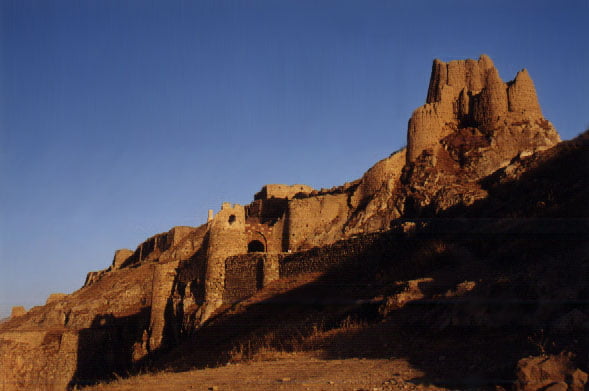
Տոսպայ լիճ (Dosba Lidj/Tospa Litch) is also a name we give to lake Van. Tospa = Tushpa.[...]
Van-Tosp
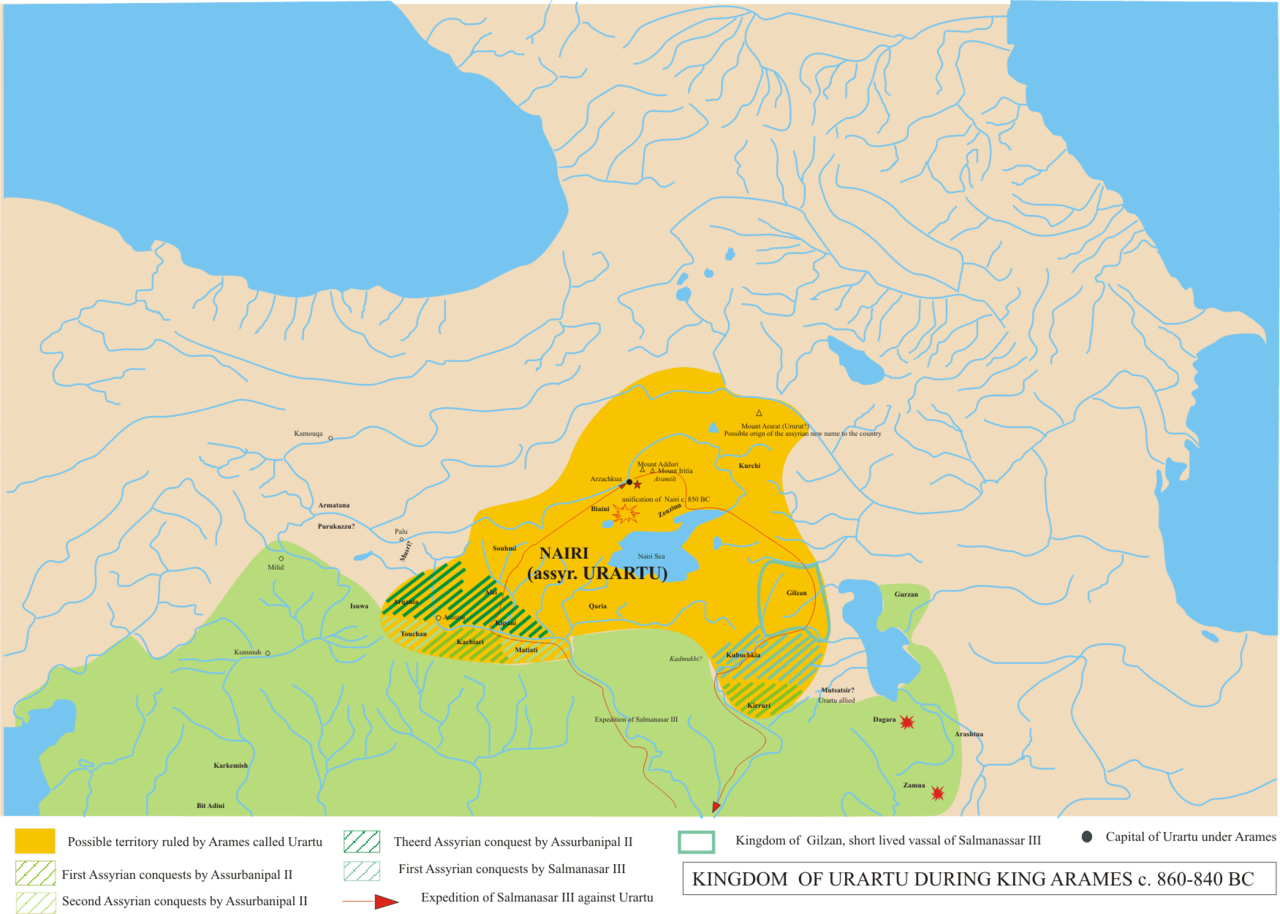
The seat of this theocratic monarchy was Thuspa, capital of the territory of Biaina, corrupted into the form Van. The Armenian national historian, Moses of Khoren (Khorenatsi), mentions Van as "in the province of Tosp." In some of the ancient inscriptions, one finds, "King of Biaina, inhabiting the city of Thuspas." Going back into history we find Tiglat-Pileser I, King of Assyria, asserting that he conquered twenty-three kings of Nairi in 1114 B.C. These "kingdoms" must have been very small, indeed; and when we find that this same Tiglat claimed to have slain with his own hand ten elephants and 920 lions, we are inclined to receive his statements with reserve. In an inscription of the Assyrian Assurbelkala (1077‑1060 B.C.), first appears the name Uruatru. A Shalmanaser of Assyria (1028‑1017 B.C.), claimed the conquest of "the entire country of Uruatru" in three days. In inscriptions of Ashurnasirpal (885‑859 B.C.) the name appears as Urardhu or Urarthu. The succeeding king Shalmaneser, now called by most historians the Second (859‑825 B.C.) sent an army against a king of Urartu named Aramé, whose capital was Arzasku or Arzaskun, identified with the modern Melazgerd, north of Lake Van. Aramé, who, according to Adontz, was the first organizer of the Urartean Empire, was defeated and his capital taken by Shalmanaser in 857 B.C.
Arame
To say that he was the "organizer" of the Empire, means that he combined the "Nairi countries" into a confederation under the aegis of the god Khaldis, supplanting an earlier Biaina confederation. Some authorities believe that not Aramé but Sardur I (844‑828) was the organizer of the confederation. Sardur was the son of Lutipris, who succeeded Aramé. He left an inscription in the Assyrian language, calling himself King of Sura, which, according to Professor Albrecht Goetze, is the same as Subaru. If this is so, the Urartean kings' claim of Hurrite descent entitled them to domination in Subari, or Upper Mesopotamia. Sardur's other titles were "Great King," and "Ruler of Four Regions," i.e., Shar-Kishatti, according to Babylonian and Assyrian inscriptions.
Sardur I
Sardur built a fortress of huge stones west of the Rock of Van, and Ispuinis, his son and successor, chose that rock as his residence and as the holy seat of the god Khaldis. Ispuinis was a contemporary of Adadnirari IV of Assyria, son of Shalmanaser and husband of Queen Shammuramat (Semiramis). Ispuinis fought and defeated his powerful rival, and was thus enabled to found a Khaldian colony at Musasir, west of the Pass of Kelishinin, where he erected a commemorative stone with inscriptions in Khaldian and Assyrian. Ispuinis and his son Menuas brought the empire to its peak. Under them it extended from the Zagros Mountains in the East to Palu in the North and Malatia in the West.
During their reigns great works were constructed around Van, including the aqueduct of Shamiram‑Su, 45 miles in length, completed by Menuas, which brought the pure water of the Khoshab River to the eastern shores of Lake Van (whose water is undrinkable), enabling the King to found there a "Menuas city." This canal irrigates the plain of Van even to the present time.
[cont'd...]Last edited by SevSpitak; 02-22-2010, 12:03 PM.Leave a comment:
-
Re: Hayasa's Relation in Hayastan's History
Arame/Aramu is one of the first known kings of Urartu, not last.Originally posted by jgk3 View Post
Some think that Armenia's etymology is based on the Medians' confusion of Urartians/proto-Armenians with Arameans. Why would they confuse us with them? The name Aram. Harminuya/Armina might very well come from Aram/Aramu/Arame. "The lands of Aram, or the kingdom/satrapy of Aram." If that's the case, Urartu can legitimately be included in our history, regardless of the linguistic problem (Azaris speak a Turkic language, but that doesn't prevent them from including Atrpatakan in their history). Don't forget the Behistun inscription: Armina, Harminuya [Armenia], Urashtu [Urartu], are the names given to the kingdom in the Armenian Highlands (according to Darius I the Great, all 3 are synonymous). I'm not trying to be arrogant about this subject, but historians have good reasons to believe Armenia is the successor of Urartu, even though we don't have a step by step guide to how it happened. In the same fashion that Phoenicia is part of Lebanese history. One thing we can be sure is that Urartian is definitely not the predecessor of our language. Turkic wasn't the language of Atrpatakan, Arabic wasn't the language of Peonicia and Armenian wasn't the language of Urartu.
I also don't believe Khorenatsi's history is completely mythical. Khorenatsi put together all of what had reached the Armenian people as their history at the time. Sure, there are distortions which caused anachronism, and some things are mythical, but it's not surprising that one of the first kings of an ancient kingdom can still be remembered 1000 years later (Aramu). Semiramis was remembered. In fact, Khorenatsi clearly speaks of Urartu in his history: The Kingdom of Van.

Last edited by SevSpitak; 02-22-2010, 10:50 AM.Leave a comment:
-
Re: Hayasa's Relation in Hayastan's History
I think the "Aram as a patriarch" hypothesis has some decent ground for being linked to the name of Arame. I'd like to investigate the phonology of Urartian Aramu/Arame vs. Armenian Aram and see if the last vowel being deleted is following a general pattern of Urartian terms/names showing up in Armenian records (there probably aren't that many instances of this to compare anyway). I wish we could know more about the last Urartian king Arame/Aramu, but I don't think much info exists about his cultural background from the records we have.Originally posted by SevSpitak View PostLast edited by jgk3; 02-22-2010, 08:06 AM.Leave a comment:
-
Re: Hayasa's Relation in Hayastan's History
Quick, direct, and irrefutable until/if new material is discoveredOriginally posted by jgk3 View Post
I posted this almost exclusively for this:
Now this is the first time I hear this, unless it's what some historians say when they associate "Ara the Beautiful" or the legendary Armenian patriarch, Aram, with the first king of Urartu [Aramu/Arame].The name Armenia honors the first Urartian king [Arame]
Speaking of which, what do you think about that? It's an interesting coincidence that the first known king of Urartu was named Arame/Aramu, and one of the patriarchs of ancient Armenia, according to the history of Khorenatsi (which is generally accepted as somewhat mythical), is also called Aram.Last edited by SevSpitak; 02-22-2010, 10:13 AM.Leave a comment:
-
Re: Hayasa's Relation in Hayastan's History
1. We cannot yet subgroup Phrygian and Armenian together. Nor can we say Armenian is a Phrygian dialect. They are distinct languages and at best, and [can possibly] be subgrouped with Greek.Originally posted by SevSpitak View Post
2. The Hatti language isn't affirmed to be "a Hurrian language" according to those who have worked on it.
3. Phrygians were resettled by Urartians in their domain during the latter's height in power. Not only were Phrygians settled there, but also Semitic Ugarits and many other neighbouring peoples who were now under Urartian power. Where Armenians come into the picture remains mysterious, and equating them with any of these peoples is a fatal shortcut.
3. Armenian is an Indo-European language. Armenian is not descended from Hurrian. The oldest Armenian we have attested does not reflect any significant inheritence from a non-Indo-European source. In the domain of syntax and morphology, it was probably very much influenced by all sorts of neighbouring languages, but its lexical core, the gauge we use to determine what family or branch a language hails from, rejects any notion that Armenian comes from Hurrian or anything of the like.Leave a comment:

Leave a comment: