
Re: Destruction by "Restoration" – Armenia's Ancient Monuments in Peril
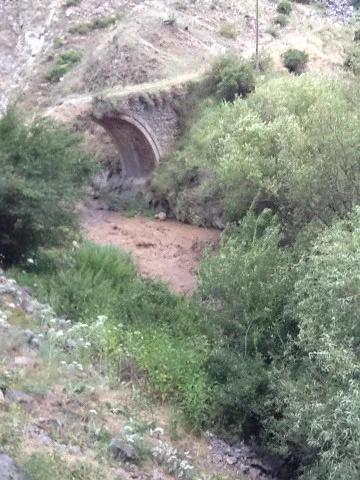
Restoration of medieval bridge of Garni causes displeasure of activists
A group of citizens held a protest action in front of the building of Culture Ministry today demanding explanations concerning recent restoration of the medieval
Garni bridge.
As architect Marina Parazyan told ArmInfo correspondent, activists are confident that after restoration the bridge lost its cultural value, and has turned from an ancient construction into a modern bridge. She said that old stones have found themselves "sealed up" in concrete and modern coat. For this reason, an attempt to return an initial image to the bridge may be destructive for it, she said.
"At present our key task is to draw careful attention to the rest projects on restoration of ancient monuments. As for the Garni bridge, here transparency of the process was not provided. For this reason, we scare repetition of similar scenario when restoring other monuments", - she said.
To note, Garni bridge was built in XI-XIII centuries.
The restoration/destruction was paid for by the American Embassy.
US to fund restoration of Garni Medieval Bridge
The U.S. Embassy in Armenia marked the 10th anniversary of the U.S. Ambassador's Fund for Cultural Preservation (AFCP) on November 2, 2011 at the Aram Khachaturyan House Museum in Yerevan.
During the celebration, the U.S. Ambassador to Armenia John Heffern and Minister of Culture Hasmik Poghosyan took part in a ceremonial signing for the restoration of the Garni Medieval Bridge, the 2011 AFCP initiative. The $110,000 U.S.-funded Garni Medieval Bridge project is the largest AFCP project received by Armenia. Guests, government officials, and Armenia's past AFCP project recipients recognized the role of the fund in preserving Armenia's cultural legacy and a shared world heritage.
Since its approval by the U.S. Congress in the fall of 2000, the U.S. Ambassador's Fund for Cultural Preservation has funded more than 640 cultural preservation projects in over 100 countries, representing a contribution of nearly $26 million towards the preservation of cultural heritage worldwide.
The Fund supports a wide range of projects that work to preserve cultural heritage including the restoration of historic buildings, assessment and conservation of museum collections, archaeological site preservation, documentation of vanishing traditional craft techniques, improved storage conditions for archives and manuscripts, and documentation of indigenous languages.
Medieval bridge of Garni will be put in operation in autumn
YEREVAN, AUGUST 10, ARMENPRESS: The bridge of Garni built in the 11th century will be put in operation in autumn. The restoration works have started since July 2 and the first stage will be finished on August 15. The responsible persons of Construction Company assure that it will be fully ready even earlier of planned term, earlier than November. The basis of reconstruction of this historical and cultural monument was put in September of last year by the memorandum “Keeping cultural values by ambassadors” signed by Minister of Culture Hasmik Poghosyan and ambassador extraordinary and plenipotentiary of USA to Armenia John Heffern. American embassy for that purpose provided 110 000 US dollars. Armenpress was informed that representatives of US embassy in Armenia and ministry of culture visited Garni, got acquainted in place with the reconstruction works.
Attache of the department of public relations of US embassy in Armenia Sean O’Harra assured that Armenia is a blessed country as it has many historical and cultural values which must be kept. “The monument which exists for already 800 years will be steady at least for 800 more years. This monument from one side is a bridge between Armenia and USA and from the other side between the past and future of Armenia” he mentioned. The representative of the embassy considered the process of the works satisfactory
And here is Ambassador Heffern boasting of "Loving that cultural work"
-
Re: Destruction by "Restoration" – Armenia's Ancient Monuments in Peril
Destruction by restoration - the medieval bridge at Garni
ARMENIA PROTEST: ACTIVISTS CALL FOR ATTENTION TO GARNI BRIDGE
TERT.AM
15.03.13
A crowd of people gathered outside the Ministry of Culture on Friday,
protesting against the reconstruction of the bridge of Garni.
The activists claimed that the medieval construction (11th-13th
centuries) had lost it one time historical-cultural value over
this period.
Speaking to Tert.am, one of the protesters, Argishti Kiviryan,
they accuse the Ministry of contributing to the cultural monument's
destruction.
"The Ministry is trying to justify its unlawfulness, saying that this
kind of reconstruction is possible. But once you put together an old
photograph with a picture featuring the [bridge's] present-day image
it will be enough even for a person with an elementary logic to see
that the construction has been destroyed," he said.
Gor Hakobyan, another protester, said new polished stones and tiles
have caused the bridge to lose its spiritual value.
"It no longer has any value, or even if it does, it has turned into
a completely different monument. We demand an open public account,"
he said, adding that they seek in that way to prevent more such cases
in future.
In letter sent to the Ministry on Monday the activist demanded an
explanation for the existing situation.
Today they submitted the replies to Vladmir Poghosyan, the head of the
Historical-Environment and Historical-Cultural Museum-Reserves Service,
and Dorvard Arushanyan, the head of the Monument Reconstruction
department. Hakobyan promised to meet relevant officials at the
ministry after receiving a conclusion and forming an alternative
opinion.
Video of the protest
Leave a comment:
-
Destruction by "Restoration" – Armenia's Ancient Monuments in Peril
Destruction by "Restoration" – Armenia's Ancient Monuments in Peril
This thread will document the growing number of historical buildings in Armenia that have been seriously damaged or even destroyed as a result of "restoration", "reconstruction", "renovation" or "redevelopment". I’ll also add reports about out-and-out demolitions.
The principal culprits seem to be Armenian oligarchs, the Armenian Church (often using oligarch money), and foreign "benefactors" (mainly wealthy diaspora Armenians, but sometimes foreign governments or ngo organisations). The protection of cultural monuments in Armenia has been reduced dramatically since independence. Hundreds of medieval churches and monasteries were given by the State to the Armenian Church, which went on to do whatever it wanted with them. And, if you have the money or the political clout, it seems that anyone can do whatever they want. Armenia is a signatory to various UNESCO and other international treaties intended to protect and conserve cultural monuments, yet Armenia now regularly ignores the requirements of those treaties.
Restoration versus Conservation
Restoration is the process of making alterations and repairs to a building with the intention of restoring it to its original form. Restoration is a more drastic intervention than conservation. Outrage at the damage done during ruthless "restorations" in 19th-century Europe created the first codes of conduct to limit such activities. These have progressed to the extent that today the concept of restoration is regarded as a discredited and obsolete practice that has been replaced by that of conservation.
Conservation is the preservation of an existing building, taking great care not to alter or destroy any aspect of it. Any repairs must be restricted to essential repairs only, and must always respect the existing character of the building. Article 9 of the International Charter for the Conservation and Restoration of Monuments and Sites (which Armenia is a signatory to) states that "the aim of restoration is to preserve and reveal the aesthetic and the historical value of the monument and is based on respect for the original building and on authentic documents". The fundamental principles of modern conservation are minimal intervention and conserve as found. Conservation methods must retain the authenticity of the monument, use materials sympathetic to the original structure, preserve important original fabric, and apply the least visual change to a structure.Last edited by bell-the-cat; 03-25-2013, 06:31 PM.




Leave a comment: