Announcement

Collapse
No announcement yet.

America's Financial Crisis

Collapse
X
 
  • Filter
  • Time
  • Show
Clear All
new posts

  • Armenian
    replied
    Re: America's Financial Crisis

    A Challenge for the U.S.: Sun Rising on the East


    What a difference five years — and one war — make!


    In a 2003 article in Newsweek, written on the eve of the invasion of Iraq, Fareed Zakaria — a columnist for the magazine and the editor of its international edition — wrote: “It is now clear that the current era can really have only one name, the unipolar world — an age with only one global power. America’s position today is unprecedented.” He went on to declare that “American dominance is not simply military. The U.S. economy is as large as the next three — Japan, Germany and Britain — put together,” adding that “it is more dynamic economically, more youthful demographically and more flexible culturally than any other part of the world.” What worries people around the world above all else, he wrote, “is living in a world shaped and dominated by one country — the United States.” In his new book, “The Post-American World,” Mr. Zakaria writes that America remains a politico-military superpower, but “in every other dimension — industrial, financial, educational, social, cultural — the distribution of power is shifting, moving away from American dominance.” With the rise of China, India and other emerging markets, with economic growth sweeping much of the planet, and the world becoming increasingly decentralized and interconnected, he contends, “we are moving into a post-American world, one defined and directed from many places and by many people.”

    For that matter, Mr. Zakaria argues that we are now in the midst of the third great tectonic power shift to occur over the last 500 years: the first was the rise of the West, which produced “modernity as we know it: science and technology, commerce and capitalism, the agricultural and industrial revolutions”; the second was the rise of the United States in the 20th century; and the third is what he calls “the rise of the rest,” with China and India “becoming bigger players in their neighborhoods and beyond,” Russia becoming more aggressive, and Europe acting with “immense strength and purpose” on matters of trade and economics. Many of this volume’s more acute arguments echo those that have been made by other analysts and writers, most notably, the New York Times columnist Thomas L. Friedman on globalization, and Jimmy Carter’s national security adviser, Zbigniew Brzezinski, on America’s growing isolation in an increasingly adversarial world. But Mr. Zakaria uses his wide-ranging fluency in economics, foreign policy and cultural politics to give the lay reader a lucid picture of a globalized world (and America’s role in it) that is changing at light speed, even as he provides a host of historical analogies to examine the possible fallout of these changes.

    The irony of the “rise of the rest,” Mr. Zakaria notes, is that it is largely a result of American ideas and actions: “For 60 years, American politicians and diplomats have traveled around the world pushing countries to open their markets, free up their politics, and embrace trade and technology. We have urged peoples in distant lands to take up the challenge of competing in the global economy, freeing up their currencies, and developing new industries. We counseled them to be unafraid of change and learn the secrets of our success. And it worked: the natives have gotten good at capitalism.” But at the same time, he goes on, America is “becoming suspicious of the very things we have long celebrated — free markets, trade, immigration and technological change”: witness Democratic candidates’ dissing of Nafta, Republican calls for tighter immigration control, and studies showing that American students are falling behind students from other developed countries in science and math.

    While readers might take recent signs like recession at home, a falling dollar abroad and a huge trade deficit as suggesting that the American economy is in trouble, Mr. Zakaria asserts that the United States (unlike Britain, which was undone as a world power because of “irreversible economic deterioration”) can maintain “a vital, vibrant economy, at the forefront of the next revolutions in science, technology, and industry — as long as it can embrace and adjust to the challenges confronting it.” As Mr. Zakaria sees it, the “economic dysfunctions in America today” are the product not of “deep inefficiencies within the American economy,” but of specific government policies — which could be reformed “quickly and relatively easily” to put the country on a more stable footing. “A set of sensible reforms could be enacted tomorrow,” he says, “to trim wasteful spending and subsidies, increase savings, expand training in science and technology, secure pensions, create a workable immigration process and achieve significant efficiencies in the use of energy” — if only the current political process weren’t crippled by partisanship, special-interest agendas, a sensation-driven media, ideological attack groups and legislative gridlock.

    As for the United States’ role in a world that is rapidly shifting from unipolarity into a far messier and more dynamic system, Mr. Zakaria suggests that it should become a kind of “global broker,” forging close relationships with other major countries, while exchanging the peremptory, directive-issuing role of a superpower for “consultation, cooperation, and even compromise” — in short, repudiating the sort of cowboy unilateralism favored by the current Bush administration and embracing a behind-the-scenes power derived from “setting the agenda, defining the issues and mobilizing coalitions.” The central strategic challenge for American diplomacy in the years to come, Mr. Zakaria says, concerns China: how to deter its aggression and expansionism, while at the same time accommodating its legitimate growth. He suggests that in a world in which “the United States is seen as an overbearing hegemon,” China might well seek to position itself as “the alternative to a hectoring and arrogant America,” gradually expanding its economic ties and enlarging its sphere of influence.

    “How will America,” he asks, “cope with such a scenario — a kind of cold war but this time with a vibrant market society, with the world’s largest population, a nation that is not showcasing a hopeless model of state socialism or squandering its power in pointless military interventions? This is a new challenge for the United States, one it has not tackled before, and for which it is largely unprepared.” There are some curious gaps and questionable assertions in this book. While President Bush’s controversial No Child Left Behind program has put increased emphasis on test-taking, and college applicants worry about their SAT scores in what Forbes magazine calls “a test-crazed era,” Mr. Zakaria writes: “Other educational systems teach you to take tests; the American system teaches you to think,” adding that “American culture celebrates and reinforces problem solving, questioning authority, and thinking heretically.”

    He skims lightly over the critical role that the Iraq war played in shaping America’s current problems on the world stage (he himself supported the effort to oust Saddam Hussein and wrote in March of 2003 that the war “will look better when it is over” and weapons of mass destruction are found). And in sharp contrast to Qaeda experts like the former C.I.A. officer Michael Scheuer (who argue that the Iraq war has served as a recruitment tool for Osama bin Laden) and a new State Department report (which notes the growth of Qaeda affiliates in the Middle East, North Africa and Europe, and the growing ability of al Qaeda itself to plot attacks from Pakistan), Mr. Zakaria contends that “over the last six years, support for bin Laden and his goals has fallen steadily throughout the Muslim world.” Such dubious assertions distract attention from the many more convincing arguments in this book and the volume’s overall take on the United States’ place in a rapidly changing global landscape — a provocative and often shrewd take that opens a big picture window on the closing of the first American century and the advent of a new world in which “the rest rise, and the West wanes.”

    Source: http://www.nytimes.com/2008/05/06/bo...341&ei=5087%0A

    Leave a comment:


  • Armenian
    replied
    Re: America's Financial Crisis

    Rural U.S. Takes Worst Hit as Gas Tops $4 Average


    Gasoline prices reached a national average of $4 a gallon for the first time over the weekend, adding more strain to motorists across the country. But the pain is not being felt uniformly. Across broad swaths of the South, Southwest and the upper Great Plains, the combination of low incomes, high gas prices and heavy dependence on pickup trucks and vans is putting an even tighter squeeze on family budgets. Here in the Mississippi Delta, some farm workers are borrowing money from their bosses so they can fill their tanks and get to work. Some are switching jobs for shorter commutes. People are giving up meat so they can buy fuel. Gasoline theft is rising. And drivers are running out of gas more often, leaving their cars by the side of the road until they can scrape together gas money. The disparity between rural America and the rest of the country is a matter of simple home economics. Nationwide, Americans are now spending about 4 percent of their take-home income on gasoline. By contrast, in some counties in the Mississippi Delta, that figure has surpassed 13 percent. As a result, gasoline expenses are rivaling what families spend on food and housing. “This crisis really impacts those who are at the economic margins of society, mostly in the rural areas and particularly parts of the Southeast,” said Fred Rozell, retail pricing director at the Oil Price Information Service, a fuel analysis firm. “These are people who have to decide between food and transportation.” A survey by Mr. Rozell’s firm late last month found that the gasoline crisis is taking the highest toll, as a percentage of income, on people in rural areas of the South, New Mexico, Montana, Wyoming and North and South Dakota.

    With the exception of rural Maine, the Northeast appears least affected by gasoline prices because people there make more money and drive shorter distances, or they take a bus or train to work. But across Mississippi and the rural South, little public transit is available and people have no choice but to drive to work. Since jobs are scarce, commutes are frequently 20 miles or more. Many of the vehicles on the roads here are old rundown trucks, some getting 10 or fewer miles to the gallon. The survey showed that of the 13 counties where people spent 13 percent or more of their family income on gasoline, 5 were located in Mississippi, 4 were in Alabama, 3 were in Kentucky and 1 was in West Virginia. While people here in Holmes County spent an average of 15.6 percent of their income on gasoline, people in Nassau County, N.Y., spent barely more than 2 percent, according to the survey. Economists say that despite widespread concern about gasoline prices, the nationwide impact of the oil crisis has so far been gentler than during the oil crises of the 1970s and 1980s, when shortages caused long lines at the pump, set off inflation and drove the economy into recession. Americans on average now spend about 4 percent of their after-tax income on transportation fuels, according to Brian A. Bethune, an economist at Global Insight, a forecasting firm. That compares with 4.5 percent in early 1981, the highest point since World War II. At its lowest point, in 1998, that share dropped to 1.9 percent. “Gas prices have doubled over the last year but the economy has not fallen off the cliff,” said Rajeev Dhawan, director of the Economic Forecasting Center at Georgia State University. “But for the rural lower income people, as a proportion of their income the rise of gas prices is very high.”

    While people everywhere are talking about gasoline prices these days, some folks in Tchula (the T is silent) have gone beyond talking. Anthony Clark, a farm worker from Tchula, says he prays every night for lower gasoline prices. He recently decided not to fix his broken 1992 Chevrolet Astro van because he could not afford the fuel. Now he hires friends and family members to drive him around to buy food and medicine for his diabetic aunt, and his boss sends a van to pick him up for the 10-mile commute to work. A trip from Tchula to the nearest sizable town about 15 minutes away can cost him $25 roundtrip — for the driving and the waiting. That is about 10 percent of what he makes in a week. Taking a break under some cottonwood trees beside a drainage ditch filled with buzzing mosquitoes, Mr. Clark and members of his work crew spoke of the big and little changes that higher gas prices have brought. The extra dollars spent at the pump mean electric bills are going unpaid and macaroni is replacing meat at supper. Donations to church are being put off, and video rentals are now unaffordable. Cleveland Whiteside, who works with Mr. Clark and used to commute 30 miles a day, said his Jeep Cherokee was repossessed last month, because “I paid so much for gas to get to work I couldn’t pay my payments anymore.” His employer, Larry Clanton, has lent him a pickup truck so he can get to work. Signs of pain and adaptation because of the cost of gas are everywhere. Local fried chicken restaurants are closing because people are eating out less. At the hardware store here, sales have plummeted to $30 a day from $250 a day a month ago. “Money goes to gasoline — I know mine does,” said the hardware store’s manager, Pam Williams, who tries to attract customers by putting out choice crickets for fishing bait beside the front door.

    Local governments are leaving grass high along the roads and doing fewer road repairs to save on fuel costs. The Holmes County government has cut the work week to four days to give workers gasoline relief (keeping the same total of hours), and politicians are even considering replacing sanitation workers with prison inmates on some shifts to conserve money for fuel. The local price for a gallon of regular unleaded gasoline was roughly $3.85 last week, slightly below the national average, but the median family income in Holmes County is about $18,500. Nationwide, regular unleaded gasoline reached an average of $4.005 on Sunday, according to the American Automobile Association. That is the highest price ever and about a dollar higher than at the start of the year. While looking to cut workers at his fish processing plant in nearby Isola, Miss., xxxx Stevens, president of Consolidated Catfish Producers, said that 10 workers walked into his office last week and volunteered to take a buyout rather than continue commuting from Charleston, Miss., 65 miles away. “The gas ate them alive,” he said. Workers at the plant are trying to find ways to cope. Josephine Cage, who fillets fish, said her 30-mile commute from Tchula to Isola in her 1998 Ford Escort four days a week is costing her $200 a month, or nearly 20 percent of her pay. “I make it by the grace of God,” she said, and also by replacing meat at supper with soups and green beans and broccoli. She fills her car a little bit every day, because “I can’t afford to fill it up. Whatever money I have, I put it in.”

    Sociologists and economists who study rural poverty say the gasoline crisis in the rural South, if it persists, could accelerate population loss and decrease the tax base in some areas as more people move closer to urban manufacturing jobs. They warn that the high cost of driving makes low-wage labor even less attractive to workers, especially those who also have to pay for child care and can live off welfare and food stamps. “As gas prices rise, working less could be the economically rational choice,” said Tim Slack, a sociologist at Louisiana State University who studies rural poverty. “That would mean lower incomes for the poor and greater distance from the mainstream.”

    Source: http://www.starnewsonline.com/articl...806090305/1002

    Leave a comment:


  • Armenian
    replied
    Re: America's Financial Crisis

    On Track for U.S. Collapse


    Bush and Cheney are steering the U.S. into a collapse. Only strong public voices by influential people can prevent the coming disaster. We desperately need for men and women who are known to the public and have credibility to speak up in the critical period ahead to avoid catastrophe.

    * A few weeks ago, Israel bombed a alleged nuclear facility in Syria. This is a warm-up for an attack on Iran.
    * In the last few days, the U.S. unilaterally tightened sanctions on Iran. Russia and China do not support this move.
    * A week ago Bush warned Iran that its attainment of nuclear arms would lead to World War III.
    * Russia, which has been assisting Iran in its nuclear construction program for decades, regards Western military action against Iran as unacceptable.
    * China has been arming Iran with missiles. Its relations with Iran have been improving for years.


    We know that Bush and Cheney are capable of pre-emptive attack. We know that Bush will act if he believes he is right no matter what the costs are. In his distorted worldview, Iran with nuclear weapons is a scenario worth any cost to avoid. We know that Bush, Cheney, and Rice have repeatedly warned Iran of meaningful consequences if Iran arms itself with nuclear weapons. We know that their terms in office end in 15 months. These are the critical months. But it is by no means clear that the front-running candidates for office who may replace them hold substantially different views. Hillary Clinton has publicly called for sanctions against Iran and has called Iran a threat to Israel. Why may an unprovoked attack on Iran lead to WWIII and why may it lead to the collapse of the U.S.?

    Imagine this scenario. The U.S. encourages Israel to bomb the Natanz nuclear facility in Iran. Russia attempts to restrain an Iranian response but fails. Iran responds in any of many ways, such as launching missiles on Israel, firing on shipping in the Straits of Hormuz, mining the Straits of Hormuz, sending troops into Iraq, or allying its military with Hezbollah and attacking Israel from Lebanon. The U.S., citing Iran’s aggressions (that will be the story), launches a full-scale attack on Iran designed to devastate the country. This attack has actually been planned by the U.S. for years. Syria is unable to maintain neutrality and quickly becomes a battleground between Iran and Israel.

    The price of oil by this point has already soared to $200 a barrel. The U.S. begins to use its strategic reserve and to divert Iraqi production. Russia responds by taking steps to prevent its oil production from reaching the U.S. China responds by cutting off its support of the U.S. Treasury market. Venezuela halts oil shipments to the U.S. The first stages of WWIII are economic warfare designed to cripple the U.S. and halt its war-making capacity.

    The U.S., unable to finance its deficits and fund its sovereign debt, is forced into raising interest rates drastically in order to borrow. The Fed is forced to print money. An inflationary spiral occurs. Meanwhile the high interest rates and high oil prices, not to mention the shock of a spreading conflict, drive the U.S. economy into severe decline. The U.S. attempts to raise taxes in order to fund itself, further crippling the economy. Gold soars to $1,500–$2,000 an ounce. The U.S. attempts to bolster its military forces. The draft is reinstated. The severity of the emergency allows Bush and Cheney to assume emergency powers and begin a dictatorship. Elections are postponed.

    The U.S. collapses.

    Unfortunately, even if this scenario does not occur, the position of the U.S. is so precarious that any number of other scenarios equally disastrous lie in wait. This house needs urgently to be put in order or it will fall, and especially if it does not terminate its imperial adventures. The very fact that Bush and Cheney (or any major U.S. political officials) gain by starting WWIII is a terrible indictment of our entire political system. Who can stop this? Who can prevent this? It will only take a few well-placed people to prevent this catastrophe. My guess is 5–20 people could sway public opinion against war or provide enough cover for Congressional dissenters to screw up their courage. Maybe even as few as 3 or 4 influential people could derail the Bush-Cheney train to disaster. They need to speak out at the right times and they must be heard. Previously mute or muted voices simply must speak out. They know who they are. They know that their silence will mean silent approval of a U.S. collapse.

    Source: http://www.lewrockwell.com/rozeff/rozeff183.html

    Leave a comment:


  • Armenian
    replied
    Re: America's Financial Crisis

    Brazil, Russia, India and China Overtake USA


    June 26, 2007

    The largest threats to the American economic power have overtaken the domination of the USA in the global energy industry. Brazil, Russia, India and China – have taken over the domination of the USA in the global energy industry, shows the newest study by the investment bank, Goldman Sachs. The strengthening of the economic power of those four countries – new economic giants united under the name BRIC – is already obvious in the metal and mining sector, and it is slowly starting to be felt in the insurance and consumer industries, says Anthony Ling, the director of that investment bank.

    “For all companies that operate globally, the world is changing at an ever faster rate, bringing larger challenges than ever before – that is true globalization”, he said. One of the most important changes is the growth of the BRIC economies, he added. According to a Goldman Sachs study, at the end of the first Gulf War in 1991, of the 20 largest companies in the energy sector by market capitalization, 55 percent were American, and 45 percent European. However, in 2007, 35 percent of the largest energy companies come from BRIC countries, 35 percent European, and around 30 percent American, it says in the study. “The USA is now trailing behind, with the smallest percentage of energy companies in the world”, says Ling.

    “If we assume the global resources industry is a traditional leader as far as global trends are concerned, we will start to notice the same trend in the mining industry, where 20 percent of the top 20 companies are from BRIC countries”, he said. “We are convinced that the same form will happen in all other industries”.

    This form is already present in the insurance sector, in which the BRIC countries hold 10 percent of the top 20 companies. In the world industry of refreshing drinks, in which the new economic powers are just starting to be represented with a 5 percent share. Ling is predicting that BRIC will soon start to penetrate the food and pharmaceutical sectors. If investors and corporations do not take into account the growing strength of BRIC in the global economy, they will start to fall behind in the growth of investments, and lose their competitive advantage of their companies, warned Ling, talking at a press conference before the summit in Geneva on July 5-6, about the United Nations Global Compact initiative.

    An initiative that was stated in 2000 is in question. The aim of the initiative is connecting the business sectors with UN agencies, governments, and the civilian population, in supporting basic social values, which reflect the ten principles on which the initiative is based, which includes respecting human rights and fair work, responsible behaviour towards the environment, and anti-corruption measures. The Goldman Sachs study, which analyses the effect of those factors in a number of industry sectors, will be released on the 3rd of July.

    Source: http://www.javno.com/en/economy/clanak.php?id=57122

    Leave a comment:


  • Armenian
    replied
    Re: America's Financial Crisis

    The Asian connection...

    **************************

    An anti-American military confederacy may loom in Asia


    September 21st, 2005

    The members of the Shanghai Cooperation Organization (SCO), an intergovernmental association comprising China, Russia, Kazakhstan, Kyrgystan, Tajikistan and Uzbekistan, will recognize the organization’s fifth anniversary in June 2006 with a much anticipated celebration, “Everyone agrees this first jubilee date must be celebrated accordingly,” said Vitally Vorobyev, Russia’s coordinator in the SCO. Washington, however, will not be joining in the festivities. The reason for Washington’s sour mood? Growing anxiety surrounding the ultimate mission of the SCO and its impact on Central Asia and the Middle East. Pictures taken by journalists of Russian President Vladimir Putin during the recent joint Russsian-Chinese Peace Mission 2005 military exercises, showing the president in full military attire and holding a large model warplane were not reassuring. His subsequent flight in a supersonic bomber specifically designed to deliver a nuclear payload did not help either. This raises an important question: with SCO leaders such as Russia’s Vladimir Putin, China’s Hu Jintao and Iran’s Mahmoud Ahmadinejad openly embracing military modernization and improved synergies, is the organization destined to become a military confederacy with the U.S. as its main target? “For the SCO to be turned into a military and political bloc or alliance, the present-day SCO would need to be dissolved. The legislation of some of the SCO member-countries makes this [military confederacy] impossible,” said Vitally Vorobyov. He immediately followed these comments with a contradictory statement, “Cooperation between defense agencies within the SCO framework can and should develop. The SCO makes provision for this, it’s nothing new.” Statements of this type from high-level Russian and SCO officials continue to perplex western intelligence officials, leading some to speculate that it may be only a matter of time before the SCO begins to exert its collective military influence in Central Asia and the Middle East.

    Peace Mission 2005

    In August, “Peace Mission 2005,” a joint eight-day military exercise involving 10,000 Russian and Chinese troops, was held in Russia’s Far East and China’s Shandong Peninsula. The exercises were led by Russian General Makhmut Gareyev, a veteran of World War II who fought against both Germany and Japan. Requests by Washington to reduce the scope of the exercises were rejected by both Russia and China. The joint exercises involved beach landings, airborne assaults, naval blockades, anti-ship missiles and precision bombing from strategic bombers. To the surprise of western intelligence officials, Russian Tu-95MS Bear and Tu-22M3 Backfire strategic bombers designed to carry nuclear-tipped cruise missiles were deployed during the exercises. The exercises reportedly involved a mock intervention to stabilize an imaginary country driven by ethnic strife. In response, the U.S. launched a week long “Joint Air Sea Exercise 2005” in Okinawa and Guam which included 10,000 troops and 100 warplanes from the USS Kitty Hawk strike group. In addition, the U.S. and South Korea participated in a twelve day “Ulchi Focus Lens 2005” military exercise. Taiwan has already announced that it has scheduled its own invasion defense exercise code named “Yama Sakura” for 2006. Taken collectively, the military exercises send a clear message to Moscow and Beijing that the U.S. is prepared to respond to any collaborative military threat.

    Recent Military Exchanges

    In September, Russian Defense Minister Sergey Ivanov announced his country had agreed to supply China with a total of 40 IL-76 transport and IL-78 refueling planes at a cost of about $1 billion. Later this month, Ivanov is expected to sign contracts to deliver Russian military vehicles to China. The recent plane and vehicle sales continue a trend of Russian military hardware transfers to China which have included: 200 fourth-generation fighter aircraft, several S-300 air defense batteries, guided missile destroyers and sophisticated submarines worth a combined $15 billion over the past ten years. In 2004 alone, Russian arms exports to China totaled $2.3 billion. According to Konstantin Makiyenko, the deputy director of the Center for Strategic and Technological Analysis, a Moscow-based think tank, China is also interested in purchasing Russian made A-50 Mainstay AWACS planes and a manufacturing license for the Su-30MK2 multi-role fighter. Moreover, Beijing has made it clear that wants to accelerate the purchase of advanced Russian fighters, unmanned aircraft and long and short-range missiles as part of its ongoing modernization program. Not surprisingly, Russian Defense Minister Ivanov announced this month that Russian servicemen would travel to China for training stating, “Russia needs more experts who can speak Chinese.” More than 500 Chinese students already study at Russian military universities. But why the sudden urgency for improved communication between the two militaries? Washington has begun to take notice of the evolving relationship. U.S. State Department spokesman Sean McCormack commented in August, “We would hope that anything that they [China and Russia] do is not something that would be disruptive to the current atmosphere in the [Central Asia] region.” Unfortunately, Mr. McCormack may be disappointed.

    Future Military Exercises

    Immediately after the completion of their historic joint military exercises, Russia and China announced plans to hold additional joint exercises in 2006. Both countries anticipate expanding the exercises to include SCO member states Kazakhstan, Kyrgyzstan, Tajikistan, and Uzbekistan, as well as observer states India, Iran, Mongolia and Pakistan. “It is possible by the time we decide to hold such exercises with China; other SCO countries would be willing to join, like India,” one Russian official said. Russian Defense Minister Ivanov concurred, “I think that future Russia-China military exercises will be held and other members of the SCO will probably take part in them.” Russia and India are scheduled to hold their first joint army drill next month, with mock raids on terrorist facilities taking place in the Indian province of Rajastahn, on the boarder with Pakistan. Andrei Kokoshin, a former secretary of the Russian Security Council and a member of parliament said the impending follow-up to the Peace Mission 2005 exercises could be part of a Russia-China-India triangle which supports the increased activity of the SCO. “The exercise might focus on maintaining stability in Central Asia and ensuring the security of oil supplies via sea routes,” Kokoshin said. Chinese, Indian and Russian naval assets working in unison to protect oil supplies in the Persian Gulf? This comment shows another disturbing aspect of the emerging confederacy, an increased willingness to use its combined military strength to secure strategic energy reserves located in the Middle East. The mere thought of the Persian Gulf clogged with warships enforcing multilateral allegiances and interests is enough to make any intelligence analyst stay up all night. General Yury Baluyevskiy, Chief of Staff of the Russian Armed Forces, further elaborated on the topic of SCO military cooperation, “I do not rule out that, if a decision is made by the SCO, of which Russian and China are members, the armed forces of our countries may be involved in performing certain tasks.” General Baluyevskiy failed to elaborate on what those “certain tasks” would include. Observer country Pakistan is also becoming more active in the military aspects of the SCO. In September, Chinese General Liang Guanglie, a member of the Central Military Commission and Chief of Staff of the People’s Liberation Army (PLA), met with Pakistani General Ehsan Ul Haq, Chairman of the Joint Chiefs of Staff, to strengthen military-to-military ties. During the meeting in Beijing, the two generals exchanged views on issues of common global and regional interest, as well as army building. The most troubling development of the past month related to the SCO is the growing prospect of a nuclear-obsessed Iran joining the organization as a permanent member. Mahmoud Ahmadinejad, the newly elected conservative President of Iran, is a proven U.S. antagonist and a firm believer in spreading revolutionary Islamist ideology throughout the Muslim world. His recent comments at the U.N. concerning the U.S. show a preparation for confrontation with the U.S. Making matters worse; Iran is planning to build up its military forces. Iran had planned to double its military budget by 2010, but thanks to record oil revenues, that timetable has been adjusted to 2008.

    New Thinking Needed

    The SCO is a menacing confederacy of powerful nations arising out of the shadows of the Cold War that could cause tremendous global instability and even lead to world war. Geopolitics aside, the SCO has the potential to become the most powerful alliance on earth, combining Russia’s energy, military and technology expertise; China and India’s economic and human capital; and Iran’s enormous energy resources and growing military capabilities. This unique combination makes the SCO a formidable adversary for the U.S. In February, Chinese People’s Liberation Army (PLA) chief of staff General Liang Guanglie said the Peace Mission 2005 exercises would, “protect the peace and stability in our region and the world.” The world? The world has been led to believe that the SCO is a regional alliance designed to address issues of mutual concern such as terrorism, separatism and extremism -- whatever they may mean at the moment for the members of the SCO. With military operations scheduled for 2006 and an expanded list of participating nations, the military threat posed by the SCO is starting to take shape. At this time, what steps need to be taken by the U.S. to prepare for a possible SCO military threat? First, the U.S. Congress, Department of Defense and U.S. intelligence community must recognize that the continued military modernization and integration involving Russia, China, India, Pakistan and Iran will directly threaten the U.S. and its allies within the next several years. This is an uncomfortable reality, but one which is taking shape right before our eyes. Second, calls by the SCO and others in the international community for an immediate withdraw of U.S. troops from the Middle East and Central Asia should be disregarded, due to the horrific consequences that the inevitable power vacuum would cause. Instead, strategic alliances should be strengthened with countries such as Georgia and the Ukraine to counter any regional threat. Third, recent calls by Iran for a Muslim seat on the UN Security Council should be viewed for what they are; an effort by Tehran to weaken U.S. legitimacy in the international community and diminish its influence in Central Asia and the Middle East. Iranian President Mahmoud Ahmadinejad’s announcement that his country will sell “peaceful” nuclear technology to other Islamic countries is too chilling to contemplate. In short, the SCO is an immature, but potentially dangerous confederacy of countries with a mutual interest to dethrone the U.S. and if necessary, confront it militarily. Under the guise of economic partnership, regional alliances and friendship, China, Russia and the other members of the SCO are rapidly increasing their collective power. Recent Pentagon reports identifying China as a growing threat are indeed accurate, but don’t go far enough. The reports are deficient in that they base their analysis and predictions on countries such as China acting unilaterally. As a result, compulsory discussions concerning the rise of regional and global alliances that threaten the U.S. are not taking place. This could be a fatal mistake, since the SCO has become the perfect vehicle for coordinated military action in the future. Frederick W. Stakelbeck Jr. is an expert on bilateral and trilateral alliances as they relate to China foreign policy.

    Source: http://www.americanthinker.com/artic...rticle_id=4837

    Leave a comment:


  • Armenian
    replied
    Re: America's Financial Crisis

    The South American connection...

    ***************************

    Doing It Their Own Way: Venezuela, Argentina, Bolivia, Ecuador


    A new wave of Latin American leaders is changing the face of the region and its relations with the United States, multilateral institutions, international financial markets and foreign investors. While this is often seen in Washington in political terms, as the rise of populism or anti-Americanism, much can be explained by looking at the economics of these changes. Rafael Correa, Ecuador's newly elected president, is a case in point. Correa recently sent the country's bond markets tumbling by announcing that he would seek to restructure Ecuador's foreign debt. He is looking toward a 75 percent debt reduction, and will use the savings on debt service to increase social spending.

    Correa, who got his Ph.D. in economics at the University of Illinois in Urbana, understands very well that foreign capital can, in some circumstances, contribute to development. But when a country is borrowing simply to pay off debt, it may make more sense to clear some debt off the books and start over, just as someone who declares bankruptcy in the United States does. Argentina defaulted on its debt in December 2001. The government drove a hard bargain with its foreign creditors and with the International Monetary Fund, which wanted the government to pay more to the defaulted bondholders and to follow more orthodox macro- economic policy prescriptions. In the end the Argentines were proven right. The economy shrank for only about three months after the default; it has since grown at an annual rate of more than 8 percent, pulling more than 8 million people out of poverty in a country of 36 million.

    President Néstor Kirchner of Argentina has pursued these policies outside of the international spotlight. But the way he led Argentina out of its depression of 1998-2002 is comparable to President Franklin D. Roosevelt's leadership in the United States during the Great Depression. Like Roosevelt, Kirchner had to reject the advice of the majority of the economics profession (Roosevelt did this even before Keynes had published his General Theory), stand up to powerful interests (foreign bondholders and utility companies, the IMF and World Bank), and do what was best for the country. A stable and competitive exchange rate, reasonable interest rates and the use of unorthodox measures to control inflation were some of the policies that Argentina needed to produce its remarkable economic recovery.

    Venezuela's Hugo Chávez is a more controversial leader, but his government's economic policies are working. The year 2006 will be the second in a row in which Venezuela has a 10 percent growth rate, the highest in the region, after a 17.8 percent jump in 2004. To put the country on a solid growth path, the government needed to get control over the national oil company PDVSA, which is the source of nearly half the government's revenues and 80 percent of the country's export earnings. The opposition resisted fiercely, with a U.S.-backed military coup and an oil strike that devastated the economy in 2002-2003. But since the government prevailed it has been able to assure not only rapid growth but vastly expanded social programs for the poor, including free health care, subsidized food and increased access to education.

    Some say this is just an oil boom that will collapse when oil prices drop, but the Chávez government has budgeted conservatively for oil prices that were about half of what they are now. The governments of Argentina and Venezuela are transforming not only their own countries but also the region by finally breaking the IMF's control over credit. Only a few years ago, a government that did not agree to IMF conditions would find itself denied credit not only from the Fund but from the much larger World Bank, Inter-American Development Bank, G-7 governments and even the private sector. This was the major instrument of Washington's influence in the region, and helped bring higher interest rates, tighter budgets, privatization, indiscriminate liberalization of international trade and capital flows and the abandonment of development strategies.

    Venezuela has now provided an alternative source of credit, with no economic policy strings attached, to Argentina, Bolivia, Ecuador and other countries. The dissolution of the IMF's "creditors' cartel" is the most important change in the international financial system since the collapse of the Bretton Woods system of fixed exchange rates in 1973. Now even poor countries like Bolivia can say no to the "Washington consensus," capture billions of dollars of additional revenues from resources like natural gas, and use them to deliver on their promises of a New Deal for the region's poor.

    The region's first indigenous president, Evo Morales, is also making history as he completes his first year in office. President Luiz Inácio Lula da Silva of Brazil has continued the neoliberal policies (and resultant sluggish economic growth) of his predecessor. But he has been a team player internationally, forging a close alliance with Argentina and Venezuela that has buried Washington's proposed "Free Trade Area of the Americas," and pursuing increased regional economic integration. Latin America has clearly taken a turn in a new economic direction, and it looks to be overwhelmingly positive. After 26 years of slow economic growth, it would be difficult for the new leaders to do worse.

    Source: http://www.venezuelanalysis.com/analysis/2156

    Leave a comment:


  • Armenian
    replied
    Re: America's Financial Crisis

    The Russian connection...

    **************************

    Putin’s War-whoop: The impending clash with Russia


    June 21, 2007, By Mike Whitney

    "What is a 'unipolar’ world?

    It is world in which there is one master, one sovereign--- one center of authority, one center of force, one center of decision-making. And at the end of the day this is pernicious not only for all those within this system, but also for the sovereign itself because it destroys itself from within. It has nothing in common with democracy, which is the power of the majority in respect to the interests and opinions of the minority. In Russia, we are constantly being lectured about democracy. But for some reason those who teach us do not want to learn themselves." Russian President Vladimir Putin’s address to the Munich Conference on Security Policy 2-10-07. The deployment of the US Missile Defense System in Eastern Europe is a de-facto declaration of war on the Russian Federation. As Russian President Putin said in a recent press conference, "If this missile system is put in place, it will work automatically with the entire nuclear capability of the United States. It will be an integral part of the US nuclear capability." This will disrupt the current configuration of international security and force Russia to begin work on a new regime of tactical nuclear weapons. This is a very serious development. Russia will now have to rethink its current policy vis a vis the United States and develop a long-range strategy for fending off further hostile encroachments into former-Soviet states by NATO.

    Welcome to the new Cold War.

    Putin cannot ignore the gravity of the proposed system or the threat it poses to Russia’s national security. Bush’s Missile Defense is not defensive at all, but offensive. It thrusts US military bases--with nuclear infrastructure and radar--up to Russia’s doorstep giving the US a clear advantage in "first-strike" capability. That means that Washington will be able to intimidate Russia on issues that are of critical international importance. Putin cannot allow this. He must force Bush to remove this dagger held to Moscow’s throat.

    Bush’s Pyrrhic Victory at the G-8

    The central issues on the docket at the G-8 meetings were downplayed in the media. The press primarily focused its attention on the "anticipated" conflict between Bush and Putin. But, the brouhaha never materialized; both were respectful and gracious. President Bush, however, was adamant that his plan for missile defense in Czechoslovakia and Poland would go ahead according to schedule. Putin, for the most part remained politely silent. His objections were censored in the media. But less than 10 hours after the closing ceremonies of the G-8, Putin fired off the first salvo in what will certainly be remembered as "the war that brought down the Empire". Putin addressed 200 corporate leaders at the International Economic Forum in St. Petersburg and his comments left little doubt that he had already settled on a plan for countering Bush’s missile shield in the Czech Republic. Putin’s speech articulated his vision of a "Moscow-centered" new world order which would create a ``new balance of power''--less dependent on Washington. He said, ``The new architecture of economic relations requires a completely new approach. Russia intends to become an alternative global financial center and to make the ruble a reserve currency for central banks."

    "The world is changing before our eyes.'' Countries that yesterday seemed hopelessly behind are today the fastest growing economies of the world. Institutions such as the World Trade Organization and the IMF are ``archaic, undemocratic and inflexible''. They don’t `` reflect the new balance of power.''

    Putin's speech is defiant rejection of the present system. We can be sure that it has not passed unnoticed by anxious mandarins in the US political establishment. Russia is announcing the beginning of an asymmetrical war; designed to cripple the United States economically, weaken the institutions which have traditionally enhanced its wealth, and precipitate a shift of global power away from Washington. Putin’s challenge to the US dollar is particularly worrisome. He emphasizes the inherent unfairness of the current system, which relies almost entirely on the dollar and which has an extremely negative effect on many smaller countries’ economies and financial reserves.

    "There can be only one answer to this challenge," he said. "The creation of several world currencies and several financial centers."


    Putin’s remarks are a direct attack on the dollar and its position as the de facto international currency. He imagines a world where goods and resources are traded in rubles or "baskets of currencies"--not just greenbacks. This would create greater parity between the countries and, hence, a more even distribution of power. Putin's vision is a clear threat to America’s ongoing economic dominance. Already, in the last few months, Norway, Iran, Syria, UAE, Kuwait, and Venezuela have announced that they are either cutting back on their USD reserves or converting from the greenback to the euro or a "basket of currencies". Dollar hegemony is at the very center of American power, and yet, the downturn is visible everywhere. If the dollar loses its place as the world’s "reserve currency"; the US will have to pay-down its monstrous current account deficit and live within its means. America will lose the ability to simply print fiat money and use it in exchange for valuable resources and manufactured goods. Putin is now openly challenging the monetary-system that provides the flow of oxygen to the American superpower.

    Can he carry it off?

    What kind of damage can Russia really inflict on the dollar or on the many lofty-sounding organizations (WTO, World Bank, IMF, NATO and Federal Reserve) which prop up the US Empire? Russia’s power is mushrooming. Its GDP is leaping ahead at 8% per annum and by 2020 Russia will be among the five biggest economies in the world. It now has the third largest Forex reserves in the world and it is gradually moving away from the anemic dollar to euros and rubles. Nearly 10% of its wealth is currently in gold. Russia has also overtaken Saudi Arabia as the world’s leading supplier of petroleum. It produces 13% of the world’s daily output and has the world’s largest reserves of natural gas. In fact, Putin has worked energetically to create the world’s first Natural Gas cartel—an alliance between Russia, Qatar, Iran and Algeria. The group could potentially control 40% of the world’s remaining natural gas and set prices as it sees fit. Putin’s ambitions are not limited to the energy sector either---although he has strengthened the country by turning away foreign investment and "re-nationalization" vital resources. As Pavel Korduban says in his recent article "Putin Harvests Political Dividends from Russian Economic Dynamism"; Putin intends to expand beyond energy and focus on technological modernization:

    "The shift in official discourse to "innovations" reflects an attempt to reorient economic policy from the goal of consolidating the status of "energy superpower" to the emphasis on industrial modernization and catching up with the technological revolution. The key role in formulating this new policy is given to Sergei Ivanov, who promised that by the year 2020 Russia would gain leadership (measured as 10% of the world market) in such high-technology sectors as nuclear energy, shipbuilding, aircraft, satellites and delivery systems, and computer software."

    Putin has also strengthened ties with his Central Asian neighbors and engaged in "cooperative" military maneuvers with China. "Last month it signed deals with Turkmenistan, Uzbekistan and Kazakhstan to revive the Soviet-era united system of gas pipelines, which will help Russia strengthen its role of the monopoly supplier from the region". (Reuters) He has transformed the Commonwealth of Independent States (CIS) into a formidable economic-military alliance capable of resisting foreign intervention in Central Asia by the United States and NATO. The CIS is bound to play a major role in regional issues as the real motives behind the "war on terror" are exposed and America's geopolitical objectives in Central Asia become clearer. So far, Washington has established its military bases and outposts throughout the region with impunity. But the mood is darkening in Moscow and Beijing and there may be changes in the future. We should also remember that Putin is surrounded by ex-KGB agents and Soviet-era hardliners. They’ve never trusted America's motives and now they can point to the new US bases, the "colored-coded" revolutions, the broken treaties and the projected missile defense system--to prove that Uncle Sam is "up to no good".

    Putin sees himself as leading a global insurgency against the US Empire. He represents the emerging-market economies of China, India and Brazil. These 4 nations will progressively overtake the "old order". Last year 60% of the world's output was produced outside the G-7 countries. According to Goldman Sachs, by 2050 Brazil, Russia, India and China will be the world's leading economies. The transition from "superpower rule" is already underway. The centers of geopolitical power are shifting like giant tectonic plates. The trend is irreversible. The deployment of Bush’s missile defense system will only hasten the decline of the "unipolar-model" by triggering an asymmetrical war, where Forex reserves, vital resources and political maneuvering will be used as the weapons-of-choice. War with Russia is pointless and preventable. There are better choices than confrontation.

    Source: http://uruknet.info/?p=m33894&s1=h1

    Leave a comment:


  • Armenian
    replied
    Re: America's Financial Crisis

    A very illuminating news report about the plunder of Iraq's natural resources currently going on by a consortium of Western powers. History is repeating once again, and once again it's more-or-less the same players. As the stress on global oil/gas reserves increases so will global wars. With the Russian Federation controlling a large percentage of these reserves, as well as having great influence in the oil/gas rich regions such as Central Asia and the Caspian Sea region, the emphasis on oil/gas exploitation will be placed upon other more vulnerable regions, namely Africa, the Middle East and South America. For those with a keen understanding of geopolitics it was obvious why the US and its allies went to war in Iraq and Afghanistan. Increasingly the masses are beginnings to see this obvious fact as well. So, the question remains: Will there be indignation or mass protests throughout the West? I'm afraid the answer is, no. With oil and gas prices rising higher and higher the masses will be made to comply.

    Armenian

    *****************************

    Deals With Iraq Are Set to Bring Oil Giants Back


    Four Western oil companies are in the final stages of negotiations this month on contracts that will return them to Iraq, 36 years after losing their oil concession to nationalization as Saddam Hussein rose to power. Exxon Mobil, Shell, Total and BP — the original partners in the Iraq Petroleum Company — along with Chevron and a number of smaller oil companies, are in talks with Iraq’s Oil Ministry for no-bid contracts to service Iraq’s largest fields, according to ministry officials, oil company officials and an American diplomat. The deals, expected to be announced on June 30, will lay the foundation for the first commercial work for the major companies in Iraq since the American invasion, and open a new and potentially lucrative country for their operations.

    The no-bid contracts are unusual for the industry, and the offers prevailed over others by more than 40 companies, including companies in Russia, China and India. The contracts, which would run for one to two years and are relatively small by industry standards, would nonetheless give the companies an advantage in bidding on future contracts in a country that many experts consider to be the best hope for a large-scale increase in oil production. There was suspicion among many in the Arab world and among parts of the American public that the United States had gone to war in Iraq precisely to secure the oil wealth these contracts seek to extract. The Bush administration has said that the war was necessary to combat terrorism. It is not clear what role the United States played in awarding the contracts; there are still American advisers to Iraq’s Oil Ministry.

    Sensitive to the appearance that they were profiting from the war and already under pressure because of record high oil prices, senior officials of two of the companies, speaking only on the condition that they not be identified, said they were helping Iraq rebuild its decrepit oil industry. For an industry being frozen out of new ventures in the world’s dominant oil-producing countries, from Russia to Venezuela, Iraq offers a rare and prized opportunity. While enriched by $140 per barrel oil, the oil majors are also struggling to replace their reserves as ever more of the world’s oil patch becomes off limits. Governments in countries like Bolivia and Venezuela are nationalizing their oil industries or seeking a larger share of the record profits for their national budgets. Russia and Kazakhstan have forced the major companies to renegotiate contracts.

    The Iraqi government’s stated goal in inviting back the major companies is to increase oil production by half a million barrels per day by attracting modern technology and expertise to oil fields now desperately short of both. The revenue would be used for reconstruction, although the Iraqi government has had trouble spending the oil revenues it now has, in part because of bureaucratic inefficiency. For the American government, increasing output in Iraq, as elsewhere, serves the foreign policy goal of increasing oil production globally to alleviate the exceptionally tight supply that is a cause of soaring prices. The Iraqi Oil Ministry, through a spokesman, said the no-bid contracts were a stop-gap measure to bring modern skills into the fields while the oil law was pending in Parliament.

    It said the companies had been chosen because they had been advising the ministry without charge for two years before being awarded the contracts, and because these companies had the needed technology. A Shell spokeswoman hinted at the kind of work the companies might be engaged in. “We can confirm that we have submitted a conceptual proposal to the Iraqi authorities to minimize current and future gas flaring in the south through gas gathering and utilization,” said the spokeswoman, Marnie Funk. “The contents of the proposal are confidential.” While small, the deals hold great promise for the companies. “The bigger prize everybody is waiting for is development of the giant new fields,” Leila Benali, an authority on Middle East oil at Cambridge Energy Research Associates, said in a telephone interview from the firm’s Paris office. The current contracts, she said, are a “foothold” in Iraq for companies striving for these longer-term deals.

    Any Western oil official who comes to Iraq would require heavy security, exposing the companies to all the same logistical nightmares that have hampered previous attempts, often undertaken at huge cost, to rebuild Iraq’s oil infrastructure. And work in the deserts and swamps that contain much of Iraq’s oil reserves would be virtually impossible unless carried out solely by Iraqi subcontractors, who would likely be threatened by insurgents for cooperating with Western companies. Yet at today’s oil prices, there is no shortage of companies coveting a contract in Iraq. It is not only one of the few countries where oil reserves are up for grabs, but also one of the few that is viewed within the industry as having considerable potential to rapidly increase production.

    David Fyfe, a Middle East analyst at the International Energy Agency, a Paris-based group that monitors oil production for the developed countries, said he believed that Iraq’s output could increase to about 3 million barrels a day from its current 2.5 million, though it would probably take longer than the six months the Oil Ministry estimated. Mr. Fyfe’s organization estimated that repair work on existing fields could bring Iraq’s output up to roughly four million barrels per day within several years. After new fields are tapped, Iraq is expected to reach a plateau of about six million barrels per day, Mr. Fyfe said, which could suppress current world oil prices. The contracts, the two oil company officials said, are a continuation of work the companies had been conducting here to assist the Oil Ministry under two-year-old memorandums of understanding. The companies provided free advice and training to the Iraqis. This relationship with the ministry, said company officials and an American diplomat, was a reason the contracts were not opened to competitive bidding.

    A total of 46 companies, including the leading oil companies of China, India and Russia, had memorandums of understanding with the Oil Ministry, yet were not awarded contracts. The no-bid deals are structured as service contracts. The companies will be paid for their work, rather than offered a license to the oil deposits. As such, they do not require the passage of an oil law setting out terms for competitive bidding. The legislation has been stalled by disputes among Shiite, Sunni and Kurdish parties over revenue sharing and other conditions. The first oil contracts for the majors in Iraq are exceptional for the oil industry. They include a provision that could allow the companies to reap large profits at today’s prices: the ministry and companies are negotiating payment in oil rather than cash.

    “These are not actually service contracts,” Ms. Benali said. “They were designed to circumvent the legislative stalemate” and bring Western companies with experience managing large projects into Iraq before the passage of the oil law. A clause in the draft contracts would allow the companies to match bids from competing companies to retain the work once it is opened to bidding, according to the Iraq country manager for a major oil company who did not consent to be cited publicly discussing the terms. Assem Jihad, the Oil Ministry spokesman, said the ministry chose companies it was comfortable working with under the charitable memorandum of understanding agreements, and for their technical prowess. “Because of that, they got the priority,” he said. In all cases but one, the same company that had provided free advice to the ministry for work on a specific field was offered the technical support contract for that field, one of the companies’ officials said.

    The exception is the West Qurna field in southern Iraq, outside Basra. There, the Russian company Lukoil, which claims a Hussein-era contract for the field, had been providing free training to Iraqi engineers, but a consortium of Chevron and Total, a French company, was offered the contract. A spokesman for Lukoil declined to comment. Charles Ries, the chief economic official in the American Embassy in Baghdad, described the no-bid contracts as a bridging mechanism to bring modern technology into the fields before the oil law was passed, and as an extension of the earlier work without charge. To be sure, these are not the first foreign oil contracts in Iraq, and all have proved contentious. The Kurdistan regional government, which in many respects functions as an independent entity in northern Iraq, has concluded a number of deals. Hunt Oil Company of Dallas, for example, signed a production-sharing agreement with the regional government last fall, though its legality is questioned by the central Iraqi government. The technical support agreements, however, are the first commercial work by the major oil companies in Iraq.

    The impact, experts say, could be remarkable increases in Iraqi oil output. While the current contracts are unrelated to the companies’ previous work in Iraq, in a twist of corporate history for some of the world’s largest companies, all four oil majors that had lost their concessions in Iraq are now back. But a spokesman for Exxon said the company’s approach to Iraq was no different from its work elsewhere. “Consistent with our longstanding, global business strategy, ExxonMobil would pursue business opportunities as they arise in Iraq, just as we would in other countries in which we are permitted to operate,” the spokesman, Len D’Eramo, said in an e-mailed statement. But the company is clearly aware of the history. In an interview with Newsweek last fall, the former chief executive of Exxon, Lee Raymond, praised Iraq’s potential as an oil-producing country and added that Exxon was in a position to know. “There is an enormous amount of oil in Iraq,” Mr. Raymond said. “We were part of the consortium, the four companies that were there when Saddam Hussein threw us out, and we basically had the whole country.”

    Source: http://www.nytimes.com/2008/06/19/wo...l?ref=business

    Leave a comment:


  • Armenian
    replied
    Re: America's Financial Crisis

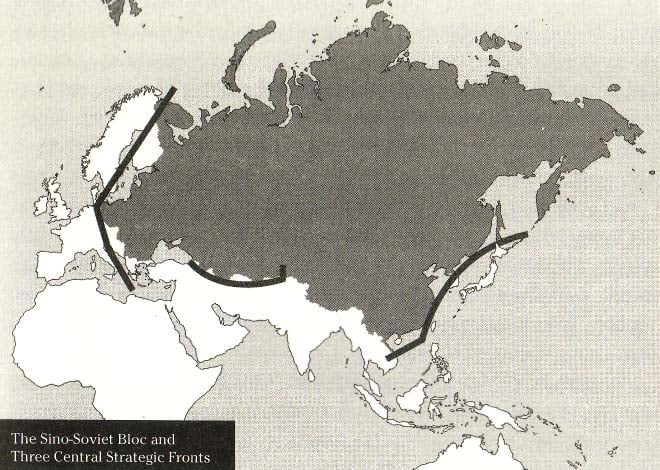
    The Sino-Russian Alliance: Challenging America's Ambitions in Eurasia


    Global Research, September 23, 2007

    “But if the middle space [Russia and the former Soviet Union] rebuffs the West [the European Union and America], becomes an assertive single entity, and either gains control over the South [Middle East] or forms an alliance with the major Eastern actor [China], then America’s primacy in Eurasia shrinks dramatically. The same would be the case if the two major Eastern players were somehow to unite. Finally, any ejection of America by its Western partners [the Franco-German entente] from its perch on the western periphery [Europe] would automatically spell the end of America’s participation in the game on the Eurasian chessboard, even though that would probably also mean the eventual subordination of the western extremity to a revived player occupying the middle space [e.g. Russia].”

    -Zbigniew Brzezinski (The Grand Chessboard: American Primacy and Its Geostrategic Imperatives, 1997)


    Sir Isaac Newton’s Third Law of Motion states that “for every action there is an equal and opposite reaction.” These precepts of physics can also be used in the social sciences, specifically with reference to social relations and geo-politics. America and Britain, the Anglo-American alliance, have engaged in an ambitious project to control global energy resources. Their actions have resulted in a series of complicated reactions, which have established a Eurasian-based coalition which is preparing to challenge the Anglo-American axis.

    Encircling Russia and China: Anglo-American Global Ambitions Backfire

    “Today we are witnessing an almost uncontained hyper use of force – military force – in international relations, force that is plunging the world into an abyss of permanent conflicts. As a result we do not have sufficient strength to find a comprehensive solution to any one of these conflicts. Finding a political settlement also becomes impossible. We are seeing a greater and greater disdain for the basic principles of international law. And independent legal norms are, as a matter of fact, coming increasingly closer to one state’s legal system. One state and, of course, first and foremost the United States, has overstepped its national borders in every way.”

    -Vladimir Putin at the Munich Conference on Security Policy in Germany (February 11, 2007)


    What American leaders and officials called the “New World Order” is what the Chinese and Russians consider a “Unipolar World.” This is the vision or hallucination, depending on perspective, that has bridged the Sino-Russian divide between Beijing and Moscow. China and Russia are well aware of the fact that they are targets of the Anglo-American alliance. Their mutual fears of encirclement have brought them together. It is no accident that in the same year that NATO bombarded Yugoslavia, President Jiang Zemin of China and President Boris Yeltsin of Russia made an anticipated joint declaration at a historic summit in December of 1999 that revealed that China and the Russian Federation would join hands to resist the “New World Order.” The seeds for this Sino-Russian declaration were in fact laid in 1996 when both sides declared that they opposed the global imposition of single-state hegemony.

    Both Jiang Zemin and Boris Yeltsin stated that all nation-states should be treated equally, enjoy security, respect each other’s sovereignty, and most importantly not interfere in the internal affairs of other nation-states. These statements were directed at the U.S. government and its partners. The Chinese and Russians also called for the establishment of a more equitable economic and political global order. Both nations also indicated that America was behind separatist movements in their respective countries. They also underscored American-led amibitions to balkanize and finlandize the nation-states of Eurasia. Influential Americans such as Zbigniew Brzezinski had already advocated for de-centralizing and eventually dividing up the Russian Federation.

    Both the Chinese and Russians issued a statement warning that the creation of an international missile shield and the contravention of the Anti-Ballistic Missile Treaty (ABM Treaty) would destabilize the international environment and polarize the globe. In 1999, the Chinese and Russians were aware of what was to come and the direction that America was headed towards. In June 2002, less than a year before the onslaught of the “Global War on Terror,” George W. Bush Jr. announced that the U.S. was withdrawing from the ABM Treaty. On July 24, 2001, less than two months before September 11, 2001, China and Russia signed the Treaty of Good-Neighbourliness and Friendly Cooperation. The latter is a softly worded mutual defence pact against the U.S., NATO, and the U.S. sponsored Asian military network which was surrounding China. [1]

    The military pact of the Shanghai Treaty Organization (SCO) also follows the same softly worded format. It is also worth noting that Article 12 of the 2001 Sino-Russian bilateral treaty stipulates that China and Russia will work together to maintain the global strategic balance, “observation of the basic agreements relevant to the safeguard and maintenance of strategic stability,” and “promote the process of nuclear disarmament.” [2] This seems to be an insinuation about a nuclear threat posed from the United States. Standing in the Way of America and Britain: A “Chinese-Russian-Iranian Coalition” As a result of the Anglo-American drive to encircle and ultimately dismantle China and Russia, Moscow and Beijing have joined ranks and the SCO has slowly evolved and emerged in the heart of Eurasia as a powerful international body.

    The main objectives of the SCO are defensive in nature. The economic objectives of the SCO are to integrate and unite Eurasian economies against the economic and financial onslaught and manipulation from the “Trilateral” of North America, Western Europe, and Japan, which controls significant portions of the global economy. The SCO charter was also created, using Western national security jargon, to combat “terrorism, separatism, and extremism.” Terrorist activities, separatist movements, and extremist movements in Russia, China, and Central Asia are all forces traditionally nurtured, funded, armed, and covertly supported by the British and the U.S. governments. Several separatist and extremist groups that have destabilized SCO members even have offices in London.

    Iran, India, Pakistan, and Mongolia are all SCO observer members. The observer status of Iran in the SCO is misleading. Iran is a de facto member. The observer status is intended to hide the nature of trilateral cooperation between Iran, Russia, and China so that the SCO cannot be labeled and demonized as an anti-American or anti-Western military grouping. The stated interests of China and Russia are to ensure the continuity of a “Multi-Polar World.” Zbigniew Brzezinski prefigured in his 1997 book The Grand Chessboard: American Primacy and the Geostrategic Imperatives and warned against the creation or “emergence of a hostile [Eurasian-based] coalition that could eventually seek to challenge America’s primacy.” [3] He also called this potential Eurasian coalition an “‘antihegemonic’ alliance” that would be formed from a “Chinese-Russian-Iranian coalition” with China as its linchpin. [4] This is the SCO and several Eurasian groups that are connected to the SCO.

    In 1993, Brzezinski wrote “In assessing China’s future options, one has to consider also the possibility that an economically successful and politically self-confident China — but one which feels excluded from the global system and which decides to become both the advocate and the leader of the deprived states of the world — may decide to pose not only an articulate doctrinal but also a powerful geopolitical challenge to the dominant trilateral world [a reference to the economic front formed by North America, Western Europe, and Japan].” [5]

    Brzezinski warns that Beijing’s answer to challenging the global status quo would be the creation of a Chinese-Russian-Iranian coalition: “For Chinese strategists, confronting the trilateral coalition of America and Europe and Japan, the most effective geopolitical counter might well be to try and fashion a triple alliance of its own, linking China with Iran in the Persian Gulf/Middle East region and with Russia in the area of the former Soviet Union [and Eastern Europe].” [6] Brzezinski goes on to say that the Chinese-Russian-Iranian coalition, which he moreover calls an “antiestablishmentarian [anti-establishmentarian] coalition,” could be a potent magnet for other states [e.g., Venezuela] dissatisfied with the [global] status quo.” [7] Furthermore, Brzezinski warned in 1997 that “The most immediate task [for the U.S.] is to make certain that no state or combination of states gains the capacity to expel the United States from Eurasia or even to diminish significantly its decisive arbitration role.” [8] It may be that his warnings were forgotten, because the U.S. has been repealed from Central Asia and U.S. forces have been evicted from Uzbekistan and Tajikistan.

    “Velvet Revolutions” Backfire in Central Asia

    Central Asia was the scene of several British-sponsored and American-sponsored attempts at regime change. The latter were characterised by velvet revolutions similar to the Orange Revolution in Ukraine and the Rose Revolution in Georgia. These velvet revolutions financed by the U.S. failed in Central Asia, aside from Kyrgyzstan where there had been partial success with the so-called Tulip Revolution. As a result the U.S. government has suffered major geo-strategic setbacks in Central Asia. All of Central Asia’s leaders have distanced themselves from America. Russia and Iran have also secured energy deals in the region. America’s efforts, over several decades, to exert a hegemonic role in Central Asia seem to have been reversed overnight. The U.S. sponsored velvet revolutions have backfired. Relations between Uzbekistan and the U.S. were especially hard hit.

    Uzbekistan is under the authoritarian rule of President Islam Karamov. Starting in the second half of the 1990s President Karamov was enticed into bringing Uzbekistan into the fold of the Anglo-American alliance and NATO. When there was an attempt on President Karamov’s life, he suspected the Kremlin because of his independent policy stance. This is what led Uzbekistan to leave CSTO. But Islam Karamov, years later, changed his mind as to who was attempting to get rid of him. According to Zbigniew Brzezinski, Uzbekistan represented a major obstacle to any renewed Russian control of Central Asia and was virtually invulnerable to Russian pressure; this is why it was important to secure Uzbekistan as an American protectorate in Central Asia. Uzbekistan also has the largest military force in Central Asia. In 1998, Uzbekistan held war games with NATO troops in Uzbekistan. Uzbekistan was becoming heavily militarized in the same manner as Georgia was in the Caucasus. The U.S. gave Uzbekistan huge amounts of financial aid to challenge the Kremlin in Central Asia and also provided training to Uzbek forces.

    With the launching of the “Global War on Terror,” in 2001, Uzbekistan, an Anglo-American ally, immediately offered bases and military facilities to the U.S. in Karshi-Khanabad. The leadership of Uzbekistan already knew the direction the “Global War on Terror” would take. To the irritation of the Bush Jr. Administration, the Uzbek President formulated a policy of self-reliance. The honeymoon between Uzbekistan and the Anglo-American alliance ended when Washington D.C. and London contemplated removing Islam Karamov from power. He was a little too independent for their comfort and taste. Their attempts at removing the Uzbek President failed, leading eventually to a shift in geo-political alliances.

    The tragic events of Andijan on May 13, 2005 were the breaking point between Uzbekistan and the Anglo-American alliance. The people of Andijan were incited into confronting the Uzbek authorities, which resulted in a heavy security clampdown on the protesters and a loss of lives. Armed groups were reported to have been involved. In the U.S., Britain, and the E.U., the media reports focused narrowly on human rights violations without mentioning the covert role of the Anglo-American alliance. Uzbekistan held Britain and the U.S. responsible accusing them of inciting rebellion.

    M. K. Bhadrakumar, the former Indian ambassador to Uzbekistan (1995-1998), revealed that the Hezbut Tahrir (HT) was one of the parties blamed for stirring the crowd in Andijan by the Uzbek government. [9] The group was already destabilizing Uzbekistan and using violent tactics. The headquarters of this group happens to be in London and they enjoy the support of the British government. London is a hub for many similar organizations that further Anglo-American interests in various countries, including Iran and Sudan, through destabilization campaigns. Uzbekistan even started clamping down on foreign non-governmental organizations (NGOs) because of the tragic events of Andijan. The Anglo-American alliance had played its cards wrong in Central Asia. Uzbekistan officially left the GUUAM Group, a NATO-U.S. sponsored anti-Russian body. GUUAM once again became the GUAM (Georgia, Ukraine, Azerbaijan and Moldava) Group on May 24, 2005.

    On July 29, 2005 the U.S. military was ordered to leave Uzbekistan within a six-month period. [10] Literally, the Americans were told they were no longer welcome in Uzbekistan and Central Asia. Russia, China, and the SCO added their voices to the demands. The U.S. cleared its airbase in Uzbekistan by November, 2005. Uzbekistan rejoined the CSTO alliance on June 26, 2006 and realigned itself, once again, with Moscow. The Uzbek President also became a vocal advocate, along with Iran, for pushing the U.S. totally out of Central Asia. [11] Unlike Uzbekistan, Kyrgyzstan continued to allow the U.S. to use Manas Air Base, but with restrictions and in an uncertain atmosphere. The Kyrgyz government also would make it clear that no U.S. operations could target Iran from Kyrgyzstan.

    [...]

    Source: http://www.globalresearch.ca/index.p...xt=va&aid=6688

    Leave a comment:


  • Armenian
    replied
    Re: America's Financial Crisis

    The geopolitical perspective.

    **************************

    Europe and America: Sharing the Spoils of War


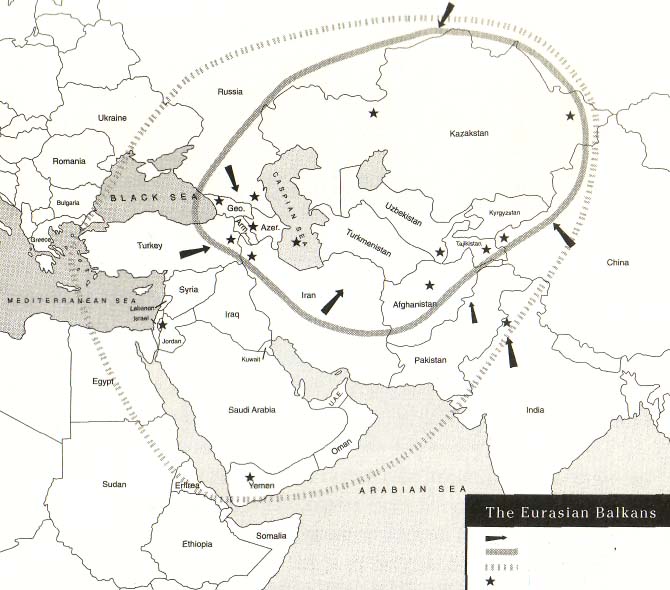
    The “Pivotal Area” Discovered: Defining Geo-Strategic Boundaries

    The “pivotal area” was used in Sir Halford J. Mackinder’s “Heartland” to describe the area of Eurasia that formed the pivotally important core of the global geo-strategic and geo-political environment. We now find that through geo-political realities and necessity the area in question must be redefined. Halford Mackinder coined the term to define an area within the Eurasian landmass, but it is apparent that the “pivotal area” in the truest sense of the word and possibly the “Heartland” itself is a much broader and diverse area that not only lies in Eurasia, but extends into Africa. The global environment is not static. It seems that this area is anchored by geographic reality, but is shifting because of socio-economic, demographic, and political factors. To define the pivotal area, we must look at the area(s) in which — in the course of the post-Cold War era — the U.S. military has been heavily involved in, from low spectrum to high spectrum warfare and operations. This also includes hostile economic actions and covert intelligence operations.

    After pinpointing these areas one can set a conceptual boundary. This subject area is of vast geography, it includes the Balkans, the Caucasus, Central Asia, the Middle East, and East Africa. These regions, arguably, together form the tectonic plate that holds the globe together in a geo-political sense. It is this geographic stretch that has been, and continues, to be a geo-strategic chessboard for competitions of expansion and repulsion. These areas are also some of the most important cultural bridges on the face of the earth. The cultures and knowledge of different civilizations have interacted here for thousands of years. Intense cultural diffusion has also taken place within this geographic stretch as a global cross-road.


    Zbigniew Brzezinski has also stipulated that an area roughly corresponded in geographic boundaries to the area that has just been defined is pivotal to global power and Eurasian security. Henry Kissinger has also more or less made similar statements by explaining the importance of neutralizing Iraq and Afghanistan (before its pro-Soviet government was overthrown), both Soviet allies, and containing an Iran fresh with revolutionary fervor in 1979. This was according to Henry Kissinger because of the pivotal importance of the area. [2] Global security encompasses this vast and “pivotal” area as a singularity and it is the Middle East that is the focal point of this geographic stretch.

    From “Pivotal Area” to “Arc of Instability”

    An arc of uncertainty and instability has been generated by Britain, Israel, the U.S., and their partners, including their intelligence apparatus, from East Africa and the Balkans to the Middle East, the Caucasus, and Central Asia. Decades of American-led military confrontations, low-intensity warfare, sanctions, economic manipulation, and intelligence operations have undermined the nation-states of the subject area. From the remains of the former Yugoslavia, Sudan, war-torn Somalia, and Anglo-American occupied Iraq to Afghanistan, Kashmir, and the South Federal District of the Russian Federation where Chechnya is located the U.S. has fomented instability. This area roughly corresponds to what Zbigniew Brzezinski calls the “Eurasian Balkans” an area that the U.S. must seek to manipulate and ultimately control should it continue to be a superpower. [3] The pivotal area has also synthetically been manufactured into a zone of instability that can be called the “Arc of Instability.”


    In 1993, Zbigniew Brzezinski stated that, “The tragedies of Lebanon of the 1980s, or of Kurdistan and the former Yugoslavia of the early 1990s are previews of things to come within the Eurasian oblong of maximum danger.” [4] What was implied by Brzezinski was balkanization ranging from sectarianism to ethnic clashes. The situation in Iraq is part of this process, as are the tensions in Lebanon, Kosovo, Turkey, and Caucasia. A classical “divide and conquer” strategy is at play. The underlying objective is to provoke ethnic clashes across the Middle East and Central Asia. This venture, which is linked to Bzezinski’s forecast, is part of an agenda which consists in literally redrawing the map of this broader region. Moreover, there have also been attempts at sparking sectarian and ethnic differences in Iran from adjoining areas in Anglo-American occupied Iraq and NATO-garrisoned Afghanistan that implicate America and its allies.

    CENTCOM and the Rimland: Encircling Russia, China, and Central Asia

    CENTCOM more or less corresponds to what Brzezinski calls a “large geographic oblong that demarcates the central zone of global instability” which runs from the Balkans through the Middle East and Central Asia to Kashmir and East Africa. [5] This “central zone of global instability” is also linked to the central area of Nicholas Spykman’s “Rimland.” It must be noted that, during the Cold War, Nicholas Spykman was also known as a master of containment theory. The Rimland is the concept of a geographic area adjacent to the “Heartland” that is comprised of most of Europe, the Middle East, the Indian sub-continent, Southeast Asia, and the Far East. This area forms an enveloping geographic ring around Mackinder’s “Heartland.” In other words, the Rimland essentially surrounds the central, core region of Eurasia. CENTCOM lies in the axis or midpoint of Spykman’s Rimland. This area, the Rimland, was central to Cold War containment theories in regards to the Soviet Union and China, the “Red Giants.” The concept of this area was also used in geo-strategic planning in regards to Iraq, Iran, and Afghanistan. This is an important fact to remember, because it deeply influences American geo-strategy in regards to the Iraq-Iran War and the Soviet-Afghan War. The encirclement of the Eurasian core, which was where the Soviet Union was geographically placed, is still a U.S. objective after the end of the Cold War. Containment theory it appears may really have been more about “penetration.”

    Penetration of the Eurasian core is underway. NATO is a bridgehead from Europe that is pushing towards Russia. An Asiatic sister-alliance of NATO is being forged against China. The axis of the Rimland, which includes the Middle East and Afghanistan, is being militarily infiltrated and mobilized by NATO and its allies. CENTCOM indeed is an appropriate and suitable name for this mid-area that is crucial and “central” to connecting the Asiatic and European flanks of any trans-Eurasian military network surrounding Russia and China. Furthermore, this area can also be used for creating a wedge between the European portion of Russia, which is the nerve of Russia, and China. Additionally, if one also examines the geographic position of U.S. and NATO military bases they are concentrated in the Rimland.

    The Geo-Strategic Importance of the Middle East in regards to Eurasia

    The Middle East, formerly called the Near East, is an abstract geographic concept that has been shifting with geo-strategic, political, and socio-economic policy. For example, there was a time when academics, map makers, and geographers considered the Balkans as a part of the region. In the mind of many the Middle East is a synonym for Arab World or for Southwest Asia, but both terms are different. The Middle East includes non-Arab countries like Iran, Turkey, and Cyprus. The term Southwest Asia also excludes Egypt, the European portion of Turkey in Thrace and even Greece, depending if you categorize it as a part of the region. The Middle East is a region that embraces three continents (two if you look at Europe and Asia as Eurasia); Europe, Asia, and Africa. It is from here that Anglo-American geo-strategists believed they could establish global hegemony by controlling Eurasia.

    Three important maritime passages and five important bodies of water also are located or embrace the area around the Middle East. The important maritime passages and straits can be used to manipulate, cut, and control global navigation, international trade, maritime traffic, and energy supplies. Theses strategic maritime passages are the Suez Canal of Egypt, the Bosphorus/Bosporus of Turkey, and the Gate of Tears (Bab al-Mandeb) located between Djibouti and Yemen at the southern tip of the Red Sea. The five important bodies of water in this area are the Black Sea, the Caspian Sea, the Persian Gulf, the Red Sea, and the eastern end of the Mediterranean Sea. Control over these maritime passages would have grave ramifications for Russia, China, Iran, and any adversaries of NATO in regards to trade, naval movements, and energy supplies.

    It is safe to say the post-Cold War objective of the United States in Eurasia is penetration. The different geographic regions of Europe and Asia are important, but they are not as pivotal in geo-strategic value as the Middle East and its geographic periphery (including Central Asia), which are also important energy hubs. If one scrutinizes a map of the earth or Eurasia they will notice that Indo-China or Japan or the Korean Peninsula cannot lead to any meaningful “penetration” of Eurasia. The Russian Federation also acts as a barrier to any drive from Eastern Europe that would be meaningless unless Ukraine fell into NATO’s orbit and Russia lost its Caucasian territories. Due to political realities India, the giant of the Indian sub-continent, can only be used as a counter-weight to China or to spoil the formation of a Eurasian alliance led by Russia, China, and Iran. Whatever value these geographic areas have in regards to containment theory is lost in regards to penetration, aside from India and Ukraine under the proper circumstances. It is from the Middle East and the area that has been mandated to the U.S. military under CENTCOM that Eurasian penetration can commence. Thus, it is by way of instability and war in this region that the U.S. and NATO have a pretext and justification for their military presence. It is also this area that will be the linkage between the military flanks being created against Russia, China, and their allies on the outer edges of Eurasia.

    The Outer Peripheries of the “Arc of Instability” are manned by NATO

    The hub of the “Arc of Instability” is where Iraq, Iran, Eastern Syria, and portions of Anatolia are geographically situated. This area is the most dangerous and volatile section of the “Arc of Instability.” Should a crisis with Iran and Syria be lit then the whole “Arc of Instability” can be lit ablaze like a powder keg. Iraq and the Persian Gulf are currently active and tense military zones of operation. This hub within the “Arc of Instability” is distinctly Anglo-American in its characteristic. It is the Anglo-American alliance that manages and oversees this war zone. Several European countries had initially posted their troops in Anglo-American occupied Iraq, but gradually reduced and removed their military contingents. Italy and Spain were amongst these countries. The European troop movements were publicly correlated to political changes in national governments within the respective capitals of these European countries. The aim of the troop movements was to portray the departures as acts of opposition to the war in Iraq. Angry European populations were misled into believing that a shift in foreign policy was underway, but this was an act of public deception. These nations compensated the broader war effort and agenda by deploying or re-shuffling their troops to Afghanistan or to Lebanon. Their actions were almost inconsequential to the broader war effort.

    NATO members, such as Germany, are also involved and present in military operations in the Horn of Africa. The military activities of NATO and its members, including their almost perfectly coinciding military operations in the Eastern Mediterranean, the Red Sea, and the Arabian Sea, discloses advanced insight about a larger war agenda. The whole “Arc of Instability” is manned by NATO and close NATO allies, such as Australia and Israel. NATO as a whole is involved in the war project and American, British, Polish, Danish, Czech, and Romanian troops are present in Anglo-American occupied Iraq. Moreover, NATO is also responsible for certain aspects of military training inside Iraq. Additionally, there is a Franco-German presence in the Persian Gulf and NATO also has made security arrangements in the Persian Gulf with nations such as Kuwait.

    However, what gives a particular NATO characteristic to the outer peripheries (tiers) of the “Arc of Instability” (in reality the area of military operations) is that greater numbers of NATO countries are involved in the military operations in these zones. Also NATO has an official mandate in these areas and has a role in the so-called “post-conflict” phase of operations in these areas. This phase in reality is the occupational and restructuring phase of the conflicts ensuing in the “Arc of Instability.” This form of “post-conflict” participation could also be linked to the low tolerance the populations of many of these NATO states would have in regards to casualties or supporting the war effort. The bulk of NATO troops have been positioned within the eastern and western outer peripheries of the military theatre of operations. Once again, the war zones almost precisely correspond to what is defined by the U.S. military as CENTCOM. It is only the former Yugoslavia that falls outside CENTCOM’s borders. It is from the Balkans that academics get the geo-political term “balkanization,” meaning to divide. The Balkans constitutes the westernmost periphery of the “Arc of Instability.”

    [...]

    Source: http://www.globalresearch.ca/index.p...xt=va&aid=6423

    Leave a comment:

Working...
X