Announcement

Collapse
No announcement yet.

Cultural Horizons of Armenians

Collapse
X
 
  • Filter
  • Time
  • Show
Clear All
new posts

  • Siamanto
    replied
    Re: Cultural Horizons of Armenians

    2 of 2

    Armenians and The Silver Screen
    Part I - Recent Movies


    Modern Love
    (France-Canada)
    By DEREK ELLEY


    A Pathe Distribution (in France)/Alliance Atlantis Vivafilm (in Canada) release of a Galatee Films, Delante Films presentation of a Galatee, Delante, France 2 Cinema (France)/Cirrus Communications (Canada) production, in association with Poste Image, La Banque Postale, Image Uni Etoile 5, with participation of Canal Plus, TPS Star, Kiosque. (International sales: Pathe Pictures Intl., London.) Produced by Valentine Perrin, Jacques Perrin, Caroline Adrian, Antoine Rein. Co-producer, Pierre Even. Directed, written by Stephane Kazandjian.

    With: Alexandra Lamy, Stephane Rousseau, Berenice Bejo, Pierre Francois Martin-Laval, Clotilde Courau, Stephane Debac, Melanie Bernier, Valerie Karsenti, Kad Merad, David La Haye, Thomas Jouannet, Francis Leplay, Raphaelle Agogue, Eric Naggar, Mai Ahn Le, Annie Gregorio.

    French cinema's on-off flirtation with the contempo musical continues with "Modern Love," a bright and breezy piece of fluff that doesn't pretend to anything other than entertainment. Tale of a movie director's emotional tangles -- intercut with scenes from a tuner he's just directed -- slides back and forth between romantic comedy and old-style musical with considerable charm and a cast that's lively and upbeat. Not one for the serious crowd, the March 12 release should score with young, romantically inclined female auds, especially in Europe, and with overseas film weeks in search of something different.

    Sophomore pic by writer-director Stephane Kazandjian (the "American Pie"-like "Sexy Boys") is far more engaging than last year's leaden "Love Songs," without the candy-colored campiness of 2002's "Hypnotized & Hysterical." But with all the musical numbers confined to the film-within-a-film, the movie doesn't attempt (as "Jeanne and the Perfect Guy" did a decade ago) to resuscitate the through-composed style popularized by Jacques Demy and Michel Legrand. Overall, it's more of a knowing tribute than a full-scale tuner.

    Eric Mericourt (Pierre Francois Martin-Laval) is a depressive filmmaker who's finally given the boot by his g.f. Marie (Clotilde Courau) on New Year's Eve. Three years later, he has an adoring new partner, Anne (Melanie Bernier), and is basking in the B.O. success of "Modern Love," a musical centered on two people in search of the perfect partner -- graphic artist Marianne (Alexandra Lamy) and filthy rich magazine publisher Vincent (Quebecois singer-comedian Stephane Rousseau).

    Elsewhere in Paris is sassy, unlucky-in-love Elsa (Berenice Bejo), who, as soon as she swears she'll only go out with the Perfect Man in the future -- ping! -- up pops handsome, charming, wealthy Jerome (Stephane Debac). The only problem is, Jerome seems to have a lot of gay friends and Elsa finds it difficult to even get to first base with him.

    Meanwhile, out shopping one day with Anne, Eric bumps into Marie, who apologizes for dumping him so brutally and suggests a drink sometime. One thing leads to another, and soon Marie asks him to impregnate her so she and her low-sperm-count b.f. can become parents.

    Script lightly juggles the two story threads, as Eric and Marie start to fall for each other again and Elsa, despairing of ever getting it on with Jerome, has a one-night stand with an old b.f. (Thomas Jouannet). Intercut throughout -- with no warning, apart from higher-gloss lensing by Regis Blondeau and ritzier production design -- are the five musical numbers charting the ups and downs of the movie couple, Marianne and Vincent.

    Martin-Laval, looking and acting like a younger Albert Brooks, makes an undemonstrative lead; most of the pic's energy comes from its distaff cast, led by the perky Bejo (from retro spy spoof "OSS 117") and likeably goofy Courau. Lamy and Rousseau supply some old-fashioned razzle-dazzle in the hummable numbers by Martin Rappeneau (son of helmer Jean-Paul) and Benjamin Seilles.

    Supports are bright, especially Valerie Karsenti as a friend of Elsa's who surprisingly falls for a Vietnamese lesbian (Mai Ahn Le). Kad Merad ("Bienvenue chez les Ch'tis") has a dry cameo as Eric's philosophical masseur.


    Camera (color), Regis Blondeau; editor, Philippe Bourgeuil; music, Martin Gamet; songs, Martin Rappeneau, Benjamin Seilles; art director, Philippe Chiffre; costume designers, Agnes Falque, Emmanuelle Pertus; sound (Dolby Digital), Patrick Rousseau, Martin Pinsonnault; choreographer, Sidi Larbi Cherkaoui; associate producers, Josee Vallee, Richard Speer; assistant director, Thomas Trefouel; casting, Aurelie Avram. Reviewed at Gaumont Champs Elysees Ambassade 2, Paris, March 12, 2008. Running time: 90 MIN.


    THE "TARGET" - NATIONAL VALUES AND HUMAN EMOTIONS
    By Hasmik Haroutiunian

    AZG Armenian Daily
    21/05/2008

    Culture

    "I remember, the audience kept silence after the premiere of the
    film. Then one of the soldiers approached me, shook my hand and said,
    "Thank you. Now I understood for what I fought". These words were the
    best appraisal of my film", says film-director Shavarsh Vardanian,
    who is one of the active participants of 1988 movement. He made films
    of Khodzalu, Shahumian and Shushi liberation battles during Artsakh
    war to tell the future generations about the heroism and victorious
    spirit of the Armenian people.

    "The others took up arms to go to war; my weapon was my camera".

    In "Tirakh" (Target) film shot in 2000 Shavarsh Vardanian comments on
    the struggle for existence in Artsakh with the eyes of documentalist
    and a man who took part in the war.

    It seems that the film is an autobiography but in the background we
    see the battle-field, the disaster of the war and the marriage of
    the hero as a call of new life at the end of the film.


    10TH SAN FRANCISCO BLACK FILM FESTIVAL (PART ONE)
    Peter Wong

    Beyond Chron, CA
    June 11 2008

    To write about the San Francisco Black Film Festival is not to give
    hosannas at discovering a previously unknown film festival. This black
    film showcase has thrived very well for ten years. Writing about the
    festival, then, needs to be a giving thanks for exposure to films
    not seen at other local festivals.

    "The People's Advocate: The Life And Times Of Charles
    R. Garry" reacquaints viewers with one of San Francisco's
    most famous (or notorious, depending on your point of view) criminal
    defense attorneys. This advocate gained fame during the 1960s with
    his vigorous defenses of various leftist personalities, principally
    Huey Newton, Bobby Seale, and other members of the Black Panther Party.

    Director Hrag Yedalian's documentary takes a "just the
    facts" approach to depicting Garry's life. The viewer is
    thus treated to period news footage, interviews with Garry's
    contemporaries, and a near overuse of title cards. It is suggested
    regular exposure to anti-Armenian prejudice (Garry was actually
    Armenian) predisposed the future attorney to use his legal skills on
    behalf of other discriminated groups.

    Former Black Panthers talk about how the attorney understood implicitly
    the injustices that the black power group opposed. Garry displayed a
    gift for turning the courtroom into a lectern to show Middle Americans
    just how clueless they were about black culture. One jaw-dropping
    anecdote in the film concerns Garry's questioning potential
    jurors on their knowledge (if any) of singer James Brown or the song
    "Papa's Got A Brand New Bag."

    However, the police outpaced the civilians in the cluelessness race
    when it came to understanding the rising leftist movements of the
    1960s. Having shinier shoes and newer jeans than that worn by the
    typical anti-war activist is not a recipe for blending unobtrusively
    into a protest group. Garry successfully exploited police ignorance
    in the courtroom through such tactics as getting cops on the witness
    stand to inadvertently damn themselves as rat finks.

    The attorney's empathy for leftists fighting oppression
    eventually turned out to be a mixed blessing. That talent may have
    allowed him to vigorously represent controversial leftists such
    as Los Siete. But it also blinded him to the fatal madness of the
    Reverend Jim Jones. Garry's enchantment with the progressive
    dream offered by Jones' People's Temple led to his becoming
    a public apologist for the Temple. The act of becoming an unwilling
    presence near the mass Jonestown suicides hit the attorney with the
    world's nastiest reality check. Yedalian's film states the
    attorney never recovered emotionally from that shock.

    The material described above is dramatic and humorous and even
    tragic. So why does "The People's Advocate" feel so dull
    and shallow?

    Yedalian makes the mistake of keeping Garry's life mounted on
    a pedestal. Treating him as generally flawless undercuts objective
    assessment of the attorney's work. The cops who clashed with Garry
    over the years or less enthusiastic co-workers at Garry's firm
    needed acknowledgment in the film. Such acknowledgment need not be
    agreement with their opposing positions. But even non-flattering
    appraisals can provide necessary perspective on Garry's
    achievements.

    How much of the film's emotional shortcomings derived from
    its apparent presentational shortcuts (e.g. excess use of title
    cards)? It's unclear. But the resulting film does a disservice to
    an important participant in some of the 1960s' biggest historical
    flashpoints.
    ........

    To write about the San Francisco Black Film Festival is not to give hosannas at discovering a previously unknown film festival. This black film showcase has thrived very well for ten years. Writing about the festival, then, needs to be a giving thanks for exposure to films not seen at other local festivals. “The People’s […]


    (Not so recent!)


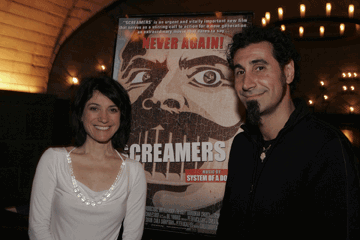
    SYSTEM OF A DOWN SCREAMING OUT LOUD
    Andrew Sheridan

    The Massachusetts Daily Collegian

    March 10 2008
    MA

    One point five million people dead, thousands of children orphaned.

    Three-fourths of an entire population murdered in the span of two
    years, and a guilty government in complete denial. Such was the state
    of the Armenian Genocide of 1915, "the forgotten massacre." It was
    the inspiration for the Holocaust, the first Great War crime of the
    20th century and the topic of the new documentary, "Screamers."

    The film is the product of the Grammy-winning band System of a Down,
    and from the start, one might think that it is simply a profile of
    the group. It begins at a System concert in the U.S., where rabid
    fans flock the stadium, and the members prepare to perform. The
    emphasis quickly changes, however, to the political activity going
    on at the event.

    Tents and stands dot the area, distributing literature about genocide
    and circling petitions. Activists push their social agendas freely
    with the blessing of the group, who announce their intentions right
    off the bat saying, "This band just started to make you ask questions."

    The concert, which took place in 2005, was held on the 90th anniversary
    of the Armenian genocide. The band members, all of Armenian descent,
    feel strongly about the event, which is largely unknown and denied
    openly by many of the world's governments.

    The documentary mixes interviews of band members, survivors of war
    crimes and experts. It is also laced with live performances by SOAD,
    in which the sometimes incomprehensible lyrics are layered over the
    instrumentals, revealing their highly political nature often lost on
    casual System listeners.

    Though the film chronicles genocide in general, much focus is given to
    the near-extermination of the Armenians. Following the introduction of
    band member Serj Tankian's 96 year-old grandfather Stepan Haytayan,
    a survivor, the film starts in on a heart-wrenching depiction of
    Turkey circa World War I.

    Unbeknownst to most Americans, during the turn of the century the
    Christian Albanian population of Turkey was being persecuted by the
    Muslim majority. When war broke out, Turkish leader Mehmet Resat used
    the confusion to carry out the mass execution of the Albanian people.

    The narration is supplemented by poignant accounts of the terrible
    incident from survivors and was made even more effective by
    black-and-white images of the carnage and death.

    After Turkey is discussed, the focus of the film is widened to genocide
    in general throughout the twentieth century. As one expert says,
    "Genocide is about using the cover of an overall conflict to deal
    with ethnic ... claimants that you've been wanting to get out of the
    way for a long time."

    >From the Holocaust to Rwanda, Kosovo, Bosnia, Kurdistan and even
    Darfur, "Screamers" profiles some of the lowest points in human
    history in graphic detail.

    Chilling accounts from those left behind are almost too much to bear at
    times, and full color photographs of recent events bring the conflicts
    a little too close to home. Not for the faint of heart or the weak
    of stomach, these scenes are well edited and make a significant impact.

    The latter part of the piece is dedicated to the United States and its
    responses to past atrocities. After every single act of genocide in
    the past century, a high-ranking U.S. official has publicly denounced
    the act, boldly saying "never again." Time and time again, however,
    the government witnesses the murder of thousands and does nothing
    because of political interests.

    Released in 2006, "Screamers" has been shown at theaters and film
    festivals around the world, bringing home awards at Sundance and
    Montreal. The DVD, which debuted at the end of 2007, contains a
    backstage tour with System as well as additional songs and press
    interviews with the artists.

    It has been acclaimed by critics nationwide and for good reason. At
    times powerful and eye-opening, the film succeeds in the band's
    original goal of making you ask questions. It doesn't stand out from
    other documentaries in terms of production values or pacing; but in
    terms of impact and information, it is one of the best of the year.

    Those who are simply looking for an entertaining movie to pass the time
    should most likely look elsewhere, but for the politically minded -
    and System of a Down fan - "Screamers" is top-notch.

    Leave a comment:


  • Siamanto
    replied
    Re: Cultural Horizons of Armenians

    1 of 2

    Armenians and The Silver Screen
    Part I - Recent Movies


    10 Directors to Watch: Anna Melikyan

    Daily Variety
    January 16, 2008
    By Matthew Ross

    Sometimes a wild imagination can get a young filmmaker into
    trouble. For Anna Melikyan it seems to be her magic elixir.

    With "Rusalka" (Mermaid), the 32-year-old helmer shows off an
    astonishing combination of creative ingenuity and technical
    expertise. Loosely based on Hans Christian Andersen's classic fable
    "The Little Mermaid" but set in modern-day Russia, pic tells the story
    of a girl named Alisa who is both blessed and cursed with a special
    gift: She has the power to make wishes come true.

    "Mermaid" does what every great fairy tale should do: transport its
    audience to another place. As Alisa journeys from the run-down seaside
    community of her childhood to Moscow, every frame seems to pulsate
    with relentless visual inventiveness and a mischievous comic
    tone. "Humor is my main instrument," Melikyan says. "I think that to
    understand a subject completely, you should find something funny about
    it."

    Born in Azerbaijan and raised in Armenia, Melikyan moved to Moscow to
    attend film school. After graduating, she honed her skills directing
    fiction and nonfiction television before making her first feature,
    "Mars," in 2004.

    She found the inspiration for "Mermaid" in the form of actress Masha
    Shalaeva, whom she'd known since college. "All these years, I've
    wanted to make a movie with her in the lead, but there wasn't a good
    story," Melikyan explains. "And suddenly it came to me -- 'Mermaid'
    would be for Masha. I could only see her in this role. The script was
    very easy to write, because I wasn't thinking about an abstract image,
    but a specific person -- her face, voice and attitude."

    "Mermaid" makes its international premiere in Sundance's World Cinema
    Dramatic Competition program.

    "The uniqueness of Anna as a filmmaker is that her films are without
    national boundaries," says "Mermaid" producer Ruben
    Dishdishyan. "('Mermaid') is understandable and accessible to any
    human being in any part of our planet."

    VITAL STATS
    AGE: 32
    PROVENANCE: Baku, Azerbaijan
    INSPIRED BY: "Italian films, especially neorealism, but Fellini
    remains my favorite film director."
    REPS: Film's sales agent is Central Partnership


    ANNA MELIKIAN'S "NYMPH" AWARDED GRAND PRIZE

    AZG Armenian Daily
    19/03/2008

    Culture

    Russian film director Anna Melikian's film "Nymph" was awarded the Best
    Film Prize in "Sofia film fest" 12th international film festival. The
    international representative jury highly appreciated Melikian's skill
    of producer, nice montage, actors' skill, the idea and the energetics
    of the film.

    Earlier another Russian director Nikita Mikhalkov was awarded "Sofia
    film fest" prize for the investment in the sphere of development of
    cinematographic art.


    FILM CATCHES LIFE MOVIEMAKER SAYS 'MY BIG FAT ARMENIAN FAMILY' IS ABOUT HIS
    By Joyce Rudolph

    Glendale News Press, CA
    June 11 2008

    Culture, Generation.

    Glendale resident Sevak Ohanian recreates the problems of growing up
    in an Armenian American family in his new film "My Big Fat Armenian
    Family" but adds a twist of humor.

    The film, which will premiere July 12 and 18 at Glendale High School,
    tells the story of a family of four -- a father, mother, son and
    daughter. The son can't seem to do anything right in his father's eyes,
    and there is a constant air of friction between them.

    The parents, Robert and Rima, are played by one man, Ajmin Baghramian,
    Ohanian said.

    "I decided to have Ajmin play both characters because he is just
    a phenomenal actor and good at performing caricatures of Armenian
    people," the 21-year-old filmmaker said. "Having a male actor
    masquerading as a female is innately funny. It goes back to the Greek
    comedies where men played females."

    The scenario, Ohanian said, also posed a challenge for him as the
    film's writer, director, cameraman and editor.

    "I wanted...to see if I could achieve this effect of
    two different characters being played by the same actor," he said. "And
    I think, if you watch the movie, you will come to identify each of
    them as their own person."

    Ohanian is studying film at UC San Diego and received some feedback
    from his independent study teacher, Michael Trigilio, a lecturer at
    the university.

    While there are some amateur qualities to the project because of
    time constraints to work on the film, Ohanian has done remarkably
    well with such a complex production, Trigilio said.

    "It's very complicated to have one actor playing the male and female
    leads," he said. "In the editing of the scenes with the two characters,
    Ohanian was able to make the editing look seamless."

    But what most impressed Trigilio was how well Ohanian crafted the
    story so it wasn't just about a farcical family, he said.

    "There is an emotional touchstone in the family dynamics and the way
    it deals with the first- and second-generation immigrant families,"
    Trigilio said. "I'm Italian American, and in our own culture there
    are generational conflicts. It's interesting to see how Sevak exposes
    a lot of the jokes that are part the Armenian community but without
    belittling the Armenian community."

    For this project, Ohanian said he wanted to combine comedy and drama
    while instilling a message in the film. What evolved was a social
    commentary on how Armenian American families behave, he said.

    "We reflect how parents act with their children and how children view
    their parents," he said.

    While it's not autobiographical, Ohanian asked his sister, Ramela
    Ohanian, 18, to play the sister in the film, he said.

    "My sister is playing herself, not literally, because it's not
    autobiographical," he said. "It's just about my culture and my
    generation."

    Ramela Ohanian has no plans for an acting a career, but said
    participating was fun.

    And she is proud of her brother's project, having written the script,
    shot, directed and edited it, she said.

    "Who can say their brother has done all that," she said. "It's
    something to look up to."

    Sevak Ohanian will enter a three-year program at USC School of Cinema
    in August and try to make filmmaking a career, he said. But for now
    he's looking forward to the public premiere in July, he said.

    "I think afterward I'll sleep for a week," he said.

    "This movie is the most challenging but rewarding thing I've ever
    committed to."

    Photo: Filmmaker Sevak Ohanian, front, sits at a Glendale home which
    was used to film much of his movie My Big Fat Armenian Family. Behind
    are three actors featured in the film (left to right) Arabo Sarkisian,
    portraying Arabo Armenian, Ajmin Baghramian, portraying Rima Armenian,
    and Narbeh Yermian, portraying Narbeh Armenian. Arabo is a cousin
    who his aunt, Rima, loves and admires while Narbeh is her son which
    she cares little about. (Alex Collins/ News-Press)


    Central Partnership to make 'Nasha' pic
    Russian TV show to get feature-length treatment


    Variety
    By Nick Holdsworth
    February 9, 2008

    Russian independent production, sales and distribution shingle Central
    Partnership is set to make a feature-length movie based on hit local
    television comedy show "Nasha Rasha."

    The weekly comedy sketch show -- which takes its title from a play on
    words and the English pronunciation of Russia and translates to "Our
    Russia" -- is a hit on youth channel TNT with market share of some
    20%.

    Produced by Comedy Club Production -- the company behind last month's
    surprise box office success "Very Best Film" -- "Nasha Rasha" is
    hugely popular with 14- to 25-year-olds, Russia's key movie-going age
    group.

    Featuring two comics, Sergei Svetlakov and Misha Galustyan, who play a
    variety of familiar Russian characters such as migrant workers, old
    "babushki" grannies and homeless "bomzhi," "Nasha Rasha" has achieved
    cult status in the two years since it launched.

    Central Partnership wants to capitalize on that by creating a feature
    script for the first movie in what they hope will become a
    long-running franchise.

    "It is going to be a full feature film, something like 'American Pie'
    that becomes a brand and a franchise. We are intending to establish a
    strategic partnership with Comedy Club to create a sustainable
    long-term product," Armen Dishdishian, head of Central Partnership
    Sales House said.

    Central Partnership, which is in Berlin with a raft of Russian titles,
    including "12," Nikita Mikhalkov's remake of Sidney Lumet's 1957 jury
    drama "12 Angry Men," is also developing thematic movie strands in two
    other directions.

    Anna Melikyan, director of Sundance award-winning "Mermaid," who is
    married to Central Partnership founder and company head Ruben
    Dishdishian, will develop arthouse fare with bright young directors
    from Russia and former Soviet states via Magnum, a new company set up
    for that purpose.

    Producer Alexei Sidorov, who directed Central Partnership's "Shadow
    Boxing" and produced its recent sequel "Shadow Boxing 2" will work
    with helmer Anton Megerdichev on creating big-budget commercially
    oriented films. Projects in the pipeline currently include horror
    thriller "Ghosts."

    "The success of 'Very Best Film' shows there is a market for such
    films. We understand that as part of our overall strategy 'Nasha
    Rasha' has to be a first week film," Dishdishian said, meaning the
    movie would need to make the majority of its box office over its
    opening days.

    "Of course we think it is possible to do a better film that is not
    just a series of sketches, which is why we are working to polish and
    improve the script we have from Comedy Club," he said. "We're not
    aiming to make an Oscar film, but want to be sure that people do not
    leave the cinema thinking they could have seen the same thing on
    television."

    Wider audiences, which in Russia have only just begun to return to the
    cinemamore than a decade after barely any over 30 went, need to
    nurtured if the local industry is to have a sustainable future,
    Dishdishian noted.

    Leave a comment:


  • Siamanto
    replied
    Re: Cultural Horizons of Armenians

    3 of 3

    Remembering Saroyan
    Part III - Where Is He Now?


    Fresno Bee (California)
    May 4, 2008 Sunday
    FINAL EDITION

    Month-long Saroyan project celebrates Fresno culture


    Betsy Lumbye The Fresno Bee


    I was young, 11 or 12, reading my way through another hot Virginia
    summer. He was already in his late 50s, dividing his time between
    Fresno and Paris.

    Actually, William Saroyan never knew I existed. And l didn't know
    about him until I read "The Human Comedy," which my brother, Paul, and
    I discovered among the stacks of books my librarian mother would bring
    home.

    Paul and I felt like we'd discovered fire. I can't even remember all
    the reasons, but we thought Saroyan was just about the greatest author
    ever. Somehow he just knew how the world looked to kids, in all its
    sadness, adventure and sweetness. Authority figures could be
    bewildering in their stupidity. Adult relatives could be funny and
    even crazy, but within a safe, extended family framework.

    We'd never heard of Armenians before, but as we learned a little about
    Saroyan, we thought they must be just like Southerners, only a lot
    more interesting, and apparently louder.

    If I'd known then what I've learned from the stories we'll publish in
    The Bee and on fresnobee.com for the rest of the month, I would have
    been even more enchanted. And if I'd read "Follow," the novella we
    begin publishing in installments today about a strong-willed teenager
    who strikes out to find his place in the world, I'd have been
    completely hooked.

    It's my fervent wish that other kids now will make the same
    discoveries I have. Saroyan is cool, and so is Fresno. Because in many
    ways, I've come to see as a transplant the past 11 years, the more you
    learn about one, the more you know about the other.

    Saroyan was a poor immigrant kid who turned out to have a lot more
    going on than people suspected. He wasn't much of a student, and truth
    be told, was a square peg who gave up on mainstream education fairly
    young. But he devoured books and looked and listened. He was funny,
    earthy, independent and resourceful.

    Unlike Fresno, which suffers from a chronic inferiority complex,
    Saroyan had an ego as big as the Sierra. Like Fresno, but in a
    different way, he was decidedly hot! Just check out the picture on the
    front page of today's paper. He wasn't always the mustachioed
    eccentric most often depicted these days.

    I hope that our month-long Saroyan project sparks a revival of
    interest in the author. I'd guess that even in Fresno, to a lot of
    kids Saroyan is just a name on a theater or an elementary school. If
    they'd read his work or even about him, they'd not only have a great
    time, but they'd develop a new respect for the place where they live.

    For the Saroyan project, reporters Donald Munro, Guy Keeler and Don
    Mayhew are writing about Saroyan's life, celebrity and literary
    legacy. Reporter Doug Hoagland will write about the discrimination
    experienced by Armenian immigrants, which Saroyan refers to in
    "Follow."

    On fresnobee.com, we've assembled dozens of photographs of Saroyan and
    old Fresno, with help from the Pop Laval Foundation, the Fresno
    Armenian Society and historian Bill Secrest Jr. of the Fresno County
    Library. Assistant Photo Editor Renée Fernandes has created slideshows
    from Saroyan's life, with background music from the period.

    If you miss any part of the novella in print, you can find it all on
    fresnobee.com. There's a bonus on the online version: Managing Editor
    Jack Robinson has annotated the manuscript with hyperlinks to click on
    for explanations of names or places that might not be familiar.

    Bee staff artist SW Parra and Web designer Jason Melgoza have created
    an interactive map comparing the Fresno of Saroyan's youth with the
    city of today. We also have produced an interactive timeline of
    Saroyan's life.

    Then there are the audio clips taken from an interview with Saroyan,
    first broadcast in 1976, on KFCF, FM 88.1.

    One of the most interesting quotes is about his hometown:

    "Fresno is a good place. It's the world, and how good can the world be
    in any case, wherever you go? How much different from Fresno is Paris?
    If you're there, you're there, and you can see and feel a culture, and
    you can see and feel a culture in Fresno, too."

    It makes sense. In the end, culture is about people and their stories,
    ideas and feelings -- all the things Fresno is lush with. Read
    Saroyan's novella, browse through the pictures online, listen to him
    talk about Fresno, and think about how much more this soil has
    nurtured over the years than grapes and peaches.

    It's a mystique that definitely captured the imaginations of a couple
    of kids in Virginia 40 years ago.


    Bound to honor its favorite son
    By Marc Weingarten

    Los Angeles Times
    calendarlive.com
    March 2 2008
    CA

    Centennial celebration will mark the writer's legacy with readings,
    screenings, lectures and plays.

    WILLIAM Saroyan is one of the great conundrums of 20th century
    literature. He was among the most famous American writers of the '30s
    and '40s, a versatile prose stylist who was conversant in many genres,
    and yet Saroyan hasn't been widely read in this country for decades. At
    one time, the Armenian American writer was mentioned in the same breath
    as Hemingway and Steinbeck. Now it's hard to find his books in stores.

    Fresno has not forgotten, however. Saroyan's hometown wants the world
    to reconsider the accomplishments of its most prominent cultural
    export. To mark the 100th birthday of Saroyan, who died in 1981 in
    Fresno at age 72, the city is hosting a yearlong celebration of the
    writer's life and work.

    The centennial features readings, screenings, lectures from Saroyan
    experts, exhibitions of photographs and paintings created by Saroyan
    as well as productions of his plays. A collaboration among 40 local
    and state organizations, it will continue until November.

    Larry Balakian, the chairman of the Saroyan Centennial Committee,
    said he was not sure why Saroyan had fallen out of favor. "Perhaps
    it's because he's not modern enough," Balakian said. "I certainly
    don't think his style has become outdated. That's why we're trying
    to revive his reputation, to show readers that his work remains as
    fresh and relevant as it's always been."

    Saroyan was born in Fresno in 1908, the son of an Armenian vineyard
    owner. His father died from peritonitis when Saroyan was only 3,
    and the future author and his brothers were shunted into an Alameda
    orphanage until his mother could find work to support the family.

    Saroyan relocated to San Francisco in 1929 with his family, and began
    furiously producing stories while supporting himself with odd jobs.

    His breakthrough came with the publication of "The Daring Young Man on
    the Flying Trapeze," a quietly devastating portrait of a struggling
    writer's privations in Depression-era America that was published by
    Story magazine in 1934. "In the gutter he saw a coin which proved to
    be a penny dated 1923," Saroyan wrote, "and placing it in the palm of
    his hand he examined it closely, remembering that year and thinking
    of Lincoln, whose profile was stamped upon the coin. There was almost
    nothing a man could do with a penny."

    Saroyan's greatest triumphs came early in his career. His 1939 play,
    "The Time of Your Life," is set in a waterfront saloon in San Francisco
    and limns the troubles of disparate characters -- a cop, a prostitute,
    a longshoreman -- who find solace in one another's misery. The play
    won a Pulitzer Prize, though Saroyan refused the award on the grounds
    that art should not be a competitive sport.

    (Later in life, however, Saroyan lobbied hard for the Nobel Prize
    for literature.)

    Still, there's the widespread perception that Saroyan was a literary
    lightweight, a sentimentalist whose work is too old-fashioned to
    resonate now. Perhaps Saroyan was too prolific for his own good. Even
    after the early triumphs, including "The Time of Your Life" and
    "My Name is Aram," he continued to churn out an astonishing amount
    of material -- novels, journalism, plays, stories. Some good, some
    less so. But the best, according to Saroyan's champions, is sublime.

    "Jack Kerouac was greatly influenced by Saroyan," said novelist Barry
    Gifford, who co-wrote a biography of Saroyan with Lawrence Lee in
    1984. "There's a kind of gentle truth that he conveys in his work. It
    has a beautiful innocence about it." Gifford points to the 1979 book
    "Obituaries," a free-associative memoir that Gifford edited, as an
    example of Saroyan's mature artistry. "He's a writer that made it
    look very simple, but it's very difficult to do what he did. He was
    protean as a person and an artist."

    Still, the early work seems frozen in time. "The Time of Your Life"
    feels a bit musty now, a sepia-toned example of socially conscious
    prewar entertainment. The same goes for "The Human Comedy," Saroyan's
    1943 novel about a Fresno farming family that clings to hope despite
    the horrors of World War II and the scars it leaves on the community.


    Maintaining a presence
    SAROYAN'S far superior work is to be found in the stories that make
    up collections such as "My Name Is Aram" and "Fresno Stories."

    (Saroyan's son, Aram, grew up to be a well-known poet and novelist.)
    " 'My Name Is Aram' was drilled into me practically as soon as I could
    read," said Katherine Taylor, an Armenian American native of Fresno
    and the author of the novel "Rules for Saying Goodbye." "I'm sure his
    cadences are apparent in my work. I started reading him too early,
    and too often, for his voice not to have helped shape my own.

    I can't underestimate his influence on my development. Also, there's
    the obvious point of a little Armenian boy from Fresno managing to
    become a writer. His legacy made it possible for me to be an artist."

    Saroyan's lasting presence can be felt in subtle ways around Fresno.

    There's a theater named after him, and a statue of Saroyan sits on the
    Cal State Fresno campus. But it speaks to the neglect of the writer's
    legacy that the statue was a decrepit relic that sat on a mound of
    dirt in downtown Fresno, until it was donated to the university seven
    years ago.

    There are many Fresno natives who knew Saroyan personally. For many
    years the owner of a clothing store, Balakian would often share a cup
    of coffee in his store with the author when he was in town (Balakian's
    late cousin Nona, a former editor at the New York Times, wrote an
    acclaimed biography of Saroyan in 1989). "He had traveled the world,
    and so he always had wonderful stories," Larry Balakian said. "But,
    ultimately, he came back to live in Fresno."

    Those who knew Saroyan professionally remember him as prickly and
    combative. He often got into scrapes with editors and movie executives,
    railing about the evils of the publishing and movie businesses to
    anyone who would listen. "The Human Comedy," in fact, was originally
    commissioned as a screenplay for Louis B. Mayer at MGM. When Saroyan
    bristled at Mayer's notes for the script, the writer reclaimed his
    material and turned it into a novel.

    "Bill made a lot of enemies," said Gifford, who worked with Saroyan
    near the end of his life. "One time, he just signed a book contract
    sight unseen, to show what a trusting soul he was. Well, he later
    complained constantly about that contract. He had a kind of perverse
    way of dealing with the world."

    Whatever Saroyan's flaws, the centennial's organizers wanted to pay
    tribute to a man who had a deep connection with his native city. Like
    many of the volunteers for the centennial festival, Balakian feels
    a strong civic kinship with Saroyan's work. "He is the poet of the
    San Joaquin Valley," Balakian said.

    Though his work is rooted in Central California, Saroyan's themes
    of human suffering and redemption are universal, and his loyalists
    would like his best work to find the audience they think it deserves.

    "Saroyan wasn't a modernist, but he was a great storyteller," Balakian
    said. "It's a shame he's semi-forgotten."

    Fresno is pulling out all the stops, staging a centennial celebration it hopes will breathe new life into the legacy of William Saroyan.

    Leave a comment:


  • Siamanto
    replied
    Re: Cultural Horizons of Armenians

    2 of 3

    Remembering Saroyan
    Part III - Where Is He Now?


    ART FRAMES COLORFUL LIFE OF SAROYAN: WRITER IS THE INSPIRATION FOR CAROL TIKIJIAN'S ART MUSEUM SHOW.
    by Felicia Cousart Matlosz

    The Fresno Bee (California)
    Distributed by McClatchy-Tribune Business News
    May 12, 2008 Monday

    May 12--Artist Carol Tikijian's 15-year journey via a black-and-white
    dotted line has led her to the planetary steps of William Saroyan.

    In a vivid contemporary exhibit at the Fresno Art Museum, Tikijian's
    six door-sized, gold-accented mixed media panels -- as well as her
    intricate black-and-white drawings -- thrive against the deep-hued
    red walls of the gallery. One panel is called "Come On-a My House,"
    a cozy memory of an Armenian grandmother's home: a red Persian rug;
    pomegranates piled in a large, antique pot; a small kitchen device
    used to make Armenian coffee; and a quilt popping with small squares
    in all kinds of color.

    Of course, that title also is the name of the famous Rosemary Clooney
    1951 hit song written by Saroyan and his cousin, Ross Bagdasarian. As
    you spend time in the exhibit, the lively tune plays in a regular
    rotation. Clooney's warm voice is a connective point for this art that
    is a biographical take on the famous writer, his Armenian ancestry
    and his world.

    The other link flows from Tikijian's black-and-white dotted line. She
    says she started using the line as a metaphor for a journey or a
    path. So, in this show, it follows Saroyan's path. It's there, running
    down the right side of "Come On-a My House." Or providing a large
    circle for a floor installation marking moments in Saroyan's life.

    The exhibit, which ends Sunday, is called "Why Abstract? William
    Saroyan's Dotted Line." The term "Why Abstract?" is the title of
    a 1945 book mostly written by Hilaire Hiler (sounds like, as Time
    magazine once said, kill-care smiler). Hiler was many things, including
    a painter, a musician and a psychologist whose paths crossed with
    Saroyan. Tikijian says that Saroyan contributed to the book, writing
    about how artists feel more deeply and sense things more deeply.

    The show comes in a year celebrating the centennial of Saroyan's
    birth in Fresno in 1908. Tikijian's aim is that visitors leave the
    gallery with an enhanced insight into Saroyan.

    "I don't expect people to understand what I'm doing cold," says
    Tikijian, who has been an exhibiting artist for more than 30 years
    and is a member of Gallery 25 in Fresno. "I know that's not going to
    happen, but if they just glean an essence that might lead them toward
    an understanding -- of, in this case, William Saroyan -- that's what
    I hope to do."

    Tikijian's art here is accessible. "I like art that is open-ended,"
    she says. "I like people to bring their own interpretations to
    it. Oftentimes, I'm pleasantly surprised by what someone gets out of
    it that I didn't put into it intentionally."

    The exhibit sprung from an invitation by Jacquelin Pilar, the museum's
    curator. "Carol has such an immediate sense of living life in a full
    way," says Pilar, who adds that there's a "real vibrancy" to Tikijian
    and her art.

    Pilar says visitors "absolutely love" the exhibit. It also will be
    shown in the fall at a Merced arts center.

    "Her work is expressive, and I felt that she brought to this work
    the kind of characteristics that Saroyan also brought to his work."

    Which brings us back to "Come On-a My House." Tikijian says she was
    thinking of what her grandmother's home was like in creating the
    panel. And Saroyan is there, not just in the title of the song he
    co-wrote or in the lyrics painted in the background, but physically as
    well. A framed photo of him as an older man sits on what looks like
    the end of an aged, narrow white-wooden table. Next to the picture
    is a glass jar of pennies.

    Tikijian, who did a lot of research for her exhibit, explains the
    pennies connect to Saroyan's brilliant short story, "The Daring
    Young Man on the Flying Trapeze," about a young writer dying of
    starvation. She says the main character finds a penny in a gutter
    and wonders how many pennies it takes to stay alive.

    Those are the kind of layers that deepen this exhibition. The floor
    installation, for example, includes a Saroyan bicycle on loan from the
    Fresno Metropolitan Museum, and two piles of earth, one from Fresno and
    one from Armenia. Tikijian says his ashes are buried in both places.

    "It is like the beginning and ending of his life," she says. "And
    earth is an important part of his writing. He talks about the earth
    and being from the Central Valley."

    There also is a crate of lettuce, marking the time Tikijian saw
    Saroyan. She was a student at California State University, Fresno,
    in the early 1970s. Saroyan spoke to a club to which she belonged, and
    several agriculture majors were there as well. She remembers Saroyan
    spoke in support of farm labor leader Cesar Chavez's lettuce boycott,
    and the ag students stomped out: "It really stayed with me."

    The gallery is divided into two spaces. Nine exquisite and intricate
    black-and-white drawings line the walls toward the back. They feature
    circular and labyrinth patterns -- representing, for example, Saroyan's
    bicycle wheels and travel, meditative journeys and direction. Feathers
    symbolize him as a writer and a free spirit. His written words also
    are incorporated into these designs, as they are in the panels.

    It was important to Tikijian to present a fully dimensional
    Saroyan. Hence, there's the black-and-white dotted line looping around
    a pair of female legs adorned with a youthful black polka-dotted gold
    skirt in "Double Helix." The panel reflects aspects of his personal
    life, chiefly his relationship with his two children and their mother,
    Carol Marcus, whom he twice married and divorced.

    There's also the homage to Armenian people in another panel that
    evokes their spirit and strength. The piece includes a powerfully
    written passage by Saroyan about his ancestry; the number 1915,
    which is the year that the Armenian genocide started; and a pair
    of black boots representing those forced out of their homes and,
    in many cases, to their deaths.

    All these aspects are elements in the 72-year timeline of Saroyan's
    life. As Tikijian says: "I wanted to show a complete William Saroyan."


    Fresno Bee , CA
    Jan 20 2008

    Saroyan in black and white

    By Felicia Cousart Matlosz / The Fresno Bee01/20/08 00:00:00


    If you go

    What: "Saroyan As Captured Through the Lens of Boghos Boghossian"
    Where: Fresno City Hall, Tulare and P streets
    When: Through Jan. 31, 8 a.m. to 5 p.m.
    Cost: Free
    Details: (559) 243-5880


    For all his fame as a writer, William Saroyan also cut a compelling
    figure on film. In photographs, to be exact.

    The dashingly handsome face of his youthful days aged into the
    countenance that many Fresnans remember from the writer's later years
    in his native city. The longish hair. The drooping, walruslike
    mustache. The long, wide sideburns. The deep, piercing eyes. The
    serious look of an artist.

    It's that familiarity that makes a photo exhibit of Saroyan in
    Armenia an interesting insightful slice of the writer's life. The
    40-plus black-and-white photos, displayed on the first and second
    floors at City Hall, were taken by Boghos Boghossian.

    They are from 1976 and 1978, when Saroyan visited his ancestors'
    homeland. Boghossian, an award-winning photographer who was born and
    lives in Armenia, went with him everywhere. Saroyan once wrote to
    Boghossian: "For my friend, one of the great poets of the camera in
    the world."

    But more than just photographs, this exhibit -- called "Saroyan As
    Captured Through the Lens of Boghos Boghossian" -- melds the two
    Saroyan treks with the writer's own words.

    The curator of this display is Varoujan Der Simonian, who enjoys
    photography as a hobby. He is president of the Armenian Museum of
    Fresno and is executive director of the Armenian Technology Group, a
    Fresno-based nonprofit group that provides support for Armenian
    farmers.

    Both organizations are presenting this exhibit, one of many events
    marking the centennial year of Saroyan's birth in Fresno. (Art
    exhibits on City Hall's first and second floors are coordinated by
    the Fresno Arts Council.)

    What does Der Simonian hope that visitors take away from this show?

    "The human personality of Saroyan, his character," Der Simonian says.
    "While he is in a crowd or away from Fresno, he is able to recall
    moments of his life that have touched him and that he has written
    stories of. It's the sensitivity of the man, which probably has not
    been so clear."

    On the first floor, for example, is a page of short excerpts from the
    story "Return to the Pomegranate Trees." Saroyan writes about the
    pomegranate trees that a relative planted near Fresno, and that he
    helped tend as young teenager in 1919 and 1920. Twenty-five years
    later, he takes his 5-year-old son Aram for a drive and searches for
    the trees. They are gone: "The whole place was taken over again by
    the little burrowing animals, the horned toads, and the jack
    rabbits."

    The two drive to Sanger, where Saroyan shows Aram a pomegranate tree
    and hands him a fruit that's not quite ripe. They return to San
    Francisco, and Aram keeps the small fruit. More than a month later,
    they visit Fresno, and Aram wants to drive out to the land where his
    father tended pomegranate trees. Once there, the boy glances around
    and wordlessly and carefully places the fruit on the ground.

    Now look at the photo, one of Der Simonian's favorites in this show,
    taken in 1976. Saroyan, dressed in a light-colored jacket and a dark
    shirt, is looking upward, his left hand holding a small pomegranate.
    "Look at his eyes. His mind is not there," Der Simonian says. "It's
    sad. It's beautiful. ... You can see the feelings in his eyes.
    People, hopefully, can relate to it."

    Another photo shows a completely different side of Saroyan. Der
    Simonian titled it "Sam, the Highest Jumper of Them All." The 1978
    shot shows a smiling Saroyan between two other authors, his arms
    around their shoulders, his feet gleefully lifted off the ground.

    Der Simonian says the exhibit will travel to other parts of the state
    after Fresno.

    The exhibit came about when Der Simonian and Boghossian met last
    summer. Der Simonian knew of Boghossian and his work and had been
    introduced to him through mutual friends. When Der Simonian saw the
    extent of Boghossian's photos of the Fresno writer, Der Simonian
    asked whether he could put together a show. The photographer agreed
    and also approved the approach of how each shot would be titled.

    The pictures not only present contemplative photos of the writer but
    also document how he was followed like a rock star by crowds of
    college students and other admirers.

    Larry Balakian, chairman of the William Saroyan Centennial Committee,
    says it's interesting how Saroyan is seen interacting with not just
    writers but other artists in these photos, taken only a few years
    before his death in 1981. He also says the comments he's heard about
    the exhibit have been "absolutely tremendous."

    "It certainly takes you back to that period," Balakian says. "It
    makes you feel like you're there."

    Leave a comment:


  • Siamanto
    replied
    Re: Cultural Horizons of Armenians

    1 of 3

    Remembering Saroyan
    Part III - Where Is He Now?


    TMCnet
    June 1 2008

    Will Saroyan's literary legacy be lost?


    (Fresno Bee (CA) (KRT) Via Acquire Media NewsEdge) Jun. 1--William
    Saroyan was a comet in the literary sky from 1934 through the
    mid-1940s. Before his light began to fade, he was compared to the
    brightest stars.

    At the height of his fame, Saroyan was depicted in a cartoon, sitting
    on a teeter-totter with George Bernard Shaw and vying for the title of
    "World's Greatest Writer." As a short-story writer, beginning with
    "The Daring Young Man on the Flying Trapeze" in 1934, and playwright,
    with works such as his 1939 Pulitzer Prize-winning play "The Time of
    Your Life," he was as well-known as Ernest Hemingway and John
    Steinbeck.

    "In 1942, he was No. 1 in readership and name recognition," said
    xxxxran Kouymjian, a friend of Saroyan and retired chairman of the
    Armenian studies program at California State University, Fresno.

    But things changed for Saroyan after World War II. His light dimmed,
    leaving future generations to ponder what happened and to wonder
    whether that light might ever return.

    Experts see no simple reason for Saroyan's flagging popularity. He
    didn't retire, nor did he flame out. He remained a writer to the end,
    which makes his long fade-out as fascinating as his rapid rise.

    Saroyan rose to prominence by being ahead of his time, said David
    Calonne, a lecturer in the English department at Eastern Michigan
    University and the author of "William Saroyan: My Real Work Is Being."
    His stories were kettles of ethnic stew long before multiculturalism
    was popular. Not only did he write about Armenians, he also worked
    Mexicans, Filipinos, Italians and members of other ethnic groups into
    his tales.

    "He also was way ahead of his time in terms of style," Calonne
    added. "His work was very lyrical and poetic, with a Walt Whitmanlike
    line that was new in American prose."

    Saroyan's creative energy helped fuel his rapid rise. After breaking
    into print in 1934, he wrote, by his own account, 100 short stories a
    year for five years. His work appeared before television took over
    American homes and short stories fell out of fashion.

    Saroyan came on the national scene during the Great Depression, and
    readers often saw themselves in his stories, which gave them hope that
    the human spirit could survive.

    Another trait that set Saroyan apart was his ability to cross genres
    as a writer, said Michael Kovacs, who teaches English and creative
    writing at Gavilan College in Gilroy. He began as a master of the
    short story, saw his plays produced on Broadway, wrote song lyrics and
    novels and, toward the end of his life, reflected on the past through
    memoirs.

    Saroyan's personality also helped keep him in the public eye. When he
    refused the $1,000 Pulitzer Prize money for "The Time of Your Life,"
    he cast himself, intentionally or not, as anti-establishment.

    "He didn't come out of Harvard or Yale," Kovacs said. "He taught him-
    self to write."

    Jack Kerouac and the other Beat Generation writers were influenced by
    Saroyan.

    "The beats were reading Saroyan for his message and his experiments
    with writing," he said.

    In his book, Calonne calls Saroyan a "literary godfather" to the Beat
    Generation:

    "In his early prose, Saroyan was a true innovator, spawning a fresh
    new style -- a fusion of jazz, Whitman, the quick tempi of American
    life, popular songs and the oral tradition of Armenian literature. It
    is precisely this oral, musical dimension of Saroyan's prose-poetry,
    along with its emphasis on immediate, passionate experience, which
    appealed so powerfully to the Beats: his words are meant to be heard."

    Paul Marion, in his introduction to "Atop an Underwood," a collection
    of 60 unpublished works by Kerouac, tells of a poem Kerouac wrote at
    age 18 in which he said he would "nibble at some sweet Saroyan" for
    dessert when he fed his head with books.

    But Saroyan's legacy suffers because he has no great novels to his
    credit, said Fresno journalist and writer Mark Arax, who knew Saroyan.

    "He was spontaneous," Arax said. "He wrote in these incredible bursts
    of energy and creativity. That kind of talent served him best in short
    stories. I think he found the writing of the great American novel, and
    all the character development you have to do, a little tedious."

    With no serious novels they could celebrate, critics could easily
    write Saroyan off as simply a Depression-era writer of lovely short
    stories, Arax said.

    Several other explanations have been offered for Saroyan's declining
    popularity after World War II.

    "Some people say he was too senti- mental," Calonne observed. "They
    saw him as this sweet Santa Claus figure from the 1930s who was
    speaking to a different mood in the post-nuclear age."

    A new generation of critics trashed Saroyan's writing style and
    faulted him for not addressing social issues in his work, said Saroyan
    scholar Micah Jendian, a Fresno native who teaches English at
    Grossmont College in El Cajon.

    The literary establishment believed stories should have structure, but
    Saroyan was a native storyteller who didn't always use conventional
    plot techniques.

    Kouymjian, who addressed this conflict in an essay entitled "Who Reads
    Saroyan Today?" believes critics found Saroyan's unorthodox style
    difficult to categorize and failed to understand that he was using
    imagination as the form for his plays.

    Saroyan's ego, which manifested itself in a stubborn refusal to revise
    his work or to take criticism lightly, also contributed to his ebbing
    status.

    Rather than accept editorial changes, Saroyan found it easier to
    change publishers.

    Random House published Saroyan's first collection of short stories but
    refused to include everything he submitted for his second anthology,
    "Inhale and Exhale." The disagreement caused Saroyan to cut his ties
    with Random House after the second book came out.

    "Saroyan didn't want to work on revisions, so he went to a different
    publisher," Kouymjian said, noting that learning to work with editors
    might have extended his period of popularity.

    Saroyan's voice as a writer also got in the way.

    "He had such an incredible voice," Arax said. "The problem was it
    became his gift and curse. He never moved beyond his voice. It was so
    booming and so Godlike, from the sky, he was constrained by it. He
    never developed characters that had other voices. All his characters
    were Saroyan. I think that explains why he made a mark in literature,
    but it also explains why critics today see him as one-dimensional."

    Saroyan's ultimate place in American literature is open to
    question. Some doubt he will ever regain the stature he once
    enjoyed. Others be- lieve he may be rediscovered some-day.

    "Right now, there isn't much of a place for him in American
    literature," Kovacs said. "Saroyan is not studied in school, and
    unless he is taught, he won't be in the literary canon."

    Saroyan's works are not required reading in the Fresno and Clovis
    school districts, although teachers are free to incorporate them into
    literature classes.

    The Armenian Studies Program at Fresno State offers a course on
    Saroyan, but the English Department does not, even though department
    Chairman James Walton admires the writer.

    Walton said professors tend to teach what they studied in graduate
    school, which may be one reason why interest in Saroyan is lagging.

    "I don't recall ever seeing a presentation on Saroyan at a meeting of
    the Modern Language Association of America," he said, referring to the
    nation's foremost association of language and literary scholars.

    Saroyan short stories have started to reappear in anthologies, Calonne
    said. That exposure could gain Saroyan a new generation of fans, he
    added, but it may not be enough to generate the kind of critical
    reappraisal needed to elevate his stature.

    "What is needed is for some well- known critics to take up the cause,"
    Calonne said.

    Jendian believes critics will rediscover Saroyan.

    "I see it coming," he said. "In Saroyan, you have a writer who was
    dedicated to artistic integrity. A closer examination of his work will
    yield that kind of relevance."

    Forgotten writers have been rediscovered before, he said, citing Zora
    Neale Hurston as an example. Hurston was a folklorist and writer who
    died in obscurity in 1960. Interest in her work was renewed in 1975
    when African-American novelist Alice Walker wrote an article "In
    Search of Zora Neale Hurston" for Ms. magazine.

    The 20 years when Saroyan was at the top of his game are worth looking
    at, Kovacs said. That productive period, plus Saroyan's influence on
    writers such as Kerouac, could revive critical interest, he said.

    "The literary stock market goes up and down," said Aram Saroyan, son
    of William Saroyan. "It's capricious. My father's standing right now
    is unclear. He once said to me that a writer is remembered for his
    best stuff, not his worst stuff. The highest level of my father's work
    stands with anyone in his literary generation."

    Last edited by Siamanto; 06-09-2008, 08:39 PM.

    Leave a comment:


  • Siamanto
    replied
    Re: Cultural Horizons of Armenians

    2 of 2

    Remembering Saroyan
    Part II - The Many Faces of The Man and The Writer


    The Fresno Bee (California)
    May 1, 2008 Thursday

    The story behind the untold story

    by Guy Keeler, The Fresno Bee, Calif.

    May 1

    William Saroyan's dream of becoming a writer sprouted in Fresno
    and blossomed in San Francisco. Like the first flower of spring, he
    seemed to burst on the literary scene overnight.

    But from the time he signed up for a typing class at Fresno Technical
    School around 1920 until Story magazine published "The Daring Young
    Man on the Flying Trapeze" in 1934, he wrote many things that never
    saw print.

    Beginning today, The Bee will present one of Saroyan's early,
    unpublished works. "Follow," a virtually unknown novella of about
    26,000 words, will appear in 13 installments through June 1.

    Publication of the novella was arranged through the Stanford
    University Libraries, which keeps the work in its collection of
    Saroyan papers.

    "William Saroyan was a truly prolific writer, and there is a vast body
    of unpublished work in his archives," said Annette Keogh, William
    Saroyan Curator for American and British Literature at Stanford. "Many
    know him through the Saroyan classics, but there is so much in the
    archives that is very good. Anything that draws new readers to
    unpublished Saroyan material is an exciting thing."

    "Follow" was brought to The Bee's attention by Bill Secrest Jr., who
    learned about the novella last year from Aram Saroyan, the son of
    William Saroyan. Secrest, history librarian for the Fresno County
    Public Library and a member of the William Saroyan Society and the
    William Saroyan Centennial Committee, was looking for ways to create a
    tangible Saroyan tribute.

    "When Bill told me the centennial was coming up, I thought of
    'Follow,' " Aram Saroyan said. "I had read it about 10 years ago while
    going through some of my dad's archive material. It's a beautiful
    piece of work. I haven't read anything among his unpublished works
    that I like better."

    The novella bears the address of a second-story apartment on Carl
    Street in San Francisco, a block south of Golden Gate Park and seven
    blocks from the corner of Haight and Ashbury streets. Saroyan shared
    the place with his mother, Takoohi, brother Henry and sister
    Cosette. At the time he wrote "Follow," he had returned from an
    unsuccessful quest to become a writer in New York and was continuing
    to pursue his dream in the security -- and obscurity -- of his
    mother's San Francisco flat.

    Saroyan typically put a date on everything he wrote, said xxxxran
    Kouymjian, a Saroyan friend and retired chairman of the Armenian
    Studies program at California State University, Fresno. But he also
    sent manuscripts to typing services, which produced undated copies for
    him. No date appears on any of the copies of "Follow" at Stanford.

    When writing from personal experience, which he often did, Saroyan
    liked to get things down on paper while the memories were fresh,
    Kouymjian said. Since Saroyan returned from New York in 1929, he might
    have written the novella that year or in 1930.

    "Follow," which begins in the summer of 1924, tells the story of
    16-year-old Aram Diranian, who breaks away from his Fresno roots to
    seek adventure and a new life in New York.

    Secrest said those who knew Saroyan or have read about his life will
    be intrigued by the autobiographical tidbits in "Follow." He describes
    his boyhood home on San Benito Avenue, with its walnut tree, crickets,
    spiders and mice. He tells about eating oatmeal and bread for
    breakfast and lamb stew or cabbage soup at night. He also mentions
    writers who captured his attention -- H. L. Mencken, Walt Whitman,
    Sherwood Anderson, Mark Twain and Jack London, to name a few -- and
    yearns to get away from his hometown.

    "The thrust is similar to James Joyce's 'A Portrait of the Artist as a
    Young Man,' " Secrest said. "It's about a young fellow trying to feel
    his way around in the world. It's a classical coming-of-age piece."

    Aram Saroyan said readers familiar with his father's published work
    will find, in "Follow," some rehearsals of scenes that show up in
    later Saroyan books and plays. The novella also showcases Saroyan's
    early writing skill.

    "On the first page, you see the work of a writer who is barely 21
    years old," Aram Saroyan said. "The prose is so beautiful and
    lyrically done that it already has the stamp of the writer that my
    father would become."

    Aram Saroyan calls "Follow" the best of his father's apprentice works,
    a collection of several unpublished book-length manuscripts in the
    Saroyan archives at Stanford. He is not surprised the manuscript is
    still around after eight decades, adding, "My father kept
    everything. He was a pack rat."

    Aram Saroyan said he has found no evidence that his father ever
    submitted "Follow" for publication. Although William Saroyan was to
    gain fame as a master of the short story, he might have produced
    "Follow" in an effort to write longer pieces. An editor's letter in
    the archives, urging his father to write a novel, might have motivated
    the work, Aram Saroyan said.

    Secrest said the autobiographical aspects of "Follow" might offer
    another clue to why it was written.

    "One thing about Saroyan, he was at the typewriter every day," Secrest
    said. "Writing was something he ate, lived and dreamed about. It was
    catharsis and therapy. I think in 'Follow' there may have been
    something in Saroyan that needed to come out."

    Betsy Lumbye, executive editor and senior vice president of The Bee,
    and Managing Editor Jack Robinson had been looking for unpublished
    Saroyan material to share with readers when they first read "Follow."

    "It's a rare honor and a privilege to be able to unveil an unpublished
    work by an author of William Saroyan's stature," Lumbye said. "It
    means a lot to me, personally, because I first read "The Human Comedy"
    when I was growing up in Virginia in the 1960s and was captivated by
    the place and people he depicted."

    "Follow" also will appear on The Bee's Web site, which could generate
    an even wider worldwide audience.

    "We were immediately taken with the piece," Robinson said. "It works
    as a story, and it also says a lot about Saroyan the man. He was so
    young at the time that he had to rely heavily on his own experience
    for material. His passionate character just shines off the page."


    WONDER BOY: BORN 100 YEARS AGO, PULITZER WINNER WAS A POP-CULTURE ICON IN HIS HEYDAY.
    By Donald Munro

    RedOrbit, TX
    May 4 2008

    May 4

    After his acclaimed first book of short stories was published
    in 1934, William Saroyan sent a letter to Random House asking: "Do you
    think it would help any if I was photographed swinging on a trapeze?"

    Saroyan knew how fame worked. At the peak of his renown, from 1939
    through the early years of World War II, he cozied up to America as a
    celebrity who was equal parts literary giant and pop-culture icon. This
    self-proclaimed "world's best author," who came to prominence with
    his short story "The Daring Young Man on the Flying Trapeze," was a
    big deal in a way authors in our contemporary image-oriented society
    -- a culture tilted toward movies and television -- can pretty much
    only dream about.

    Saroyan's literary fame has not endured in the way his partisans
    might have hoped. (He is admired but not widely taught, and most of
    his titles are hard to find in chain bookstores, even in his hometown
    of Fresno.) And his pop-culture fame, while perhaps more lasting than
    the vapid notoriety bestowed by such gossip outlets as TMZ and People
    magazine, lacked staying power.

    Yet as The Bee marks the centennial of Saroyan's birth by printing one
    of his never-before-published novellas, "Follow," keep in mind just how
    well-known this former unruly school kid was at his peak. His publisher
    at the time, Bennett Cerf, dubbed him "the wonder boy from Fresno."

    Even when he eloquently (and very publicly) showed disdain for
    the trappings of fame -- refusing to accept the Pulitzer Prize and
    the $1,000 that went with it for his play "The Time of Your Life"
    in 1940, for example -- Saroyan gained more notoriety than if he'd
    simply taken the money.

    Saroyan liked to be recognized for his literary merits as the author of
    such acclaimed works as "The Human Comedy" and "My Name Is Aram." But
    he also realized, living at a time when the names of serious writers
    floated in conversations alongside those of movie stars and socialites,
    that people gravitated to the whole William Saroyan package. All of it
    added up: the dark and exotic good looks, the fierce temperament, the
    loud voice, the stormy marriages and divorces, the expensive tastes,
    the precarious finances. And especially the muscular ego.

    "Modesty," he wrote, "almost invariably accompanies mediocrity and
    is usually an inside-out variety of immodesty."

    When publishers wanted to tinker with his precious words, his first
    inclination was to change publishers.

    Saroyan wasn't content just to have three plays open on Broadway in a
    period of 13 months, as he did in 1939. He wanted to run the theater,
    too. He named it after himself, naturally. New York's Saroyan Theatre
    might not have been the financial success that he'd hoped. But for a
    time, he was known as the playwright who had wrested control from the
    "money guys" and taken charge of his own destiny.

    Saroyan's desire for control extended to Hollywood, and there, perhaps,
    he met his match. When he sold the script for "A Human Comedy"
    to MGM for $60,000, he assumed he'd direct the movie as well. The
    studio chief, Louis B. Mayer, who had an even greater reputation for
    obstinance, didn't agree.

    Yet for all the ways that Saroyan burned bridges by alienating
    publishers, theater investors and movie moguls, his celebrated xxxxy
    attitude helped define an image that endeared him to the public.

    A 1940 article in Life magazine -- one of the great arbiters of popular
    culture at the time -- painted a glowing portrait of a headstrong,
    confident writer taking Broadway by storm. The article repeated the
    oft-told anecdote about publisher Bennett Cerf. In 1934, while a guest
    at San Francisco's Palace Hotel, Cerf was informed that "a young man
    who says he is the world's greatest author is in the lobby." Replied
    Cerf: "Tell Mr. Saroyan to come right up."

    At the peak of his success, with "My Name Is Aram" a best-selling
    Book of the Month Club selection and "The Time of Your Life" running
    successfully on Broadway, Saroyan moved into a suite in the prestigious
    Hampshire House Hotel overlooking Central Park, and for a time, writes
    Saroyan scholar Brian Darwent, lived "the life of a millionaire."

    Yet for much of his life, he struggled with debt and a nasty gambling
    habit -- which only added to his larger-than-life personality.

    Key to Saroyan's image is his humble beginnings in Fresno. He was
    the first son in his family of Armenian immigrants born on American
    soil. A writer with an outsized personal voice, he produced many works
    drawing on his own experiences growing up in the Armenian section
    of Fresno. It is in these glimpses of his hometown -- of the old
    Armenian Presbyterian Church on Tulare Street, the Postal Telegraph
    office on Fulton Street, the family house on Santa Clara Avenue --
    that readers came to feel that they knew not only the characters in
    his stories but Saroyan himself.

    Nothing captures that autobiographical flavor better than Saroyan's
    Homer Macauley, the schoolboy hero of "The Human Comedy" who made $15
    a week working 4 p.m.-midnight delivering telegrams. In "Follow," you
    see a slightly surlier -- and more ethnic -- interpretation of this
    archetypal character in Aram Diranian, the unfulfilled telegraph clerk.

    Homer is youth itself, a ubiquitous folk character and something of a
    priest flitting from one American town to the next, "a modern American
    Mercury," writes Saroyan scholar Alfred Kazin, "riding his bike as
    Mercury ran on the winds, with a blue cap for an astral helmet and
    a telegraph blank waving the great tidings in his hand."

    Yet this wind-riding boy grew up, slowed down, grew old.

    Saroyan lived far beyond his relatively few years of intense favor in
    the public spotlight. Critical tastes are hard to explain and even
    harder to predict: Who can say why Saroyan doesn't have the name
    recognition today of, say, his contemporary John Steinbeck? There is
    no arbitration board of literary reputation, no rules of fairness as
    to why some authors go out of print and others have entire shelves
    at Borders.

    But Saroyan himself seemed to recognize the vagaries of fame.

    The 1940 Life magazine article -- which was not a cover story, showing
    that even then there were limits on his celebrity -- noted that since
    becoming successful, Saroyan returned to Fresno on occasion.

    There, the article went on to say, "he is amused by the fact that
    the Armenian boys and girls he went to school with have no idea of
    his fame. When they ask him what he's doing there, Saroyan replies
    that he is out of a job and 'looking for work.' "

    What he did with words was work, of course, and he knew it. The most
    glorious kind of work: one in which you leave a mark. Although the
    headlines and the space on bookstore shelves might diminish, the
    words will always remain.

    Leave a comment:


  • Siamanto
    replied
    Re: Cultural Horizons of Armenians

    1 of 2

    Remembering Saroyan
    Part II - The Many Faces of The Man and The Writer


    MAN OF MANY FACES; FRESNANS WHO KNEW WILLIAM SAROYAN LATE IN HIS LIFE RECALL HIM AS A BUNDLE OF CONTRADICTIONS
    by Don Mayhew The Fresno Bee

    Fresno Bee
    June 1, 2008 Sunday
    California

    Dorvin Piombino will never forget shooting out William Saroyan's
    window with his Daisy BB gun.

    As a teenager, Piombino lived with his parents behind one of two
    side-by-side homes on Griffith Way in Fresno where the author lived
    about half the year during the last decades of his life.

    "He knew I did it," said Piombino, now 51. "He chewed me out, up one
    side and down the other."

    But that was the end of it. Saroyan never told Piombino's parents. In
    fact, the subject never came up again.

    That was Saroyan in a nutshell. On the 100th anniversary of his birth,
    many people think of him in his later years as that crazy old guy who
    rode his bicycle all over town. But talk to people who spent time
    with him during the 1970s, and what emerges is a man of marvelous
    contradictions.

    Cantankerous yet gregarious, depending on his whims. A private man, yet
    eternally inquisitive. Eccentric, a notorious pack rat, yet ready to
    dispense wisdom to anyone he thought might take it seriously. Miserly,
    yet generous with his books, which he'd autograph and give away.

    And, yes, sometimes angry, yet quick to forgive, especially if the
    offense was committed by one of the neighborhood kids, who liked to
    hide in the tall weeds that filled his yards and ambush passers-by
    with water balloons -- or the fruit from Saroyan's trees.

    "He'd never really cuss at you," Piombino said. "You just knew
    you deserved it. You did it, that was it. He never treated you any
    different. He went on."

    It should come as no surprise that Saroyan was a bundle of
    contradictions. As his writing amply demonstrates, he understood the
    value of internal conflict in a good story. This is particularly true
    in the previously unpublished novella "Follow," which ends a 13-part
    serialization in The Bee today.

    Saroyan was born in Fresno a century ago. As a toddler, he was sent
    to live in an Oakland orphanage after his father died in 1911. The
    family was reunited five years later, and Saroyan spent formative
    years delivering telegrams and selling newspapers on downtown Fresno
    street corners.

    After leaving his hometown for San Francisco, then New York, he became
    one of the nation's famous authors, awarded a Pulitzer Prize for his
    play "The Time of Your Life" in 1940. His screenplay for "The Human
    Comedy" later won an Academy Award.

    A stormy marriage to Carol Marcus (they wed and divorced more than
    once) and a nasty gambling habit left Saroyan debt-ridden in middle
    age. He lived in Europe for a while as a tax exile. But in 1964,
    he bought the two homes on Grif- fith Way and began splitting his
    time between Fresno and Paris.

    He wrote prolifically throughout his later years and left an estate
    worth $1.3 million when he died in 1981.

    Fresno author Mark Arax visited Saroyan every few months during the
    late 1970s. Arax was a teenager flip-flopping between possible futures
    in law and writing. He peppered Saroyan with questions about becoming
    an author.

    "I said, 'Is it lonely?' " Arax said. "He said, 'Yes, there's a
    loneliness to it, but it's a majestic kind of loneliness, one in
    which you are connected to all living things, so you're never, ever
    quite lonely, even though you're by yourself in a room.' "

    As he was in many Armenian homes, Saroyan was a mythical figure in
    the Arax household. Seeing him at the library years earlier, young
    Arax mustered the courage to go up and speak to him.

    Saroyan's famous curiosity was in full flower.

    "He would ask you a thousand questions," Arax said. "Off of that,
    maybe he'd tell you some story."

    The point of the tale was never too clear. Arax left the library
    wondering what had just happened.

    "The whole encounter, you left curious," he said. "You were curious
    about him, about what kind of knowledge he tried to impart to you."

    Arax and others say Saroyan's reputation as a stingy eccentric was
    deserved.

    "If you walked [into his house] during the day, during the summer,
    be prepared to perspire," Arax said. "He wanted to sweat when he
    was writing."

    For a few years during the mid-'70s, Brenda Najimian-Magarity drove
    Saroyan on errands in Fresno every few weeks, often to Fig Garden
    Village.

    "He knew where all the free things were in Fresno -- free newspapers,
    free coffee, free this, free that," she said. "One time, he jumped
    out of the car and started going through this trash bin. Everything's
    flying around. Then he got in the car and said, 'I guess you're
    wondering what I was doing.' But I kind of knew, because I'd read
    before that he kept paper from every hotel he'd ever been to and used
    it for writing paper."

    On the other hand, Saroyan could be quite
    benevolent. Najimian-Magarity, who taught English at Madera High
    School until retiring in 2003, invited him to lecture her students.

    When he took her up on the offer, she was struck by how deftly Saroyan
    sized up her classes.

    "Right away, he knew the problem students," she said. "They were
    all giggling and laughing. ... He was a genius at being able to take
    these kids, who were so outrageous you could hardly get them to be
    quiet to listen to anything, and make them listen."

    Arax agrees that Saroyan was a keen observer.

    "Any writer has to be a great observer," he said. "But he also knew
    how to play to the crowd. He was a character. ... There was nothing
    shy about Saroyan."

    Najimian-Magarity said Saroyan "was totally a ball of fire" in social
    situations. But he was content outside the limelight.

    "When he walked into a room, everyone knew he was there, because he had
    a booming voice," she said. "However, when I took him to places like
    Longs or Mayfair Market or wherever we went, no one would notice him."

    Roxie Moradian, 94, first met Saroyan in the late 1930s, when she
    began dating the man who would become her husband, Frank. The men
    had been boyhood friends who stood across the street from one another
    selling newspapers on downtown corners.

    Their friendship lasted until Saroyan's death. They often dined
    together at the Moradians' Fresno home on Sunday afternoons.

    She remembers Saroyan as a funny guy who liked to goof around.

    "But he also could get depressed," she said. "It bothered him that
    he had been put in an orphanage. He talked about that a lot."

    Saroyan collected all kinds of flotsam -- rocks, shards of glass,
    twine -- on his bike rides through Fresno. He documented much of
    what he did, Arax said, going so far as to peel the label off a can
    of beans and jot down when he'd eaten them.

    "I remember him saying, 'I collect rocks to remind myself that art
    should be simple,' " Arax said. " 'There's nothing more deceptively
    simple than a rock.'

    "He put a tape recorder on the window ledge. The tape recorder would
    record the sounds at night. I remember him playing it back, and it
    would be 20, 30 minutes of silence punctuated by the buzz of a fly."

    Saroyan lived in one of the two Griffith Way homes -- the other he
    used for storage.

    Piombino got to peek inside the second house when Saroyan autographed
    a copy of "My Name Is Aram" for Piombino's brother, Russell.

    "We followed him in," he said. "But we only stepped two paces,
    three paces in the door. [There] was just a pathway through his
    house. Everything was books, taller than me, 6-foot tall books,
    stacked, not in bookcases, just on the floor."

    Saroyan knew where everything was, though. He grabbed the book,
    signed it and handed it over. The whole transaction took maybe a
    couple minutes. But 30 years later, the story still sounds larger
    than life as Piombino relates it.

    Najimian-Magarity says that's how it was with Saroyan. He could
    be friendly, gruff, odd, curious, sage, funny or circumspect. But
    never boring.

    "Every day with Saroyan was like being in one of his stories," she
    said. "He didn't care what people thought. If he did, I'm sure he
    wouldn't have done most of the things he did."

    Leave a comment:


  • Siamanto
    replied
    Re: Cultural Horizons of Armenians

    2 of 2

    Remembering Saroyan
    Part I - The Community That Nurtured Him

    Fresno Bee (California)
    May 4, 2008 Sunday
    FINAL EDITION

    I remember SAROYAN; The best part of life was fun

    by Bruce J. Janigian


    The stage lights go up this year to honor the centennial of America's
    daring young man and Fresno's favorite son, William Saroyan. Playwright,
    novelist, short story and song writer, the life of Saroyan captured
    the American dream and heart nearly as much as his writing. From the
    child of Armenian immigrants growing up in an orphanage to the toast
    of New York's literary elite, Saroyan's unbowed brashness lifted the
    spirits of the nation through the Great Depression and, after the
    World War II, inspired a new generation in search of significance.

    With xxxxed fedora and unrepentant self-confidence, Saroyan wrote for
    every man about the intrinsic and overriding beauty of humanity and
    individual honesty overcoming all adversity.

    The world absorbed his simple truths and fresh delivery, even as its
    leaders prepared to sacrifice their populations for dominance and
    wealth. From a race destroyed in a world gone mad, Saroyan answered
    the fundamental question of all time: How should a man live? "In the
    time of your life, live ... so that in that good time you do not add
    to the sorrow and misery of the world... but shall smile to the
    infinite delight and mystery of it."

    Growing up in San Francisco with William Saroyan in our family circle
    was memorable, as was later representing this cousin in publishing
    deals in New York and being able to sit back and reflect with him
    about the human condition. Boyhood memories include him at our Sunday
    dinner table one week and the following week watching him on
    television's Omnibus Theater, as he introduced a new play.

    But Willie wasn't the only interesting member of the family. My
    mother, uncles and other cousins who grew up with him in Fresno all
    shared the same temperament and incredible sense of humor and
    fun. And, of course, we all looked to our marvelously self-important
    Uncle Aram as the greatest target for impersonations, joke-telling and
    general merriment. In fact Aram, who was a formidable figure in his
    day and who inspired a good many of Willie's stories, was probably
    most valued in the family as the catalyst for the greatest laughter
    any of us can recall.

    You didn't have to tell a joke to turn the atmosphere festive. All you
    had to do was a quick impersonation of chest-thumping Aram, and the
    rest followed like a nuclear reaction. Just saying his name was
    usually sufficient.

    Willie lived close by us with his older sister Cossette. He also kept
    two adjoining tract homes in Fresno, made up identically, and a walk
    up apartment in Paris. Many leisurely visits were also in Palo Alto
    with my poet and painter uncle, Archie Minasian, who was very close to
    Bill and beloved for his warmth and wit. (My cousin was nicknamed both
    Willie and Bill. Within the family, we preferred Willie; and in his
    professional life, he went by Bill).

    They shared a love of life, horse racing and an innocent
    playfulness. They would shed their clothes and swim in an irrigation
    ditch if the spirit moved them, just as they had done as children,
    even as men in their 60s. It was at Archie's that Bill drove up in a
    huge, old gangster limousine once owned by Frank Nitti, a notorious
    mobster. Willie bought it for the laughs, see? We all had fun racing
    around and imagining what action it saw in Chicago.

    It was about this time that Bill told us that John F. Kennedy was
    having an affair with Marilyn Monroe. When we asked how he knew this,
    he said he was also having an affair with her, and she told him so.

    Other cousins were also having a good run in those days. Ross
    Bagdasarian had earlier written the music to Willie's lyrics for the
    million-seller song, "Come On-a My House," which launched the career
    of Rosemary Clooney. He was now on "The Ed Sullivan Show" and creating
    the successful Chipmunks, including an "Alvin for President" campaign.

    Willie's advice to my brothers and me? Never join
    anything. Organizations tend to corrupt the pure sense of
    yourself. Don't worry about getting good grades; it's more important
    to have fun. While other grownups would ask about achievements, Willie
    wanted to make sure you were focused on enjoying your life. Yet there
    was also a very serious side, "If you don't make it by 25, you never
    will."

    Several years later, after I became an attorney and Bill had a falling
    out with his Paris lawyer, Aram Kevorkian, I worked to untangle
    various relationships and rebuild burned bridges. Bill had a low
    tolerance for the rich and powerful, and, like my entire family,
    abhorred pretension. The fact that these characteristics described
    some of his best publishers made for fireworks.

    We had a week together in Washington, D.C., where I was then
    living. He joined me for a visit to the White House, which he
    remembered from Franklin D. Roosevelt days, and to the Library of
    Congress, where he, for the first time, saw the extent of his work and
    its many translations in the library's voluminous card catalogues.

    Bill absorbed everything he saw on the streets and followed the
    conversations even of the children passing by. He was alert to so many
    more details than I could even begin to notice -- architectural
    designs, leaf patterns and coloring, accents and speech, clothing, the
    feelings people projected and so many other things simultaneously.
    This was, indeed, the man to appreciate and capture the human comedy.

    I took Bill to the Dulles Airport, where we awaited his flight to
    Paris, never realizing it would be the last time to see him. I'm still
    holding the packages of items he collected on our strolls. Reports
    about his declining health followed from Archie's visits and from his
    own writings, which continued very close to the end. In one of his
    last passages, Bill describes being absorbed in his writing, but
    briefly catching a reflection in the mirror -- not his own, but of all
    people who had ever lived.

    He died as a common person in the Veterans Hospital in Fresno and
    would not entertain anything else.

    Some years later, I watched a very pretentious senior public official
    lick a stamp with Bill's picture on it and then look closely at his
    image while sticking it to an envelope. I stood silently smiling for
    Bill, who not only had the loudest and best laugh, but also the last
    laugh.

    Bruce J. Janigian is an attorney with offices in Sacramento and San
    Francisco, and formerly represented his cousin, William Saroyan.

    INFOBOX

    See and hear more from these writers

    Bruce J. Janigian will be on a panel on the life and writings of
    William Saroyan Nov. 19 at the William Saroyan Theatre as part of the
    San Joaquin Valley Town Hall Lecture Series. Joining Janigian on the
    panel will be Richard Rodriguez, journalist and author, and Annette
    Keogh, curator of the William Saroyan Collection at Stanford
    University. Jon Whitmore, president of Texas Tech University, will
    moderate.

    Listen to Armen D. Bacon tell Bee Associate Editor Gail Marshall about
    the joy of growing up in her Armenian neighborhood on a podcast,
    available at fresnobee.com http://www.fblinks.com/whi.

    If you have a personal story about Saroyan to tell or would like to
    comment on the columns by Bacon or Janigian, send a letter to
    [email protected] The length limit is 200 words.


    Fresno Bee (California)
    May 4, 2008 Sunday
    FINAL EDITION


    I remember SAROYAN; I grew up as a very proud Armenian

    by Armen D. Bacon

    My name is Armen. I am full-blooded Armenian. A "purebred," as my
    father used to say. 100%. I like that percentage. It's
    solid. Strong. Unwavering. Slightly stubborn and hot headed. And
    passionate. To sum it up, I'm all hye.

    There are actually two of us -- we are identical twin sisters. For the
    first days of my existence, I was known as Baby A; she was Baby B. I
    am the eldest -- by three minutes. Once the shock wore off that there
    were two of us, my parents gave us names. Mine was to be: Armen
    Zarouhi Derian. A big name for a preemie baby weighing in at barely 3
    pounds. Hard to pronounce, multi-syllabled and very Armenian, it would
    be a name that I would hope to live up to and grow into some day.

    I was born and raised in Fresno, and it was my childhood Mecca. My
    land of Oz. It was the only place on earth where I would never have to
    explain myself. I was surrounded by friends with names that sounded
    much like mine -- Ara, Aram, Arsen, Arshile, Araxie, Arpie. We were
    all Armenians. Brothers and sisters. Cousins and friends. And that
    made life simple and uncomplicated. Even when it was 110 in the shade
    during the long, hot summers, it was the best place on earth to
    experience childhood.

    We lived in a section of town drenched with Armenians -- I had cousins
    across the street, Sunday school friends a block away and an
    extraordinary collection of extended aunties and uncles within a
    stone's throw of our modest tract home on East Alta Avenue. The world
    was safe. We played outside and rode bikes from dawn until dusk. Every
    so often, I would brush handlebars with William Saroyan. I always
    wondered if he might make a journal entry about our accidental
    collisions. Years later, I fantasized that he had sprinkled magic dust
    onto my spirit -- somehow sharing or passing along his love of the
    written word.

    My grandmother's house was just a few blocks away. She lived with us
    long enough to teach us the language and hint at the tragedy that had
    driven the Armenian people from the country of their birth and the
    massacre that would teach our generation about the sanctity of human
    life.

    Most of the time, she was quiet and reserved. She baked lahvosh in our
    oven, and taught us the art of moistening it and then carefully
    placing it between towels to make it soft. My taste buds likened it to
    communion. To this day, it feeds my soul. Marcel Proust's madeleines
    take a back seat to my memories of fresh, warm lahvosh coming out of
    the oven. It's a mainstay in our modern household, even now, some 50
    plus years later.

    I attended grammar school with a veritable melting pot of other
    children, but found true friendship and sisterhood with a group of
    Armenian girls. Yazijian, Chooljian, Torigian, Arakelian, Mooradian,
    Avakian. Our last names varied, but all ended in "ian."

    We grew up with the Beach Boys and Gidget movies and wanted
    desperately to be surfer girls. We resented our wavy curls, ironed
    them faithfully and dreaded the young suitors who would come to
    visit. Our fathers cursed in Armenian, and most of them never got past
    the front door. I understand it now, but as a teenager, I likened it
    to purgatory. I began to resent my parents, my culture, my nationality
    and woke up one morning wanting to flee the traditions, the cultural
    boundaries and discover the world.

    This, of course, meant that as friends, we would go our separate ways
    after high school. But fate and a strong sense of family would reunite
    us as adults to share weddings, births, baptisms, holidays and other
    milestones. Our children and even our children's children were
    destined to be friends. We know now, how fortunate we were to have
    this incredible bond.

    I left Fresno in 1972 during my third year of college. I was fluent in
    French, so France seemed like a logical and exotic destination to
    continue my studies. I made the journey solo, much to the chagrin of
    my parents.

    In retrospect, I suppose the decision to travel abroad as a young,
    single woman was a pilgrimage of sorts to find myself: a test of my
    own personal limits. These travels would take me to all corners of
    Europe. Before returning to American soil, I would visit the Middle
    East, befriend young Turks, be robbed and mugged by Italian thieves
    and even burn the corneas of my eyes in Greece. Funny how these
    unusual and sometimes not-so-pleasant incidents would inch me toward a
    new-found comfort level with my birth name. Each, in their own way,
    was life-changing and memorable.

    The Armenian connection sustained me, thankfully, and happened the
    moment I landed in Marseilles. I met an Armenian family who, when
    discovering that I was Armenian and alone in France, immediately
    adopted me. For one year, I joined them at their dinner table almost
    every Sunday. Just like Armenians everywhere, they showed their love
    and generosity of spirit through food. Whatever language or cultural
    barriers might have existed between us could always be remedied by a
    second or third serving of pilaf. Some things are universal.

    The rest is history. I returned to Fresno in 1973. In 1976, I met the
    man of my dreams, the love of my life who, to my family's great
    pleasure, was also Armenian. Our marriage has thrived for more than 30
    years. Through our children, and now our grandchildren, we have
    marveled at and relied upon the strength and beauty of our rich
    culture and heritage, insistent to pass it down to these next
    generations.

    I carry Saroyan's words with me everywhere I go, as they are a
    constant and important reminder to be vigilant about living life with
    passion: "In the time of your life, live -- so that in that wondrous
    time you shall not add to the misery and sorrow of the world, but
    shall smile to the infinite delight and mystery of it."

    My name is Armen. I am full-blooded Armenian.

    Armen D. Bacon is senior director for communications and public
    relations for the Fresno County Office of Education.

    Leave a comment:


  • Siamanto
    replied
    Re: Cultural Horizons of Armenians

    1 of 2

    Remembering Saroyan
    Part I - The Community That Nurtured Him

    TMCnet
    May 25 2008

    Saroyan is a prominent thread in Fresno's Armenian tapestry

    (Fresno Bee (CA) (KRT) Via Acquire Media NewsEdge) May 25--Like much
    of William Saroyan's work, "Follow" is a story about the Armenian
    immigrant experience.

    The author was born in Fresno on Aug. 31, 1908, well after Armenians
    began flocking to the Valley. Many had fled persecution half a world
    away and had arrived under difficult circumstances. Collectively, they
    would go on to reshape a city that is now known worldwide as a center
    for Armenian culture.

    It all started in 1881 when the Seropian brothers -- Hagop, Garabed
    and Simon, and their half-brothers, Kevork and Hovhaness -- came to
    Fresno from Massachusetts.

    Hagop Seropian had tuberculosis and was advised to seek a milder
    climate, said Barlow Der Mugrdechian, a professor in the Armenian
    Studies department at California State University, Fresno. The
    Seropians chose Fresno, possibly because they had heard favorable
    reports from people who had visited the area.

    Fresno's population was 1,112 when the Seropians arrived. The town,
    established in 1872, had a new courthouse, five hotels and several
    saloons. Land was cheap and opportunities abundant for those willing
    to work.

    The immigration began as a trickle, but soon gathered momentum as word
    spread about Fresno. Many of the Armenians who followed the Seropians
    were merchants and went into business, said Berge Bulbulian, a retired
    farmer and author of "The Fresno Armenians." Others became farmers.

    "Agriculture was developing, and you could be a farmer in those days
    with very little money," he said. "You also could be a farmer without
    knowing how to speak English."

    The Seropians and other Armenian immigrants planted vineyards, and
    started raising and shipping raisins and other crops. By 1908,
    according to Bulbulian, Armenians were farming more than 16,000 acres
    in the central San Joaquin Valley.

    Armenians have made significant contributions to the Valley
    agricultural economy as raisin growers and packers of fresh fruit,
    said Ron Kazarian, a second-generation grower who runs Circle K Ranch
    in Fowler with his brother, Mel.

    "Armenians came to the Valley for the opportunities America allows,"
    he said.

    Circle K Ranch, now a diversified farm that produces peaches, plums,
    nectarines, table grapes and raisins, was started in 1946 by
    Kazarian's father, the late Peter Kazarian, and an uncle, the late
    Walter Ishkanian.

    "My dad and uncle came up from Los Angeles and bought 320 acres,"
    Kazarian said. "They were rookies. They did extremely well their first
    year, but then the bottom fell out."

    Rather than give up their dream, Peter Kazarian and Walter Ishkanian
    used persistence and old-fashioned pragmatism to work their way to
    success.

    "They went to the coffee shop and learned how to farm," Kazarian
    said. "Farmers are good about sharing their techniques. They're always
    trading information. In farming, your neighbor is your friend."

    Kazarian said growers today continue to benefit from the expertise
    developed by Armenian immigrants.

    "We're passing along what we've learned to our sons behind us," he
    said. "How to be efficient and innovative while being good stewards of
    the land."

    Der Mugrdechian said Armenians began coming to the United States in
    the 1830s to attend school or start businesses. But they did not come
    in large numbers until the mid-1890s, when persecution in Armenia led
    to the first of several massacres under the Ottoman Empire.

    More than 100,000 Armenian immigrants came to America in the three
    decades after the persecution began. Der Mugrdechian said many of
    these immigrants were drawn to the central San Joaquin Valley by the
    positive comments of friends and relatives who already had settled in
    the area and sent word that Fresno reminded them of Armenia.

    In his book, Bulbulian says Fresno's Armenian population rose from an
    estimated 360 in 1894 to nearly 4,000 by 1920. Today, there are an
    estimated 60,000 people of Armenian descent living in the central San
    Joaquin Valley, Der Mugrdechian said.

    Although discrimination forced many to live in a largely segregated
    Fresno neighborhood known as "Old Armenian Town," Armenians were eager
    to gain acceptance.

    To encourage assimilation, they learned English and made education a
    priority for their children, Bulbulian said. Initial family success in
    agriculture or business often paved the way for second-generation
    Armenians to pursue careers in medicine, law and other professions.

    "The Armenians were determined and had a strong will to succeed," Der
    Mugrdechian said. "They were achievement-oriented, and with that goes
    hard work."

    Armenian immigrants also brought the flavor of Armenia with them,
    which they introduced to the Valley through their food, religious life
    and cultural traditions.

    Today, that influence lives on through events such as the annual
    blessing of the grapes ceremony and a cuisine that includes
    traditional favorites such as shish kebab, pilaf and peda
    bread. Armenian restaurants are plentiful, and traditional food from
    local institutions like the Valley Lahvosh Bakery are on supermarket
    shelves across the city.

    As an Armenian growing up in Fresno, Saroyan also encountered a vortex
    of discrimination and opportunity. He experienced life as the son of
    immigrants but found, in America, the chance to rise above adversity
    through ambition and hard work.

    "Saroyan has been the interpreter of what it is to be Armenian," Der
    Mugrdechian said. "His stories about family life and the
    eccentricities of people reflect Armenian culture. But he also was a
    small-town person who knew about growing up and being successful."

    Saroyan is revered by Armenians around the world as a writer who has
    celebrated the resiliency of the Armenian people, said Varoujan
    Altebarmakian, physician in chief at Kaiser Permanente Medical Center
    in Fresno.

    Altebarmakian, whose family is Armenian, came to the United States
    from Lebanon in 1975 to complete his medical training.

    "The more I learned about the Fresno Armenian community, the more I
    admired how the early Armenians were able to not only preserve their
    ethnic heritage but to absorb a new culture," he said. "They came up
    with an outcome that preserved their inner soul of Armenianship."

    Altebarmakian said the Armenian soul is an attitude that shares
    talent, time, treasure and touch with others.

    Part of the Armenian soul -- a love of freedom and independence -- is
    symbolized in the statue David of Sassoon, created by the late Varaz
    Samuelian and installed on the southeast corner of Courthouse Park in
    1971. The 21/2-ton copper-plate work stands 18 feet high and depicts a
    legendary Armenian warrior who is said to have defeated an invading
    Egyptian king in the seventh century.

    Altebarmakian said the Armenian soul also is displayed in support for
    organizations that benefit the community, such as the Fresno
    Philharmonic Orchestra and the Fresno Art Museum.

    Armenians have been involved with the Fresno Philharmonic since its
    inception. In 1954, Haig Yaghjian became the orchestra's first
    conductor. In recent years, Altebarmakian added, nearly every
    philharmonic season has seen the appearance of a guest Armenian artist
    during one of the programs.

    Armenian immigration and Saroyan's literary reputation continue to
    distinguish Fresno in the eyes of Armenians and Saroyan scholars
    around the world.

    Fresno is regarded as one of the world's core areas of Armenian
    culture, Altebarmakian said. Saroyan, as one of the city's most famous
    native sons, also generates interest.

    Among many Armenian organizations with national and international
    reach based in Fresno is the William Saroyan Society. This summer,
    Saroyan fans in Armenia will hold film and theater festivals and a
    conference to commemorate the 100th anniversary of his birth.

    "People know about Fresno because they know Saroyan," said xxxxran
    Kouymjian, a friend of Saroyan and retired chairman of the Armenian
    Studies program at Fresno State.

    John Kallenberg, chairman of the William Saroyan Society, said people
    around the world continue to associate Fresno with Saroyan, either
    through his published works or through landmarks such as the Saroyan
    Theater, which is part of the Fresno Convention Center.

    Kallenberg expects this association to continue, especially as more
    readers discover Saroyan.

    "I hope more students will read Saroyan," he said. "He provides a
    flavor for our Valley and its rich, cultural heritage."

    Leave a comment:


  • TomServo
    replied
    Re: Cultural Horizons of Armenians

    A familiar strangeness. An Armenian life in Germany

    By Sylvia Bourdjian - Matta


    Azad-Hye Special

    The film "Meine Mutter, mein Bruder und Ich!" (My mother, my brother and I!) tells the story of a different family in Germany. It deals, without unnecessary exaggerations, with the critical subjects that affect the everyday life of people living in new societies, such as issues related to the national origin and identity.

    The film is coated with a mild comedy and is enriched with detailed observations about the power of dream and the sweetness of wishes. It tells the story of 23 years old Areg (23), originally from Armenia, but lives in the past 10 years with his widowed mother Maria and younger brother Garnik in the German city Regensburg.

    Areg has adopted Germany as his new home country; he speaks fluent German, identifies himself as German and has embraced big dreams; he moves to Munich to study movie making. His mother Maria (Lida Zakaryan) has a totally different perspective; she speaks only Armenian, tries always to marry Areg with an Armenian girl and wishes simply to return back home (Armenia). Although diabetic, she does not refrain from cooking traditional Armenian food, known to be fat rich.

    The younger brother Garnik (10) still feels himself attached to Armenia. An Armenian clergyman once told him about a big amount of money hidden somewhere in his mother’s village and Garnik is determined to go and find the money. He is convinced that believing in a dream makes it eventually come true.

    At a certain point in the movie, the doctors inform Areg that his mother’s illness is in advanced stage. As expected, he moves back to live with his mother and brother in Regensburg, leaving behind in Munich his girlfriend Lilly (Mira Bartuschek). Gradually he realizes that he can’t avoid his origins and little by little he comes closer to his roots.

    The Director Nuran David Calis (born in Bielefeld to an Armenian-xxx immigrants from Turkey in 1976), presents his own story and experiences throughout the film. He concludes that a person should be aware of his own origins in order to be able to move forward!

    The film is a touching one. It combines several important elements that sometimes work in conflicting ways: self-realization and devotion to others, reality and great dreams, early age impatience and old age wisdom, etc.

    This "particularly valuable" rated movie runs throughout Germny starting 8 May until 13 June 2008.

    HITAM138 menawarkan platform game online dengan deposit Bitcoin terenkripsi yang cepat, aman, dan mudah digunakan oleh pemain modern di Indonesia.

    Leave a comment:

Working...
X