Announcement

Collapse
No announcement yet.

Georgian-South Ossetian conflict

Collapse
X
 
  • Filter
  • Time
  • Show
Clear All
new posts

  • Alexandros
    replied
    Re: Georgian-South Ossetian conflict


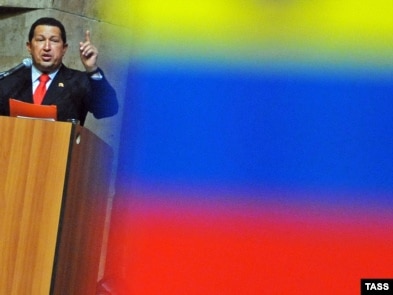
    Venezuelan President Hugo Chavez addresses students at Moscow's Patrice Lumumba Peoples' Friendship University in Moscow.


    Chavez Recognizes South Ossetia, Abkhazia As Independent

    Last updated (GMT/UTC): 10.09.2009 09:29

    MOSCOW -- On a visit to Moscow, Venezuelan President Hugo Chavez says Caracas plans to immediately recognize Georgia's pro-Russia separatist regions of Abkhazia and South Ossetia as independent states.

    Chavez told Russian President Dmitry Medvedev during a visit to the Kremlin that his country would consider the two regions -- considered by most of the world as part of Georgia -- sovereign states "from today," Russian news agencies reported.

    Russia recognized the two rebel regions as independent in the wake of its war last year with Georgia, but most of the world condemned the move and considers them part of Georgian territory.

    Only Nicaragua had previously joined Moscow in recognizing them as independent.

    Earlier, Chavez praised Russian leader Vladimir Putin for standing up to the United States, on a visit that the Kremlin said will focus on major energy and military agreements.

    Cooperation between Russia, the world's No. 2 oil exporter, and OPEC member Venezuela has been dismissed by the United States as mostly talk but is watched with concern by Colombia, which has stormy ties with its Latin American neighbor.

    Chavez began his visit with a two-and-a-half hour speech to Moscow students in which he berated the United States for seeking to control the world with a "terrorist" empire.

    "The United States wants to dominate the entire world...The empire of the Yanks will fall this century and I am not talking about the end of the century but in the next decades," Chavez told about 1,000 students.

    "That is why it is so important that Russia is getting up from its knees -- this is the great inheritance from Putin," he said in a speech which feted Russian revolutionary Vladimir Lenin and Cuban leader Fidel Castro.

    Chavez was greeted warmly by students of the Patrice Lumumba Peoples' Friendship University, though scores left early to watch a World Cup soccer qualifier between Russia and Wales.

    The Kremlin, which under Putin's presidency from 2000 to 2008 frequently clashed with Washington, has previously sought to distance itself from Chavez's fiery anti-U.S. rhetoric.

    The Kremlin said talks with President Dmitry Medvedev and Putin, who now serves as prime minister, would focus on widening military and energy cooperation.

    "About 10 agreements which embrace the fuel and energy sector, military technical cooperation, and finance have been prepared," said Kremlin foreign policy aide Sergei Prikhodko.

    Arms, Energy

    Chavez, a former soldier who led an abortive 1990s coup before later winning an election, has purchased more than $4 billion worth of Russian arms to rearm the Venezuelan Army, including fighters and thousands of Kalashnikovs.

    The Kremlin said no major arms deals were expected during the visit but that Russia could lend Venezuela money to buy its military equipment.

    Chavez has said he wants to buy dozens of Russian tanks to counter a planned increase in U.S. military cooperation with Venezuela's Andean neighbor Colombia.

    Venezuela and Colombia came close to war last year and Colombian President Alvaro Uribe has accused Chavez of supporting FARC Marxist rebels fighting Bogota.

    Venezuelan state oil company PDVSA and a consortium of Russian companies were expected to present a joint venture to develop a block in the Orinoco oil belt this month.

    "An agreement between the Russian oil consortium and PDVSA will be signed in the near future," Deputy Prime Minister Igor Sechin told reporters in Moscow. "The creation of a joint venture is yet to be approved by Venezuela's parliament."

    It was unclear if a formal contact to jointly develop the Junin 6 block, with estimated production capacity of 200,000 barrels per day, would be signed during the visit.

    The Russian consortium includes Rosneft, Gazprom, Lukoil, TNK-BP, and Surgutneftegaz. It also intends to bid for blocks in the Carabobo project.

    Compiled from agency reports

    Link

    Leave a comment:


  • Federate
    replied
    Re: Georgian-South Ossetian conflict

    Georgia 'seizes Russian soldier'


    Russia has accused Georgia of capturing a Russian soldier in the breakaway Georgian region of South Ossetia, Russian news agencies report.

    A Russian defence ministry spokesman said soldier Alexander Glukhov had been seized in the Akhalgori region.

    Georgia's interior ministry said the soldier had surrendered to its police, requesting Georgian citizenship.

    The Akhalgori region was under Tbilisi's control until last August's war between Georgia and Russia.

    During the brief war, Georgia's attempts to regain control of South Ossetia were repelled by Russian forces.

    Tbilisi has urged Moscow to withdraw forces from Akhalgori after the conflict ended with an EU-brokered ceasefire.

    'Provocation'

    "A preliminary investigation has revealed that Alexander Glukhov was captured by Georgian forces in the Akhalgori region of South Ossetia and taken to Tbilisi," Russian defence ministry spokesman Colonel Alexander Drobyshevsky told Russian news agencies.

    Col Drobyshevsky said the defence ministry was demanding that Tbilisi hand back the soldier.

    The spokesman also described comments by the Georgian defence ministry as "provocation".

    Tbilisi said the 21-year-old deserted the Russian army on Monday night.

    In a televised interview filmed by the Georgian army, Alexander Glukhov said he decided to seek asylum in Georgia because he was fed up with poor conditions in the Russian army.

    He also said that he had to go without food in the Russian army during the cold winter.

    BBC, News, BBC News, news online, world, uk, international, foreign, british, online, service

    Leave a comment:


  • jgk3
    replied
    Re: Georgian-South Ossetian conflict

    To me it's just another sign (though this one has strong symbolic significance) that Moscow is pulling the strings in the region.

    Leave a comment:


  • Armanen
    replied
    Re: Georgian-South Ossetian conflict

    For him to have said that more than likely means something big is brewing in tiflis. He won't be in office much longer, due to his unpopularity at home and lack of usefulness to the puppiteers in washington.

    Leave a comment:


  • jgk3
    replied
    Re: Georgian-South Ossetian conflict

    Hmmm, and after a confession like that, he's still able to hold office? Looks like before he gets chucked out, Moscow made sure he spoke the right words for the history books.

    Leave a comment:


  • Federate
    replied
    Re: Georgian-South Ossetian conflict

    Georgia started August war, Saakashvili confesses
    29.11.2008 15:29 GMT+04:00 Print version Send to mail In Russian In Armenian

    /PanARMENIAN.Net/ For the first time ever, Georgian President Mikheil Saakashvili has admitted that his country started hostilities against South Ossetia in August. But the Georgian leader is adamant the action was justified, Russia Today reports.

    He said it was a response to Russia’s “intervention” in the region. “It was a hard decision but we had to defend our citizens,” he said.

    Giving evidence to a parliamentary inquiry into the conflict, Mr Saakashvili denied planning the attack months in advance. He insisted Russia made the first move, pouring tanks and men over the border.

    Mr Saakashvili said the decision to launch an assault on South Ossetia was made after nearby Georgian villages came under "heavy bombardment" from South Ossetia, and after "hundreds of [Russian] tanks and heavy vehicles" started crossing the border.

    "Under these conditions, if you ask me whether Georgia had to undertake military actions against these firing positions, the answer is yes," he said.

    The Georgian President claims Russia moved tanks into South Ossetian territory before Georgia launched its attack.

    Leave a comment:


  • Federate
    replied
    Re: Georgian-South Ossetian conflict

    GeorgiaTimes obtains document reconfirming Georgia’s plans to invade South Ossetia
    26.11.2008 15:50 GMT+04:00 Print version Send to mail In Russian In Armenian

    /PanARMENIAN.Net/ Following the end of the August military operation there was a rather long argument on "who was the first"? Who initiated the military aggression by planning actions beforehand and who had to respond? As a result the world community admitted: it was Mikheil Saakashvili who started the war. GeorgiaTimes reports it obtained a document that reconfirms that Georgia’s armed forces were preparing the invasion in South Ossetia.

    (Translation from the Georgian language)

    Signed away to: Executive Officer Signature 07.08.08

    Confidential Copy №4 Infantry Brigade 4 HQ Vasiani 05.15 August 07 2008

    Interim order № 02 Map № 1:50000, К-38-64-А, К-38-90-Б, К-38-64-В, К-38-64-Г Edition 1987 Local time

    1.Situation

    No change (see Interim order № 01)

    А. Counter force

    No change (see Interim order № 01)

    B. Proper forces:

    No change (see Interim order № 01)

    Higher commander task

    For task group to carry out military operation in Samachablo (South Ossetia) region and within 72 hours defeat the enemy. Restore Georgia’s jurisdiction over the region.

    Higher commander plan

    - Fast performance of military operation;

    - Decrease in risk of destroying civilians and their property;

    - Elimination of counter force by localized strikes;

    - Proper defense;

    G. Affixed units

    None

    Registration seal 7.08.08

    2. Task

    4th infantry brigade units are set in combat alert status at the location not later than 11.00 am August 7 2008 in order to support the task group.

    3. Execution

    Commander's plan:

    - quick performance of military operation;

    - decrease in risk of destroying civilians and their property;

    - elimination of counter force by localized impacts;

    - proper defense;

    - offensive and defensive operations in the battle zone;

    - city functionality protection;

    Final result:

    - detection of antiseparatist forces in the region;

    - establishment of peaceful and secure environment in the region.

    4th brigade general borders (coordinates according to encrypting map):

    In the north: к. 858864: к. 056868.

    In the east: к. 056868 к. 112732

    In the south: к. 112732: к. 977690: к. 951682: к. 868709

    In the west: к 868 709

    4th brigade internal borders:

    infantry battalion 41:

    In the north: к. 858864; к. 935865.

    In the east: к. 935865 к. 977690

    In the south: к. 977690; к. 948681.. 878708

    In the west: к 878708; к. 858864.

    infantry battalion 42:

    In the north: к. 935865; к. 973867

    In the east: к. 973867; к. 025748; к. 046718

    In the south: к. 046718; к. 977690

    In the west: к 977690; к. 935865

    infantry battalion 43:

    In the north: к. 9738674; к. 056868

    In the east: к. 056868; к. 112732

    In the south: к. 112732; к. 046718.

    In the west: к 046718; к. 025748. . 973867

    Commander's Critical Information (CCIR)
    (а) Priority intelligence requirements (PIR)

    1.Tools/methods/modes using which antiseparatist forces can destabilize security in the region.

    2. Where does direct confrontation of forces take place?

    3. Who supports antiseparatist forces?

    4. Where are camps and shelters of antiseparatist forces located?

    5. Where is their firepower located?

    6. Counter force number and applied means?

    7. Where and when will enemy's various units execute offensive against our forces

    8. Who are influential persons (leaders) in the battle zone.

    Risks

    -Russian peacekeeping bases in Samachablo region imply risk of provocations in case of bringing down fire on them;

    - Risk that during transfer of civilians and refugees there might be separatist units members among them that would destabilize situation in the rear.

    Orders to manoeuvre elements:

    - for manoeuvre elements (battalions 41, 42 and 43) to prepare reconnaissance platoons for tactic reconnaissance operations in their zones of responsibility;

    - for manoeuvre elements to train offensive and defensive operations (offensive in settlements, penetration into buildings,
    search, assault and seizure).

    Orders to support units:

    For brigade support units (tank battalion; artillery battalion; procurement battalion and independent companies) - to be set in full combat alert status in order to support manoeuvre elements and be ready for march to the brigade assembly point. 0259.

    Security measures:

    - keep secure distance during march;

    - units guarantee protection of flags by proper forces during relocation.

    4. Material and technical support.

    No change (see Interim order № 01)

    5. Management and communication.

    No change (see Interim order № 01)
    4th infantry brigade commander Major signature G. Kalandadze
    Overleaf:

    №_

    Printed: 7 (seven) copies
    Copy №1-16161
    Copy №2-16162
    Copy №3-16163
    Copy №4-16164
    Copy №5-16165
    Copy №6-16166
    Copy №7-16167

    Leave a comment:


  • Federate
    replied
    Re: Georgian-South Ossetian conflict

    Armenia: Georgian Refugees Set to Return

    Many refugees from August war planning to head home, but still traumatised by their experiences.

    By Gayane Mkrtchian in Yerevan (CRS No. 465 23-Oct-08)
    Twenty-four-year-old Teona Kurtanidze is still living with her three-year-old son Nikolai in a room on the edge of the Armenian capital Yerevan, given them as temporary refuge from the fighting in neighbouring Georgia this summer.

    “A few days ago I took Nikolai to Victory Park,” she said. “There was a plane there and he climbed on it and said, ‘Mama, let’s go and bomb Gori!’ I said ‘Why should you bomb Gori?’ and he replied, ‘There are Russian soldiers there.’ When it rained heavily in the night, he would wake up and shout, ‘Mama, let’s run, tanks are coming’.”

    Teona and her son fled the town of Gori for Yerevan when fighting broke out in August and were given shelter by the Armenian migration agency.

    Ruzanna Petrosian, an official in the migration agency, said that since August 11, when Georgian civilians began to flee in large numbers, 106 people had been given temporary refuge and two had received refugee status. The vast majority of them were ethnic Armenians who were Georgian citizens.

    Armenia was bracing itself for a bigger flood of refugees and it was able to cope with those who did come. Now, many of the latter are planning to head home, but are still traumatised by the brief August war between Russia and Georgia.

    “We were drinking tea that morning,” recalled Teona of the day the Russians attacked Gori. “It was around 11 or 12 o’clock and planes appeared over the town and began to bomb us. I couldn’t believe my eyes – it looked as though it was raining. I grabbed Nikolai and ran out of the house, without even taking anything with us.”

    Two days later, she headed to Armenia where she believed her son would be safe. They are now virtually the only Georgians who have remained in government accommodation, with all basic facilities and food provided for them.

    Susanna Harutyunian, 57, was born in Tbilisi and has lived there for 42 years but says she does not want to return.

    “When it all began, it didn’t take me long to decide to come to Armenia with my daughter and grandchildren,” she said. “I sent her to her husband in St Petersburg and stayed on here. My husband could not come with us because of his health. They say it’s all calm there now but I don’t know. I am very afraid, I want to bring my husband there, just so long as we have a roof over our heads.”

    According to Ruzanna Petrosian, people who apply for temporary refuge have the right to live there for three months and should return home if the situation in their home country has stabilised.

    “If that is not the case their case continues to be considered and an appropriate decision is made,” she said.

    The Armenian Red Cross Society and the United Nations refugee agency, UNHCR, also give humanitarian aid to refugees, both those in temporary accommodation and staying with relatives.

    Volodya Martirosian, 60, an economist, came to Armenia from Poti. “My time here in this shelter runs out on November 1,” he said. “If my request is granted I will stay in Armenia, my homeland. I don’t want to go back to Georgia.”

    Martirosian blames Georgian president Mikheil Saakashvili for the August war. “Any person who knows the slightest bit about politics should not have made this step,” he said. “A clever person, if he is not sure of his own strength will not start a war. Why do so if you are going to lose?”

    Teona Kurtanidze does not agree and is full of praise for Saakashvili, saying merely that he gave in to a provocation.

    She is a journalist by profession and worked in the local television station and newspaper in Gori. Turning on a computer, she opens up pictures of the bombing of Gori, with burning buildings, people fleeing in panic and bodies on the streets. In one picture, a wounded woman with a bleeding face wants to flee but does not know where to go.

    “These pictures were taken by my friends in the TV station,” she said. “We lived through this horror ourselves. And now I just want one thing – that there is no more war, and that no child should have to see what my son saw.”

    All the same, she has taken the decision to go back to Georgia when her three months in the shelter expire on November 22. “Gori is my homeland and I want to go back there,” she said. “Where else can I go if not to Gori?”

    Gayane Mkrtchian is a correspondent for Armenianow.com in Yerevan

    Leave a comment:


  • Federate
    replied
    Re: Georgian-South Ossetian conflict

    Abkhazia going to develop cooperation with Karabakh
    /PanARMENIAN.Net/ Abkhazia intends to develop cooperation with the Nagorno Karabakh Republic in trade, economic, political and cultural fields, reported the press office of Abkhazia president's administration.

    Abkhazian Foreign Minister Sergei Shamba held a meeting with NKR Deputy FM Eduard Atanesyan and National Assembly Speaker Ashot Ghulyan to discuss bilateral relations, Rosbalt reports.

    From http://www.panarmenian.net/news/eng/?nid=27262

    Leave a comment:


  • Federate
    replied
    Re: Georgian-South Ossetian conflict

    Update on today's car bomb
    ----------------------------
    Car bomb kills 9 Russians in South Ossetian capital

    MOSCOW: A car bomb in the capital of South Ossetia on Friday killed nine Russian peacekeepers and wounded three others, raising tensions in the separatist enclave days before a scheduled pullback of Russian troops from Georgian territory.

    President Eduard Kokoity of South Ossetia said he had "no doubt" that Georgian special forces were behind the explosion in the capital, Tskhinvali. The acts, he said, "undermine international efforts to stabilize the situation and torpedo the Medvedev-Sarkozy plan."

    The blast came six days before a deadline for Russia to pull back from the so-called buffer zone outside South Ossetia, yielding a large swath of land back to Georgian control. European Union monitors began patrolling the buffer zone Wednesday, in accordance with a cease-fire agreement brokered by President Nicolas Sarkozy of France and agreed to by Russia. President Dmitri Medvedev of Russia agreed to adhere to the timetable for withdrawal.

    "The last terrorist act in South Ossetia proves that Georgia has not abandoned the policy of state terrorism," Kokoity told the Russian news agency Interfax.

    Shota Utiashvili, head of the analysis department for the Georgian Interior Ministry, said his country was not involved.
    Today in Europe

    "It's completely unclear how it could have been done by the Georgians, as Kokoity has said," Utiashvili said. "There is no way we can know where this car came from and why it was taken to a Russian military base."

    Utiashvili said the explosion was part of a Russian strategy to delay the planned withdrawal.

    "They have tried to create tensions several times by killing Georgian policemen, and we didn't respond to any of the actions," he said. "They just did it themselves."

    Zalina Tskhovrebova, editor of South Ossetia, the largest newspaper in Tskhinvali, said the blast was so powerful that it had broken windows and knocked pictures off the wall of her office, which is about 110 meters, or 350 feet, from the site. It also frayed nerves in a city still rebuilding from fighting involving Russian, Ossetian and Georgian forces in August.

    Since then, aid has poured into the city from Russia, with teams of workers swarming around school buildings and trucks distributing fresh bread and Russian newspapers.

    "My windows had just been replaced," Tskhovrebova said. "People were beginning to be happy."

    A low-level war had been simmering between Ossetian and Georgian forces for years, but it flared into open warfare late on Aug. 7, when Tbilisi ordered an attack on the separatist capital. Russia sent troops over the border in response, driving deep into Georgia proper. Russia has recognized South Ossetia and Abkhazia as sovereign nations and promised to protect their borders.

    Earlier Friday, an explosive device went off near a car belonging to Anatoli Margiyev, head of South Ossetia's Leningorsk district administration, as he was en route to Tskhinvali, Interfax reported. The car was set on fire, but Margiyev jumped clear.

    The explosion occurred in an ethnic Georgian area, and a South Ossetian government spokesman said it had been an attempt on Margiyev's life. Since he took the position as chief of the district administration, he has been threatened repeatedly and asked to step down, Interfax reported.

    From http://www.iht.com/articles/2008/10/...pe/ossetia.php

    Leave a comment:

Working...
X