
Re: Georgian-South Ossetian conflict
Sappy sh*t
Georgians in America watch the violence back home
Aug 12, 2008 (8:47p CDT)
By VERENA DOBNIK (Associated Press Writer)
NEW YORK - Khatuna Baghaturia has spent countless hours in the last week on the phone with relatives in her native country and watching the bloodshed on TV. The sight of Russian troops laying waste to Georgia was all the more horrifying because her three children are there now - on vacation.
"Every bomb - we hope it's going to be the last," said Baghaturia, who lives in Brooklyn and whose children have managed to stay out of harm's way. "It's like a bad dream."
The 37-year-old is among about 20,000 Georgians living in the United States and about 5,000 in New York City - home to the nation's largest Georgian population, according to the country's New York consulate.
They have spent the past five days making frantic phone calls home and praying in crowded churches in Brooklyn, where Georgians are scattered in different neighborhoods.
Baghaturia is a former teacher who now runs a restaurant called Tbilisi in the Sheepshead Bay section of Brooklyn, where she says neighborhood Russians have been flocking for days to offer their support. Brooklyn is home to a sizable Russian population, creating the odd juxtaposition of people from two warring countries living side by side.
"They try to support us, they understand us, they come and say that, you know, we are really sorry, and we are your friends - and we are, we are," Baghaturia said.
Katya Ivanova, a Russian-born architect who lives in Ocean Parkway, in Brooklyn, said she supports the Georgians "because we Russians remember those days when we were quite friendly. I vacationed almost every summer on the Black Sea (in Georgia). They're great people, so friendly."
She added, "I hope intelligent Russians are against their government. And I think most Russian-Americans support the Georgians. The Russian government will always be the same - even if its name changes."
With tears in her eyes, the cook at Tbilisi prepared the kitchen Tuesday to make her country's "comfort" food - kachapuri, a kind of Georgian cheese pizza that warmed tables as daily life moved on under a sunny Brooklyn sky.
"I'm scared for my children and my grandchildren," said Leila Mikeladze, the 46-year-old cook whose grown daughter, son and pregnant daughter-in-law, as well as three grandchildren, are skirting dangers not far from the Georgian capital, Tbilisi.
Her parents, caught in the heart of the conflict, cannot be reached by telephone; Mikeladze relies on calls from her children for news.
Baghataria, her husband and staff rely on Internet phone connections, including video images, to keep track of events hour to hour. She hopes her children - two daughters ages 19 and 13, and a 7-year-old son - remain safe and make it back to New York for the start of the academic year.
But that doesn't solve the problems of Georgia, whose President Mikhail Saakashvili is a lawyer educated at New York's Columbia University. Baghataria says that despite Russia ordering a halt to the war, friends and relatives reported that bombs were still going off Tuesday.
"We need the whole country to be saved and all Georgians to be alive," said Baghataria.
On Saturday, a rally at the United Nations drew Georgians carrying signs that read: "Hands off Georgia" and "Stop Evil Russia."
Protesters included members of St. Nino's Georgian Orthodox church choir who formed a circle to sing their native songs. A room on the third floor of a Roman Catholic school in Brooklyn's Williamsburg serves as the chapel of the church on most Sundays.
In the meantime, Georgians - including ethnic Russians - gather at places like the Tbilisi restaurant to talk and eat together, make calls, and share hopes for a quick end to the conflict.
Last weekend, there was no entertainment at the Tbilisi restaurant.
"We said, 'People are dying, we can't sing and dance here,'" said Baghataria.
She and her husband came to the United States in 1999, leaving behind a shattered Georgian economy - and their children, whom the couple didn't see for four years until their U.S. immigration status was settled.
"I still hope that everything is going to be OK," she said, smiling faintly.
At her Manhattan apartment and studio, artist Rusudan Grigolia spends anxious, sleepless days and nights watching TV, making phone calls to Georgia and keeping in touch by computer.
She flew back from Georgia last week, leaving behind her daughter, a fashion designer in the capital known as Nina K, as well as her 3-month-old granddaughter, her mother and her sister.
"I wish I didn't leave," said Grigolia. "I wish I could go back there and be with them."
She has "lots of Russian friends, and I love them," she said, adding, "I would not expect from Russian government to be so greedy and to be so cruel."
Echoing Republican presidential candidate John McCain, she said, "We all are Georgians now. And I believe the whole world should feel like that because if Russia wins now in Georgia, that means that we all lose - not only Georgians."
-
Re: Georgian-South Ossetian conflict
August 13, 2008
'Poor Little Georgia' – Not!
The Georgia lobby has hoodwinked the Western media – and it wasn't hard
The commander in chief of America's laptop bombardiers, Weekly Standard editor Bill Kristol, can always be counted on to reveal not only the content of the neoconservative party line, but also, in so many words, the impulse that motivates it. In his latest peroration from his perch at the New York Times, the intellectual architect of our disastrous war in Iraq lays out a rationale for yet another catastrophic blunder in the foreign policy realm, this time in the Caucasus:
"In August 1924, the small nation of Georgia, occupied by Soviet Russia since 1921, rose up against Soviet rule. On Sept. 16, 1924, The Times of London reported on an appeal by the president of the Georgian Republic to the League of Nations. While 'sympathetic reference to his country's efforts was made' in the Assembly, the Times said, 'it is realized that the League is incapable of rendering material aid, and that the moral influence which may be a powerful force with civilized countries is unlikely to make any impression upon Soviet Russia.'
"'Unlikely' was an understatement. Georgians did not enjoy freedom again until 1991."
You get the idea: in Kristol's world, Putin's Russia is Stalin's USSR, and poor, doe-like little Georgia – a bastion of freedom – is in danger of being devoured by the insatiable Russian bear. Meanwhile, the world stands by, helpless, as appeals are made to a nation impervious to the very concept of morality.
To begin with, Kristol's historical analogy is misleading: Georgia in 1924 was very far from a democracy. What he doesn't tell you is that it was under the control of the Mensheviks, a faction of the Russian Social Democrats (later renamed the Communist Party) that lost out to Lenin's Bolsheviks but was in fact very little different from its factional rivals. As the British writer Carl Bechhofer described Georgia's Menshevik regime:
"The Free and Independent Social-Democratic State of Georgia will always remain in my memory as a classic example of an imperialist 'small nation.' Both in territory-snatching outside and bureaucratic tyranny inside, its chauvinism was beyond all bounds."
George Hewitt, a professor of Circassian languages at London University, cites the colorful and well-traveled Bechhofer in an illuminating essay that lays out the grave error underlying American policy in the region:
"In the hope of avoiding a proliferation of an unpredictable number of small states, the international community in its collective wisdom decreed that it would recognize only the USSR's constituent union-republics and would, thus, not give any encouragement to the yearning for self-determination that characterized some ethnic minorities living in regions endowed with only lower level autonomy according to the Soviet administrative system (such as the Autonomous Republic of Abkhazia and the Autonomous Region of South Ossetia, both lower-status entities within the union-republic of Soviet Georgia). It was a huge irony that, in adopting this stance, the West was effectively enshrining the divisions created for his fiefdom by none other than the Soviet dictator Iosep Besarionis-dze Dzhughashvili, a Georgian known to the wider world as Joseph Vissarionovich Stalin."
Aside from memorializing Stalin's policy of imprisoning ethnic minorities within larger administrative entities, refusing to recognize South Ossetia and Abkhazia as independent states allows the U.S. and the European community to maintain the fiction of Russian "expansionism." According to Washington, the Russians invaded "Georgia"; Saakashvili's invasion of South Ossetia doesn't qualify as aggression, since how can you invade your own country? South Ossetia and Abkhazia are part of Georgia, you see. Just like a small mammal is part of the anaconda that swallowed it whole.
Hewitt goes on to point out:
"Had the Soviet Union collapsed during the first decade of its existence in the 1920s before Abkhazia was reduced in status by fiat of Stalin in February 1931 from being a fully-fledged republic, which entered the Transcaucasian Federation on 13 December 1922 in treaty-alliance with Georgia, to that of an autonomous republic within Georgia, and had the then League of Nations adopted the same principle of recognition later practiced by its successor, the United Nations, then Abkhazia would for decades have enjoyed independence and membership in its own right of the said international community."
The same goes for Ossetia, which is today split into North and South, with the latter under the Georgian heel – as placed there by the half-Ossetian (on his father's side), half-Georgian Stalin.
Readers of Hewitt's 1998 book, The Abkhazians: A Handbook, will note how effectively he explodes Kristol's myth of poor little Georgia, whose supposedly "democratic" history reflects its present "pro-Western" orientation and general worthiness:
"The aggressive politics of the government of Georgia towards Abkhazia occasioned extreme displeasure among the local Abkhazian, Armenian, Russian, Greek, and a significant proportion of the Kartvelian peoples, which actually helped to facilitate the establishment of Soviet power in the region on March 4th, 1921."
The fall of Menshevik communism in Georgia was celebrated by the captive mini-nations of the region "as a deliverance from the repression and meddling of the Georgian Republic." Things have remained pretty much unchanged since 1921 – albeit not in the way Kristol would have us believe.
While Kristol sentimentalizes the old Georgian republic, its Menshevik founders and leaders were, as Hewitt points out, unapologetic authoritarians:
"The politics of this state was quite accurately characterized by one of its eminent activists, the jurist-internationalist Zurab Avalov (Avalishvili). In his book The Independence of Georgia in International Politics, 1918-1921 (Paris, 1924), he remarked, 'At the start of 1921, Georgia had in the person of its government and in the shape of the Constituent Assembly a simple creature of party organization … Georgian democracy 1917-1921, a form of social-democratic dictatorship (i.e., of the right wing of Marxism), was a period of preparation for the triumph in Georgia of Soviet dictatorship."
This dictatorial tradition is today carried on by President Mikheil Saakashvili, who unleashed police on demonstrators, injuring 500 people, during the hotly contested elections and shut down independent media with the same alacrity displayed by his Menshevik predecessors. It is little short of astonishing that Kristol holds up this smarmy regime of small-time hoodlums with big-time regional ambitions as some kind of model, the ideal U.S. ally whose fate we might even go to war over.
Georgia, in Kristol's view, is worthy not only of U.S. support, but of membership in an imaginary "League of Democracies," a neocon project touted by John McCain and pushed by the neocon-dominated wing of the GOP as the "conservative" answer to the United Nations. In short, NATO writ large, albeit with an ideological gloss such as only Kristol (or a Marxist) could bring to it.
No, that's not a misprint: I wrote Marxist, and meant it. The whole flavor of Kristol's screed calling for U.S. support to Georgia, with its appeals to emotion interwoven with bogus historical analogies, reeks of the ideologue's sweaty-browed rhetoric. He is like a little Lenin, exhorting us to follow the bright flag of "democratic" internationalism to the very ends of the earth, which is surely where South Ossetia is located, as least as far as Americans are concerned. One hears, in Kristol's exhortations, the hectoring tone of the old Soviet commissar, albeit of the Menshevik rather than the Bolshevik variety, and this brings to mind a point made by the late Murray N. Rothbard in his justly famous 1992 speech to the John Randolph Club:
"When I was growing up, I found that the main argument against laissez-faire, and for socialism, was that socialism and communism were inevitable: 'You can't turn back the clock!' they chanted, 'you can't turn back the clock.' But the clock of the once-mighty Soviet Union, the clock of Marxism-Leninism, a creed that once mastered half the world, is not only turned back, but lies dead and broken forever. But we must not rest content with this victory. For though Marxism-Bolshevism is gone forever, there still remains, plaguing us everywhere, its evil cousin: call it 'soft Marxism,' 'Marxism-Humanism,' 'Marxism-Bernsteinism,' 'Marxism-Trotskyism,' 'Marxism-Freudianism,' well, let's just call it 'Menshevism,' or 'social democracy.'
"Social democracy is still here in all its variants, defining our entire respectable political spectrum, from advanced victimology and feminism on the left over to neoconservatism on the right. We are now trapped, in America, inside a Menshevik fantasy, with the narrow bounds of respectable debate set for us by various brands of Marxists. It is now our task, the task of the resurgent right, of the paleo movement, to break those bonds, to finish the job, to finish off Marxism forever."
Of course, the neoconservatives, of which Kristol is the ringleader, came from the left side of the spectrum and trace their historical antecedents all the way back to the schismatic Marxist sects of the 1930s and the epic battles between Trotsky and Stalin (they were partisans of the former). They were, in short, the American Mensheviks of their time. In their hegira from the far left to the neocon right – a more fully documented odyssey exists only for that undertaken by Ulysses – they yet retain the telling characteristics of their Menshevik heritage, which Kristol proudly upholds to this day.
At a time when people are losing their homes and economists are beginning to talk about another Great Depression, Kristol's proposal to send millions more in "aid" to Georgia is obscene. Now that's real anti-Americanism – sending taxpayer dollars to a Georgian despot while people in this country are hurting. It's also political suicide for the Republicans to raise the prospect of intervening in Georgia's internal problems when we're already bogged down in the Iraq quagmire, from which there seems little hope of early extrication. So much for Kristol, the grand strategist of the GOP. He and his fellow neocons are dragging down the Republican Party along with their own sinking credibility.
The myth of poor little Georgia, a newborn and promising "democracy" threatened, bullied, and battered by Putin-the-reincarnation-of-Stalin is bogus from beginning to end. It is a Bizarro World rendition of what is really happening in South Ossetia and the wider region: that is, a curiously and consistently inverted version of reality in which up is down, black is white, and the Georgians did not invade South Ossetia, killing thousands and driving many more northward.
According to our "free" media, the Georgians didn't invade the land of the Ossetians – they merely tried to "retake" it, as a child would bloodlessly and even quite playfully retake a shiny red ball from a playmate. Those evil Russkies, on the other hand, invaded, plunged into, and escalated their attack on Georgia. At least, those are the words our "reporters" are using. As George Orwell emphasized, the corruption of language is a form of control, and the American media in collusion with the government is expert at this, especially in its war reporting.
That's why Antiwar.com's continued survival is such a value for our growing audience: we give you the facts without the Washington-centric spin that comes with "mainstream" media coverage. You know you can come here to find out what's really happening out there in the wide world. You also know that we aren't afraid to fly in the face of the conventional wisdom. Maybe you remember how often that collective "wisdom" has been wrong.
The news media – and, not coincidentally, the War Party – isn't interested in reporting the facts. All they care about is the "narrative" – one not necessarily based on reality, designed to convince the public that what our rulers are doing and planning is right and just. The Kristolian narrative of poor, little, pro-Western Georgia is a tall tale. Georgian "free market democracy" exists in the same alternate universe as Iraq's famed "weapons of mass destruction" and the Piltdown Man, but you won't see many other media outlets saying that.
I want to urge all of my readers, especially those who log in with some regularity, to contribute to our end-of-summer fundraising drive, which, as I write, is in its second day. We still have a very long way to go, and I can't impress upon you the urgency of our appeal. The foreign policy crisis has been ongoing ever since 9/11, and it still shows very little sign of letting up. We seem to be approaching the breaking point, where the various crises in different parts of the world are seeming to converge into one mega-crisis: the threat of a new world war, involving most of the world's major powers, is a real possibility. And it is a near certainty as long as the neocons are anywhere near the levers of power in the U.S.
Please, consider giving more than you usually give, considering how grave the prospects for peace have become. The world, I fear, is slowly but surely darkening, with the bright promise of the post-Cold War era now just a distantly flickering memory, the echo of a lost peace.
Let us pray that peace is not lost forever, and that, once lost, it can be recovered. We can do it, and you can help – but we can't do it alone. Contribute today.
~ Justin RaimondoLeave a comment:
-
Re: Georgian-South Ossetian conflict
BREAKING NEWS --- Saakashvili's an idiot...err wait...that's not breaking news!
**********************
Georgia Says Leaving CIS
source: http://www.asbarez.com/index.html?sh...40_8/12/2008_1
TBILISI (Combined Sources)-- Georgia President Mikhail Saakashvili announced that his embattled nation will leave the Commonwealth of Independent States (CIS) which was created after the Soviet Union dissolved in 1991.
"We are leaving the CIS for good.....and encourage others to do so," he reportedly told supporters in the capital of Tbilisi in an email sent to Newsmax by Georgian authorities.
The CIS is composed of 15 of the former Soviet republics and has been a loose confederation of economic and political ties. Some of those states, namely Georgia and Ukraine, have repeatedly charged that Moscow has used the association to bully many of the former Soviet states.
Now, with Georgia breaking ranks, the question is: how many more will follow?
Ukraine, perhaps the most important of the former Soviet republics outside Russia -- and a close ally of Georgia -- is said to be seriously considering the Georgian lead. A complete breakup of the CIS could leave Moscow politically isolated around its borders.
Even as Moscow announced a cessation of its military campaign in Georgia, its U.N. ambassador, Vitaly Churkin, raised an ominous specter. Churkin, who has repeatedly denied U.S. accusations that Moscow wants to overthrow the Georgian government, did seem to confirm those allegations when he spoke of the Georgian president.
"He is not a man we can do business with," Churkin said Monday, leaving Georgians "to draw the proper conclusions."
The Russian representative also noted that if the French delegation tried to force the Security Council to vote on a cease-fire resolution, he would veto it.
"Why should we vote on something we were not consulted on?" he asked journalists.
U.S./U.N. Ambassador Zalmay Khalilzad told reporters that he sensed a softening of the Russian position, but he criticized Russia's continuing attempts to stall any U.N. action.
U.N. Secretary-General Ban Ki-moon, perhaps acknowledging the U.N.'s inability to address the Russian-Georgian crisis, remained on vacation at a secure, undisclosed location.Leave a comment:
-
Re: Georgian-South Ossetian conflict
Bush rebuking Russia? Putin must be splitting his sides
One thing is for sure. This week's operation in Georgia has displayed the failure of the west's policy of belligerence towards Vladimir Putin's Russia. The policy was meant to weaken Russia, and has strengthened it. The policy was meant to humiliate Russia with Nato encirclement, and has merely fed its neo-imperialism. The policy was meant to show that Russia "understands only firmness" and instead has shown the west as a bunch of tough-talking windbags.
Georgia, a supposed western ally and applicant to Nato, has been treated by Russia to a brutal lesson in power politics. The west has lost all leverage and can do nothing. Seldom was a policy so crashingly stupid.
Putin would die laughing if he read this week's American newspapers. The president, George Bush, declared the Russian invasion of Georgia "disproportionate and unacceptable". This is taken as a put-down to the vice-president, xxxx Cheney, who declared the invasion "will not go unanswered", apparently something quite different. Bush says that great powers should not go about "toppling governments in the 21st century", as if he had never done such a thing. Cheney says that the invasion has "damaged Russia's standing in the world", as if Cheney gave a damn. The lobby for sanctions against Russia is reduced to threatening to boycott the winter Olympics. Big deal.
Every student of the Caucasus has known since the fall of the Soviet empire that this part of the world was an explosion waiting to happen. The crisscrossing fault lines of ethnicity, religion and nationalism, fuelled by gas and oil, would not long survive the removal of the Red Army and communist discipline. There were too many old scores to settle, too much territory in dispute and too much wealth at stake - rivalries brilliantly portrayed in Kurban Said's classic novel of Edwardian Azerbaijan, Ali & Nino.
In every crisis the west craves goodies and baddies. The media finds it impossible to report a modern conflict without taking sides. In Yugoslavia, where a similar clash of separatist minorities occurred in the 1990s, coverage was so biased that Kosovo is still "plucky little" and the Serbs can still do no right.
In South Ossetia both sides appear to have committed appalling atrocities, and can thus generate a sense of outrage in front of whatever camera is pointed at them. Georgia's government claimed the right to assert military control over its two dissident provinces, South Ossetia and Abkhazia, even if they were openly in league with Russia. Equally, Russia felt justified in stopping the consequent evictions and killings of its nationals in these provinces, in which it had a humanitarian locus as "peacekeeper".
The difficulty is that entitlement and good sense are rarely in accord. Georgia may have been entitled to act, but was clearly unwise to do so. Russia may have been entitled to aid its people against an oppressor, but that is different from unleashing its notoriously inept and ruthless army, let alone bombing Georgia's capital and demanding a change in its government.
What is clear is that the Georgian president, Mikheil Saakashvili, is a poor advertisement for a Harvard education.He thought he could reoccupy South Ossetia and call Russia's bluff while Putin was away at the Olympics. He found it was not bluff. Putin was waiting for just such an invitation to humiliate a man he loathes, and to deter any other Russian border state from applying to join Nato, an organisation Russia had itself sought to join until it was rudely rebuffed.
Saakashvili thought he could call on the support of his neoconservative allies in Washington. Tbilisi is one of the few world cities in which Bush's picture is a pin-up and where an avenue is named after him. It turned out that such "support" was mere words. America is otherwise engaged in wars that bear a marked resemblance to those waged by Putin. It defended the Kurdish enclaves against Saddam Hussein. It sought regime change in Serbia and Afghanistan. As Putin's troops in South Ossetia were staging a passable imitation of the US 101st Airborne entering Iraq, Bush was studiously watching beach volleyball in Beijing.
The truth is that the world has no conceptual framework for adjudicating, let alone resolving, these timeless border conflicts. Where poverty is rife, it takes only a clan war and a ready supply of guns for hostilities to break out. The only question is how to stop them escalating.
Once such conflicts could be quarantined by the United Nations' requirement to respect national sovereignty. That has been shot to pieces by the liberal interventionism of George Bush and Tony Blair. The result has reinvigorated separatist movements across the world. Small-statism is not an evil in itself: witness its quadrennial festival at the Olympics. But the process of achieving it is usually bitter and bloody.
The west's eagerness to intervene in favour of partition, manifest in Yugoslavia, Iraq and Sudan, is more than meddling. It encouraged every oppressed people and province on earth to be "the mouse that roared", to think it could ensnare a great power in its cause.
The parallels are glaring. If we backed Kosovo against the Serbs, why not back South Ossetia against the Georgians? But if we backed the Kurds against the Iraqis, why not the Georgians against Russia? Indeed, had Nato admitted Georgia to full membership, there is no knowing what Caucasian horror might have ensued from the resulting treaty obligation. Decisions which in Washington and London may seem casual gestures of ideological solidarity can mean peace and war on the ground.
I retain an archaic belief that the old UN principle of non-interference, coupled with a realpolitik acceptance of "great power" spheres of influence, is still a roughly stable basis for international relations. It may on occasions be qualified by soft-power diplomacy and humanitarian relief. It may demand an abstinence from kneejerk gestures in favour of leaving things to sort themselves out (as in Zimbabwe). But liberal interventionism, especially when it leads to military and economic aggression, means one costly adventure after another - and usually failure.
The west has done everything to isolate Putin, as he rides the tiger of Russian emergence from everlasting dictatorship. This has encouraged him to care not a fig for world opinion. Equally the west has encouraged Saakashvili to taunt Putin beyond endurance. The policy has led to war. If ever there were a place just to leave alone, it is surely the Caucasus.
[email protected]
Leave a comment:
-
Re: Georgian-South Ossetian conflict
From BBC:
Refugees seek shelter in Russia
VIDEO -- http://news.bbc.co.uk/2/hi/europe/7557547.stmLeave a comment:
-
Re: Georgian-South Ossetian conflict
The Tbilisi lion crawls from under his rock
Leave a comment:
-
Re: Georgian-South Ossetian conflict
Doesn't matter -- irrelevant. Georgians are accurately represented by their leader.Some Georgians already questioning their "president"Leave a comment:
-
Re: Georgian-South Ossetian conflict
Some Georgians already questioning their "president"
From Guardian:
Maybe he was thinking somebody would help us. But nobody did help us," Bacho Janashia, a 24-year-old student said. "We hope Saakashvili disappears from Georgia. He's a bastard."
The cost of Georgia's ill-fated adventure against Vladimir Putin was beginning to sink in. Many blamed Georgia's president Mikhail Saakashvili — querying why he had taken on mighty Moscow given Georgia's military inferiority and the improbability of US intervention.
"Saakashvili has to resign. There is no other way," Misha Iashvili said, stopping to mend his truck next to a roadside café. Its owners had gone, locking up and leaving behind their neat dahlia garden. He added: "Russia had been close to us for years. It will defend us. The US and Europe won't."
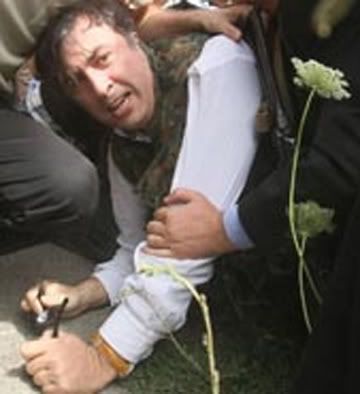
Saakashvilli just cannot think clearly. It seems like he has some mental problems...
President Saakashvili was forced to the ground by over-protective bodyguards during the visit of the French Foreign minister in Tbilisi on Monday. Note that the cameraman's hands didn't shake and he managed to film the panic outburst professionally.

Saakashvili welcomes the French and Finnish
foreign ministers at Tbilisi airport which was
earlier claimed to be 'ruined' by Russian
air forces. The nation's leader seems to be
enjoying himself while fighting is underway
just several kilometres away.

The President keeps looking up...
Suddenly, he seems to have detected
something in the sky, putting an end to the
improvised open air news conference.
Source -- http://www.russiatoday.com/features/news/28883
Leave a comment:
-
Re: Georgian-South Ossetian conflict
Russia masses naval force opposite Georgia’s third sensitive region, Ajaria
August 12, 2008, 11:41 PM (GMT+02:00)
Georgian president addresses mass rally in Tbilisi
While the world’s attention was fixed on the Russian-Georgian contest over two breakaway regions of South Ossetia and Abkhazia, DEBKAfile’s exclusive military sources reveal that Russia has massed a fleet of warships and marine forces opposite the Gerogia's semi-autonomous Black Sea region of Ajaria.
Moscow is preparing to punish what it regards as Georgian president Mikhail Saakashvili’s further provocations by occupying this coastal strip on Georgia’s southwestern border with Turkey.
The appearance of Ukraine’s president Viktor Yushchenko alongside Saakashvili, leaders of the pro-Western Orange and Rose Revolutions, at a huge national rally outside the Georgian parliament in Tbilisi Tuesday night, Aug. 12, may well be seen by the Kremlin as over the top. It came hours after Russian President Dimitry Medvedev’s gesture to the European mediation bid of ordering the Russian military operation in Georgia halted there and then.
Half of Ajaria’s ethnically Georgian population professes Islam, in contrast to the country’s Christian majority. The other half is Russian.
Ajarian has come to mean a Georgian Muslim.
The Russian Black Sea buildup is deployed opposite the Ajurian capital of Batumi, an important port for the shipment of oil from Kazakhstan and Turkmenistan. Its oil refinery handles Caspian oil from Azerbaijan.
When Saakashvili was elected president five years ago, the region’s leaders refused to recognize his authority and maintained close ties with Moscow up until May 2004 when, after Ajurians demonstrated against Tbilisi, he ordered them to obey the Georgian constitution and disarm.
Russia maintained a military base at Batumi which it agreed to close by November 2007.
DEBKAfile’s sources report that by recovering the base, Moscow will not only punish the Georgian president, but also profit from the turmoil of the past week in three ways:
1. A third semi-autonomous province will be hacked off Georgian territory after the loss of South Ossetia and Abkhazia.
2. Russia will gain a strategic Black Sea foothold at Turkey’s back door.
3. It will also control a gateway to Kazakhstan, Turkmenistan, Azerbaijan and Armenia.
From http://www.debka.com/headline.php?hid=5505Leave a comment:
-
Re: Georgian-South Ossetian conflict
Armenian Exodus From Georgia Continues

Thousands of Armenian vacationers are continuing to hastily return home from Georgia amid the uncertain security situation in the country, the Foreign Ministry in Yerevan said on Tuesday.
A ministry statement said some 4,500 of them streamed back into Armenia in the past two days, raising to more than 11,000 the number of people evacuated from Georgian Black Sea resorts since the outbreak of the Russian-Georgian war.
There was no word on the number of Armenian citizens remaining in the area bordering Turkey. An estimated 50,000 of them spent their summer holidays there last year.
Armenia has also received scores of foreigners, most of them Western tourists, caught up in the bitter fighting. According to the Foreign Ministry, at least 750 of them crossed the Georgian-Armenian border on Monday and Tuesday alone.
The evacuees also included family members of U.S. diplomats and Peace Corps volunteers in Georgia. Citing the U.S. State Department, the Associated Press reported that more than 170 Americans left Georgia on Sunday and Monday in two convoys. The department has recommended that all U.S. citizens leave Georgia due to continued Russian bombing of civilian and military targets.
In a separate statement on Tuesday, the Armenian embassy in Tbilisi said nearly 3,300 Georgian citizens have found refuge in Armenia since the start of Russian military operations in their country. Most of them are presumably ethnic Armenians.
From http://www.armenialiberty.org/armeni...E79980F3BE.ASPLeave a comment:





Leave a comment: