

Re: Trouble in Kyrgyzstan
Where there is islam there is always trouble..
palestine, nigeria, turkey, uyghur..
muslims are the trouble for this world
-
Re: Trouble in Kyrgyzstan
Kyrgyz army tries to get control in riot-hit south
OSH, Kyrgyzstan – Kyrgyzstan's weak military attempted Wednesday to regain control of the city of Osh, a major transit point for Afghan heroin and the epicenter of ethnic violence that has driven much of the Uzbek population from the country's poor, rural south.
Troops encircled the city with checkpoints and held the central square, but citizens reported that some soldiers also were looting food aid, casting doubt on the government's ability to re-establish stability after nearly a week of brutal attacks.
The leader of Kyrgyzstan's Uzbek community said the death toll among Uzbeks exceeded 300. The official toll on both sides is 189, although officials have acknowledged it is likely far higher. More than 100,000 Uzbeks have fled to Uzbekistan, with tens of thousands more camped on the Kyrgyz side of the border.
The interim Kyrgyz government has alleged that attackers hired by deposed President Kurmanbek Bakiyev set off the bloodshed by shooting at both Kyrgyz and Uzbeks, who have a history of ethnic tensions. The United Nations bolstered the claims by declaring that the fighting was "targeted and well-planned," and appeared to have begun with five simultaneous attacks in Osh by men wearing ski masks.
Bakiyev was ousted in April in a bloody uprising fueled by anger over alleged corruption. Mars Sariyev, an independent political analyst in the capital, Bishkek, said members of his family continued to control the drug trade in the Osh Knot, an area where Kyrgyzstan, Uzbekistan and Tajikistan meet that is one of the most heavily used routes for Afghan heroin heading to Russia. (Go America, get that heroin, save the world from Bin Laden!)
The drugs are transported by car and truck along a 400-mile-long (700-kilometer-long) highway that runs across the Pamir Mountains from Tajikistan's porous border with Afghanistan to Osh, as well as along other smaller roads in southern Kyrgyzstan where borders are poorly controlled, according to the United Nations.
Much of the heroin is repackaged in Osh before being transported west to Uzbekistan and north to Kazakhstan and Russia by plane, train and land, the U.N. says. Kyrgyz officials have reported major seizures of heroin and opium in Osh in recent years.
U.N. and Kyrgyz officials also have noted an increased use of "mules," individuals who carry the drugs in their stomachs or rectums, by consuming or inserting condoms filled with heroin.
Members of the Bakiyev clan lost their hold on the drug trade a week ago with the killing of the leader of an Uzbek criminal group who worked closely with them, Sariyev said. The reputed Uzbek criminal boss, Aibek Mirsidikov, was in a turf war against the leader of the Uzbek community in the Jalal-Abad region, the 24.kg news agency reported, citing an acting deputy prime minister, Azimbek Beknazarov.
The Bakiyevs may have helped instigate the ethnic violence in an attempt both to weaken the interim government and create a power vacuum that would help them regain control over the drug flow, Sariyev charged. He and other analysts also have said they believe that Bakiyev's clan wanted to derail a constitutional referendum that the provisional government needs to gain legitimacy and pave the way for the parliamentary elections in the fall.
Bakiyev has denied having any role in the violence, speaking from his self-proclaimed exile in Belarus.
Uzbek leader Jalalidin Salahuddinov told The Associated Press on Wednesday that 300 deaths had been reported by members of his community who buried friends and relatives. Some were buried on the day they were killed in keeping with Muslim tradition. Salahuddinov said the number includes some Uzbeks already counted in the official toll.
Military trucks and armored personnel carriers were stationed on the central square, and at least five checkpoints had been established around the city, including along the road to the airport and other entry points. An APC and a dozen soldiers manned each post. Every few hours military trucks transported refugees out of the city.
The U.N. Office for the Coordination of Humanitarian Affairs said security in Osh remained fragile with violence persisting in pockets on the city's edges. It said the Red Cross and rights organizations had trouble reaching some Uzbek neighborhoods, and voiced concern that humanitarian assistance was not reaching all of the population.
Munojat Tashbayeva, a 31-year-old sociologist, said 20 or so Kyrgyz men in military uniform stormed a building where five sacks of flour had just been delivered in central Osh and ordered her to get out, threatening to shoot her if she objected, before hauling the sacks away.
Tashbayeva said she saw how the assailants beat up several teenagers who had helped unload the cargo and took the flour away. One of the teenagers, 18-year-old Shokhrukh Sobirov, had a severe cranial wound and was left lying on the floor, his head bleeding.
The violence reduced much of Osh to charred rubble. Roving mobs of young Kyrgyz men burned down Uzbek homes and attacked Uzbek-owned businesses, looting them and then setting them on fire. Some Uzbeks who remained in Osh built barricades around their homes from felled trees and fences ripped up from a cemetery.
The letters SOS have been painted in white on streets and walls in Uzbek neighborhoods.
Salahuddinov said that an Uzbek man had been stabbed to death in a market Wednesday and people still feared leaving their basements to receive aid.
"If they don't kill us, we could die of hunger if the situation doesn't change in the next few days," he told the AP.
An AP photographer saw military patrols and heard artillery fire from their positions in central Osh overnight. One of the few Uzbek families to remain in Osh told The Associated Press that a mother of two was killed by shrapnel from a shell launched toward their home by the Kyrgyz military before dawn.
A few stores opened in Osh, but the streets were mostly empty and sporadic shots were heard. The military said that snipers remained active in the city.
Thousands of ethnic Uzbeks were camped in squalid conditions near the Uzbekistan border, waiting to cross and enter one of the dozens of refugee camps there.
In neighboring Kazakhstan, border guards were prohibiting ethnic Uzbeks from crossing from Kyrgyzstan and will deport some 200 ethnic Uzbeks who had crossed into Kazakhstan in recent days, said Zaridjan Sultanov, an Uzbek leader in Bishkek.
Kazakh border officials were not immediately available for comment.
Kyrgyz authorities said some 160 tons of aid have been sent to Osh and Jalal-Abad — another city suffering serious damage in the rioting. But there were concerns about whether it was all reaching the needy.
Svetlana Permyakova, an ethnic Russian resident of Osh, said the supplies she and her neighbors received were "dismal."
She said the 63 residents of an apartment building in southern part of Osh received a total of several pounds of rice and macaroni, a bottle of vegetable oil and one flat bread per person.
The U.S. has allocated $10 million for humanitarian aid, the embassy in Bishkek said.
Both the U.S. and Moscow have air bases in Kyrgyzstan, but they are in the north, far from the rioting.
The West has urged Kyrgyzstan to forge ahead with a June 27 referendum on the constitution and parliamentary elections in October despite the violence.
Leave a comment:
-
Re: Trouble in Kyrgyzstan
One thing i dont get..in CSTO we have Armenia Belarus Russia which is a very capable in military manner countries and partially Kazakhstan cause half of population is actually Russians,forming up one MILITARY ALLIANCE the catch is why the hell the "stan" countries got into it?
It is maybe for there own security,its clear enough that stans cant defend properly against a modern army.
Also is very hard to imagine "stans" forming brigades to send them west helping there allies.
More to consider is they are all expect Tajikistan turkish speaking countries and they have disputes one with the other..see Azerbaijan and Turkmenistan!Leave a comment:
-
Re: Trouble in Kyrgyzstan
Chances are that Russia wants the U.S. base shut down and out of their backyard which is what the current government was leaning towards. This organized uprising was most likely backed by the ousted government and their henchmen supported by the U.S. Russia is going to dominate Kyrgyzstan and that means problems for the U.S. Russia will use this as a bargaining chip in negotiations with America seeing that they need to use Kyrgyzstan as a base for the war in Afghanistan.Originally posted by Muhaha View PostLeave a comment:
-
Re: Trouble in Kyrgyzstan
Guess you're right.Originally posted by Davo88 View Post
-----------------------
Armenian Troop Deployment In Kyrgyzstan Seen Possible
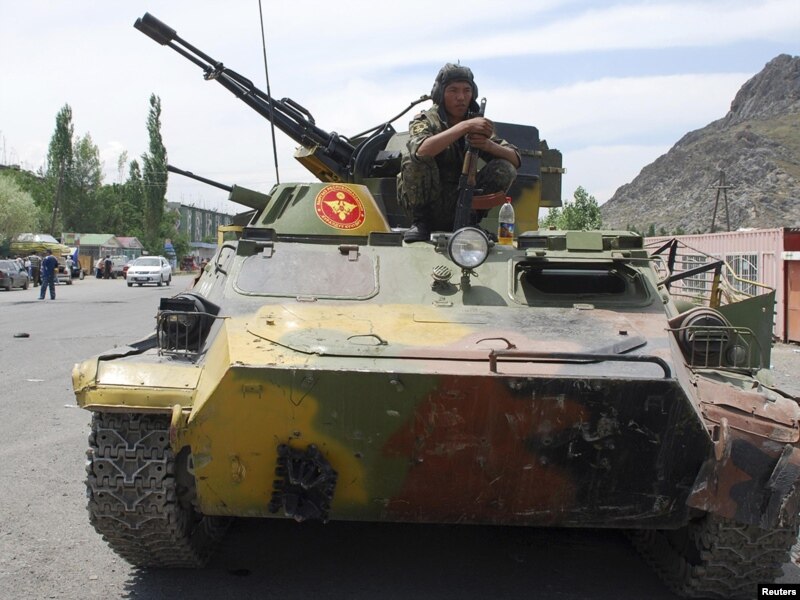
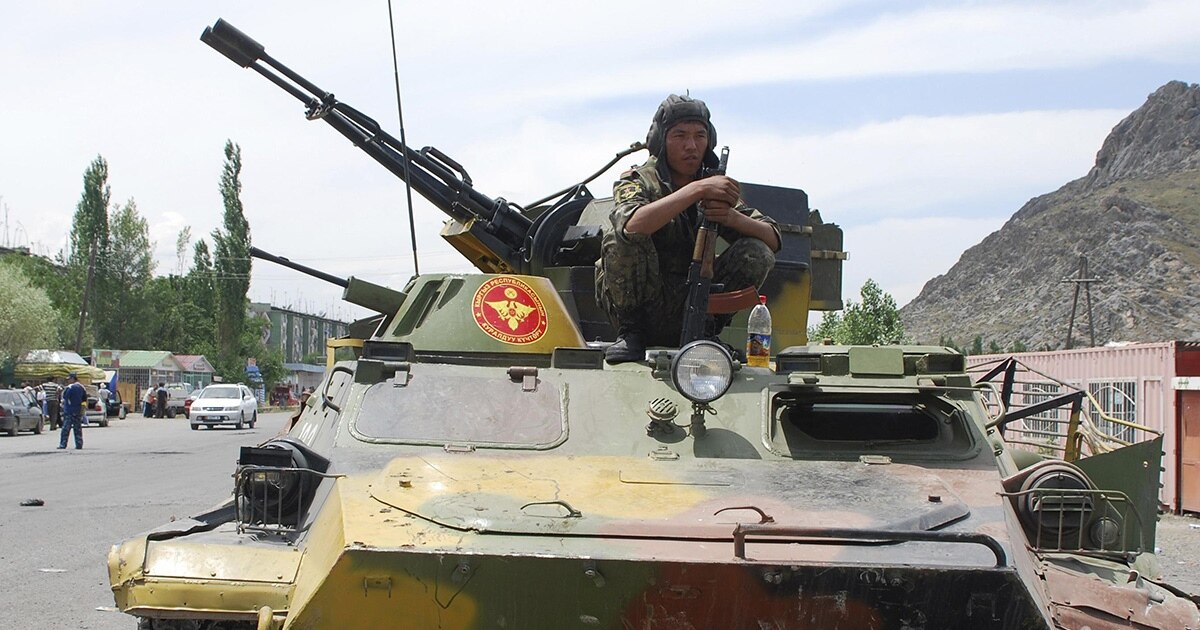
Armenia might join Russia and other ex-Soviet allies in sending troops to Kyrgyzstan to stop continuing ethnic violence there that has killed at least 124 people, senior lawmakers in Yerevan indicated on Tuesday.Kyrgyzstan -- A Kyrgyz serviceman sits on an armoured vehicle in the city of Osh, southern Kyrgyzstan, 15Jun2010
Top security officials from the Collective Security Treaty Organization (CSTO), a Russian-led defense alliance of seven former Soviet republics, met in Moscow on Monday to discuss how to respond to deadly rioting in southern Kyrgyzstan mainly targeting ethnic Uzbeks. Over 100,000 of them have fled to neighboring Uzbekistan in recent days.
National security chiefs from the CSTO member states attending the Moscow meeting reportedly proposed sending helicopters, equipment and possibly troops to the area in order to help the Kyrgyz authorities end the bloody unrest. CSTO Secretary-General Nikolai Bordyuzha presented a joint anti-crisis proposal worked out by them to Russian President Dmitry Medvedev later on Monday.
“They [Kyrgyz authorities] have enough forces today but they do not have enough equipment, helicopters, ground transport ... even fuel,” Bordyuzha said, according to Russian news agencies.
Medvedev called the situation in the volatile Central Asian state “intolerable” and hinted at more aggressive measures, saying he might call an emergency summit of the CSTO “if the situation worsens,” Reuters news agency reported. He told Kyrgyzstan's interim leader Roza Otunbayeva earlier that “everything must be done to stop actions -- within the law, but harshly.”

The interim government appealed to Russia at the weekend to send in troops. Moscow said it would consult with the CSTO, which includes Kyrgyzstan and Uzbekistan as well as Russia, Belarus, Armenia, Kazakhstan and Tajikistan.Kyrgyzstan -- Ethnic Uzbek women cry and plea for help at a refugee camp 10kms outside of Osh in Nariman, 15Jun2010
Armenia was represented at the Moscow meeting by Artur Baghdasarian, the secretary of President Serzh Sarkisian’s National Security Council. His office declined to give any details of the emergency session and chances of Armenian involvement in a possible CSTO peace-keeping mission in Kyrgyzstan.
Senior members of the Armenian parliament did not rule out such possibility. “I think that after the meeting [in Moscow] Russia submitted a certain request to the other CSTO member states,” Hrayr Karapetian, chairman of the parliament committee on defense and security, told RFE/RL’s Armenian service. “The issue must now be discussed by their presidents. Let’s see what happens next.”
“This is an issue that requires detailed discussion,” said Galust Sahakian, the parliamentary leader of President Sarkisian’s Republican Party of Armenia (HHK). “Since Armenia is a member of the CSTO and has obligations, it is possible that there will be troop movements based on a decision to be made by that structure.”
Speaking to RFE/RL’s Armenian service, Sahakian said Armenian troop deployment in Kyrgyzstan will not require parliamentary ratification if it is carried out within the framework of a NATO-style rapid reaction force which the CSTO members except Belarus and Uzbekistan agreed to form in June last year.
The Russian military was due to commit by far the largest number of troops for the Collective Operational Reaction Forces (CORF). Armenian troop contribution to the force is still not clear.
Representatives of Armenia’s leading opposition forces indicated on Tuesday they do not object, in principle, to Armenian participation in a possible CSTO military operation in Kyrgyzstan.
“We have obligations within the CSTO framework, and in case of a particular turn of events, we can provide troops,” said Vladimir Karapetian of the Armenian National Congress. “I think that at yesterday’s meeting Armenia’s authorities received comprehensive information about the events in Kyrgyzstan which is necessary for making the right decision.”Leave a comment:
-
Re: Trouble in Kyrgyzstan
I'm sure the U.N. will come to the rescue . There are claims that the rape and killing of uzbeks were planned and orchestrated.
Anyone know more about the Kyrgyzstan population? I'm ignorant to its ethnic makeup and they look kinda Chinese.
Let's see what's driving the politics here....
The economy depends on agriculture, despite significant supplies of natural resources, including hydropower, oil and gas, and minerals such as gold. A Canadian company – Saskatchewan-based Cameco – has invested heavily in gold operations in the country.
Cotton, tobacco, wool, and meat make up the bulk of what's raised on the land. Only tobacco and cotton are exported in any quantity. Industrial exports include gold, mercury, uranium, natural gas and electricity.
Kyrgyzstan is one of the five "Stans" that are, by virtue of their strategic location next to Afghanistan, a key component of the U.S.-led anti-terror coalition. The others are the republics of Kazakhstan, Uzbekistan, Turkmenistan and Tajikistan.
The "Stans" have other things in common, as well. They sit on some of world's largest untapped oil and gas reserves. And since gaining independence after the collapse of the Soviet Union, they have been led by authoritarian, communist-era strongmen.Last edited by KanadaHye; 06-15-2010, 01:56 PM.Leave a comment:
-
Re: Trouble in Kyrgyzstan
Indeed another case of intentionally badly drawn borders by Stalin. As long as Russia comes out on top, they can both kill each other as much as they wish.Leave a comment:
-
Re: Trouble in Kyrgyzstan
It looks like our troops may soon be sent to Kyrgyzstan...
Ousted Kyrgyz president says he will not return
By the CNN Wire Staff
June 14, 2010 3:19 p.m. EDT
Minsk, Belarus (CNN) -- Ousted Kyrgyz President Kurmanbek Bakiev said Monday that he had no intention of returning to power and hopes to remain in Belarus, Russia's Interfax news agency reported.
Bakiev was ousted in April when violent protests erupted in Bishkek, sparked by higher utility prices and allegations of corruption. He had been under criticism by his opponents for fueling ethnic tensions in the south.
Speaking from Belarus' capital, Minsk, where he lives in exile, Bakiev said he is looking for opportunities with the private sector.
"I am a man from the production sector, and I am examining Belarusian law now. I have yet to consult with Alexander Grigoryevich [Lukashenko, the president of Belarus]. We have already exchanged opinions," Bakiev said in Minsk on Monday.
"I think that, if I am helpful here, I will do something in the production sector. I am not going to engage in politics," he said.
Bakiev also said that peacekeeping forces, under the auspices of the Collective Security Treaty Organization, should be sent to areas of conflict in Kyrgyzstan. The organization comprises Kyrgyzstan, Russia, Armenia, Belarus, Kazakhstan, Uzbekistan and Tajikistan.
"I believe CSTO's Collective Operational Reaction Force could normalize the situation, and this should be done," he said.
According to the International Crisis Group, the former president left a power vacuum that was exploited by different political agendas.
In its April report after the installation of an interim government, the group projected that the economic failure and a collapsing infrastructure generated public resentment and that there were long-term risks of violence.
The International Crisis Group is an independent, nonprofit nongovernmental organization involved in conflict resolution.
Leave a comment:


Leave a comment: