
Re: Why Turkey will never be admitted into the European Union
NO EU NO US!!
yippee, Independent Türkiye!!
(Turkish people think so %60)
-
Re: Why Turkey will never be admitted into the European Union
I don't believe Turkey deserves to join the European union which is why this whole thing is endlessly dragging. They are ignorant and arrogant in thinking they have a chance. The country is run down by greed, poverty, religion and lack of resources. 12yr old kids are let into brothels if they could afford a packet of cigarettes for the pimp's dogs downstairs. They have no moral standards and they think they're good.Leave a comment:
-
 Guest repliedRe: Why Turkey will never be admitted into the European Union
maloom hast chi dari zer mizanee .har 2 taeet00n 1 hastid .keshvar koochike amma na NIROO.motasefam baratoon.Originally posted by Iran Forever View Post
Leave a comment:
-
Re: Why Turkey will never be admitted into the European Union
have a look to my blog of course turkey wouldnt be able now and in the future to enter in eu
Leave a comment:
-
Guest repliedRe: Why Turkey will never be admitted into the European Union
That's WrightLeave a comment:
-
Guest repliedRe: Why Turkey will never be admitted into the European Union
THAT'S WRIGHTOriginally posted by Armenian View Post
Leave a comment:
-
Re: Why Turkey will never be admitted into the European Union
maybe cuz its a terrorist state..Leave a comment:
-
Re: Why Turkey will never be admitted into the European Union
Who let this qunadz in our fourm, hope he gets his ass band soon. And do you know that the people of europe don't want Turkey in it nor do the countries. lolLeave a comment:
-
Re: Why Turkey will never be admitted into the European Union
Sarkozy seems determined.I dont believe he will change just for USA.Leave a comment:
-
Re: Why Turkey will never be admitted into the European Union
The following is what I written within the HAM website last week about Sarkozy's rise as president of France.
In my opinion, Armenians who are applauding Sarkozy's win in France because of his 'anti-Turkish' rhetoric are being somewhat shortsighted and naive.
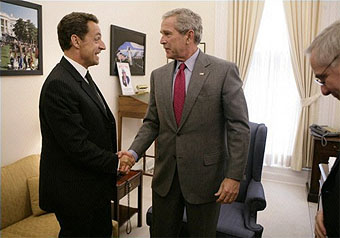
It is quite natural to assume that Sarkozy's J-e-wish roots would have helped shape his overall outlook on life and his approach to politics. It is also obvious that this man in question seems to be very fond of the criminal "Neoconservative" Kabal running the show in Washington DC. Moreover, his anti-Russian, anti-Iranian sentiments are quite pronounced within his political rhetoric. There is also a danger that he might eventually drag France into the bogus "War on Terror" as well.
Take a close look at his recent comment about Russia and America:
After the global chaos and destruction that has been created by the bloodthirsty Kabal in Washington DC how dare this Sarkozy character complain about Russian's actions within Chechnya? Does anyone else see how absurd of a comment this is by him, especially coming from a man that is to lead France?In an interview ahead of the May 6 runoff, Sarkozy said, "If you asked me which of the [two] countries France will have closer relations with - the United States or Russia, known to us for its Chechen war -'the U.S.' would be my answer."
As a result, I fear that his political rhetoric and his foreign policy formulations may in the longterm be actually harmful to Armenia's interests. So, let's not be surprised if in the future Sarkozy "moderates" his anti-Turkish stance - due his greater fears/paranoia over the Arab/Persian Muslim world and his very warm sentiment towards the Kabal in Washington DC. Sarkozy or no Sarkozy Turks would have never been admitted into the European Union. Thus, in the big picture, Sarkozy's win is a potential setback for European politics, not to mention Russian, Iranian and Armenian interests.
I hope I'm wrong but only time will tell.
In related news from Moscow:
Russian analysts warily optimistic over Sarkozy win
Nicolas Sarkozy's victory in France's presidential polls Sunday is unlikely to influence the country's traditionally amicable relations with Russia, but they may lack warmth, Russian analysts said in post-election comments. Conservative Sarkozy won 53% of the vote, against 47% for Socialist Segolene Royal. Sarkozy, who served as finance and interior minister in Jacques Chirac's outgoing government, is an advocate of liberal economic reforms and tough policies on crime and immigration. He opposes further European Union expansion, but is a staunch champion of trans-Atlantic integration. His vision for France's policy regarding Russia is not immediately clear. In an interview ahead of the May 6 runoff, Sarkozy said, "If you asked me which of the [two] countries France will have closer relations with - the United States or Russia, known to us for its Chechen war -'the U.S.' would be my answer."
Speaking to Europe 1 radio, he said that if elected France's next president, he would raise the issue with President Vladimir Putin, as "Russian democracy has progress to make."
The remarks alerted France watchers in Russia, making some predict a chill in the relations with the Kremlin, accused by human rights organizations of abuses in Chechnya, where Moscow has been intermittently waging a war against separatist militants since 1994. Leonid xxxxsky, second in charge of the international relations committee in parliament's State Duma lower house, described Sarkozy's pronouncements on Russia as "dubious."
Strategic Analysis Institute Director Alexander Konovalov, however, downplayed their possible impact on relations between the two countries: "Both Sarkozy and Royal have taken issue with Russia on human rights and European values. But we'll remain among France's major partners, as has historically been the case."
Vyacheslav Nikonov, head of the Politika think tank, said that under Sarkozy, relations will, perhaps, lack the warmth of his predecessor, Chirac.
"Unlike Jacques Chirac, Sarkozy has no close personal relations with the Russian leadership," Nikonov said. "There is no reason therefore to expect a quick rapprochement between Russia and France, especially given that Russia's relations with NATO and the European Union, of which France is part, are far from brilliant."
Chirac has been friends with Putin, and both were allied in their opposition to the U.S. invasion of Iraq in 2003. But Sarkozy, belonging to the same Conservative UMP party as Chirac, seeks to repair the trans-Atlantic rift caused by the Iraq war, and has already signaled to President George W. Bush that Washington could rely on the friendship of France. According to International Security Center Director Alexei Arbatov, "France will be pursuing closer cooperation between the European Union and the U.S., and will support the U.S. in its increasingly aggressive, heavy handed global policies."
Bernard Owen, the head of France's Comparative Elections Study Center, whose own political science research focuses on Russia, said major changes in French-Russian relations are unlikely as "Russia is an important country and one to be reckoned with."
He put Sarkozy's comments on Chechnya down to his lack of knowledge of the real situation.
"Me personally, I think he is not informed well enough about developments in Chechnya," Owen said in a RIA Novosti interview. Senior Russian lawmakers also said French-Russian relations are unlikely to suffer under Sarkozy, but predicted his pro-American stance would make France less independent in its international policies.
"Sarkozy's victory gives reason to believe relations between Russia and France will be at least as steady, but I hope they will develop further," said the speaker of Russia's lower house, Boris Gryzlov. He is the leader of the pro-Kremlin United Russia party, with which Sarkozy's Union pour un Mouvement Populaire has long-standing ties. UMP representatives attended United Russia's national congress last December, at which Gryzlov's party approved an action plan in the lead up to a legislative election set for late 2007.
In France, however, quite a few people seem concerned about where Sarkozy's tough style may leave them. His Socialist rival warned ahead of the runoff ballot that the 52-year-old hardliner would bring in a climate of brutality if elected. Indeed, France's new leader has been hugely unpopular with North African immigrants since he ordered the violent suppression of riots in the fall of 2005 when serving as interior minister. Following Sarkozy's election this Sunday, youths from immigrant communities torched cars and clashed with police in protest. Overnight, about 35 cars were reportedly set on fire in Paris alone, and 79 people were detained for taking part in the protests. According to official French statistics, a total of 172 automobiles were set alight in the central Ile de France province.
Source: http://en.rian.ru/russia/20070507/65039060.htmlLeave a comment:

Leave a comment: