Announcement

Collapse
No announcement yet.

America's Financial Crisis

Collapse
X
 
  • Filter
  • Time
  • Show
Clear All
new posts

  • Armenian
    replied
    Re: America's Financial Crisis

    Walker's World: Could U.S. go bankrupt?



    Is the Fed running out of firepower? Or, to rephrase the question, is it possible that the central bank of the world's biggest economy is becoming overstretched and overwhelmed by the costs of the crisis? If so, does that mean the United States could go bankrupt? The question is becoming urgent, because Tuesday the Fed cut the federal funds rate from an extraordinarily low 1 percent to an unprecedented 0.25 percent, with a prospect of going down to zero. But even such unheard-of steps might not, on recent experience, revive the animal spirits of entrepreneurs and get bankers lending again. Fear still rules the markets. Ben Bernanke, the chairman of the Federal Reserve Board, is trying desperately to keep the good ship capitalism afloat and is deploying heroic, innovative and risky measures to do so.

    The costs are becoming astronomic. Over the course of the last year the Fed's balance sheet has tripled to $2.2 trillion. Like Atlas of the Greek myths, who bore the world pressed down on his shoulders, the Fed is currently holding up the U.S. financial system. It has launched new credit facilities, accepted dubious collateral for loans to banks, arranged currency swaps and generally done things it has never done before in its 95-year history. Under the Term Auction Facility, it has issued $448 billion in liquidity to banks against various securities including Treasury bonds, municipal bonds, AAA securities and so on. Under the Term Securities Lending Facility it has issued $185 billion in Treasury securities to guarantee inter-bank loans, backed by vaguely defined collateral that includes the now-notorious "mortgage-backed securities." Since Oct. 29, when it decided to intervene to unblock the commercial paper market, on which many U.S. corporations depend for operating funds, it has issued $349 billion in net liquidity.

    Under the Commercial Paper Funding Facility it has issued $309 billion and a further $41 billion under the Asset-backed Commercial Paper Money Market Mutual Fund Liquidity Facility. The Fed's balance sheet also shows another $628 billion in assets, much of it in the form of currency swaps, like the special agreement on Oct. 29 to extend $120 billion to Mexico, Singapore, Brazil and South Korea. This followed the $180 billion swap agreement the previous month with the Bank of England and the Japanese, the European, the Canadian and the Swiss central banks. And all this is being done under a veil of secrecy. Citing banking confidentiality, it has rejected a Freedom of Information act request from Bloomberg Television to detail precisely the kinds of collateral it is now accepting and the credit it is issuing. It is also allowing banks to turn a neat arbitraging profit on the funds it lends out to commercial banks at an interest rate of 0.49 percent. The banks then deposit these funds back with the Fed as reserves, on which they receive 1 percent interest. In theory, the Fed's ability to issue credit and supply funds is limitless; they can simply continue to print money or extend guarantees, and they will be backed up by the full faith and credit of the United States.

    In practice, there will come a limit when the markets, foreign or domestic, start questioning the value of that credit and demand much higher interest rates to hold dollars that are visibly declining in value. That has not happened yet, and given the need of the rest of the world's central banks for the U.S. economy to remain afloat, it may never do so. But we are getting into risky and uncharted territory. This expansion of the Fed's balance sheet is but a fraction of the overall exposure. The Fed has said it is prepared to put as much as $2.4 trillion into the commercial paper market (the $349 billion listed above on the balance sheet is the current net position). And at the end of the day, the Fed also stands behind the $1.55 trillion issued by the Federal Deposit Insurance Corporation, and the $950 billion by the Treasury and the $300 billion by the Federal Housing Administration and the $200 billion that has been pledged to Fannie Mae and Freddie Mac. Altogether, more than $7 trillion (or about the wealth that the entire U.S. economy produces in six months) has been committed to the financial crisis by the U.S. government and its agencies. And so far, it has probably stopped a banking collapse, but it can hardly be said to have saved the system.

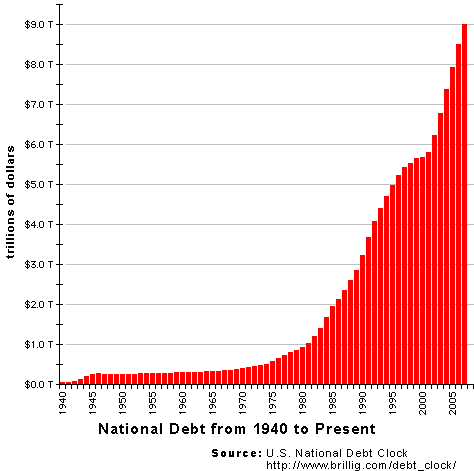
    Currently shrinking at an annual rate of more than 4 percent, the economy is sliding down the slope from recession toward depression. Consumers are on strike. The housing market continues to sink, with new housing starts falling another 19 percent in November. And the world is following the United States down this grim slope, with China reporting drops in exports last week. And now this week China reports that its output of electricity, a reliable indicator of economic activity, fell 9.6 percent in November. The measures currently being taken by the Fed are historic. It never did anything like this during the Great Depression, and the only comparison is with the emergency measures it took to finance World War II. But we are only in the initial stages of this recession, and already the federal debt is heading toward 80 percent of GDP. Back in 1980, it was just over 30 percent of GDP. The last time it was as high as this was the aftermath of World War II, when the debt peaked at 120 percent of GDP. Forget about the war on terror; for the Fed, this is now the war to save the economy.

    Source: http://www.metimes.com/Security/2008...bankrupt/23c6/
    Leave a comment:


  • Armenian
    replied
    Re: America's Financial Crisis

    Originally posted by crusader1492 View Post
    From this list, what do you think, will improve or get worse under the Obama Administation (if anything). I suspect your answer will be somthing along the lines that nothing will change.
    Welcome back. You suspicions are correct. Overall, nothing will change. The team Obama has put together is just as scary as Bush's team, which is natural since there really wasn't an election. Like I have said in the past: the political/financial elite decide what you the people will wear, the people get to decide the color... Anyway, here is an interesting analysis:

    ******************************

    Our $100 Trillion National Debt


    The "official" debt of the United States is only around $10 trillion dollars as of August 6, 2008. This is a manageable number; we could pay it off in a few decades if we quit buying luxuries like food and clothing, and take a few other minor economy measures. Unfortunately, the "$10 trillion" number was produced by government accounting, which among other things allows one to ignore Social Security, Medicare, and the new prescription drug benefit. This is like ignoring rent, food, and utilities in your household budget… it will lead to a few bounced checks. Our real debt is about ten times higher. Who says so? The President of the Dallas Federal Reserve, Richard W. Fisher. In a May speech at the Commonwealth Club of California, he states that the US national debt is close to $100 trillion. You can read his whole speech at the Federal Reserve web site.

    The Real Debt

    Here is what he said regarding the actual US debt: "Add together the unfunded liabilities from Medicare and Social Security, and it comes to $99.2 trillion over the infinite horizon. Traditional Medicare composes about 69 percent, the new drug benefit roughly 17 percent and Social Security the remaining 14 percent." Interested readers will notice that the new prescription drug benefit is projected to be more fiscally crushing than all of Social Security. Mr. Fisher points out that this $99.2 trillion will be a bit of a burden to pay off: "Let’s say you and I and Bruce Ericson and every U.S. citizen who is alive today decided to fully address this unfunded liability through lump-sum payments from our own pocketbooks, so that all of us and all future generations could be secure in the knowledge that we and they would receive promised benefits in perpetuity. How much would we have to pay if we split the tab? Again, the math is painful. With a total population of 304 million, from infants to the elderly, the per-person payment to the federal treasury would come to $330,000. This comes to $1.3 million per family of four—over 25 times the average household’s income." You do have $1.3 million in your pocket, right? What, are you some kind of deadbeat? Speaking of deadbeats, the "$99.2 trillion" estimate does not include the subprime bailout. So for those who like large round numbers, by the end of 2008 the real National Debt should be large, round, and about $100 trillion.

    Other Unfunded Liabilities

    The Fed’s numbers do not include some other liabilities the US has acquired over the years. One massive but unquantifiable liability is the probability of future wars. If it cost the US hundreds of billions of dollars to invade the fifth-rate kleptocracy of Iraq and the foreign-aid regime of Afghanistan, how many trillions would wars against real powers cost? Perhaps I should ask "how many US cities" such wars would cost. Some nations could legitimately plan for peace. Sweden has not fought a foreign war since 1814 (as many Swedes have pointed out in emails regarding my Swiss article). Switzerland, not since 1815. The US record is less hopeful. The US is rarely not in foreign wars, and the current Administration has openly announced that the "Global War On Terror" will never end. Yet our government accounting is predicated on perpetual peace, on an ever-increasing flow of money into the official pyramid schemes. In any case, whether you are pro- or anti- Empire, real accounting demands some reserves for future war contingencies. When even a few US cities are burning radioactive pyres, the flow of funds to Social Security and Medicare will suffer some interruption. Any fiscal plan demands amortization of the accumulated hatred our foreign adventures have accumulated. The US taxpayer has aided every evil dictator since 1945. Stalin, Castro, Pol Pot, Nyerere, Idi Amin, go right down the roster and US money helped pay for the barbed wire and bullets (and the nuclear reactors, in the case of the Kim Dynasty rulers of Korea). So far blowback has been quite mild. But in a world full of easy do-it-yourself WMD technologies, our luck can’t hold forever. If the US were a private company, the "badwill" on our books would reach into the tens of trillions.

    Tearing Up The Credit Cards

    Most likely, the US will simply continue into bankruptcy. This is the most common pathway for nations with fiat currencies and unchecked ruling classes. But let’s assume that somehow a Clone Army of 435 Ron Pauls gets into Congress, while genetic technology brings back Jefferson and Gallatin to their old offices. Can the US be made solvent again? I think so. Most of the unfunded liability is medical. We know why the medical system does not work. So if we eliminate the FDA, guild restrictions on medical professions, and the ridiculous tax laws that force us into medical-insurance serfdom to employers, we could cut medical costs enough to phase out Medicare and the new "drug benefit." In this way more than half the shadow debt can be wiped out. The answer for the Social-Security pyramid scheme is well known. Chile fixed its Social Security disaster decades ago, by giving large IRA-style allowances and phasing out the government payments to younger recipients. The sooner we do this the easier it will be… the Boomers start retiring soon. Most important, we have to listen to the Founder’s calls for free trade with all nations but entangling alliances with none. The US cannot stop every quarrel in the world even if we wished… and the actual record of our foreign-policy geniuses has been to send a couple of trillion dollars out to the very worst criminals in human history. Aid To Dependent Dictators must stop. None of this will happen while Mordor-On-The-Potomac still possesses its plutonium credit card, the Fed. Just as we would for any other bankrupt relative, we must help Uncle Sam cut up his credit cards.

    Source: http://www.lewrockwell.com/walker/walker34.html

    Leave a comment:


  • crusader1492
    replied
    Re: America's Financial Crisis


    Downturn Spurs 'Survival Panic' for Some in the US

    16 Dec 2008

    A paralegal, recently laid off, wanted to get back at the "establishment" that he felt was to blame for his lost job. So when he craved an expensive new tie, he went out and stole one.

    The story, relayed by psychiatrist Timothy Fong at the UCLA Neuropsychiatric Institute and Hospital, is an example of the rash behaviors exhibited by more Americans as a recession undermines a lifestyle built on spending.

    In the coming months, mental health experts expect a rise in theft, depression, drug use, anxiety and even violence as consumers confront a harsh new reality and must live within diminished means.

    "People start seeing their economic situation change, and it stimulates a sort of survival panic," said Gaetano Vaccaro, deputy clinical director of Moonview Sanctuary, which treats patients for emotional and behavioral disorders. "When we are in a survival panic, we are prone to really extreme behaviors."

    The U.S. recession that took hold in December last year has threatened personal finances in many ways as home prices fall, investments sour, retirement funds shrink, access to credit diminishes and jobs evaporate.

    It is also a rude awakening for a generation of shoppers who grew up on easy access to credit and have never had to limit purchases to simply what they needed or could afford.

    Instead, buying and consuming have become part of the national culture, with many people using what is in their shopping bags to express their own identity, from the latest gadgets to designer handbags.

    For those who need to abruptly curtail spending, that leaves a major void, said James Gottfurcht, clinical psychologist and president of "Psychology of Money Consultants," which coaches clients on money issues.

    "People that have been ... identifying with and defining themselves by their material objects and expenditures are losing a definite piece of their identity and themselves," he said. "They have to learn how to replace that."

    Depression Trigger

    Beth Rosenberg, a New York freelance educator and self-professed bargain hunter, said she stopped shopping for herself after her husband lost his publishing job in June.

    She is now buying her son toys from the popular movie Madagascar for $2 at McDonald's, and is wearing clothes that have hung untouched in her closet for years.

    She said it has been stressful to stick to an austere budget after she used to easily splurge on $100 boots. "I miss it," she said of shopping.

    Resisting temptation now could be even more difficult, as struggling retailers roll out massive discounts to lure shoppers during the holiday season.

    Fueled by easy access to credit, a housing market boom and rising investments, U.S. household spending accelerated in much of the past decade while the savings rate declined.

    After the attacks of Sept. 11, 2001 killed thousands and shuttered U.S. financial markets, consumers were encouraged by politicians and business leaders to spend as a way of saving the economy and proving capitalism could not be crushed.

    "We're getting these messages that it is, in effect, patriotic to spend money," said Stuart Vyse, a psychology professor and author of "Going Broke: Why Americans Can't Hold On To Their Money." The United States is deeply dependent on such spending, with consumption generating two-thirds of economic activity.

    But problems arise when consumers become dependent on buying goods and services to cope with their emotions, Vaccaro said.

    "We have difficulty handling our internal emotional state in other ways when we can't do that," he said, prompting some to seek out immediate gratification through drugs or alcohol.

    Violent Behavior

    Besides an increase in shoplifting, psychologists said retailers need to be prepared for more instances of violent behavior like that seen at a Wal-Mart store in Long Island, New York the day after Thanksgiving.

    "I wouldn't be surprised if we see an uptick in crime, related to stealing," said UCLA's Fong. "I wouldn't be surprised if we see more workplace violence and more violence at the malls."

    A throng of shoppers seeking rock bottom prices on flat-screen TVs and computers surged into the Wal-Mart [WMT 55.42 0.18 (+0.33%) ] store in predawn hours, xxxxxling and killing a worker in the process. Fong said many shoppers have never stopped to think about why they were buying items, and it was easy to ignore looking deeper during a boom that support such spending.

    But now, patients that can no longer shop to relieve stress have become anxious or depressed, he said. Others fume: "'I used to be able to afford that, I should be able to afford that now, I deserve that stuff,"' he said.

    But Vaccaro said the downturn could be a time for shoppers to pause and study what they are attempting to achieve or what void they are attempting to fill by spending.

    "We don't buy products, we buy feelings," Vaccaro said. "We're buying the anticipation of the feeling that we think that product or service is going to give us."

    Gottfurcht said he encourages clients to take a walk or do some deep breathing before making a purchase to avoid an impulsive buy. He also recommended that clients keep a journal, noting how they felt when bought an item.

    He said clients should then check the list a week later to see if the "glow" of that purchase has worn off, and it only satisfied an immediate want, not a true need.

    The greater opportunity of the downturn, Vaccaro said, is that it represents a chance to move away from "irrational" and "careless" consumerism toward "a more discerning consumer."

    Copyright 2008 Reuters.

    Leave a comment:


  • crusader1492
    replied
    Re: America's Financial Crisis

    From this list, what do you think, will improve or get worse under the Obama Administation (if anything).

    I suspect your answer will be somthing along the lines that nothing will change.

    Leave a comment:


  • Armenian
    replied
    Re: America's Financial Crisis

    The sick man of the West


    Let's not kid ourselves anymore, America is seriously ill and has been for some time now. The many symptoms of its aliment are quite obvious. In no particular order they are:

    The idiot president in charge.

    Rumsfeld and Cheney.

    Severe abuse of presidential powers.

    Undermining of the US constitution.

    Enron, Bechtel, Halliburton, Black Water...

    Wolfowitz's World Bank scandal.

    The self inflicted wounds on September 11, 2001.

    The self inflicted Anthrax attacks.

    The invasions of Iraq and Afghanistan.

    Chasing of "Al-Qaeda" phantoms in Iraq and Afghanistan.

    The dismemberment of Serbia.

    Bullying of Russia, Venezuela and Iran.

    The continuation of the oppression of Palestinians.

    The introduction of international mercenaries into the ranks of the armed forces.

    Politicians putting the interests of special interests ahead of the people's.

    Washington DC's subservience to Zionists.

    Washington DC's subservience to international corporations and banking institutions.

    Pharmaceutical companies pushing citizens onto drugs.

    The FDA pushing genetically modified foods onto citizens.

    The gradual transformation into a police state.

    Hurricane Katrina.

    The "Beltway Madam's" murder.

    The chronic mismanagement and corruption in Wall Street.

    The Stock Market meltdown.

    The housing market collapse.

    Top executive of poorly managed companies getting multi-million dollar bailouts as workers are put on the streets.

    Rising unemployment, poverty and crime.

    The Federal Reserve.

    Cuts in social services.

    The sensational scandal of governor Blagojevich.

    The unprecedented theft of at least fifty billion dollars by Wall Street tycoon, Madoff.

    Putting armed troops on city streets.

    Controlled news media.

    A fat, lazy, dumb and self-centered population obsessed with consumption.

    Neocons, Clintonites, illegal immigrants, Zionist lobby, oil lobby, Christian Right, racists, liberals, rednecks, blacks, Hispanics, Jews, Asians...

    The list goes on and on.

    Leave a comment:


  • Azad
    replied
    Re: America's Financial Crisis

    zionism cannibalism rhyme

    Alleged Madoff fraud has worldwide exposure
    Victims who sunk cash into veteran Wall Street money manager Bernard Madoff's

    real estate magnate Mortimer Zuckerman
    foundation of Nobel laureate Elie Wiesel
    charity of movie director Steven Spielberg
    Boston-based Robert I. Lappin Charitable Foundation
    New Jersey Sen. Frank Lautenberg charitable foundation
    Philadelphia Eagles owner Norman Braman
    New York Mets owner Fred Wilpon
    Ezra Merkin, the chairman of GMAC Financial Services
    Mortimer Zuckerman, the chairman of real estate firm Boston Properties
    Carl Shapiro, founder of women's apparel company Kay Windsor Inc
    Bed Bath & Beyond Inc. co-founder Leonard Feinstein
    Yeshiva University
    EIM Group; UBS AG; Fairfield Greenwich Advisors; Tremont Capital Management; Maxam Capital Management and Ascot Partners.

    and the list goes

    Leave a comment:


  • Azad
    replied
    Re: America's Financial Crisis

    Looks like the whole "Western" Capitalism is shaking from its roots.
    Won't surprise me if more "Madoofs" will soon be exposed. The honesty of the financial sector is as rotten as our economy. It is no longer that one sector where the bubble is bursting it is the whole American economy that is bursting.

    Leave a comment:


  • Azad
    replied
    Re: America's Financial Crisis

    "The Detroit Three employ 239,000 workers in the U.S. Counting other businesses that depend on the automakers, economists estimate that 2.5 million jobs would be lost if all three companies went out of business."

    That will put the country at around 20% unemployment. Not to mention all other businesses that are feeding from the Auto industry. Chances are they will do some temporary patching .... if not ... watch out, it will be a hell.

    Leave a comment:


  • yerazhishda
    replied
    Re: America's Financial Crisis

    Originally posted by Azad View Post
    Looks like tomorrow the stock market will go to hell .... again.
    Don't be surprised if you see another -700, -800 or even (God forbid) -900 point drop tomorrow.

    Leave a comment:


  • Azad
    replied
    Re: America's Financial Crisis

    Looks like tomorrow the stock market will go to hell .... again.

    $14B auto bailout dies in Senate

    AP – Senate Majority Whip xxxx Durbin, D-Ill., is pursued by members of the press, Thursday, Dec. 11, 2008, …
    WASHINGTON – A $14 billion emergency bailout for U.S. automakers collapsed in the Senate Thursday night after the United Auto Workers refused to accede to Republican demands for swift wage cuts.
    The collapse came after bipartisan talks on the auto rescue broke down over GOP demands that the United Auto Workers union agree to steep wage cuts by 2009 to bring their pay into line with Japanese carmakers.

    Leave a comment:

Working...
X