Announcement

Collapse
No announcement yet.

Non-Judaic Nature of Christ

Collapse
X
 
  • Filter
  • Time
  • Show
Clear All
new posts

  • Armenian
    replied
    Re: Non-Judaic Nature of Christ

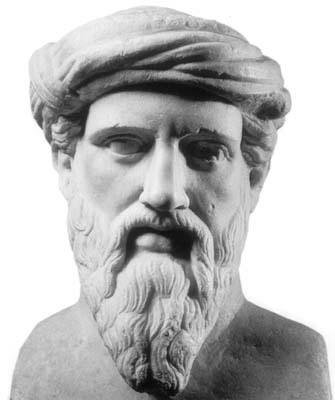
    Another historic figure that I consider to be one of the forerunners of Christ was the Greek mystic/philosopher/scientist Pythagoras.

    Armenian

    ************************************************** *******************

    Pythagoras & Theano
    Apostles & Prophets of the Great Life

    "Pythagoras . . . had himself initiated into the rites and mysteries not only of Greece, but also of foreign countries . . . he learned Egyptian . . . journeyed among the Chaldeans and the Magi'' (Diogenes Laertius, Life of Pythagoras, I, 1).

    Clement of Alexandria declares that Pythagoras was a pupil of Zoroaster and a disciple of the Brahmanas [India] (Clement of Alexandria, Misc., I, xv).

    Hippolytus states that "Pythagoras came to Zaratus the Chaldean, who explained to him that there are two original causes of things . . . two daemons, the one celestial, the other terrestrial'' (Hippolytus, Refutation, I, ii).

    A passage in Herodotus proves that even in 450 B.C.E. it was well known that the Orphic-Bacchic mystery was also Pythagorean and that its funerary customs were Egyptian (Herodotus, Persian War, II, p. 81).

    Pythagoras, and his wife Theano, were great Prophetic ones sent to earth to teach the hidden doctrine. Pythagoras of Samos was born about 569 BC in Samos, Ionia and died about 475 BC. The beliefs that Pythagoras held were:

    * (1) that at its deepest level, reality is mathematical in nature,
    * (2) that philosophy can be used for spiritual purification,
    * (3) that the soul can rise to union with the divine,
    * (4) that certain symbols have a mystical significance, and
    * (5) that all brothers of the order should observe strict loyalty and secrecy.

    J J O'Connor and E F Robertson write:

    "Pythagoras of Samos is often described as the first pure mathematician. He is an extremely important figure in the development of mathematics yet we know relatively little about his mathematical achievements. Unlike many later Greek mathematicians, where at least we have some of the books which they wrote, we have nothing of Pythagoras's writings. The society which he led, half religious and half scientific, followed a code of secrecy which certainly means that today Pythagoras is a mysterious figure. We do have details of Pythagoras's life from early biographies which use important original sources yet are written by authors who attribute divine powers to him, and whose aim was to present him as a god-like figure. What we present below is an attempt to collect together the most reliable sources to reconstruct an account of Pythagoras's life. There is fairly good agreement on the main events of his life but most of the dates are disputed with different scholars giving dates which differ by 20 years. Some historians treat all this information as merely legends but, even if the reader treats it in this way, being such an early record it is of historical importance.

    Pythagoras's father was Mnesarchus, while his mother was Pythais and she was a native of Samos. Mnesarchus was a merchant who came from Tyre, and there is a story that he brought corn to Samos at a time of famine and was granted citizenship of Samos as a mark of gratitude. As a child Pythagoras spent his early years in Samos but travelled widely with his father. There are accounts of Mnesarchus returning to Tyre with Pythagoras and that he was taught there by the Chaldaeans and the learned men of Syria. It seems that he also visited Italy with his father. Little is known of Pythagoras's childhood. All accounts of his physical appearance are likely to be fictitious except the description of a striking birthmark which Pythagoras had on his thigh. It is probable that he had two brothers although some sources say that he had three. Certainly he was well educated, learning to play the lyre, learning poetry and to recite Homer. There were, among his teachers, three philosophers who were to influence Pythagoras while he was a young man. One of the most important was Pherekydes who many describe as the teacher of Pythagoras.

    The other two philosophers who were to influence Pythagoras, and to introduce him to mathematical ideas, were Thales and his pupil Anaximander who both lived on Miletus. In [8] it is said that Pythagoras visited Thales in Miletus when he was between 18 and 20 years old. By this time Thales was an old man and, although he created a strong impression on Pythagoras, he probably did not teach him a great deal. However he did contribute to Pythagoras's interest in mathematics and astronomy, and advised him to travel to Egypt to learn more of these subjects. Thales's pupil, Anaximander, lectured on Miletus and Pythagoras attended these lectures. Anaximander certainly was interested in geometry and cosmology and many of his ideas would influence Pythagoras's own views. In about 535 BC Pythagoras went to Egypt. This happened a few years after the tyrant Polycrates seized control of the city of Samos. There is some evidence to suggest that Pythagoras and Polycrates were friendly at first and it is claimed that Pythagoras went to Egypt with a letter of introduction written by Polycrates. In fact Polycrates had an alliance with Egypt and there were therefore strong links between Samos and Egypt at this time. The accounts of Pythagoras's time in Egypt suggest that he visited many of the temples and took part in many discussions with the priests. According to Porphyry Pythagoras was refused admission to all the temples except the one at Diospolis where he was accepted into the priesthood after completing the rites necessary for admission.

    It is not difficult to relate many of Pythagoras's beliefs, ones he would later impose on the society that he set up in Italy, to the customs that he came across in Egypt. For example the secrecy of the Egyptian priests, their refusal to eat beans, their refusal to wear even cloths made from animal skins, and their striving for purity were all customs that Pythagoras would later adopt. Porphyry in and says that Pythagoras learnt geometry from the Egyptians but it is likely that he was already acquainted with geometry, certainly after teachings from Thales and Anaximander. In 525 BC Cambyses II, the king of Persia, invaded Egypt. Polycrates abandoned his alliance with Egypt and sent 40 ships to join the Persian fleet against the Egyptians. After Cambyses had won the Battle of Pelusium in the Nile Delta and had captured Heliopolis and Memphis, Egyptian resistance collapsed. Pythagoras was taken prisoner and taken to Babylon. Iamblichus writes that Pythagoras (see [8]): ... was transported by the followers of Cambyses as a prisoner of war. Whilst he was there he gladly associated with the Magoi ... and was instructed in their sacred rites and learnt about a very mystical worship of the gods. He also reached the acme of perfection in arithmetic and music and the other mathematical sciences taught by the Babylonians...

    In about 520 BC Pythagoras left Babylon and returned to Samos. lycrates had been killed in about 522 BC and Cambyses died in the summer of 522 BC, either by committing suicide or as the result of an accident. The deaths of these rulers may have been a factor in Pythagoras's return to Samos but it is nowhere explained how Pythagoras obtained his freedom. Darius of Persia had taken control of Samos after Polycrates' death and he would have controlled the island on Pythagoras's return. This conflicts with the accounts of Porphyry and Diogenes Laertius who state that Polycrates was still in control of Samos when Pythagoras returned there. Pythagoras made a journey to Crete shortly after his return to Samos to study the system of laws there. Back in Samos he founded a school which was called the semicircle. Iamblichus [8] writes in the third century AD that:-

    ... he formed a school in the city [of Samos], the 'semicircle' of Pythagoras, which is known by that name even today, in which the Samians hold political meetings. They do this because they think one should discuss questions about goodness, justice and expediency in this place which was founded by the man who made all these subjects his business. Outside the city he made a cave the private site of his own philosophical teaching, spending most of the night and daytime there and doing research into the uses of mathematics... Pythagoras left Samos and went to southern Italy in about 518 BC (some say much earlier). Iamblichus gives some reasons for him leaving. First he comments on the Samian response to his teaching methods: ... he tried to use his symbolic method of teaching which was similar in all respects to the lessons he had learnt in Egypt. The Samians were not very keen on this method and treated him in a rude and improper manner. This was, according to Iamblichus, used in part as an excuse for Pythagoras to leave Samos:-

    ... Pythagoras was dragged into all sorts of diplomatic missions by his fellow citizens and forced to participate in public affairs. ... He knew that all the philosophers before him had ended their days on foreign soil so he decided to escape all political responsibility, alleging as his excuse, according to some sources, the contempt the Samians had for his teaching method. Pythagoras founded a philosophical and religious school in Croton (now Crotone, on the east of the heal of southern Italy) that had many followers. Pythagoras was the head of the society with an inner circle of followers known as mathematikoi. The mathematikoi lived permanently with the Society, had no personal possessions and were vegetarians. They were taught by Pythagoras himself and obeyed strict rules. The beliefs that Pythagoras held were:-

    * (1) that at its deepest level, reality is mathematical in nature,
    * (2) that philosophy can be used for spiritual purification,
    * (3) that the soul can rise to union with the divine,
    * (4) that certain symbols have a mystical significance, and
    * (5) that all brothers of the order should observe strict loyalty and secrecy.

    Both men and women were permitted to become members of the Society, in fact several later women Pythagoreans became famous philosophers. The outer circle of the Society were known as the akousmatics and they lived in their own houses, only coming to the Society during the day. They were allowed their own possessions and were not required to be vegetarians. Of Pythagoras's actual work nothing is known. His school practised secrecy and communalism making it hard to distinguish between the work of Pythagoras and that of his followers. Certainly his school made outstanding contributions to mathematics, and it is possible to be fairly certain about some of Pythagoras's mathematical contributions. First we should be clear in what sense Pythagoras and the mathematikoi were studying mathematics. They were not acting as a mathematics research group does in a modern university or other institution. There were no 'open problems' for them to solve, and they were not in any sense interested in trying to formulate or solve mathematical problems.

    Rather Pythagoras was interested in the principles of mathematics, the concept of number, the concept of a triangle or other mathematical figure and the abstract idea of a proof. As Brumbaugh writes in [3]:-

    It is hard for us today, familiar as we are with pure mathematical abstraction and with the mental act of generalisation, to appreciate the originality of this Pythagorean contribution. In fact today we have become so mathematically sophisticated that we fail even to recognise 2 as an abstract quantity. There is a remarkable step from 2 ships + 2 ships = 4 ships, to the abstract result 2 + 2 = 4, which applies not only to ships but to pens, people, houses etc. There is another step to see that the abstract notion of 2 is itself a thing, in some sense every bit as real as a ship or a house. Pythagoras believed that all relations could be reduced to number relations. As Aristotle wrote:-

    The Pythagorean ... having been brought up in the study of mathematics, thought that things are numbers ... and that the whole cosmos is a scale and a number. This generalisation stemmed from Pythagoras's observations in music, mathematics and astronomy. Pythagoras noticed that vibrating strings produce harmonious tones when the ratios of the lengths of the strings are whole numbers, and that these ratios could be extended to other instruments. In fact Pythagoras made remarkable contributions to the mathematical theory of music. He was a fine musician, playing the lyre, and he used music as a means to help those who were ill. Pythagoras studied properties of numbers which would be familiar to mathematicians today, such as even and odd numbers, triangular numbers, perfect numbers etc. However to Pythagoras numbers had personalities which we hardly recognise as mathematics today:

    Each number had its own personality - masculine or feminine, perfect or incomplete, beautiful or ugly. This feeling modern mathematics has deliberately eliminated, but we still find overtones of it in fiction and poetry. Ten was the very best number: it contained in itself the first four integers - one, two, three, and four [1 + 2 + 3 + 4 = 10] - and these written in dot notation formed a perfect triangle. Of course today we particularly remember Pythagoras for his famous geometry theorem. Although the theorem, now known as Pythagoras's theorem, was known to the Babylonians 1000 years earlier he may have been the first to prove it. Proclus, the last major Greek philosopher, who lived around 450 AD wrote):-

    After [Thales, etc.] Pythagoras transformed the study of geometry into a liberal education, examining the principles of the science from the beginning and probing the theorems in an immaterial and intellectual manner: he it was who discovered the theory of irrational and the construction of the cosmic figures. Again Proclus, writing of geometry, said:-

    I emulate the Pythagoreans who even had a conventional phrase to express what I mean "a figure and a platform, not a figure and a sixpence", by which they implied that the geometry which is deserving of study is that which, at each new theorem, sets up a platform to ascend by, and lifts the soul on high instead of allowing it to go down among the sensible objects and so become subservient to the common needs of this mortal life. Heath [7] gives a list of theorems attributed to Pythagoras, or rather more generally to the Pythagoreans.

    [...]

    Source: http://essenes.net/pythag.html

    Leave a comment:


  • Armenian
    replied
    Re: Non-Judaic Nature of Christ

    Originally posted by Yeznik View Post
    Ah yes, Campbell, the man George Lucas accredited for the idea and concepts of Star Wars.
    And....?

    Star Wars is modern folklore, a contemporary myth, more-or-less based upon humanity's experiences on earth. As a typical zealot you are only concerned with assassination as a means to silence your opposition. You are referring to one of the greatest mind of the twentieth century. You should familiarize yourself with his publications: http://www.wisdom-books.com/Author.a...eferrer=Google

    Leave a comment:


  • Yeznik
    replied
    Re: Non-Judaic Nature of Christ

    Ah yes, Campbell, the man George Lucas accredited for the idea and concepts of Star Wars.

    Leave a comment:


  • Armenian
    replied
    Re: Non-Judaic Nature of Christ

    Originally posted by Lucin View Post
    ...and that leads me to quote this Campbell guy...
    I first got to know of him, many-many years ago, when I saw his now famous six hour television interview in the United States with a well known American journalist and public commentator, William Moyers. The interview was called Joseph Campbell and the Power of Myth. and is now considered to be one of the finest ever recorded. I think Campbell's humility, soft personality, intellectual demeanor and keen understanding of religions and human spirituality captivated a great many of his viewers. He died soon thereafter his interview and has since become a cult of personalities. At the time when I first saw the interview I did not make much of it, although interested I was still an adolescent, nevertheless certain themes, certain elements of his theosophies made a great impression in my mind. Gradually thereafter, I began to see spirituality and religions in a different light, in a more universal light. I set aside religious dogma, tribal divinities, and I began searching for answers. I have not yet found answers. Sadly, life always get in the way of the search. I don't know if I will ever find the answers I am looking for...

    Campbell he has written many books as well, but I advise you to first see or read his Power of Myth interview:


    Quotes from Joseph Campbell's The Power of Myth--an Interview with Bill Moyers

    CAMPBELL: People say that what we're all seeking is a meaning for life. I don't think that's what we're really seeking. I think that what we're seeking is an experience of being alive, so that our life experiences on the purely physical plane will have resonances within our own innermost being and reality, so that we actually feel the rapture of being alive. That's what it's all finally about, and that's what these clues help us to find within ourselves.

    Man should not be in the service of society, society should be in the service of man. When man is in the service of society, you have a monster state, and that's what is threatening the world at this minute. ...Certainly Star Wars has a valid mythological perspective. It shows the state as a machine and asks, "Is the machine going to crush humanity or serve humanity?" Humanity comes not from the machine but from the heart. What I see in Star Wars is the same problem that Faust gives us: Mephistopheles, the machine man, can provide us with all the means, and is thus likely to determine the aims of life as well. But of course the characteristic of Faust, which makes him eligible to be saved, is that he seeks aims that are not those of the machine. Now, when Luke Skywalker unmasks his father, he is taking off the machine role that the father has played. The father was the uniform. That is power, the state role.

    I live with these myths, and they tell me this all the time. This is the problem that can be metaphorically understood as identifying with the Christ in you. The Christ in you doesn't die. The Christ in you survives death and resurrects. Or you can identify that with Shiva. I am Shiva-this is the great meditation of the yogis in the Himalayas...Heaven and hell are within us, and all the gods are within us. This is the great realization of the Upanishads of India in the ninth century B.C. All the gods, all the heavens, all the worlds, are within us. They are magnified dreams, and dreams are manifestations in image form of the energies of the body in conflict with each other. That is what myth is. Myth is a manifestation in symbolic images, in metaphorical images, of the energies of the organs of the body in conflict with each other.

    MOYERS: So when we dream, we are fishing in some vast ocean of mythology that--

    CAMPBELL: ...that goes down and down and down. You can get all mixed up with complexes, you know, things like that, but really, as the Polynesian saying goes, you are then "standing on a whale fishing for minnows." We are standing on a whale. The ground of being is the ground of our being, and when we simply turn outward, we see all of these little problems here and there. But, if we look inward, we see that we are the source of them all.

    MOYERS: In the Christian story the serpent is the seducer.

    CAMPBELL: That amounts to a refusal to affirm life. In the biblical tradition we have inherited, life is corrupt, and every natural impulse is sinful unless it has been circumcised or baptized. The serpent was the one who brought sin into the world. And the woman was the one who handed the apple to man. This identification of the woman with sin, of the serpent with sin, and thus of life with sin, is the twist that has been given to the whole story in the biblical myth and doctrine of the Fall.

    MOYERS: Does the idea of woman as sinner appear in other mythologies?

    CAMPBELL: No, I don't know of it elsewhere. The closest thing to it would be perhaps Pandora with Pandora's box, but that's not sin, that's just trouble. The idea in the biblical tradition of the Fall is that nature as we know it is corrupt, sex in itself is corrupt, and the female as the epitome of sex is a corrupter. ...The idea of the supernatural as being something over and above the natural is a killing idea. In the Middle Ages this was the idea that finally turned that world into something like a wasteland, a land where people were living inauthentic lives, never doing a thing they truly wanted to because the supernatural laws required them to live as directed by their clergy. In a wasteland, people are fulfilling purposes that are not properly theirs but have been put upon them as inescapable laws. This is a killer. The twelfth-century troubadour poetry of courtly love was a protest against this supernaturally justified violation of life's joy in truth. So too the Tristan legend and at least one of the great versions of the legend of the Grail, that of Wolfram von Eschenbach.

    The spirit is really the bouquet of life. It is not something breathed into life, it comes out of life. This is one of the glorious things about the mother-goddess religions, where the world is the body of the Goddess, divine in itself, and divinity isn't something ruling over and above a fallen nature. There was something of this spirit in the medieval cult of the Virgin, out of which all the beautiful thirteenth-century French cathedrals arose.However, our story of the Fall in the Garden sees nature as corrupt; and that myth corrupts the whole world for us. Because nature is thought of as corrupt, every spontaneous act is sinful and must not be yielded to. You get a totally different civilization and a totally different way of living according to whether your myth presents nature as fallen or whether nature is in itself a manifestation of divinity, and the spirit is the revelation of the divinity that is inherent in nature.

    CAMPBELL: Remember the last line [of Babbitt]? "I have never done the thing that I wanted to in all my life." That is a man who never followed his bliss. Well, I actually heard that line when I was teaching at Sarah Lawrence. Before I was married, I used to eat out in the restaurants of town for my lunch and dinners. Thursday night was the maid's night off in Bronxville, so that many of the families were out in restaurants. One fine evening I was in my favorite restaurant there, and at the next table there was a father, a mother, and a scrawny boy about twelve years old. The father said to the boy, "Drink your tomato juice."And the boy said, "I don't want to." Then the father, with a louder voice, said, "Drink your tomato juice." And the mother said, "Don't make him do what he doesn't want to do." The father looked at her and said, "He can't go through life doing what he wants to do. If he does only what he wants to do, he'll be dead. Look at me. I've never done a thing I wanted to in all my life."And I thought, "My God, there's Babbitt incarnate!" That's the man who never followed his bliss. You may have a success in life, but then just think of it-what kind of life was it? What good was it-you've never done the thing you wanted to do in all your life. I always tell my students, go where your body and soul want to go. When you have the feeling, then stay with it, and don't let anyone throw you off.

    MOYERS: What happens when you follow your bliss?

    CAMPBELL: You come to bliss. In these stories, the adventure that the hero is ready for is the one he gets. The adventure is symbolically a manifestation of his character. Even the landscape and the conditions of the environment match his readiness.

    CAMPBELL: Darth Vader has not developed his own humanity. He's a robot. He's a bureaucrat, living not in terms of himself but in terms of an imposed system. This is the threat to our lives that we all face today. Is the system going to flatten you out and deny you your humanity, or are you going to be able to make use of the system to the attainment of human purposes? How do you relate to the system so that you are not compulsively serving it? It doesn't help to try to change it to accord with your system of thought. The momentum of history behind it is too great for anything really significant to evolve from that kind of action. The thing to do is learn to live in your period of history as a human being. That's something else, and it can be done.

    MOYERS: By doing what?

    CAMPBELL: By holding to your own ideals for yourself and, like Luke Skywalker, rejecting the system's impersonal claims upon you...When Ben Kenobi says, "May the Force be with you," he's speaking of the power and energy of life, not of programmed political intentions. The moral, I suppose, would be that the first requirements for a heroic career are the knightly virtues of loyalty, temperance, and courage. The loyalty in this case is of two degrees or commitments: first, to the chosen adventure, but then, also, to the ideals of the order of knighthood.

    Now, this second commitment seems to put Gawain's way in opposition to the way of the Buddha, who when ordered by the Lord of Duty to perform the social duties proper to his caste, simply ignored the command, and that night achieved illumination as well as release from rebirth. Gawain is a European and, like Odysseus, who remained true to the earth and returned from the Island of the Sun to his marriage with Penelope, he has accepted, as the commitment of his life, not release from but loyalty to the values of life in this world. And yet, as we have just seen, whether following the middle way of the Buddha or the middle way of Gawain, the passage to fulfillment lies between the perils of desire and fear.

    The influence of a vital person vitalizes, there's no doubt about it. The world without spirit is a wasteland. People have the notion of saving the world by shifting things around, changing the rules, and who's on top, and so forth. No, no! Any world is a valid world if it's alive. The thing to do is to bring life to it, and the only way to do that is to find in your own case where the life is and become alive yourself.

    We are having experiences all the time which may on occasion render some sense of this, a little intuition of where your bliss is. Grab it. No one can tell you what it is going to be. You have to learn to recognize your own depth.All the time. It is miraculous. I even have a superstition that has grown on me as the result of invisible hands coming all the time-namely, that if you do follow your bliss you put yourself on a kind of track that has been there all the while, waiting for you, and the life that you ought to be living is the one you are living. When you can see that, you begin to meet people who are in the field of your bliss, and they open the doors to you. I say, follow your bliss and don't be afraid, and doors will open where you didn't know they were going to be.

    Leave a comment:


  • Lucin
    replied
    Re: Non-Judaic Nature of Christ

    Originally posted by Armenian View Post
    Complaints about Christianity are primarily due to Semitic elements adopted within it.

    The sacred scriptures of Islam and Judaism (and some aspects of Christianity, by the way of the so-called Judeo-Christian tradition) are essentially childish books comprised of dos and donts. These Semitic traditions are very dogmatic and narrow, as a result making the very notion of God narrow and inflexible as well. The deity of Islam and Judaism is confined to strict rules, a far cry from the nature of a universal creator God.

    Yes. Notions auch as spirituality, divinity, depth and even love have very little place in Islam and Judaism. The scriptures of Islam and Judaism and their teachings are fundamentally based on many ridiculous, stricting and at times, inhuman laws and rules, laws which are ridiculing and undermining people's intelligence (հասկացողութիւն) in my opinion, and that leads me to quote this Campbell guy:

    Originally posted by Joseph Campbell View Post
    Computers are like Old Testament gods; lots of rules and no mercy.
    I didn't know him but his quotes were interesting.
    Last edited by Lucin; 11-09-2007, 09:11 AM.

    Leave a comment:


  • Armenian
    replied
    Re: Non-Judaic Nature of Christ

    Originally posted by Yeznik View Post
    Dude, its Lutow, bustin yur chops.


    Ay kez ban... I should have know I was dealing with a Christian zealot.

    Leave a comment:


  • Yeznik
    replied
    Re: Non-Judaic Nature of Christ

    Originally posted by Armenian View Post
    Yeznik, none of the verbal and rhetorical gymnastics you wrote has any bearing on the topic - namely, the non-Hebraic/Judaic nature and origin of Christ.

    Regarding spiritual guidance: I feel as close to God with my understanding of Christ as you do with your understanding of Christ. When all is said and done isn't that the most important thing? Asking how this or that has gotten me close to God is a silly question. I would like you to debate theology with me and not attempt to become my spiritual counselor.

    Regarding what the Rabbi said: Look at it this way. An Islamic nation someday becomes a global-power and succeeds in subjugating the Christians of the world. Thereafter, Islam takes our Gospels and for centuries gives the Gospels a serious "makeover" to prove that Christ was not God, to prove that Christ was not crucified, to prove that Mohammad was the last prophet of Allah, etc. What would we Christians do as a result - whine like J-ews. The aforementioned is essentially what we have done to Judaism. We have taken their sacred traditions and have done a complete "Yevro-remont" on them for centuries. You saying that unlike us Christians J-ews don't know their sacred traditions is utterly silly, it's absurd. Muslims think they know our Christian traditions better than us. They have even had countless Islamic scholars write countless pages on how erroneous the Christian faith is. Hindus have another take on the matter, J-ews another. The reality is that all can and do play this game of - I know better than you who God is. This is just a silly premise to base your arguments on.

    You are not dealing with the main issue here - theology and how Christian theology is fundamentally different from that of Judaic theology. I am afraid you are stuck in a mode to prove your formula correct and you will refuse to consider any other theological formula/approach. I was also once like you. But gradually I began to see differently. I fought it at first. I was uncomfortable by it. Then I gradually learned to accept it. Now, the realization is an integral part of me. I will never look at the "Old Testament" and "Yahweh" in the same way. And, as I said earlier, I understand Christ better now than I ever have in the past.

    I advise you to be open minded and start asking yourself serious questions. I know its difficult, it's like being told the father you thought you knew all your life is not really your father... Anyway, before you continue your debate I would like you to first seriously reconcile the following core elements within Christianity with Judaism and compare them to Zoroastrianism or other pagan traditions. Perhaps we can take it one at a time:
    Dude, its Lutow, bustin yur chops.

    Leave a comment:


  • Armenian
    replied
    Re: Non-Judaic Nature of Christ

    WHY JUDAISM REJECTS CHRIST


    What exactly is the Messiah?

    The word "Messiah" is an English rendering of the Hebrew word "Mashiach", which means "Anointed." It usually refers to a person initiated into God's service by being anointed with oil. (Exodus 29:7, I Kings 1:39, II Kings 9:3)

    Since every King and High Priest was anointed with oil, each may be referred to as "an anointed one" (a Mashiach or a Messiah). For example: "God forbid that I [David] should stretch out my hand against the Lord's Messiah [Saul]..." (I Samuel 26:11. Cf. II Samuel 23:1, Isaiah 45:1, Psalms 20:6)

    Where does the xxxish concept of Messiah come from? One of the central themes of Biblical prophecy is the promise of a future age of perfection characterized by universal peace and recognition of God. (Isaiah 2:1-4; Zephaniah 3:9; Hosea 2:20-22; Amos 9:13-15; Isaiah 32:15-18, 60:15-18; Micah 4:1-4; Zechariah 8:23, 14:9; Jeremiah 31:33-34)

    Many of these prophetic passages speak of a descendant of King David who will rule Israel during the age of perfection. (Isaiah 11:1-9; Jeremiah 23:5-6, 30:7-10, 33:14-16; Ezekiel 34:11-31, 37:21-28; Hosea 3:4-5)

    Since every King is a Messiah, by convention, we refer to this future anointed king as The Messiah. The above is the only description in the Bible of a Davidic descendant who is to come in the future. We will recognize the Messiah by seeing who the King of Israel is at the time of complete universal perfection.

    1) JESUS DID NOT FULFILL THE MESSIANIC PROPHECIES

    What is the Messiah supposed to accomplish? The Bible says that he will:

    A. Build the Third Temple (Ezekiel 37:26-28).

    B. Gather all xxxs back to the Land of Israel (Isaiah 43:5-6).

    C. Usher in an era of world peace, and end all hatred, oppression, suffering and disease. As it says: "Nation shall not lift up sword against nation, neither shall man learn war anymore." (Isaiah 2:4)

    D. Spread universal knowledge of the God of Israel, which will unite humanity as one. As it says: "God will be King over all the world -- on that day, God will be One and His Name will be One" (Zechariah 14:9).

    The historical fact is that Jesus fulfilled none of these messianic prophecies.

    Christians counter that Jesus will fulfill these in the Second Coming, but xxxish sources show that the Messiah will fulfill the prophecies outright, and no concept of a second coming exists.

    2) JESUS DID NOT EMBODY THE PERSONAL QUALIFICATIONS OF MESSIAH

    A. MESSIAH AS PROPHET

    Jesus was not a prophet. Prophecy can only exist in Israel when the land is inhabited by a majority of world xxxry. During the time of Ezra (circa 300 BCE), when the majority of xxxs refused to move from Babylon to Israel, prophecy ended upon the death of the last prophets -- Haggai, Zechariah and Malachi. Jesus appeared on the scene approximately 350 years after prophecy had ended.

    B. DESCENDENT OF DAVID

    According to xxxish sources, the Messiah will be born of human parents and possess normal physical attributes like other people. He will not be a demi-god, (1) nor will he possess supernatural qualities.

    The Messiah must be descended on his father's side from King David (see Genesis 49:10 and Isaiah 11:1). According to the Christian claim that Jesus was the product of a virgin birth, he had no father -- and thus could not have possibly fulfilled the messianic requirement of being descended on his father's side from King David! (2)

    C. TORAH OBSERVANCE

    The Messiah will lead the xxxish people to full Torah observance. The Torah states that all mitzvot (commandments) remain binding forever, and anyone coming to change the Torah is immediately identified as a false prophet. (Deut. 13:1-4)

    Throughout the New Testament, Jesus contradicts the Torah and states that its commandments are no longer applicable. (see John 1:45 and 9:16, Acts 3:22 and 7:37) For example, John 9:14 records that Jesus made a paste in violation of Shabbat, which caused the Pharisees to say (verse 16), "He does not observe Shabbat!"

    3) MISTRANSLATED VERSES "REFERRING" TO JESUS

    Biblical verses can only be understood by studying the original Hebrew text -- which reveals many discrepancies in the Christian translation.

    A. VIRGIN BIRTH

    The Christian idea of a virgin birth is derived from the verse in Isaiah 7:14 describing an "alma" as giving birth. The word "alma" has always meant a young woman, but Christian theologians came centuries later and translated it as "virgin." This accords Jesus' birth with the first century pagan idea of mortals being impregnated by gods.

    B. CRUCIFIXION

    The verse in Psalms 22:17 reads: "Like a lion, they are at my hands and feet." The Hebrew word ki-ari (like a lion) is grammatically similar to the word "gouged." Thus Christianity reads the verse as a reference to crucifixion: "They pierced my hands and feet."

    C. SUFFERING SERVANT

    Christianity claims that Isaiah chapter 53 refers to Jesus, as the "suffering servant."

    In actuality, Isaiah 53 directly follows the theme of chapter 52, describing the exile and redemption of the xxxish people. The prophecies are written in the singular form because the xxxs ("Israel") are regarded as one unit. The Torah is filled with examples of the xxxish nation referred to with a singular pronoun.

    Ironically, Isaiah's prophecies of persecution refer in part to the 11th century when xxxs were tortured and killed by Crusaders who acted in the name of Jesus.

    From where did these mistranslations stem? St. Gregory, 4th century Bishop of Nazianzus, wrote: "A little jargon is all that is necessary to impose on the people. The less they comprehend, the more they admire."

    4) J-EWISH BELIEF IS BASED SOLELY ON NATIONAL REVELATION

    Of the 15,000 religions in human history, only Judaism bases its belief on national revelation -- i.e. God speaking to the entire nation. If God is going to start a religion, it makes sense He'll tell everyone, not just one person. Throughout history, thousands of religions have been started by individuals, attempting to convince people that he or she is God's true prophet. But personal revelation is an extremely weak basis for a religion because one can never know if it is indeed true. Since others did not hear God speak to this person, they have to take his word for it. Even if the individual claiming personal revelation performs miracles, there is still no verification that he is a genuine prophet. Miracles do not prove anything. All they show -- assuming they are genuine -- is that he has certain powers. It has nothing to do with his claim of prophecy. Judaism, unique among all of the world's major religions, does not rely on "claims of miracles" as the basis for its religion. In fact, the Bible says that God sometimes grants the power of "miracles" to charlatans, in order to test xxxish loyalty to the Torah (Deut. 13:4).

    Maimonides states (Foundations of Torah, ch. 8):

    The xxxs did not believe in Moses, our teacher, because of the miracles he performed. Whenever anyone's belief is based on seeing miracles, he has lingering doubts, because it is possible the miracles were performed through magic or sorcery. All of the miracles performed by Moses in the desert were because they were necessary, and not as proof of his prophecy. What then was the basis of [xxxish] belief? The Revelation at Mount Sinai, which we saw with our own eyes and heard with our own ears, not dependent on the testimony of others... as it says, "Face to face, God spoke with you..." The Torah also states: "God did not make this covenant with our fathers, but with us -- who are all here alive today." (Deut. 5:3) Judaism is not miracles. It is the personal eyewitness experience of every man, woman and child, standing at Mount Sinai 3,300 years ago.

    5) CHRISTIANITY CONTRADICTS J-EWISH THEOLOGY

    The following theological points apply primarily to the Roman Catholic Church, the largest Christian denomination.

    A. GOD AS THREE?

    The Catholic idea of Trinity breaks God into three separate beings: The Father, the Son and the Holy Ghost (Matthew 28:19). Contrast this to the Shema, the basis of xxxish belief: "Hear O Israel, the Lord our God, the Lord is ONE" (Deut. 6:4). xxxs declare the Shema every day, while writing it on doorposts (Mezuzah), and binding it to the hand and head (Tefillin). This statement of God's One-ness is the first words a xxxish child is taught to say, and the last words uttered before a xxx dies.

    In xxxish law, worship of a three-part god is considered idolatry -- one of the three cardinal sins that a xxx should rather give up his life than transgress. This explains why during the Inquisitions and throughout history, xxxs gave up their lives rather than convert.

    B. MAN AS GOD?

    Roman Catholics believe that God came down to earth in human form, as Jesus said: "I and the Father are one" (John 10:30). Maimonides devotes most of the "Guide for the Perplexed" to the fundamental idea that God is incorporeal, meaning that He assumes no physical form. God is Eternal, above time. He is Infinite, beyond space. He cannot be born, and cannot die. Saying that God assumes human form makes God small, diminishing both His unity and His divinity. As the Torah says: "God is not a mortal" (Numbers 23:19).

    Judaism says that the Messiah will be born of human parents, and possess normal physical attributes like other people. He will not be a demi-god, and will not possess supernatural qualities. In fact, an individual is alive in every generation with the capacity to step into the role of the Messiah. (see Maimonides - Laws of Kings 11:3)

    C. INTERMEDIARY FOR PRAYER?

    The Catholic belief is that prayer must be directed through an intermediary -- i.e. confessing one's sins to a priest. Jesus himself is an intermediary, as Jesus said: "No man cometh unto the Father but by me." In Judaism, prayer is a totally private matter, between each individual and God. As the Bible says: "God is near to all who call unto Him" (Psalms 145:18). Further, the Ten Commandments state: "You shall have no other gods BEFORE ME," meaning that it is forbidden to set up a mediator between God and man. (see Maimonides - Laws of Idolatry ch. 1)

    D. INVOLVEMENT IN THE PHYSICAL WORLD

    Catholic doctrine often treats the physical world as an evil to be avoided. Mary, the holiest woman, is portrayed as a virgin. Priests and nuns are celibate. And monasteries are in remote, secluded locations. By contrast, Judaism believes that God created the physical world not to frustrate us, but for our pleasure. xxxish spirituality comes through grappling with the mundane world in a way that uplifts and elevates. Sex in the proper context is one of the holiest acts we can perform. The Talmud says if a person has the opportunity to taste a new fruit and refuses to do so, he will have to account for that in the World to Come. xxxish rabbinical schools teach how to live amidst the bustle of commercial activity. xxxs don't retreat from life, we elevate it.

    6) J-EWS AND GENTILES

    Judaism does not demand that everyone convert to the religion. The Torah of Moses is a truth for all humanity, whether xxxish or not. King Solomon asked God to heed the prayers of non-xxxs who come to the Holy Temple (Kings I 8:41-43). The prophet Isaiah refers to the Temple as a "House for all nations." The Temple service during Sukkot featured 70 bull offerings, corresponding to the 70 nations of the world. The Talmud says that if the Romans would have realized how much benefit they were getting from the Temple, they'd never have destroyed it. xxxs have never actively sought converts to Judaism because the Torah prescribes a righteous path for gentiles to follow, known as the "Seven Laws of Noah." Maimonides explains that any human being who faithfully observes these basic moral laws earns a proper place in heaven.

    Source: http://www.simpletoremember.com/vitals/xxxsandjesus.htm

    Leave a comment:


  • Armenian
    replied
    Re: Non-Judaic Nature of Christ

    Yeznik, none of the verbal and rhetorical gymnastics you wrote has any bearing on the topic - namely, the non-Hebraic/Judaic nature and origin of Christ.

    Regarding spiritual guidance: I feel as close to God with my understanding of Christ as you do with your understanding of Christ. When all is said and done isn't that the most important thing? Asking how this or that has gotten me close to God is a silly question. I would like you to debate theology with me and not attempt to become my spiritual counselor.

    Regarding what the Rabbi said: Look at it this way. An Islamic nation someday becomes a global-power and succeeds in subjugating the Christians of the world. Thereafter, Islam takes our Gospels and for centuries gives the Gospels a serious "makeover" to prove that Christ was not God, to prove that Christ was not crucified, to prove that Mohammad was the last prophet of Allah, etc. What would we Christians do as a result - whine like J-ews. The aforementioned is essentially what we have done to Judaism. We have taken their sacred traditions and have done a complete "Yevro-remont" on them for centuries. You saying that unlike us Christians J-ews don't know their sacred traditions is utterly silly, it's absurd. Muslims think they know our Christian traditions better than us. They have even had countless Islamic scholars write countless pages on how erroneous the Christian faith is. Hindus have another take on the matter, J-ews another. The reality is that all can and do play this game of - I know better than you who God is. This is just a silly premise to base your arguments on.

    You are not dealing with the main issue here - theology and how Christian theology is fundamentally different from that of Judaic theology. I am afraid you are stuck in a mode to prove your formula correct and you will refuse to consider any other theological formula/approach. I was also once like you. But gradually I began to see differently. I fought it at first. I was uncomfortable by it. Then I gradually learned to accept it. Now, the realization is an integral part of me. I will never look at the "Old Testament" and "Yahweh" in the same way. And, as I said earlier, I understand Christ better now than I ever have in the past.

    I advise you to be open minded and start asking yourself serious questions. I know its difficult, it's like being told the father you thought you knew all your life is not really your father... Anyway, before you continue your debate I would like you to first seriously reconcile the following core elements within Christianity with Judaism and compare them to Zoroastrianism or other pagan traditions. Perhaps we can take it one at a time:

    The Holy Trinity (had similar counterparts only within the pagan world)

    The Holy Spirit (appears exclusively within the Christian Gospel and the only other place that such a being is mentioned is within the Zoroastrian Avesta)

    God being all good, not capable of evil (exclusively Zoroastrian in nature)

    The Son of God (a non-J-ewish concept that was ubiquitous within the pagan world)

    The nature and order of the angelic world (exclusively Zoroastrian in nature)

    Proselytizing (exclusivly pagan in nature)

    Nature of the spirit world (exclusivly pagan in nature)

    Sainthood (exclusively pagan in nature)

    Clergy celibacy (exclusively pagan in nature)

    The performance of healing miracles (exclusively pagan in nature)

    The virgin giving birth to God (exclusivly pagan in nature)

    God descending to earth to dwell with mankind (exclusivly pagan in nature)

    God being all-good, compassionate and loving (exclusivly Zoroastrian in nature)

    Last judgment at the end-days (exclusivly pagan in nature)

    Savior of mankind (exclusivly pagan in nature)

    Cleansing and purification rites through water (exclusivly pagan in nature)

    Partaking in a communal meal ritual (pagan/Mithraic in nature)

    The nature of the demonic world, Satan and heaven/hell (exclusivly Zoroastrian in nature)

    Divine numerology, symbolic numbers such as forty, seven, three, twelve, etc (exclusively pagan in nature)
    Last edited by Armenian; 11-08-2007, 07:53 PM.

    Leave a comment:


  • Sip
    replied
    Re: Non-Judaic Nature of Christ

    Originally posted by Illuminator View Post
    Most board members would agree that you're skating on thin ice here
    Why? By making an analogy between those who somehow have this amazing ability to see God in their thoughts to smart humans and the rest of us who aren't as gifted to retards?

    Don't take offense to what I say. After all, I can 100% guarantee you that none of us knows anything for sure when it comes to matters revolving the existence of God. And those who think they know 100% for sure (one way or the other), are most definitely retards. Kind of ironic, isn't it.
    Last edited by Sip; 11-08-2007, 03:11 PM.

    Leave a comment:

Working...
X