Announcement

Collapse
No announcement yet.

Georgian-South Ossetian conflict

Collapse
X
 
  • Filter
  • Time
  • Show
Clear All
new posts

  • crusader1492
    replied
    Re: Georgian-South Ossetian conflict


    Russia Must Withdraw From Georgia Immediately - US' Rice


    LONDON -(Dow Jones)- All Russian forces and irregular units with them must leave Georgia immediately, U.S. Secretary of State Condoleezza Rice said in the Georgian capital Tbilisi Friday.

    Speaking at a joint press conference with Georgian President Mikhail Saakashvili after he had signed a ceasefire deal, Rice said: "With the signing of this accord, all Russian troops, and any paramilitary and irregular troops that entered with them must leave immediately."
    This bitch done gone craaayyyzeee.

    ...TALK TO THE HAND...

    Leave a comment:


  • RSNATION
    replied
    Re: Georgian-South Ossetian conflict

    August 15, 2008
    Blowback From Bear-Baiting

    by Patrick J. Buchanan


    Mikheil Saakashvili's decision to use the opening of the Olympic Games to cover Georgia's invasion of its breakaway province of South Ossetia must rank in stupidity with Gamal Abdel-Nasser's decision to close the Straits of Tiran to Israeli ships.

    Nasser's blunder cost him the Sinai in the Six-Day War. Saakashvili's blunder probably means permanent loss of South Ossetia and Abkhazia.

    After shelling and attacking what he claims is his own country, killing scores of his own Ossetian citizens and sending tens of thousands fleeing into Russia, Saakashvili's army was whipped back into Georgia in 48 hours.

    Vladimir Putin took the opportunity to kick the Georgian army out of Abkhazia, as well, to bomb Tbilisi, and to seize Gori, birthplace of Stalin.

    Reveling in his status as an intimate of George Bush, xxxx Cheney, and John McCain, and America's lone democratic ally in the Caucasus, Saakashvili thought he could get away with a lightning coup and present the world with a fait accompli.

    Mikheil did not reckon on the rage or resolve of the Bear.

    American charges of Russian aggression ring hollow. Georgia started this fight – Russia finished it. People who start wars don't get to decide how and when they end.

    Russia's response was "disproportionate" and "brutal," wailed Bush.

    True. But did we not authorize Israel to bomb Lebanon for 35 days in response to a border skirmish where several Israel soldiers were killed and two captured? Was that not many times more "disproportionate"?

    Russia has invaded a sovereign country, railed Bush. But did not the United States bomb Serbia for 78 days and invade to force it to surrender a province, Kosovo, to which Serbia had a far greater historic claim than Georgia had to Abkhazia or South Ossetia, both of which prefer Moscow to Tbilisi?

    Is not Western hypocrisy astonishing?

    When the Soviet Union broke into 15 nations, we celebrated. When Slovenia, Croatia, Macedonia, Bosnia, Montenegro, and Kosovo broke from Serbia, we rejoiced. Why, then, the indignation when two provinces, whose peoples are ethnically separate from Georgians and who fought for their independence, should succeed in breaking away?

    Are secessions and the dissolution of nations laudable only when they advance the agenda of the neocons, many of whom viscerally detest Russia?

    That Putin took the occasion of Saakashvili's provocative and stupid stunt to administer an extra dose of punishment is undeniable. But is not Russian anger understandable? For years the West has rubbed Russia's nose in her Cold War defeat and treated her like Weimar Germany.

    When Moscow pulled the Red Army out of Europe, closed its bases in Cuba, dissolved the evil empire, let the Soviet Union break up into 15 states, and sought friendship and alliance with the United States, what did we do?

    American carpetbaggers colluded with Muscovite Scalawags to loot the Russian nation. Breaking a pledge to Mikhail Gorbachev, we moved our military alliance into Eastern Europe, then onto Russia's doorstep. Six Warsaw Pact nations and three former republics of the Soviet Union are now NATO members.

    Bush, Cheney, and McCain have pushed to bring Ukraine and Georgia into NATO. This would require the United States to go to war with Russia over Stalin's birthplace and who has sovereignty over the Crimean Peninsula and Sebastopol, traditional home of Russia's Black Sea fleet.

    When did these become U.S. vital interests, justifying war with Russia?

    The United States unilaterally abrogated the Anti-Ballistic Missile treaty because our technology was superior, then planned to site anti-missile defenses in Poland and the Czech Republic to defend against Iranian missiles, though Iran has no ICBMs and no atomic bombs. A Russian counter-offer to have us together put an antimissile system in Azerbaijan was rejected out of hand.

    We built a Baku-Tbilisi-Ceyhan pipeline from Azerbaijan through Georgia to Turkey to cut Russia out. Then we helped dump over regimes friendly to Moscow with democratic "revolutions" in Ukraine and Georgia, and tried to repeat it in Belarus.

    Americans have many fine qualities. A capacity to see ourselves as others see us is not high among them.

    Imagine a world that never knew Ronald Reagan, where Europe had opted out of the Cold War after Moscow installed those SS-20 missiles east of the Elbe. And Europe had abandoned NATO, told us to go home and become subservient to Moscow.

    How would we have reacted if Moscow had brought Western Europe into the Warsaw Pact, established bases in Mexico and Panama, put missile defense radars and rockets in Cuba, and joined with China to build pipelines to transfer Mexican and Venezuelan oil to Pacific ports for shipment to Asia? And cut us out? If there were Russian and Chinese advisers training Latin American armies, the way we are in the former Soviet republics, how would we react? Would we look with bemusement on such Russian behavior?

    For a decade, some of us have warned about the folly of getting into Russia's space and getting into Russia's face. The chickens of democratic imperialism have now come home to roost – in Tbilisi.

    COPYRIGHT CREATORS SYNDICATE, INC.

    Leave a comment:


  • Federate
    replied
    Re: Georgian-South Ossetian conflict

    Yushchenko and Saakashvili are closer than you think!
    ---------------------------------------
    Yushchenko gives refuge to Saakashvili’s family

    Viktor Yushchenko holds Saakashvili's son,
    Nikolaz, during the ceremony of christening.


    Georgian President Mikhail Saakashvili’s wife and two children are reported to have taken refuge in the Ukraine at the holiday home of its President, Viktor Yushchenko.

    Russian newspaper DNI.ru reports that Saakashvili’s wife, Sandra Roelofs, was visiting the Olympics in Beijing with her children when Georgia attacked South Ossetia. But instead of returning to Tbilisi, they decided to stay at Yushchenko’s closely guarded dacha on the Crimean Peninsula.

    The two presidents’ families have a close relationship – Yushchenko is a godfather of Saakashvili’s younger son, while Saakashvili christened one of Yushchenko’s daughters.

    It was earlier reported that Roelofs was set to return to the U.S. and seek help from her psychotherapist. She was said to be stressed by the news of Georgia’s offensive in its breakaway republic of South Ossetia.

    As a result of the attack by the Georgian army, the ancient town of Tskhinvali was almost wiped out and over two thousand people were killed.

    From http://www.russiatoday.com/news/news/29057

    Leave a comment:


  • Armanen
    replied
    Re: Georgian-South Ossetian conflict

    falwell is burning in hell right now and robertson will soon join him there as well, not to mention all the other so called "moral majority" f*cks!

    Leave a comment:


  • RSNATION
    replied
    Re: Georgian-South Ossetian conflict

    Originally posted by Federate View Post
    Some footage of Russians in Poti and Senaki:

    http://news.bbc.co.uk/2/hi/europe/7562962.stm - Senaki and Poti including footage of destroyed Georgian navy

    http://news.bbc.co.uk/2/hi/europe/7562959.stm - Footage of actual detonation of Georgian navy ship in Poti
    Georgia's navy will soon be the same size as Armenia's

    Leave a comment:


  • Federate
    replied
    Re: Georgian-South Ossetian conflict

    Some footage of Russians in Poti and Senaki:

    http://news.bbc.co.uk/2/hi/europe/7562962.stm - Senaki and Poti including footage of destroyed Georgian navy

    http://news.bbc.co.uk/2/hi/europe/7562959.stm - Footage of actual detonation of Georgian navy ship in Poti

    Leave a comment:


  • crusader1492
    replied
    Re: Georgian-South Ossetian conflict

    Russia Seizes Arsenal Of US Weapons In Georgia - Military


    MOSCOW (AFP)--Russian forces have seized a "large arsenal" of U.S.-made weapons in the western Georgian city of Senaki including hundreds of assault rifles, a military spokesman said Friday.

    "In Senaki, we seized a large arsenal of weapons including 664 U.S.-made M-16 rifles" and a number of M-40 sniper rifles, General Anatoly Nogovitsyn told a news conference in Moscow. "There were 1,728 weapons total."
    It seems that the US is becoming more and more culpable in the war crimes directly committed by the Georgians. Coupled with these weapons, if the Russians parade captured American mercenaries to the world, perhaps the west will at least shut up.

    It seems, as of now, that the Russians are losing the propaganda war.

    BTW, speaking of propaganda, I was just watching the "700 club" on TV and the commentator, besides conveying that that the Georgians are angels and the Russians are evil, said that Georgians were the first nation to adopt Christianity...but, he forgot to mention that Georgia has attacked and killed thousands of its fellow Christian neighbors and purposely targeted Churches (hospitals, schools, vital infrastructures) in the combat zone.

    ...SOB neocon fake pious lying scum...what else can you expect from them?

    Leave a comment:


  • North Pole
    replied
    Re: Georgian-South Ossetian conflict

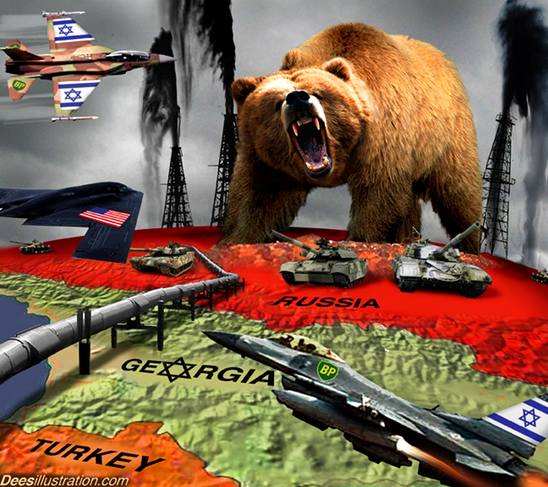
    Russia vs Zionist World.........


    For more information visit: www.rense.com


    Russo-Georgian Conflict Originates With Soros Subversion

    by Dr K R Bolton
    Editor, Restoration

    8-14-8

    George Soros, the currency speculator is one of the primary elements in subverting traditional societies in order that they better fit into a new world order. Soros backs on a world scale what might loosely be termed the contemporary version of the 'New Left'. He brings down governments via subversion, moral rot and revolution through financial patronage, akin to what Jacob Schiff the New York banker did to Russia through the funding of revolutionary propaganda.1 However Soros' revolutions are far more widespread than that of Schiff.

    Soros has established a network of think tanks, lobbies and fronts to promote sundry causes, from feminism and abortion, to narcotics liberalisation and the stream of 'velvet revolutions' that have resulted in 'regime change' throughout the former Soviet bloc. 2

    Soros declares George Bush to be a threat to world peace because of the gung ho gunboat diplomacy Bush directs towards 'rogue states'. But Soros foments more fundamental discord and conflict through his patronage of subversion and revolution. It is significant that he is one of the chief financial backers of Obama's presidential campaign, along with a mass of other plutocrats. Obama is a typical e.g. of how a 'man of the people', America's equivalent to a System Leftist, is fronting for Big Money. 3

    In 2003 Soros targeted Georgian President Eduard Shevardnadze for overthrow. Soros' aim is the destruction of Russia as a world power. Eliminating Russian influence and replacing it with new regimes hostile to Russia is his goal.

    In 2003 Mark MacKinnon writing in the Canadian Globe & Mail succinctly described how Soros applied his revolutionary formulae to overthrowing Shevardnadze, writing of how Soros' Open Society Institute,

    "Sent a 31-year-old Tbilisi activist named Giga Bokeria to Serbia to meet with members of the Otpor (Resistance) movement and learn how they used street demonstrations to topple dictator Slobodan Milosevic. Then, in the summer, Mr. Soros's foundation paid for a return trip to Georgia by Otpor activists, who ran three-day courses teaching more than 1,000 students how to stage a peaceful revolution."4

    The youthful activists are a living e.g. of how the Left has always served the interests of the Money power, whether Bolsheviks, Social Democratic liberals, or strident nihilists of the SDS variety. This was long ridiculed as "right-wing conspiracy theory" but now operates for all discerning people to see, even mainstream journalists.

    Commenting on the "Velvet Revolution"5 that had just passed over Georgia, MacKinnon described the operations that went into play, following the same patterns as they had in other Soros targeted states6:

    "The Liberty Institute that Mr. Bokeria helped found was instrumental in organizing the street protests that eventually forced Mr. Shevardnadze to sign his resignation papers. Mr. Bokeria says it was in Belgrade that he learned the value of seizing and holding the moral high ground, and how to make use of public pressure - tactics that proved so persuasive on the streets of Tbilisi after this month's tainted parliamentary election.

    READ MORE -- http://rense.com/general83/soros.htm

    Leave a comment:


  • Anonymouse
    replied
    Re: Georgian-South Ossetian conflict

    Russia marks its red lines
    By F William Engdahl

    What is playing out in the Caucasus is being reported in the United States media in an alarmingly misleading light, making Moscow appear the lone aggressor after it sent troops into the breakaway Georgian region of South Ossetia following a Georgian offensive on that territory.

    The question is whether President George W Bush and Vice President Bush Cheney are encouraging Georgian President Mikheil Saakashvili to force the next US president to back the North Atlantic Treaty Organization (NATO) military agenda of the current Bush administration. Washington may have badly misjudged the possibilities, as it did in Iraq, and there are even possible nuclear consequences.

    The underlying issue is the fact that since the dissolution of the Warsaw Pact in 1991, one after another former member as well as former states of the Soviet Union have been coaxed and in many cases bribed with false promises by Washington into joining the counter organization, NATO.

    Rather than initiate discussions after the 1991 dissolution of the Warsaw Pact about a systematic dissolution of NATO, Washington has steadily converted NATO into what can only be called the military vehicle of an American global imperial rule, linked by a network of military bases from Kosovo to Poland to Turkey to Iraq and Afghanistan.

    In 1999, former Warsaw Pact members Hungary, Poland and the Czech Republic joined NATO. Bulgaria, Estonia, Latvia, Lithuania, Romania and Slovakia followed suit in March 2004. Now Washington is putting immense pressure on the European Union members of NATO, especially Germany and France, that they vote in December to admit Georgia and Ukraine.

    The roots of the conflict

    The specific conflict between Georgia and the two breakaway regions of South Ossetia and Abkhazia has its roots in the following. First, the Southern Ossetes, who until 1990 formed an autonomous region of the Georgian Soviet Republic, seek to unite in one state with their co-ethnics in North Ossetia, an autonomous republic of the Russian Soviet Republic and now the Russian Federation.

    There is an historically grounded Ossete fear of violent Georgian nationalism and the experience of Georgian hatred of ethnic minorities under then-Georgian leader Zviad Gamsakhurdia, which the Ossetes see again under Georgian President Mikheil Saakashvili. Saakashvili was brought to power with US financing and US covert regime-change activities in December 2003 in what was called the "Rose Revolution". Now, the thorns of that rose are causing blood to spill.

    Abkhazia and South Ossetia - the first a traditional Black Sea resort area, the second an impoverished, sparsely populated region that borders Russia to the north - each has its own language, culture and history. When the Soviet Union collapsed, both regions sought to separate themselves from Georgia in bloody conflicts - South Ossetia in 1990-91, Abkhazia in 1992-94.
    In December 1990, Georgia under Gamsakhurdia sent troops into South Ossetia after the region declared sovereignty. This Georgian move was defeated by Soviet Interior Ministry troops. Then Georgia declared the abolition of the South Ossete autonomous region and its incorporation into Georgia proper. Both wars ended with ceasefires that were negotiated by Russia and policed by peacekeeping forces under the aegis of the recently established Commonwealth of Independent States.

    The situation hardened into "frozen conflicts", like that over Cyprus between Greece and Turkey. By late 2005, Georgia signed an agreement that it would not use force, and the Abkhaz would allow the gradual return of 200,000-plus ethnic Georgians who had fled the violence. But the agreement collapsed in early 2006, when Saakashvili sent troops to retake the Kodori Valley in Abkhazia. Since then, Saakashvili has escalated preparations for military action.

    Critical is Russia's support for the Southern Ossetes. Russia is unwilling to see Georgia join NATO. In addition, the Ossetes are the oldest Russian allies in the Caucasus who have provided troops to the Russian army in many wars. Russia does not wish to abandon them and the Abkhaz, and fuel yet more ethnic unrest among their compatriots in the Russian North Caucasus.

    In a November 2006 referendum, 99% of South Ossetians voted for independence from Georgia, at a time when most of them had long held Russian passports. This enabled Russian President Dmitry Medvedev to justify his military's counter-attack of Georgia on Friday as an effort to "protect the lives and dignity of Russian citizens, wherever they may be".

    For Russia, Ossetia has been an important strategic base near the Turkish and Iranian frontiers since the days of the czars. Georgia is also an important transit country for oil being pumped from the Caspian Sea to the Turkish port of Ceyhan and a potential base for Washington efforts to encircle Tehran.

    As far as the Georgians are concerned, South Ossetia and Abkhazia are simply part of their national territory, to be recovered at all costs. Promises by NATO leaders to bring Georgia into the alliance, and ostentatious declarations of support from Washington, have emboldened Saakashvili to launch his military offensive against the two provinces, South Ossetia and Abkhazia.

    Saakashvili and likely Cheney's office in Washington appear to have miscalculated very badly. Russia has made it clear that it has no intention of ceding its support for South Ossetia or Abkhazia.

    Proxy war

    In March, as Washington went ahead to recognize the independence of Kosovo in former Yugoslavia, making Kosovo a de facto NATO-run territory against the will of the United Nations Security Council and especially against Russian protest, then president (now Prime Minister) Vladimir Putin responded with Russian Duma (parliament) hearings on recognition of Abkhazia, South Ossetia and Transnistria, a pro-Russian breakaway republic in Moldova.

    Moscow argued that the West's logic on Kosovo should apply as well to these ethnic communities seeking to free themselves from the control of a hostile state. In mid-April, Putin held out the possibility of recognition for the breakaway republics. It was a geopolitical chess game in the strategic Caucasus for the highest stakes - the future of Russia itself.

    Saakashvili called Putin to demand he reverse the decision. He reminded Putin that the West had taken Georgia's side. This past April at the NATO summit in Bucharest, Romania, US President George W Bush proposed accepting Georgia into NATO's "Action Plan for Membership", a precursor to full NATO membership. To Washington's surprise, 10 NATO member states refused to support his plan, including Germany, France and Italy.

    They argued that accepting the Georgians was problematic, because of the conflicts in Abkhazia and South Ossetia. They were in reality saying that they would not be willing to back Georgia as, under Article 5 of the NATO treaty, which mandates that an armed attack against any NATO member country must be considered an attack against them all and consequently requires use of collective armed force of all NATO members, it would mean that Europe could be faced with war against Russia over the tiny Caucasus Republic of Georgia, with its incalculable dictator, Saakashvili. That would mean the troubled Caucasus would be on a hair-trigger to detonate World War III.

    Russia threatens Georgia, but Georgia threatens Abkhazia and South Ossetia. Russia looks like a crocodile to Georgia, but Georgia looks to Russia like the cat's paw of the West. Since Saakashvili took power in late 2003, the Pentagon has been in Georgia giving military aid and training. Not only are US military personnel active in Georgia today, according to an Israeli-intelligence source, Debkafile, in 2007 Saakashvili "commissioned from private Israeli security firms several hundred military advisers, estimated at up to 1,000, to train the Georgian armed forces in commando, air, sea, armored and artillery combat tactics".

    It was reported further, "They also have been giving instruction on military intelligence and security for the central regime. Tbilisi also purchased weapons, intelligence and electronic warfare systems from Israel. These advisers were undoubtedly deeply involved in the Georgian army's preparations to conquer the South Ossetian capital Friday."

    Debkafile also reported, "Moscow has repeatedly demanded that Jerusalem halt its military assistance to Georgia, finally threatening a crisis in bilateral relations. Israel responded by saying that the only assistance rendered to Tbilisi was 'defensive'."

    The Israeli news source added that Israel's interest in Georgia had to do as well with Caspian oil pipeline geopolitics. "Jerusalem has a strong interest in having Caspian oil and gas pipelines reach the Turkish terminal port of Ceyhan, rather than the Russian network. Intense negotiations are afoot between Israel, Turkey, Georgia, Turkmenistan and Azerbaijan for pipelines to reach Turkey and thence to Israel's oil terminal at Ashkelon and on to its Red Sea port of Eilat. From there, supertankers can carry the gas and oil to the Far East through the Indian Ocean."

    This means that the attack on South Ossetia is the first battle in a new proxy warfare between Anglo-American-Israeli led interests and Russia. The only question is whether Washington miscalculated the swiftness and intensity of the Russian response to the Georgian attacks of August 8.

    So far, each step in the Caucasus drama has put the conflict on a yet higher plane of danger. The next step will no longer be just about the Caucasus, or even Europe. In 1914 it was the "Guns of August" that initiated the Great War. This time, the Guns of August 2008 could be the detonator of World War III and a nuclear holocaust of unspeakable horror.

    Most in the West are unaware how dangerous the conflict over two tiny provinces in a remote part of Eurasia has become. What is left out of most media coverage is the strategic military security context of the Caucasus dispute.

    Since the end of the Cold War in the beginning of the 1990s, NATO and most directly Washington have systematically pursued what military strategists call nuclear primacy. Put simply, if one of two opposing nuclear powers is able to first develop an operational anti-missile defense, even primitive, that can dramatically weaken a potential counter-strike by the opposing side's nuclear arsenal, the side with missile defense has "won" the nuclear war.

    As questionable as this sounds, it has been explicit Pentagon policy through the last three presidents from father H W Bush in 1990, to Bill Clinton and most aggressively, George W Bush. This is the issue over which Russia has drawn a deep line in the sand, understandably so. The forceful US effort to push Georgia as well as Ukraine into NATO would present Russia with the specter of NATO literally coming to its doorstep, a military threat that is aggressive in the extreme, and untenable for Russian national security.

    This is what gives the seemingly obscure fight over two provinces the size of Luxembourg the potential to become the 1914 Sarajevo trigger to a new nuclear war by miscalculation. The trigger for such a war is not Georgia's right to annex South Ossetia and Abkhazia. Rather, it is US insistence on pushing NATO and its missile defense right up to Russia's door.

    F William Engdahl is author of A Century of War: Anglo-American Oil Politics and the New World Order (Pluto Press) and Seeds of Destruction: The Hidden Agenda of Genetic Manipulation (www.globalresearch.ca. He may be reached through his website, www.engdahl.oilgeopolitics.net.

    (Copyright 2008 F William Engdahl.)


    Particularly illuminating are the portions in bold.

    Leave a comment:


  • Armanen
    replied
    Re: Georgian-South Ossetian conflict

    Ossetia Crisis Should Serve as Lesson for Military-Minded Propositions


    YEREVAN (Armenpress)--Russia's ambassador to Armenia Thursday said that the South Ossetian situation should be a lesson for those opting to resolve conflict through the use of force, and ruled out scenarios like the aftermath of Georgia's attack on South Ossetia, as a means to resolve other conflicts, such as Nagorno-Karabakh.

    “The recent Georgian-Ossetian situation may serve as a good lesson to all countries that want to resolve conflicts through the use of force,” said Ambassador Nikolay Pavlov, speaking at a press conference at the Russian Embassy in Yerevan.

    Pavlov did not comment on official Baku's announcements that Georgia's incursion into South Ossetia served as precedent for “restoring territorial integrity” and resolving conflicts militarily.

    “I do not want to comment on such statement,” said Pavlov, reiterating that the best way to resolve the Karabakh conflict was the continuation of the peace talks under the OSCE Minsk Group's auspices.

    “It is important that negotiations between the two countries continue with foreign ministers and the president of both countries continue to meet with each other. This provides hope that the Karabakh conflict will be resolved peacefully,” said Pavlov.

    Meanwhile, Armenia's Foreign Ministry announced that an additional 1,520 Armenian citizens returned to Armenia from Georgia in the past day, while some 695 foreign citizens were evacuated to Armenia during the said time period.


    Leave a comment:

Working...
X