
Re: America's Financial Crisis
Will the American Car industry survive the coming depression?
It seams the last few reaming industries in America are on the verge of bankruptcy.
GM in 2000 it was trading for around $80.00 today under $5.00
Ford in 2000 was trading at around $40.00 today under $2.00
Chrysler which I believe is privately owned by Cerberus funds is on the block of sale ... again.
What do we have in perspective?
Ford wants to sell its shares in Mazad to acquire some cash before Bankruptcy.
GM and Chrysler are talking on merging, as if two bad apples will make one good apple.
-
Re: America's Financial Crisis
The Party is Over
by Peter Schiff, Euro Pacific Capital | October 10, 2008
More than just a mere liquidity or credit crisis, the current financial storm represents the death throes of the old global economic order, and perhaps the birth pains of a new one. The sun is setting on the borrow and spend culture that has defined us for a generation. Our long ride on the global gravy train is finally coming to an end, and once it does nothing will be the same. The sooner we come to grips with this the better.
Despite the myriad of proposals that are coming from Washington and other world capitals, we must understand that this crisis cannot be cured by governments. In the United States, credit is gone because savings are gone. Our shallow pool of savings has been depleted through bad loans, and we can no longer entice foreigners to lend us their available savings. Given that we are already too loaded up on existing debt they we cannot realistically repay, who can blame them for not wanting to lend us more?
As a result, the free market is trying to put an end to our spending spree. Without savings or home equity to fall back on, Americans struggling with rising prices are finally being forced to cut back. This has terrified our leaders and is causing them to dismantle the remaining structure of our free enterprise-based economic system.
The intention of all these daily federal interventions is to keep the credit spigots open so Americans can go even deeper into debt to buy more stuff they can't actually afford. This should be clear enough to anyone who listens to what our leaders are actually saying. When speaking about the need for an even larger fiscal stimulus package, Barney Frank, chairman of the House Financial Services Committee, said, "We have to prop up consumption." He has it backwards. The government has been propping up consumption for far too long, and the best thing they can do now is remove the props so spending can be replaced by savings.
The sad reality is that we borrowed and spent our way into this crisis, and we are not going to borrow and spend our way out of it. Legitimate credit can only be supplied if there are genuine savings to finance it. Savings can't be magically concocted into existence by a printing press, but can only be created by consumers who spend less than they earn. Efforts to fool the market will not work and will ultimately lead to a monetary disaster and runaway inflation.
Were the government to allow market forces to work, Americans would now have to pay cash for their consumption. That would mean no instant credit for new cars, plasma TVs, appliances, consumer electronics, clothing, furniture, etc. Unless buyers actually had the cash in their checking accounts these purchases would have to be deferred. From an economic perspective this is precisely what the doctor ordered. But for an economy based 72 percent on consumer spending, the medicine will go down hard.
Ultimately, a serious reduction in consumer and mortgage credit, combined with an increase in personal savings, would again provide a pool of needed capital for businesses to produce products and provide employment opportunities. However, the danger is that this potential credit could be completely crowded out by massive borrowing by the Federal Government. In addition, prices for such things as houses and college tuition will fall sharply, as the credit artificially propping them up disappears. People would still be able to buy houses and send their kids to college only they would pay much lower prices when they do.
However, if the government keeps creating inflation to artificially sustain consumer borrowing and spending, there will be no savings left to fund anything and prices will be so high that despite massive consumer spending there will be few goods that Americans could actually afford to buy.
Leave a comment:
-
Re: America's Financial Crisis
Americas Bubble Economy: Profit When It Pops
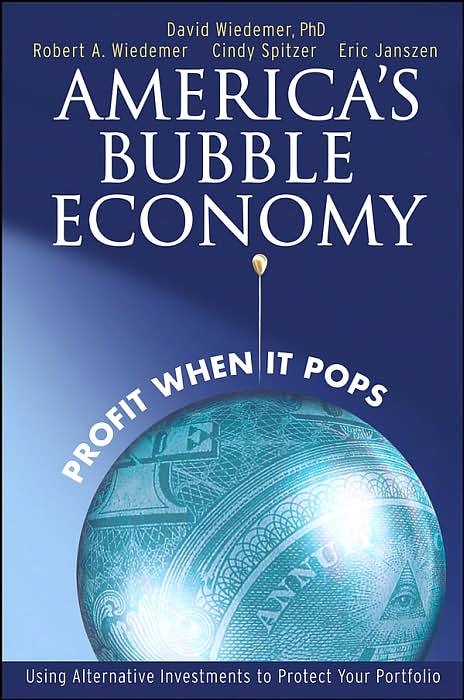
America’s Bubble Economy Top 10 Strategies for Staying Afloat: http://www.americasbubbleeconomy.com...port100306.pdf
A timely guide to creating wealth during the impending financial crisis
Americas Bubble Economy explains what drove the bubble to grow, when and why it will burst, who will win and lose, and how to cash in on the tremendous financial opportunities it will create. It provides clear and compelling evidence that the stock market and the dollar are both bubbles that, like the internet bubble of 1999, will inevitably pop in the next 2-5 years. The book puts the perfect storm of economic crisis in the much larger context of the overall evolution of money and society and offers a realistic assessment of the current business climate with suggestions for rational management in challenging times. It shows readers what to do right now to protect assets and position themselves to make huge profits in foreign currencies, the stock market, gold, and other strategies for cashing in on what will be the biggest transfer of wealth in human history. While most people ignore the warning signs, those who move quickly and correctly can position themselves now to profit from what will be the greatest financial opportunity of the coming decade. Instantly engaging and crystal clear, America’s Bubble Economy: Profit When It Pops, cuts through the denial about our over-valued dollar, over-hyped stock market, over-priced real estate, crushing consumer debt, tremendous trade deficit, and astronomical government debt, upon which the US, European, and Asian economies now depend. More importantly, America’s Bubble Economy offers priceless, truly original insights for protecting assets and creating tremendous wealth for ordinary people (not just the fabulously wealthy) during the coming financial crisis. The book also illuminates how this unique moment fits into the broader evolution of money and society.
About the authors
John David Wiedemer, PhD, is a groundbreaking evolutionary economist who created the rigorous economic analysis on which this book is based. He received a PhD in economics from the University of Wisconsin-Madison. Dr. Wiedemer has held senior management positions with several Washington, DC area high technology companies and holds 13 domestic and international patents on information technology. Robert A. Wiedemer brings to the team the real world business knowledge and investment understanding that comes from founding a NASDAQ listed information services company. He is currently President of a business valuation firm that is the primary business valuation advisor for the U.S. Small Business Administration’s Small Business Investment Company division (the largest fund of venture capital funds in the world). Cindy Spitzer is an award-winning writer who has contributed to the Washington Post, Los Angeles Times, Chicago Tribune, Newsweek, and many other publications and books, including the original Chicken Soup for the Soul. This time, she has made dry, complex economics clear, understandable, and even enjoyable to read. Eric Janszen is one of the nation’s leading financial bubble experts, having written extensively on the Internet bubble and developed the popular Web site, iTulip.com, which has been praised by the New York Times, BusinessWeek, National Public Radio, and CNBC. He has also been CEO of two venture backed companies and Managing Director of Osborn Capital from 1998 to 2001. On his itulip web site he called the top of the dot com bubble in March 2000 and recommended moving from cash to gold in 2001 when gold bottomed.
Source: http://www.researchandmarkets.com/re...t_when_it_popsLeave a comment:
-
Re: America's Financial Crisis
Russia's Stock Market long known as the playground for the nation's oligarchs have suffered immensely as a result of the global financial meltdown started in the US. However, the overall economy of the Russian Federation, jump started several years ago by petrodollars, continues to perform well.
Armenian
***************************
Putin: US image damaged forever over economy woes

The financial crisis has irreparably damaged the image of the U.S. as the leader of the free world and the global economy, Russian Prime Minister Vladimir Putin said Thursday. Putin's remarks during a Communist Party meeting were the latest Russian attack singling out the U.S. as the chief culprit in the global financial turmoil. "Trust in the United States as the leader of the free world and the free economy, and confidence in Wall Street as the center of that trust, has been damaged, I believe, forever," Putin said. "There will be no return to the previous situation." Putin and President Dmitry Medvedev have repeatedly accused the U.S. of responsibility for the crisis and called for changes in the world financial system. Finance ministers of the G-7 — the United States, Canada, Britain, France, Germany, Italy and Japan — meet beginning Friday in Washington. When Russia joins the group for political discussions, it becomes the G-8.
Source: http://ap.google.com/article/ALeqM5h...SeI4AD93N6OBG1
Russian Economy Has Very Strong Foundation - Pwc

PricewaterhouseCoopers (PwC) believes the current situation in the Russian economy differs from what is taking place in the West, Peter Gerendasi, PwC general director and managing partner in Russia, told journalists in Kazan on Thursday. PwC feels the economic foundation in Russia is very strong and the only problem that needs to be resolved quickly is an increase in liquidity in the banking system, he said. The current share prices on the Russian market are very low - speculatively low - and do not reflect the actual value of the companies, he said. Gerendasi said PwC supports the steps the Russian government is taking to bolster liquidity and hopes they will produce a positive effect. All the actions and changes the government plans to make need to be done quickly to receive the most positive effect possible, he said. It is difficult to predict how the situation will unfold further, he said. Gerendasi said he thinks the turbulence will continue on the market for a while longer, but said he is hoping to see some positive changes within a year. Gerendasi and Tatarstan Prime Minister Rustam Minnikhanov signed an agreement on cooperation between PwC and the republic in Kazan on Thursday.
Source: http://www.istockanalyst.com/article...d_2695543.html
Budget Surplus Tops 2 Trillion Rubles

The surplus in the Russian federal budget from January to September exceeded 2.5 trillion rubles (8.1 percent of the GDP), RIA Novosti reports, citing Finance Ministry data. A year ago at the same time, the surplus was slightly over 1.6 trillion rubles. Income to the Russian budget was 7.2 trillion rubles in that period this year, which is almost 80 percent of the plan for the entire year. Expenditure reached 4.6 trillion rubles, or 61.1 percent of plan.
The consolidated budget, that is the combined federal and regional budgets, topped 2.5 trillion rubles in surplus at the beginning of September. It was also notable that the biggest expense in the first half of the year was defense. Russia receives is main income from the Federal Tax Service, which put 3.2 trillion rubles in state coffers, and the Federal Customs Service, which contributed 3.5 trillion rubles.
Source: http://www.kommersant.com/p-13385/fe...udget_surplus/
Russian firms to get up to $50 bln to refinance foreign debt

Russia's government is to allocate up to $50 billion for companies to refinance their foreign debt, Prime Minister Vladimir Putin said on Friday. "Up to $50 billion is being earmarked to refinance borrowings made by Russian companies abroad," Putin told a cabinet meeting. He said the state-run VEB bank would broker the transactions. Putin also said the government had decided to place up to 175 billion rubles ($6.7 billion) in Russian securities in 2008 and the same sum in 2009, with VEB being the operator. The Russian premier said the government was drafting a bill to provide subordinated loans of up to 950 billion rubles ($36 billion) to banks for 10 years. "These funds will be used to increase banks' capitalization and to solve liquidity problems," Putin said at a cabinet session. On October 7, President Dmitry Medvedev said at an economic conference that the government would issue banks a $36 billion subordinated loan for at least five years. Russia's financial system has been affected by a global credit crunch which started in the U.S. and quickly spread to Asia and Europe leading to record losses on Russia's financial markets, rising interest rates and a liquidity shortage.
Source: http://en.rian.ru/business/20081010/117663950.html
In related news:
Iceland turns to Russia for bailout

Russia has agreed to bail out Iceland by granting this small island state a huge stabilization loan at an unbelievably low interest rate. Is it an act of wanton generosity, or a far-sighted geopolitical step? And in general, four billion euros, is it a lot or a little? The fate of Iceland has until recently not concerned Russia one bit. Now only a lazy person is not discussing the incredible sum the "island of stability" is going to inject into the economy of a sinking island of geysers. Europe has meanwhile been discussing Iceland for a long time. Hedge-fund country, an example of liberal economic regulation and a model of a rapidly developing economy, Iceland was the first in the world to feel the impact of a full-bodied economic crisis. This happened at the end of 2007. Since this year began, Iceland's currency - the krona - has lost one-third of its value against the euro. Iceland's leading banks - Kaupthing, Glitnir and Landsbanki - have been marauded by international financial sharks. At the end of September, the country's authorities bought out (read, nationalized) Glitnir bank, and on October 7 Landsbanki, while on the same day Kaupthing bank received a 500 million euro loan from Iceland's National Bank. By the autumn of 2008 it had become clear Iceland might become the world's first country to suffer a default.
Why is the bubble of Iceland's economy bursting so loudly? It ballooned too rapidly, the IMF believes. In 2003-2007, the country's GDP had risen by 25%, with this robust growth fed mainly by outside borrowing. To attract foreign investments, the authorities strengthened the currency and ratcheted up interest rates (by the beginning of 2008, they were the highest in Europe - 15.5% per annum). The result was a monstrous misbalance: a modest GDP, on the one hand, and immense financial assets and tremendous liabilities, on the other. According to 2007 figures, Iceland's GDP was $16 billion, while its financial assets stood at 1,000% of GDP and an external debt of 550% of GDP. With Iceland teetering on the brink of default, Russia's stabilization loan of four billion euros is a lifebelt, and a very sizeable one (on the evening of October 7, Finance Minister Alexei Kudrin acknowledged Russia's readiness to pay, although previously he had denied such claims by Iceland's National Bank). Judge for yourself: when, in May 2008, Iceland was drowning, the central banks of three Scandinavian countries - Sweden, Denmark and Norway - set up a special $2.3 billion rescue fund for Iceland. Now Russia alone is ready to fork over two and a half times as much for the same purpose. In other words, four billion euros by Iceland's standards is substantial.
In Russian eyes, it is a vast sum, too. And one pledged at a very fair rate. To judge from a release issued by Iceland's National Bank, Russia promised it at LIBOR+(0.3-0.5)%. This compares with LIBOR+1% at which the Russian Central Bank wants to offer loans to Russia's Vnesheconombank. At a time when Russian authorities hold crisis emergency meetings almost daily, this looks strange, to say the least. The man in the street would say this is no time for liberal loans when one's own existence is at stake. This man's response would not be quite right, in my opinion. There are several reasons why Russia should agree to issue the loan to Iceland. The first and overwhelming one is geo-economic. Leaders in many countries are gradually beginning to understand that a world caught in the maelstrom of a financial crisis could be saved only by cooperative efforts. This was a theme running through a three-day world policy conference in Evian; it will certainly be taken up at an annual meeting of the International Monetary Fund and World Bank.
WB chief Robert Zoellick only recently proposed that the G8 also include BRIC countries (Brazil, Russia, India and China), Mexico, Saudi Arabia and South Africa. World leaders more and more often speak of the need to shelve personal ambitions, put away political squabbles and do something. To come to the aid of Iceland at such a time has been for Russia a decision prompted by stark necessity. Russia has a rich war chest of windfall oil money. By the end of September, its Central Bank had $566 billion in international reserves, and $32-plus billion in the National Welfare Fund and the Reserve Fund. Of course, Russia could sit it out on its "island of stability" and fight the crisis within its four walls. But in this case Russia risks suddenly discovering that the global financial storm whipped up even further by Iceland's hurricane has wiped out all its stockpiled reserves. Most of Iceland's lenders are European banks. Should Iceland declare a default, the whole of Europe would go into a spin, and would drag Russia after it, which now has a chance to scrape its way out of the crisis the cheap way. It emerges that by saving Iceland, Russia is saving itself first. Other considerations are less global and more pragmatic. Crises come and go, but allies (sometimes) remain.
Iceland, a rapidly developing economy and a happy hunting ground for businessmen from many European countries, is certain to remember this gesture and take more kindly to Russian investments in the future. So far, Russia-Iceland trade has been $100 million per year. And it was only shortly before the crisis that Russian business (represented by Roman Abramovich and Oleg Deripaska) began exploring the country's investment possibilities. Now the price for entering Iceland's economy could prove very low. Besides, it makes a good staging post for flights to Latin America.
Source: http://en.rian.ru/analysis/20081010/117659587.htmlLeave a comment:
-
Re: America's Financial Crisis
Political Power and Economic Ignorance
Daily Article by Jeremie T.A. Rostan | Posted on 10/9/2008
Georges Bush's recent speech in defense of his bailout plan was quite a tour de force. Indeed, it managed to explain the pending recession of the US economy by a previous situation of "easy credit" without mentioning the monstrously inflationist policy of the Federal Reserve — which reached its climax in 2003 and 2004, when it lent dollars at a negative short-term interest rate, and resulted in the creation of more dollars in a seven-year period (2000–2007) than had been created cumulatively in the two centuries since the founding of the United States.
According to the 43rd President, the fault rests entirely on "foreign investors" willing to profit from the competitiveness of the US economy. Logically, the lengthening of the structure of production brought by net investment should have resulted in aggregate profits and economic growth — but not this time. For some reason (which the president deems useless to explain) low interest rates were a curse that somehow led all financial entrepreneurs to dissipate their capital in hopeless ventures and loans.
Because of fractional-reserves policies and the de facto international dollar standard, even the billions of units of the US currency spent abroad are duplicated and sent back to America, where they encourage credit. But George Bush did not mention that.
Finally, he concluded that
- the Federal Reserve should have its powers extended far beyond their current scope, notably over all financial enterprises, not just banks, and
- a massive bailout of taxed funds was necessary — as an exceptional intervention and some sort of public investment which would help the economy recover and be paid afterwards.
Economic knowledge and political ignorance
As Carl Menger explained, men's knowledge of the causal connections between natural phenomena determines the extent to which they control their own lives.[1] The outcome of their actions is only partly the product of individuals. It also depends on other factors that they do not know how to (or do not have the power to) employ as means towards their ends. Indeed, their knowledge only determines the extent to which men control their own lives theoretically. Practically, their actual control depends on the capital they have accumulated.
Conversely, men's ignorance of the causal connections between natural phenomena — as well as their preference, ceteris paribus, for present satisfactions, which limits their saving — determines the extent to which they do not control their own lives, but rather depend for the satisfaction of their needs on side causes present in their environment.The causal connection between the increasing employment of higher-order goods and the increasing quantity (or quality) of 1st-order goods produced lies in the fact that the first increases the number of factors of a given causal process of production that have goods-character — i.e., extends to less proximate ones our power to direct its various factors to the satisfaction of our needs.[2]
We can extend this Mengerian analysis and say that men's ignorance of the causal connections between human actions determines the extent to which their control over their own lives and striving towards its improvement is limited by the present side effects of past political interventions.
Indeed, the less they grasp their future consequences, the more they tend to favor policies that seem to permit the immediate attainment of their ends — through coercion.
There is a TV commercial that says, "Imagine if firefighters ruled the world." We see Congress, packed with firefighters, one proposing policies, the others supporting them unanimously. It seems so obvious!
"Do you want more schools?"
"Yeah!"
"Do you want health care for everyone?"
"Yeah!"
It only takes thirty seconds. Then the chief concludes joyfully, "That's the easiest job I have ever had…"
Is it not that obvious and that easy? Do we want jobs for everyone? Then let's make it illegal to fire employees. Do we want everyone to be rich? Then let's distribute wealth…
Yes, we may in fact all share the same goals, in the sense that Ludwig von Mises pointed out: interventionists and partisans of laissez-faire seek the same general and "obvious" ends. But as the author of Human Action noted, the laissez-fairists do not advocate the same means, because the policies promoted by the interventionists overlook two things:
- the causes of the evils they pretend to fight
- their own future consequences
The causes of the present evils are the effects of similar interventionist policies of the past. The future consequences of present interventionist policies are similar to (but worse than) the present evils they fight.
Still, so complete a lack of understanding is all too common — not only on the part of "the man in the street," but also among those who pretend to teach economics.
You will not believe what I found in an "Advanced Placement" economics test, only a few days ago.
The following is number 7 of a series of "macroeconomics" multiple choice questions:[3]
To counteract a recession, the Federal Reserve should
- A. raise the reserve requirement and the discount rate
- B. sell securities on the open market and raise the discount rate
- C. sell securities on the open market and lower the discount rate
- D. buy securities on the open market and raise the discount rate
- E. buy securities on the open market and lower the discount rate
And the answer is supposedly E.
Notice that the question is not, "Should the Federal Reserve do anything, and if so, what?"
No, the question assumes that the Federal Reserve should do something.
What this question really asks is, what intervention of the Fed will have the immediate effect of stopping a recession? It does not ask, what are the causes of recessions? It does not ask, what will be the long-term effects of the Fed's actions?
From such a perspective, it does seem obvious that aggregate losses today mean diminishing economic activity, compared to the previous period, and a policy of inflation that pumps into the economy the equivalent of the aggregate loss will permit us to maintain as high a level of economic activity as before. And such a policy is "easy": the Federal Reserve only has to turn out more green bills.
But this will only "counteract the recession" and maintain the economic activity, immediately — i.e., it will not maintain it at all. On the contrary, it will result in a new recession — more distant in time, but worse than the present one — which a similar policy originated in the past.
Not all "experts" agreed. One commentator on CNN even acknowledged that the impending recession was a consequence of Alan Greenspan's "lax money policy."
Nevertheless, if some grasped the connection between these present effects and that past cause, few of them seem to have grasped that resorting to the same policies at present will necessarily have the same consequences in the future: to delay the recession, and worsen it.
Is there anything we can learn from such demonstrations of ignorance?
Conclusion: The Iron Law of Economic Ignorance
The worse and more widespread the ignorance of the causal connections between human actions, the higher the level of political intervention in society. The more one understands the causal connections between human actions and grasps the effects of political interventions, the more one opposes the more "obvious" and "easy" policies.
George Bush was certainly the spokesman of a more common attitude when he argued that, even if he opposed interventionism "as a general rule," he favored (as an exception) a massive taxation and inflation plan, because of exceptional circumstances. This only proves a lack of understanding of the fact that a causal connection is a necessity — even in "abnormal" conditions. Once we understand that causes of the same type have always and everywhere the same type of effects, we have to extend to all cases the praxeological principle according to which more of the same type of intervention only delays and worsens the evils it supposedly counteracts.
There is a sad irony to economic ignorance — on top of its disastrous effects. Let's call it the Iron Law of Economic Ignorance: the value of economic knowledge increases with its scarcity. That is, economic knowledge gets more valuable as the economy worsens; but the economy worsens according to the level of political intervention — which is a function of economic ignorance.
Leave a comment:
- the Federal Reserve should have its powers extended far beyond their current scope, notably over all financial enterprises, not just banks, and
-
Re: America's Financial Crisis
Tomorrow (Friday) will be probably the worst disaster for Wall Street. In 12 hours, we will see.
"TOKYO - A massive sell-off on Wall Street and an escalating global equity crisis sent Asian stocks plunging Friday, with Japan's benchmark Nikkei 225 index tumbling more than 10 percent.
"Selling is unstoppable in New York and Tokyo," said Yutaka Miura, senior strategist at Shinko Securities Co. Ltd. in Tokyo. "Investors were gripped by fear."
Leave a comment:
-
Re: America's Financial Crisis
The 2nd Gilded Age is upon us. It will be much worse than the first.Leave a comment:
-
Re: America's Financial Crisis
Compared to the economies of what nations, African nations? Forget the global stock market, the reality is that the economies of certain Persian Gulf states, India, Brazil, China, Russian and many European nations have been doing much better than the economy of the US, even before the recent financial crisis. The US is still standing on its feet because foreign powers like China and Saudi Arabia keep pumping money into the US economy by loaning money, purchasing assets and purchasing government bonds. The reality is, the US economy is hollow, it has no solid foundation. This situation can not be kept indefinitely. Most probably your family is doing well. I hope they are smart enough to protect their assets. When the current financial crisis spreads from the real estate sector, the baking sector and the stock market sector to the rest of the economy, when the nation's social services and infrastructure begins to get affected, you will then see its direct impact on your family.Originally posted by Mos View Post
Why in the hell would you compare Armenia to America? It's utterly silly. It's like comparing a tiger to a kitten.Originally posted by Mos View PostLeave a comment:



Leave a comment: